
Cricket Scoring Sheet Guide for Beginners
A cricket scoring sheet is the official record of runs, wickets and overs, and the Laws of Cricket require two scorers to be appointed for every match in England and Wales. It isn't just a notebook for someone who was nearest the pavilion when the captain shouted, “Who's scoring?”
You're sitting beside the boundary, a pencil in one hand and a phone with a scoring app in the other. The bowler is charging in, somebody is asking whether that was a wide, and a parent wants to know the score before the ball has reached the boundary rope. A reliable scoring system matters in moments like this. Whether you use paper, linear notation or an electronic platform, your job is to create a record that can survive questions, corrections and the occasional dramatic appeal.
Table of Contents
- Why You Need a Cricket Scoring Sheet
- Choosing Your Scoring Method
- Step-by-Step Guide to Filling Out a Sheet
- Common Mistakes and How to Avoid Them
- Scoring in The Hundred Format
- Final Tips for Confident Scoring
Why You Need a Cricket Scoring Sheet
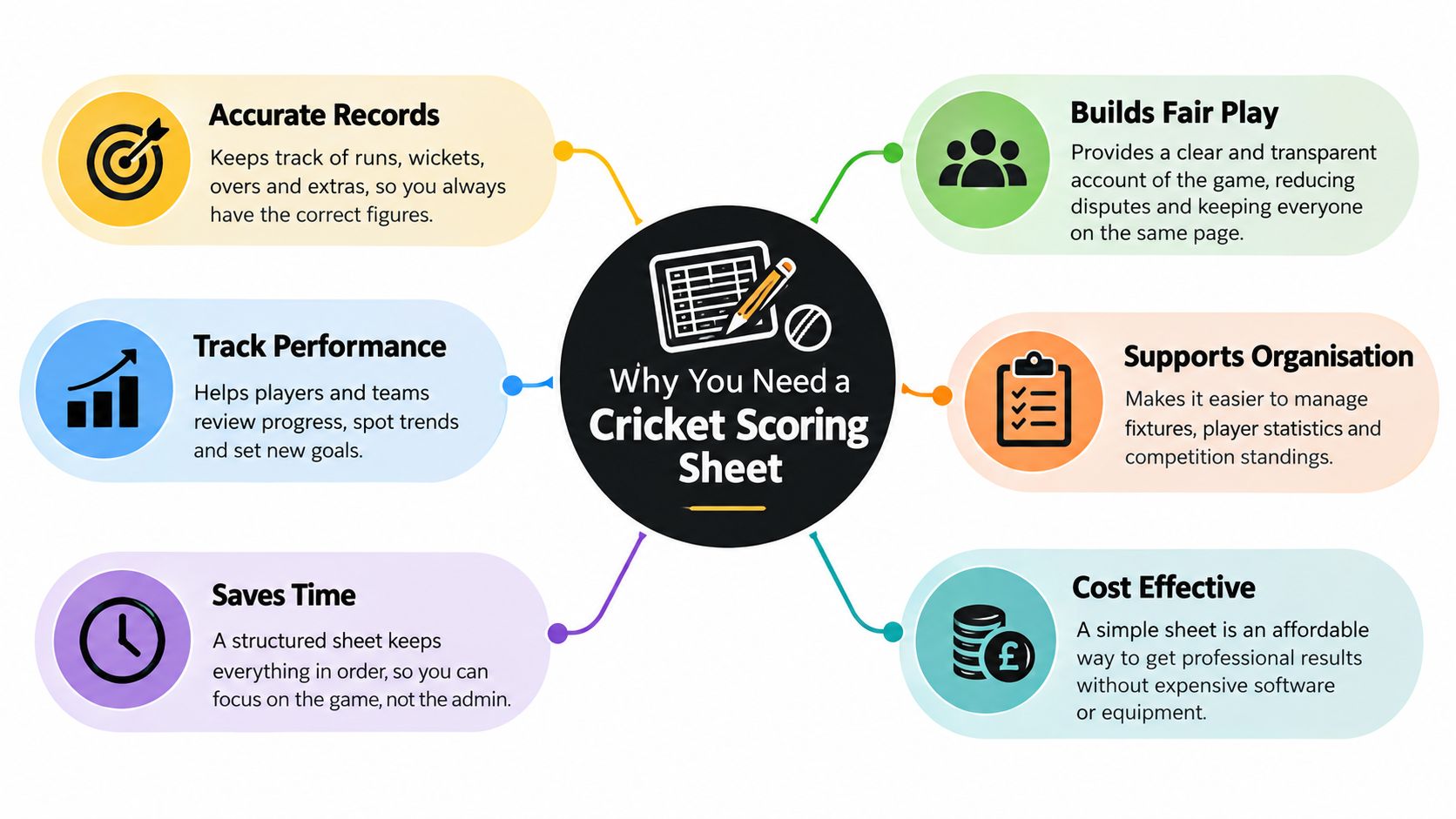
A cricket scoring sheet captures the match as it happens. Every run, wicket and relevant over must find its way into the record, because the final scorecard depends on those details rather than on somebody's cheerful estimate from the tea queue. In England and Wales, the Laws require two scorers to be appointed, and their responsibilities include recording every run, each wicket and, where relevant, the overs bowled. They must also check their records frequently and agree with the umpires at intervals and at the end of the match. The MCC Laws explain the scorer's duties.
That formal checking is the important part. A scorer accepts and immediately acknowledges each separate umpire signal, creating a direct connection between the decision in the middle and the mark in the book or tap on the screen. The sheet therefore becomes the numerical memory of the match. It supports the innings total, batter's figures, bowling analysis and result.
Paper tradition with a digital pulse
The familiar paper book remains useful because it gives you a visible trail of what happened. You can review a delivery, identify an unusual dismissal and compare the innings total with the batting and extras entries. It also works when a battery decides to retire earlier than the opening batter.
Modern scoring adds speed and connectivity. Electronic systems can share live information with players, spectators and club administrators, but they still need a sound scoring process behind them. The England and Wales Cricket Board recognises several scoring formats, from traditional book scoring and linear scoring to computers, tablets and mobile applications. The ECB's scoring guidance shows that the tool can change while the essential record stays the same.
Practical rule: Treat the cricket scoring sheet as an official match record first and a personal notebook second.
For club cricket, the best approach is organised rather than glamorous. Know who is responsible, keep the score visible to the umpire and agree the position regularly. A neat book is helpful, but a checked book is what protects the result.
Choosing Your Scoring Method
A club match can begin with a tablet at the scorer's table and end with a paper book confirming the final total. The right method depends on the match format, the scorer's confidence, the equipment available and whether players or spectators need live access to the score.
Traditional book scoring provides a physical record that does not depend on a signal, battery or internet connection. Established notation records batter runs, dots, extras and dismissals, while the scorer totals the innings by hand. That independence is valuable, though every calculation and correction must be made clearly. A hurried alteration can create more mystery than a mistimed shot.
Linear scoring places deliveries in sequence along a line. The format makes an over's progress easier to follow while you learn how wides, no-balls and wickets affect the legal-ball count. Yorkshire Cricket Foundation guidance presents linear paper scoring as a useful backup to electronic scoring, with connections to statistics, revised targets and scoreboard or livestream functions (linear scoring guidance). Check that the guidance suits your competition's requirements before adopting it.
Digital scoring moves much of the arithmetic into an application. In systems such as Play-Cricket Scorer or PCS Pro, you select the delivery outcome and confirm it. The software can produce a live scorecard, but it cannot correct an incorrect choice of batter, extra, wicket or legal-ball status. A wrong tap remains wrong, even when the screen displays it neatly.
Compare the practical trade-offs
| Method | Useful strength | Main risk |
|---|---|---|
| Paper book | Works without a device and leaves a physical audit trail | Manual totals and unclear corrections |
| Linear sheet | Shows the sequence of deliveries clearly | Can feel unfamiliar to a new scorer |
| Digital app | Shares live information and organises data | Device, power, connection or input errors |
For competitive UK club cricket, a digital record with a paper backup gives the scorer a practical safety net. The Bristol & District Cricket Association's 2026 rules require two separate scorers for each innings, with both teams completing records. They also require the away team to provide a backup paper scorebook when electronic scoring is used. Read the BDCA league playing rules.
A club management app for cricket can support fixtures, player information and coaching activity alongside the scoring process. It does not replace the scorer's judgement, but it can keep related club work organised.
Before the toss, agree who enters the electronic record, who maintains the paper record and how disagreements will be resolved. Make that decision before a disputed run-out gives the scoreboard its own version of arithmetic.
Step-by-Step Guide to Filling Out a Sheet
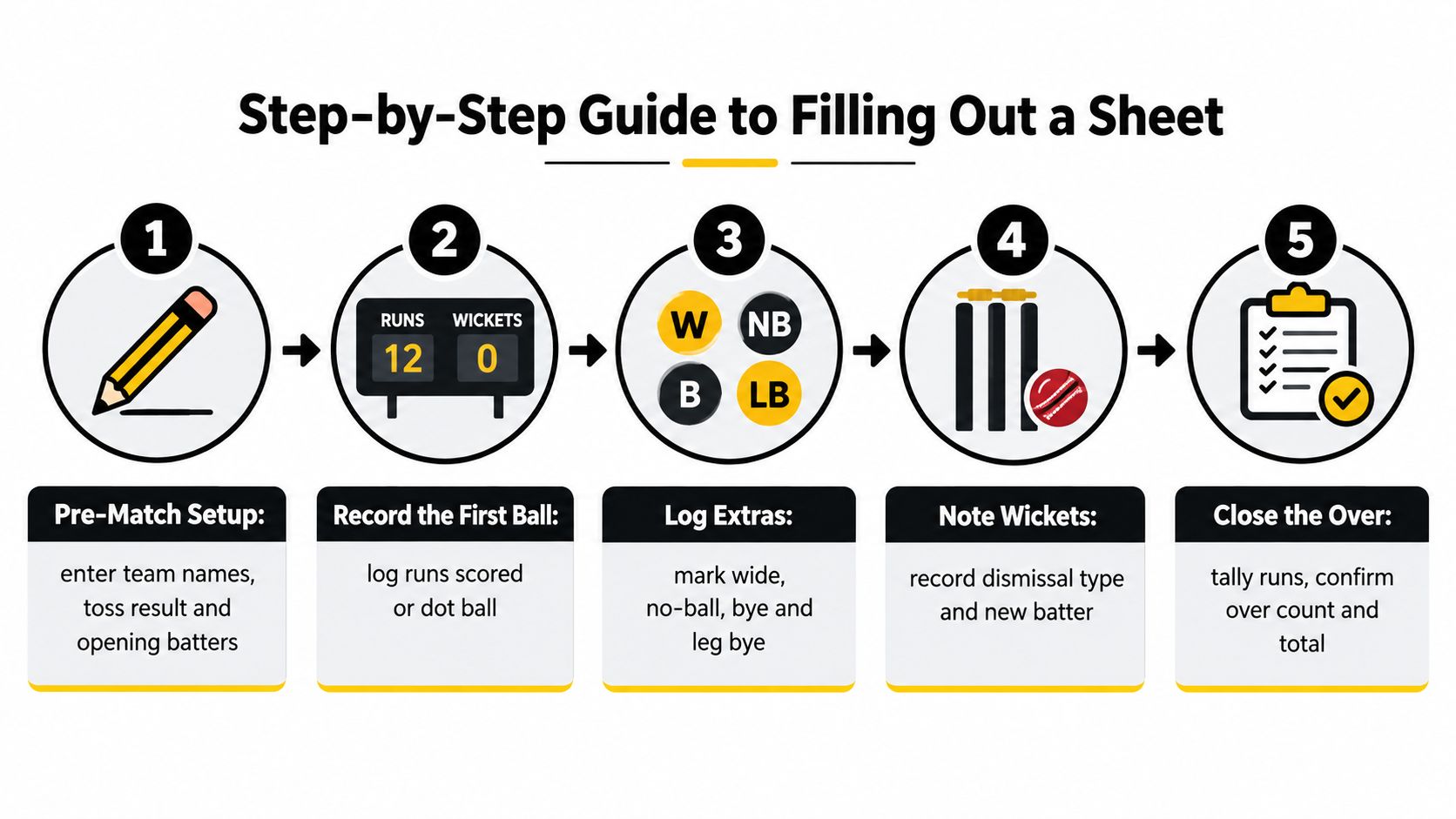
Begin before the bowler starts the run-up. Enter the fixture, venue, date, innings, teams and toss details, then confirm the opening batters and bowler. Check every name carefully. A mistake at the top can attach later runs, wickets and figures to the wrong player, creating confusion long after the delivery is forgotten.
Build a delivery routine
Treat each delivery like a small entry in a ledger. Record:
- Batter runs, such as a dot, one, two or boundary.
- Extras, identifying a wide, no-ball, bye or leg-bye.
- Wicket status, including the dismissal type and incoming batter.
- Legal-ball status, so the over count includes valid deliveries only.
A dot ball adds no run, yet it still counts as a legal delivery. A wide adds to the team total but does not count as a legal ball. A no-ball adds an extra and remains outside the legal-ball count. Runs completed from the bat or through further extras must be entered in their correct places.
The separation between batter runs and extras prevents many scorecard errors. If the ball misses the bat and the batters run, record byes or leg-byes rather than adding those runs to the batter. If the umpire signals a no-ball, enter the no-ball extra first, then record any bat runs or additional extras from that delivery.
Keep the paper book or device visible to the umpire. Take each signal, enter it promptly and ask for clarification before the next ball creates another layer of uncertainty. In a UK club match using electronic scoring alongside paper, one scorer can enter the live record while the other maintains the written book. Both should follow the umpire's signals, not just copy one another.
Reconcile before the innings disappears
Pause at the end of an over, after a wicket and at the innings break. Check that the innings total equals batter runs plus every extra, including penalty runs. Confirm that the over count contains legal deliveries only, then compare the paper record, electronic score and visible scoreboard where available.
The ECB's scoring resources emphasise a repeatable delivery-by-delivery method, coordination with umpires, accurate penalty-run recording and checks across batter totals, extras, wickets, overs and the innings total. Use the ECB's official scoring resources to establish a routine your club can repeat each week.
Complete the result only after the numbers agree. If your league requires a full scorecard upload, check your league's scorecard submission deadline before match day. The scorer's job includes that final administrative check, not just the marks made during play.
Common Mistakes and How to Avoid Them
A scorer can know the Laws and still lose the thread after an interruption, a rushed entry or an unclear umpire signal. A repeatable routine, supported by a second record, keeps one uncertain moment from distorting the whole innings.

Watch the extras
A wide or no-ball does not count as a legal delivery. Marking it as one can close the over too early and affect the strike, bowling figures and target. Byes and leg-byes belong in extras, not in the batter's individual score. That distinction keeps the batter total and innings total aligned.
Penalty runs need separate attention because they may not come from an ordinary delivery. Record them clearly, then tell the second scorer and umpire where they appear. If the app and paper book disagree, keep the original paper entry visible. Cross it out neatly, write the correction beside it and preserve the audit trail.
Use two records as a control
As noted in the BDCA rules covered earlier, dual recording is the required club model. Two separate scorers for each innings, with both teams completing records, provide a practical check against missed signals. One scorer can maintain the paper book while another enters the electronic record, rather than relying on memory while answering questions from the boundary.
Use natural pauses to compare the records:
- After an over: Check runs, legal balls and batter positions.
- After a wicket: Confirm the dismissal type, dismissed batter and incoming batter.
- After an interruption: Record the reason and check the competition's restart rules.
- Before finalising: Match batter runs and extras to the innings total.
- Before submitting: Compare the paper record, app and scoreboard.
Keep the original visible: A correction should show what changed, not erase the fact that an entry needed correction.
Communication prevents a small uncertainty from becoming a scorecard problem. Ask the umpire to repeat a signal when necessary, and ask the second scorer to confirm the position after an over. Pausing for clarity is part of accurate scoring, not a delay to apologise for.
Scoring in The Hundred Format
The Hundred looks familiar until the scorer reaches the end of an over and discovers that one square is missing. In this competition, an over consists of five balls rather than six, and the 2025 playing conditions replace references to six balls or six valid balls in the Laws with five. Check the ECB's 2025 Hundred playing conditions.
Change the count, not the discipline
The delivery routine stays the same. Record batter runs, extras, wickets and whether the delivery is valid. The difference is the point at which you close the over. In traditional cricket, you normally complete the over after six legal deliveries. In The Hundred, you close it after five legal deliveries.
A wide or no-ball still needs careful treatment because it affects the delivery sequence. It isn't a valid ball in the ordinary sense, so it doesn't just fill one of the five legal-ball spaces. Mark the event clearly, then continue counting legal deliveries until the over is complete.
The playing conditions also specify that two five-ball overs are bowled alternately from each end, and batters don't change ends between overs. That means you must track the ends according to the competition rules rather than applying your usual six-ball assumptions. A familiar scorebook can become misleading if its layout encourages you to search for a sixth legal delivery.
| Traditional scoring | The Hundred |
|---|---|
| Six legal deliveries complete an over | Five legal deliveries complete an over |
| Normal over-end habits apply | End changes follow the Hundred conditions |
| Familiar six-ball notation | Adapted five-ball notation |
Write five legal-ball spaces for each over or configure the digital system for the correct format before play begins. Don't try to repair the structure halfway through the innings while a batter is sprinting for a second run. Format awareness belongs in the pre-match setup.
Final Tips for Confident Scoring
Practise with a sample innings before volunteering for a league match. Mark a dot, a boundary, a wide, a no-ball, a bye and a wicket, then reconcile the totals. Confidence comes from knowing what you'll do when the match becomes noisy, not from hoping the quiet opening over lasts all afternoon.
Keep your pencil sharp, your device charged and your backup record within reach. Agree checkpoints with the second scorer and speak to the umpire early when a signal is unclear. The scorer's job may look calm from the boundary, but it's closer to playing rhythm guitar in a busy band. You're keeping the timing together while everyone else watches the solo.
For a little character in a scorer's office or club space, the Not all Cricketers are Tossers wall art print offers a cricket-themed visual joke without pretending the scorebook is less important than it is. A good record keeps the match honest. A good print can at least make the tea break smile.
Striped Circle offers wall art, posters and greeting cards inspired by music, football and sports culture, including playful cricket-themed designs for a home, office or club space. Visit Striped Circle to find a print that adds personality to the place where your scorebook, tablet and match-day stories come together.
