
Football Christmas Card Designs That Make Fans Smile
You've found a Christmas card that'll make your mate laugh. Unfortunately, it's in your club's colours, he supports your rivals, and you're not entirely sure whether the joke counts as festive cheer or grounds for blocking your number. The best football Christmas card designs start with the recipient, not your allegiance. Get that right, then sort the envelope and posting plan before Christmas turns into added time.
Table of Contents
- Football Christmas Card Designs at a Glance
- Choosing Designs for Different Fans
- Design Details That Make a Club Card Work
- Card Sizes and Postage Risks to Plan For
- Personalising a Card Without Overdoing the Banter
- Planning Your Post So It Arrives Before Christmas
- Pick Your Card and Order Before the Rush
Football Christmas Card Designs at a Glance
Nearly every football Christmas card worth sending falls into one of five styles. Pick the style for the person opening it rather than the badge on your own chest, and the hardest decision is already made.
Football Christmas card styles and who they suit
| Design style | Best for | Main visual cue | Safe choice when |
|---|---|---|---|
| Classic club crest | Die-hard supporters and season-ticket holders | Crest, club colours and stadium name | You know the recipient's club for certain |
| Terrace banter | Mates, office football pools and pub regulars | Witty slogan with a matchday joke | The recipient likes a laugh and you want a card that works for any fan |
| Stadium scene | Fans who love grounds and football history | Floodlights, terraces and a snow-dusted pitch | The recipient supports a different club or you're buying for a mixed group |
| Retro pencil-and-ink | Older fans and nostalgia buffs | Hand-drawn line art and faded tones | The recipient remembers the old grounds and the old kits |
| Music and football crossover | Fans who go to both gigs and matches | Lyric references and chant-style jokes | The recipient is a music fan as well as a football fan |
Pick the reference they'll recognise immediately
Classic club designs announce allegiance straight away. They're the right call for the supporter whose scarf has its own designated hook.
Terrace banter puts the joke first. Choose a shared matchday habit, like nervous score-checking during Christmas dinner, over an insult that needs explaining to anyone at the table.
A stadium scene offers atmosphere before partisanship. For mixed-club households, pick an imagined ground rather than a recognisable rival stadium wearing a suspiciously thin disguise.
Retro pencil-and-ink artwork suits someone who remembers standing on terraces and insists the old badge was better. Music crossovers land when the recipient catches the lyric reference without you performing the chorus beside the mantelpiece.
Why the physical card still works
A well-chosen card earns space in someone's home rather than a fleeting appearance on their phone. A survey reported by PG Buzz found the average person keeps Christmas cards on display for two to three weeks.
That's a worthwhile return on a stamp. Treat the table as your starting whistle: choose the style for the fan, then make sure the artwork, format and posting plan are good enough to keep their place in the side.
Choosing Designs for Different Fans
A Tottenham Hotspur book given to a Chelsea supporter appeared among disappointing Christmas presents in a Which? survey of more than 2,000 people, reported by Manx Radio. That's not a minor colour mismatch. That's gifting someone homework about the opposition.
Buy for their relationship with football, not yours. A badge can feel personal when you've chosen correctly, but spectacularly impersonal when you haven't.
Match the card to the household
For a committed club supporter, choose a club-specific design when you're certain of their team. Check whether they prefer the current identity or an older kit and badge. Nostalgia isn't interchangeable with whatever happened before this season.
In a mixed-supporter family, celebrate football culture instead. A scarf collection, an imagined terrace or a festive pitch lets everyone enjoy the card without negotiating whose club gets the best position.
For a workplace, generic floodlights or a matchday joke are safer than partisan gloating. You want a smile beside the monitor, not an email thread involving HR and disputed refereeing decisions.
A casual supporter, partner or relative may prefer a shared ritual: breakfast before a match, travelling together or claiming the same sofa seat. If you're shopping for a young player, interest in playing can matter more than club loyalty. Villarreal Houston Academy's Spanish methodology insights for young players offer a useful route into that playing-and-learning side of football.
Check before you buy
- Confirm the club and era. Ask someone who knows rather than guessing from an old photograph.
- Inspect rival symbolism. A recognisable shirt pattern or stadium outline can undo otherwise neutral artwork.
- Keep wording gender-neutral. Don't assume the family's most committed supporter is Dad.
- Check the rivalry boundary. Friendly teasing and genuine irritation aren't the same thing.
- Choose neutral when uncertain. A pitch is better than the wrong crest.
If the card accompanies a present, our guide to the best gifts for football fans helps you keep both choices focused on the person receiving them.
A crest is worth choosing when the allegiance is certain, or when a knowingly partisan derby-day exchange is the whole point. Even then, affectionate teasing about the recipient's own club usually beats another card devoted to mocking a rival.
Design Details That Make a Club Card Work
A red shirt beside a green Christmas tree might look clear on your screen and muddy on paper. Colour-vision deficiency adds another reason not to make hue carry the whole club identity: FA/UEFA guidance on colour blindness in football recommends supplementary patterns, labels and symbols, with W3C AA as the minimum text-contrast benchmark where reasonably practical.
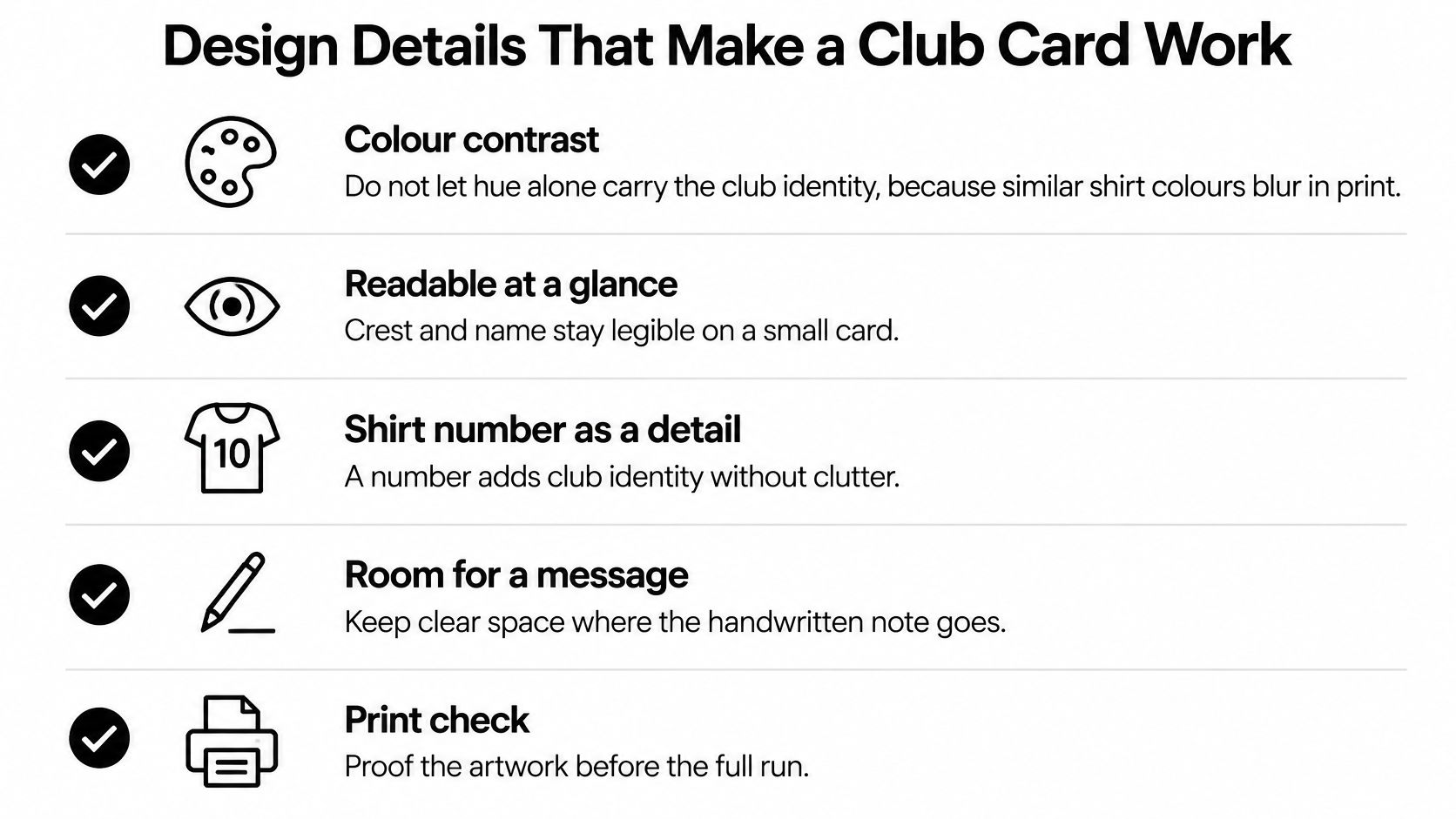
Use this visual checklist before polishing the decorative extras.
Make the artwork survive printing
- Give club colour a second code. Add stripes, a badge silhouette or recognisable shirt-number lettering. A plain coloured rectangle asks too much of the viewer, especially when several clubs share similar palettes.
- Separate adjacent colour blocks. A black or white outline helps the shirt remain distinct from the festive background. Don't bury the sleeve edge beneath a similarly toned scarf.
- Proof in CMYK, then greyscale. Use the printer's requested colour profile and inspect a physical proof. If removing colour also removes the club identity, revise the shapes rather than increasing saturation.
- Check text contrast. Use a contrast checker against the accessibility benchmark above, then inspect the actual print. Pale gold lettering on cream can look tasteful until someone tries to read it.
- Simplify the crest treatment. Thicker outlines and high-contrast lettering survive reduction better than tiny internal details. Keep the full message away from a crowded badge, and don't treat decorative imitation as proof of official status.
- Keep the joke to one line. Put the supporting story inside. If the punchline needs tiny type, you've written a programme note rather than a card.
Our greeting card design guide offers broader layout ideas, particularly for balancing an illustration with clear space. Leave the inside comfortable to write in too; nobody wants to squeeze a heartfelt message between printed confetti.
For another visual reference while reviewing the artwork, use the video below.
The three-second test: Show someone the finished-size proof briefly, then ask what it says and which club it's for. Confusion is a design problem, not a supporter knowledge test.
Card Sizes and Postage Risks to Plan For
Card formats, limits and postal risk
A beautiful card that needs an unexpectedly expensive stamp is still beautiful, but now it is also annoying. The format dimensions and letter limits below are reported in The Packaging Masters' greeting-card size guide, which puts the standard Letter ceiling at 24 × 16.5 cm, 5 mm thick and 100 g; treat its square-format surcharge warning as a prompt to check current Royal Mail rules rather than a guaranteed charge.
| Format | Size or limit | Envelope | Postal risk |
|---|---|---|---|
| Folded A6 card | 105 × 148 mm | C6, about 114 × 162 mm | Lowest-risk default, provided the finished pack meets Letter rules |
| Standard Letter limits | Maximum 24 × 16.5 cm, 5 mm thick, 100 g | Finished envelope must stay within every limit | Exceed a Letter limit and check Large Letter eligibility |
| Square card | 150 × 150 mm | Square envelope sized to fit the card | Guide reports non-machinable handling and a surcharge; check current carrier treatment |
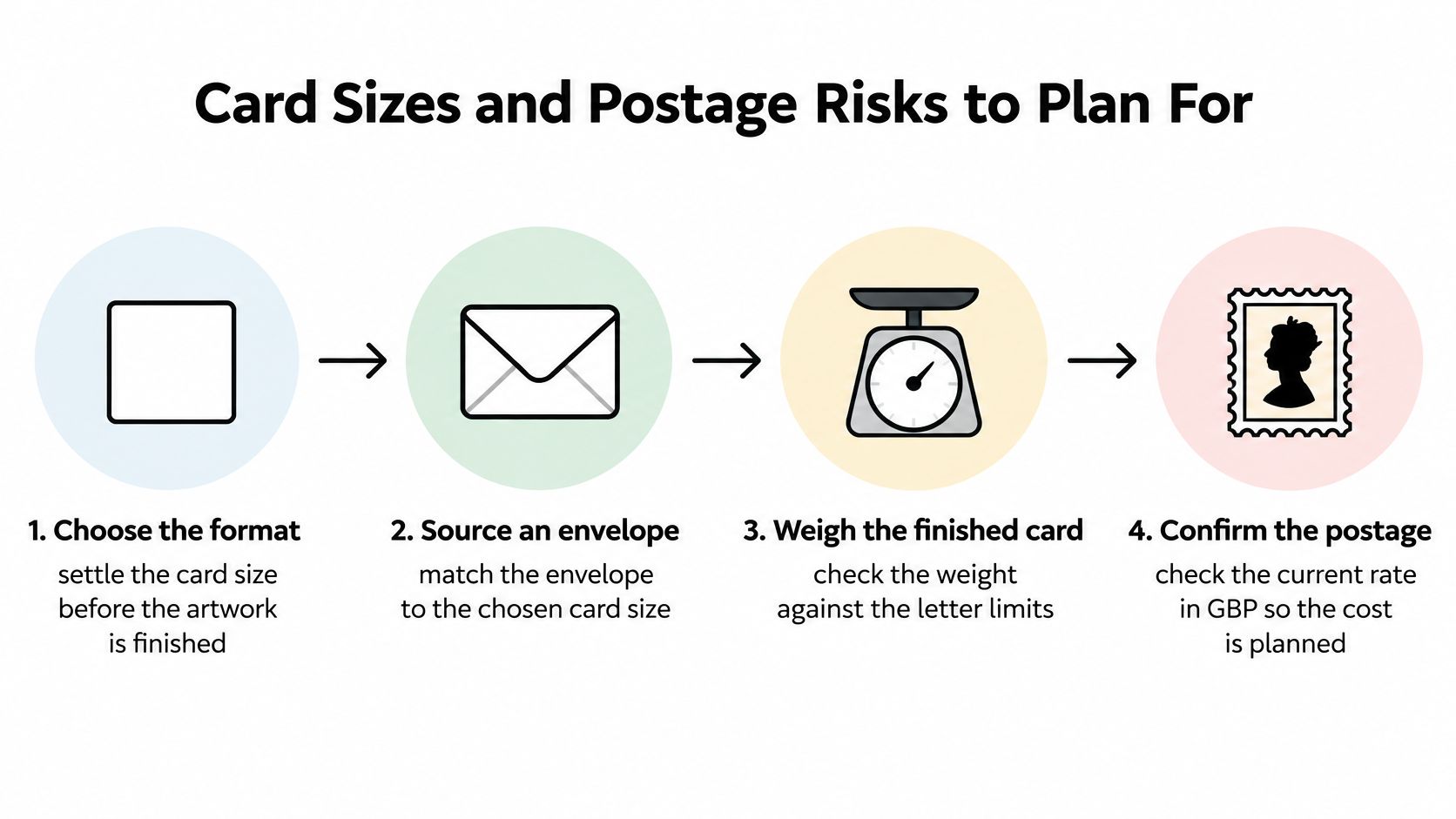
Pick the format before you finish the artwork. The 150 mm square is the greeting-card format we stock, and a square shape earns no favours at the sorting office. Measure and weigh the completed envelope rather than trusting the silhouette.
Build the pack before pricing it
- Choose the format. Rectangular A6 is the lower-risk default for a football-card range. A square edition gives you a different canvas, so price the complete pack rather than assuming the same postage.
- Source the envelope. Test the actual card inside it. An envelope that technically fits but catches every corner makes packing a faff.
- Set a safe trim margin. Keep lettering and important badge details away from the trim line, and ask the printer for its bleed and safe-area template.
- Watch the bulk. Raised badges, foam pads and layered attachments all add thickness. Flat foil causes far less trouble than a chunky glued-on decoration.
- Order a test print. Fold it, add any insert, seal the envelope, then measure and weigh the finished item.
- Confirm the postal category. Do this before buying stamps or quoting delivery-inclusive prices.
Treat the envelope as part of the product and the whole sequence is easier to remember.
For a useful comparison with another seasonal product, Rockdale Wreaths' delivery guide for wreath fundraisers is worth consulting when organising wreath deliveries. US carrier freight works differently from UK card post, so borrow the planning habit rather than the rules.
If your musical idea runs beyond a printed song reference, weigh the format implications alongside our UK musical greeting cards guide. Check current Royal Mail rules before committing to a large print run.
Personalising a Card Without Overdoing the Banter
Say you're sending a card to a grandad who never misses a Saturday match. A drawing of his battered scarf, with a handwritten nod to the flask he always packs, will feel more considered than another anonymous snowflake. You haven't commissioned his football autobiography. You've noticed something that matters.
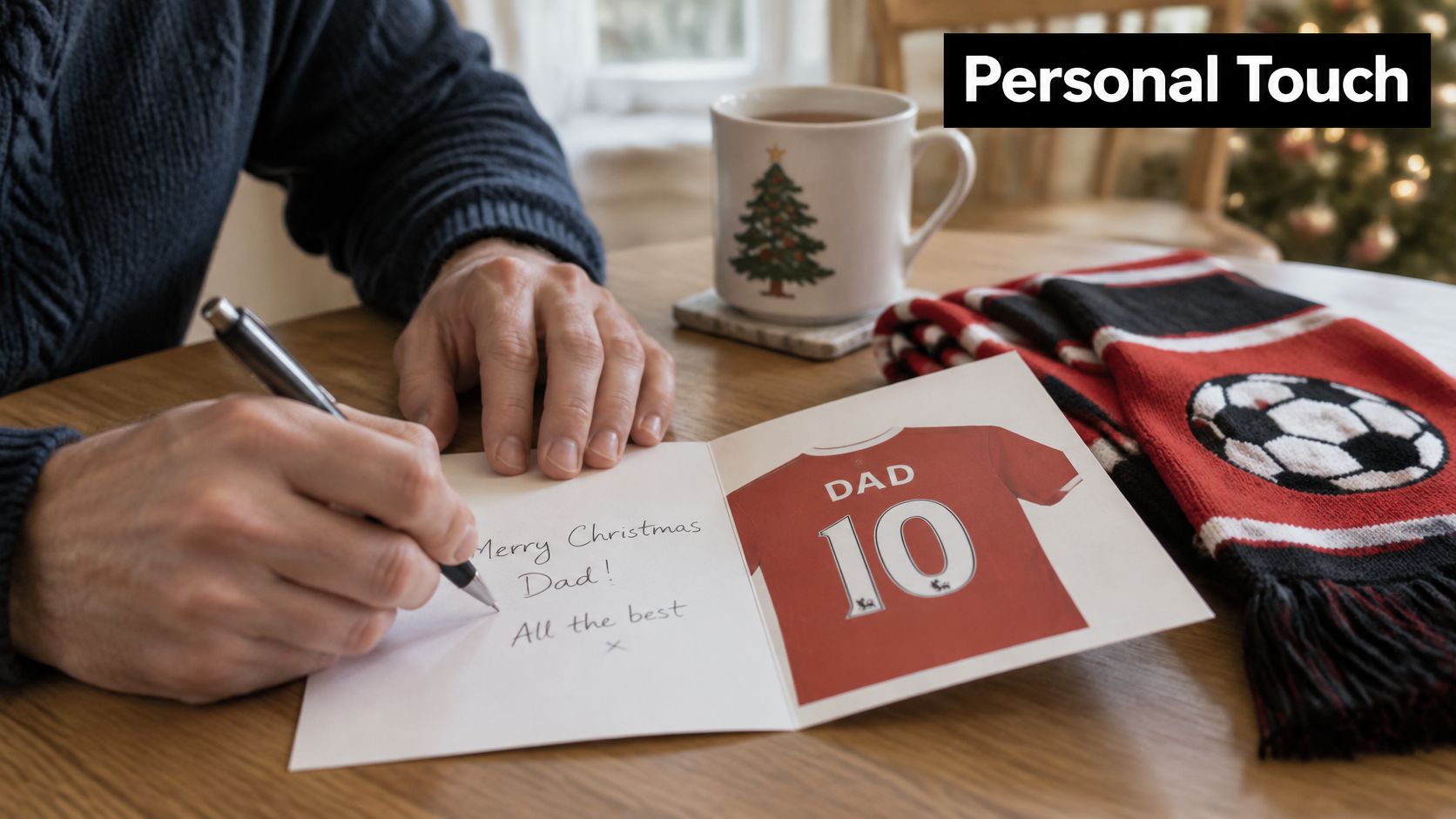
A handwritten message is often all the customisation you need.
Choose your level of effort
| Personalisation level | Effort and timing | Main risk |
|---|---|---|
| Small artwork tweak | Quickest option if the design already allows an editable name, shirt number or fixture reference | Wrong spelling, player or number |
| Handmade addition | Allow a relaxed writing or drawing session after the card arrives | Overcrowding the design or smudging ink |
| Fully custom artwork | Longest route, requiring design time, approval and a print proof | Misunderstanding the chant, club detail or intended joke |
A small tweak works when the detail is unmistakably theirs. Check the player's name carefully, and don't assume a favourite shirt number means the same thing to every supporter.
A handmade element can be warmer than elaborate artwork. Let a child draw the family's journey to the ground, or add a line about the matchday breakfast you share. Leave space around it so the personal touch doesn't resemble stoppage-time scribbling.
A fully custom design suits someone whose club and favourite chant you know properly. Build around a stable reference, such as their regular stadium, rather than a league position or manager who might be gone before the decorations come down.
Personalisation should make the recipient smile, not make them feel they've been set homework.
For a safer evergreen message, try Merry Christmas from a proper football family. Grandad's flask will probably remain relevant longer than the current tactical system.
Planning Your Post So It Arrives Before Christmas
The card can survive a mediocre pun. It can't deliver its intended Christmas greeting while sitting in a sorting office after the day itself.
Post Office research reported by the BBC found that 67% of people in the UK received Christmas cards or presents after Christmas Day. Royal Mail estimates that it delivers around 150 million Christmas cards during the festive period, according to GWP's Christmas packaging guide.
Work backwards from arrival
- List recipients and addresses. Flag international destinations and check service coverage for rural addresses and Northern Ireland rather than assuming every route takes the same time.
- Check current Christmas posting dates. Match the destination to the Royal Mail service you'll use. The seller's dispatch deadline isn't the carrier's final posting deadline.
- Leave a reprint buffer. My practical recommendation is to have a test print at least a week before your own posting deadline. That's planning space, not a promised production turnaround.
- Prepare the batch together. Check addresses, apply the correct postage and add a return address before making the posting trip.
Expect December deliveries to need breathing room, and don't treat a final posting date as a personal target. A card that lands after Christmas can still make someone laugh; one arriving in January has accidentally become your New Year material.
Pick Your Card and Order Before the Rush
December punishes anyone still browsing. The pick itself takes five minutes when you approach it like naming a starting eleven: right person, right role, no sentiment-driven punts.
- Name the recipient and their club. Write down "no club" if they follow football without a fixed allegiance, because that answer steers you away from badge-led designs.
- Choose the design style. Match their taste rather than picking the artwork you would hang above your own desk.
- Check the size and envelope. Confirm the finished pack's postal category before paying for stamps.
- Order with room to spare. Include time for delivery to you, writing and onward posting.
- Pick an envelope that fits your postal plan. Address it clearly and resist adding bulky extras at the last moment.
Bring their football and music tastes together
At Striped Circle, our greeting cards are inspired by our range of art prints, including music-led artwork. Our club-specific football prints cover teams including Arsenal, Chelsea, Liverpool, Manchester City, Manchester United and Tottenham Hotspur, so you can tell a club-focused gift apart from a broader music-inspired greeting.
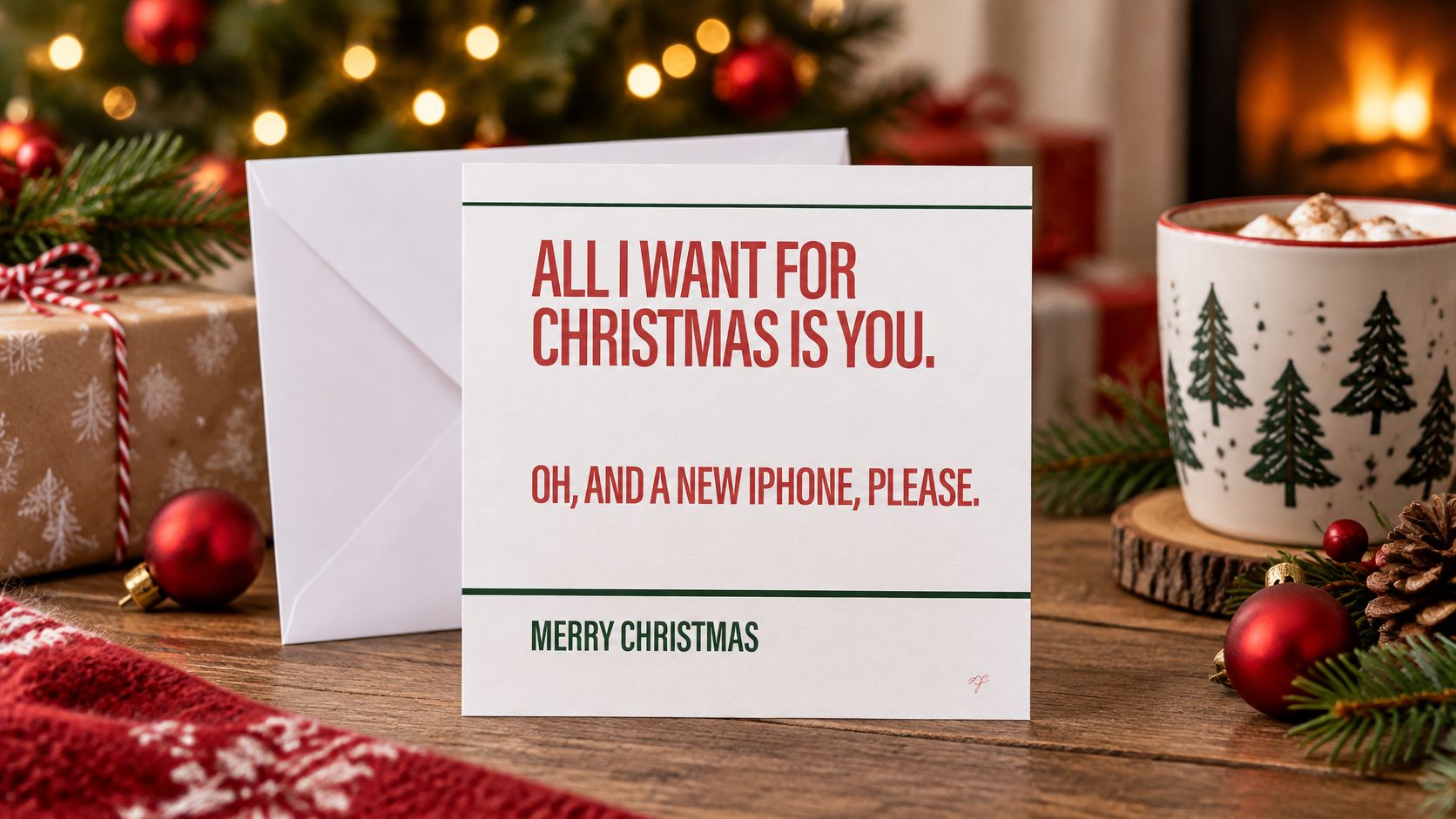
For the gig-going supporter, "All I Want for Christmas" - Greeting Card and "Driving Home for Christmas" - Greeting Card offer that crossover. Both Christmas designs are square at 150 × 150 mm, the size across our greeting card range, so let that square format shape your envelope and stamp choice rather than discovering it at the post office counter.
The music-inspired artwork gives you a starting point without forcing a club badge into the design.
UK delivery costs £1.99 for cards. That covers delivery of your order to you. Postage for sending the card onwards is a separate decision, so plan for both.
A card works like a small piece of wall art with a temporary address on the mantelpiece. It might graduate to the fridge door, while a print brings that same football, music or popular-culture personality to a home or office wall. Neither needs to shout to make someone smile.
Choose the reference they'll recognise, write something only you would say, and get it into the post before the festive fixture congestion begins.
Our greeting cards, music-inspired artwork and football prints give you ways to put a little supporter personality on the mantelpiece, fridge or office wall. Visit Striped Circle, choose something that suits your favourite fan, and leave enough posting time for the smile to arrive before Christmas.
