
Greeting Cards for Musicians Worth Sending
You're standing in the card aisle with a birthday tonight, a first headline gig to celebrate, or a thank-you to write, and every option seems to feature a generic guitar and a joke that could fit anyone who's ever owned headphones. The artist reference is familiar, but does it say anything about your friend, the musician, the gig, or the reason you're sending it?
A good card matches a person and an occasion, not just a famous face. The UK habit of buying cards for everyday moments makes that distinction useful: in 2019, consumers spent about £1.7 billion on greeting cards, and 77% of purchases were everyday cards, mainly birthdays and other personal occasions, according to UK greeting-card market history and spending. Music-inspired cards can work for birthdays, friendship, congratulations, and thank-yous, not only for one annual holiday.
Table of Contents
- Why Musicians Deserve a Better Card
- Match the Card to Their Musical Identity
- Choose Artwork Lyrics and Type That Land
- Write for Gigs Birthdays and Harder Days
- Personalise the Card and Pair the Gift
- Order a Card and Send It Smiling
Why Musicians Deserve a Better Card
It's five minutes before the shop closes. You need something for the friend who's just played their first headline gig, or the music teacher who patiently got you through the bit you kept playing wrong. The rack offers a guitar pun, a generic “rock star” greeting, and a card that appears to have been designed for a person whose entire musical life is owning headphones.
That's not a lack of famous musicians to reference. It's a failure to notice the person receiving the card. A household-name band might mean nothing to a jazz pianist, while a scribbled reference to the rehearsal room, the first gig you went to together, or the instrument they lug everywhere could land perfectly.
The UK card habit gives this kind of thoughtfulness plenty of room to work. Everyday cards make up a large part of the category, so a music-themed design can mark ordinary milestones and affectionate nonsense as readily as big occasions. A birthday card can point to their favourite genre; a thank-you can nod to the teacher who made practice less grim; a congratulations card can celebrate a new record or a performance worth remembering.
A small card beside a big industry
Music is hardly a niche hobby. The UK music industry contributed a record £8 billion in gross value added in 2024, up 5% from £7.6 billion in 2023, and generated £4.8 billion in export revenue while supporting 220,000 full-time-equivalent jobs, according to UK Music's industry figures. A greeting card is a tiny grin beside all that heavy lifting, but it can still say, “I know what this means to you.”
That's the test: does the card feel like it belongs to the recipient, or has it escaped from a pile of leftover merch? A personal card shows you've noticed more than the fact they like music. It says you know what they play, what they listen for, or what the occasion means to them.
The useful trick is to match the card to their musical identity before you choose the artwork. Get that right, and even a simple design can feel considered rather than generic. Get it wrong, and the funniest guitar pun in the shop still looks like a panic purchase.
Match the Card to Their Musical Identity
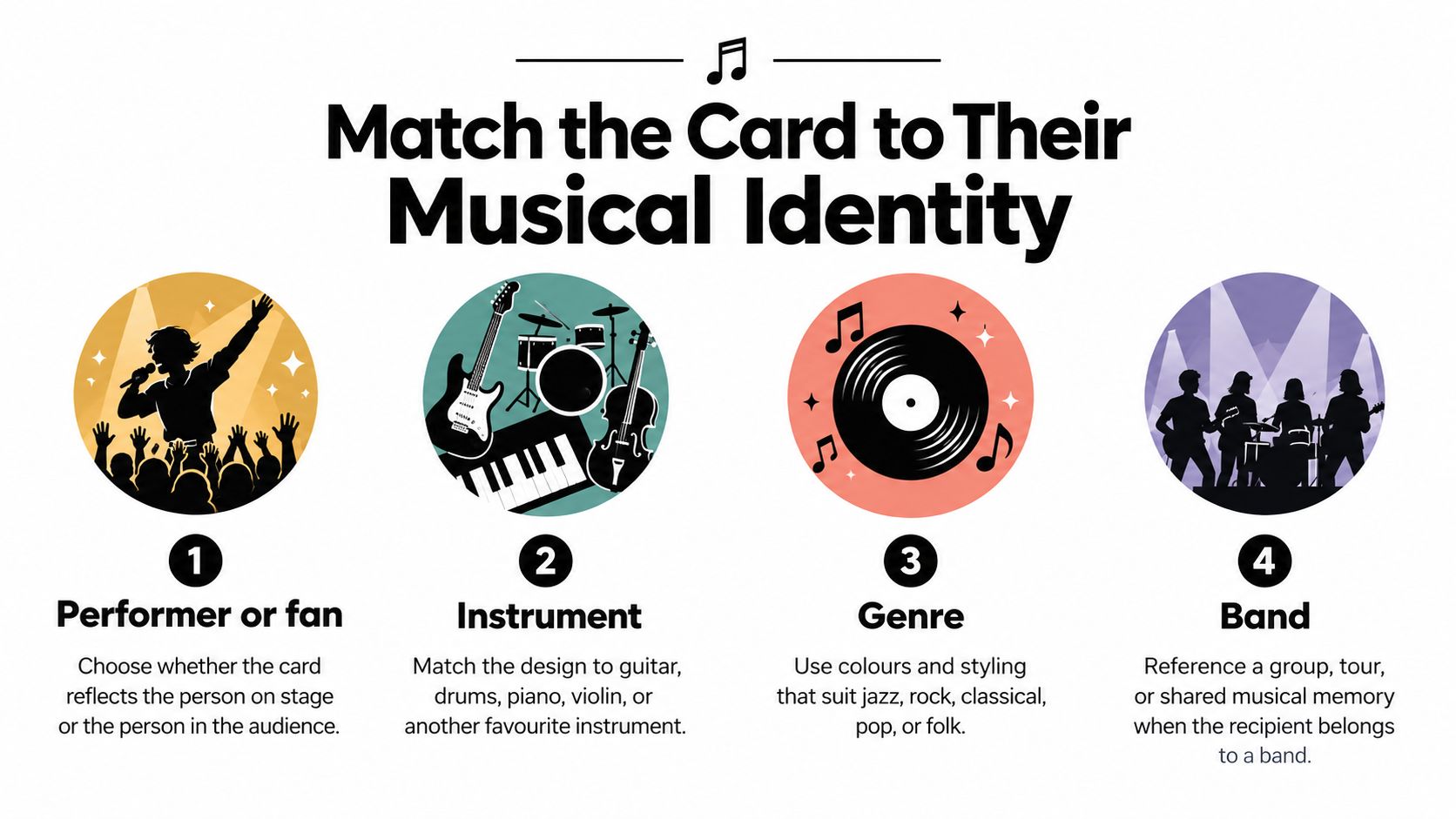
Start with the person, not the sleeve art. "Music person" is useless as a category: a bandmate, a music teacher, a songwriter, a DJ, a gig-goer, and a retired player all relate to music differently. The detail that makes a card land might be the instrument they play, the genre they defend at parties, or the story only you two share.
Read the clues before picking the design
Ask which part of music sits closest to this person:
- Performer or fan: Someone on stage wants a different card from the mate who knows every word from row three.
- Instrument: A drummer will laugh at a rehearsal reference. A pianist deserves better than the fifth guitar illustration they've received this year.
- Genre: Are they devoted to classical, rock, folk, jazz, pop, or a gloriously unclassifiable mixture?
- Band or shared memory: A first gig together, a support slot nobody else remembers, or the song they wrote and then hid can beat a famous name every time.
A music teacher wants a different tone from a bandmate. For the teacher, recognise their patience or the confidence they built. For the bandmate, an in-joke about rehearsals or the four-year argument over the setlist fits. A gig-goer may treasure a reference to the night you both travelled for a show; a retired musician may prefer a nod to the life they built around performing.
Two traps to dodge. First, don't sneer: a joke that mocks their taste reads as a dig in an envelope, and a lyric they wouldn't recognise is decoration. Second, if the card celebrates a gig, praise the playing rather than the punishment. Gags about deafening amps and running on three hours of sleep make light of the two things musicians struggle with, hearing damage and burnout, and the good ones are tired of pretending it's funny.
UK buyers back this up. Market research on greeting-card preferences reports that more than three-quarters prefer cards that are unique and different, while 92% of UK households buy greeting cards. Distinctiveness is a mainstream expectation, so collections sorted by genre, such as Striped Circle's Alternative Music range, make the search easier: a card tagged to the scene they love beats a generic treble clef.
If you're printing matching items for a choir or band, tips for printing choir shirts covers how a shared visual identity works across a group, which is the same thinking that makes a group card feel designed rather than generic. For performer-specific ideas, our guide to gifts for singers shows what suits the person behind the mic rather than the vague label of "music lover".
Quick test: If a stranger couldn't tell who the card is for, it's still generic.
Choose Artwork Lyrics and Type That Land
Pick the front by asking one question: what would make them say, “That is so me” before they even open it? A lyric reference, an instrument illustration, and a sharp typographic joke do different jobs. Choose the route that matches their musical life and the occasion, then make sure the joke survives contact with an envelope.
Three ways to get the front right
A lyric or song-title nod works when the recipient knows the line and the connection suits the occasion. A birthday card built around a shared favourite can feel spot-on. A lyric they have to look up becomes homework. Keep the reference obvious to them, even if nobody else would get it.
Instrument or scene artwork suits performers, producers, and devoted players. A recognisable instrument, rehearsal detail, or small-venue atmosphere says more about their identity than a generic music-note swirl. This route works well for gig congratulations because it celebrates the performance without treating ringing ears, exhaustion, or a late-night load-out as the price of a good show.
Typography can carry the front when the words are funny or affectionate on their own. It also suits a group card, where clear lettering and open space leave room for signatures inside. Use strong contrast and keep the layout uncluttered. A punchline should not need a torch.
| Design route | Best when | Watch-out |
|---|---|---|
| Lyric or song title | They know the reference and it fits the occasion | A line they do not recognise turns the card into a quiz |
| Instrument or scene | Their instrument, rehearsal life, or a specific gig memory is central | Generic notes and instruments could belong to anyone |
| Typography | The words are the joke or several people will sign | Weak contrast or crowded lettering makes it hard to read |
Read the product details, not just the front
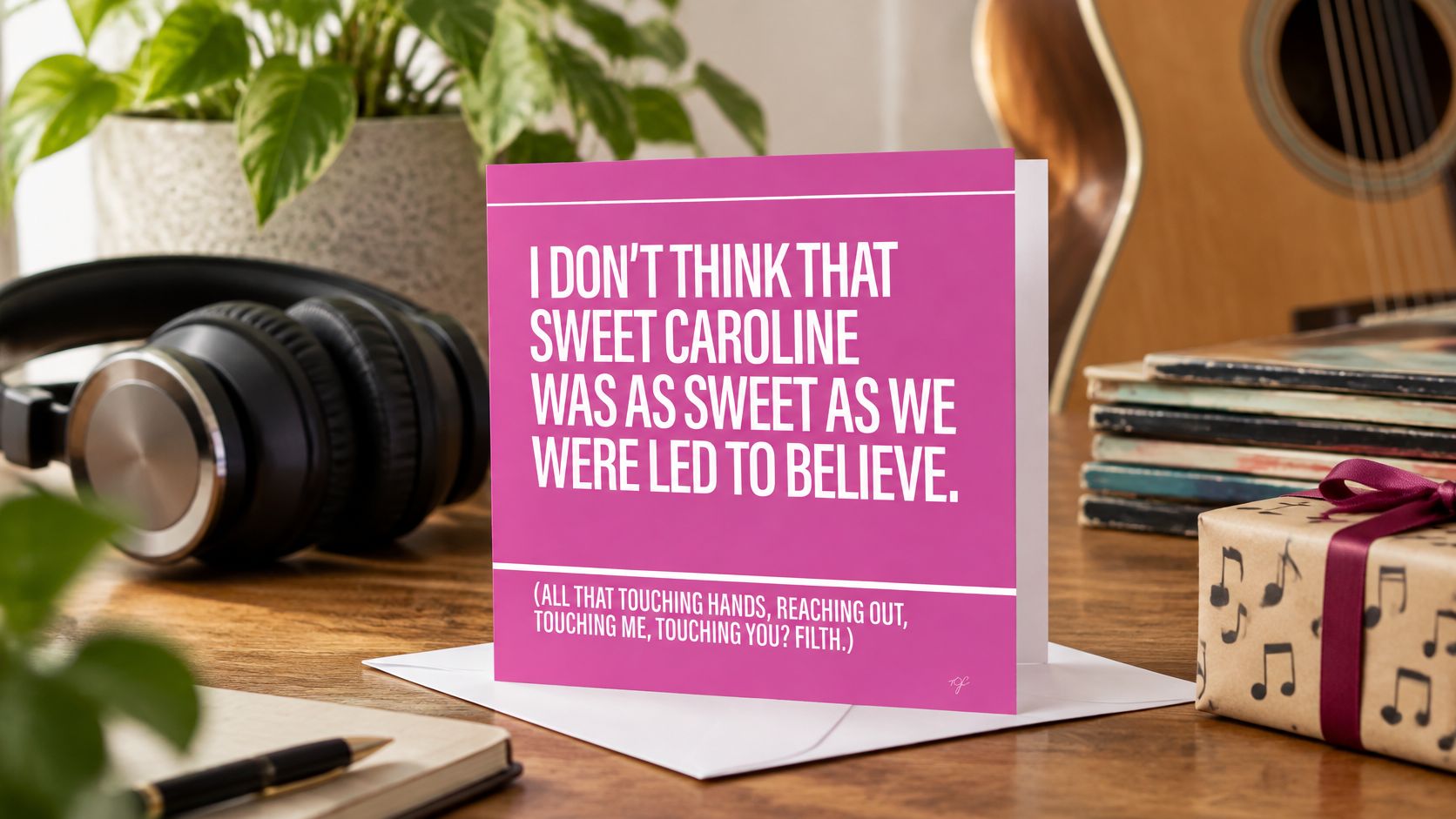
Striped Circle is a family-run maker of music- and football-inspired wall art, prints, and greeting cards. Its cards are blank inside and supplied with a plain white envelope, giving you room to write for the occasion. The “Feliz Navidad” Christmas card listing describes a square format, while the Sweet Caroline card covered earlier uses a larger square format.
Before buying, run through the occasion, the recipient, and the practical details. Does the design identify them at a glance? Is the inside blank or already written? Check the size, paper stock, envelope, and dispatch timing before promising yourself you will post it tomorrow.
Finding the right card can be harder than it looks. 52% of UK greeting-card buyers say finding an appropriate card for the recipient is difficult, while 79% believe handwritten cards feel more personal than online messages, according to Mintel's UK greeting-card findings. A clear front earns the first look. A handwritten line makes the card theirs.
Write for Gigs Birthdays and Harder Days
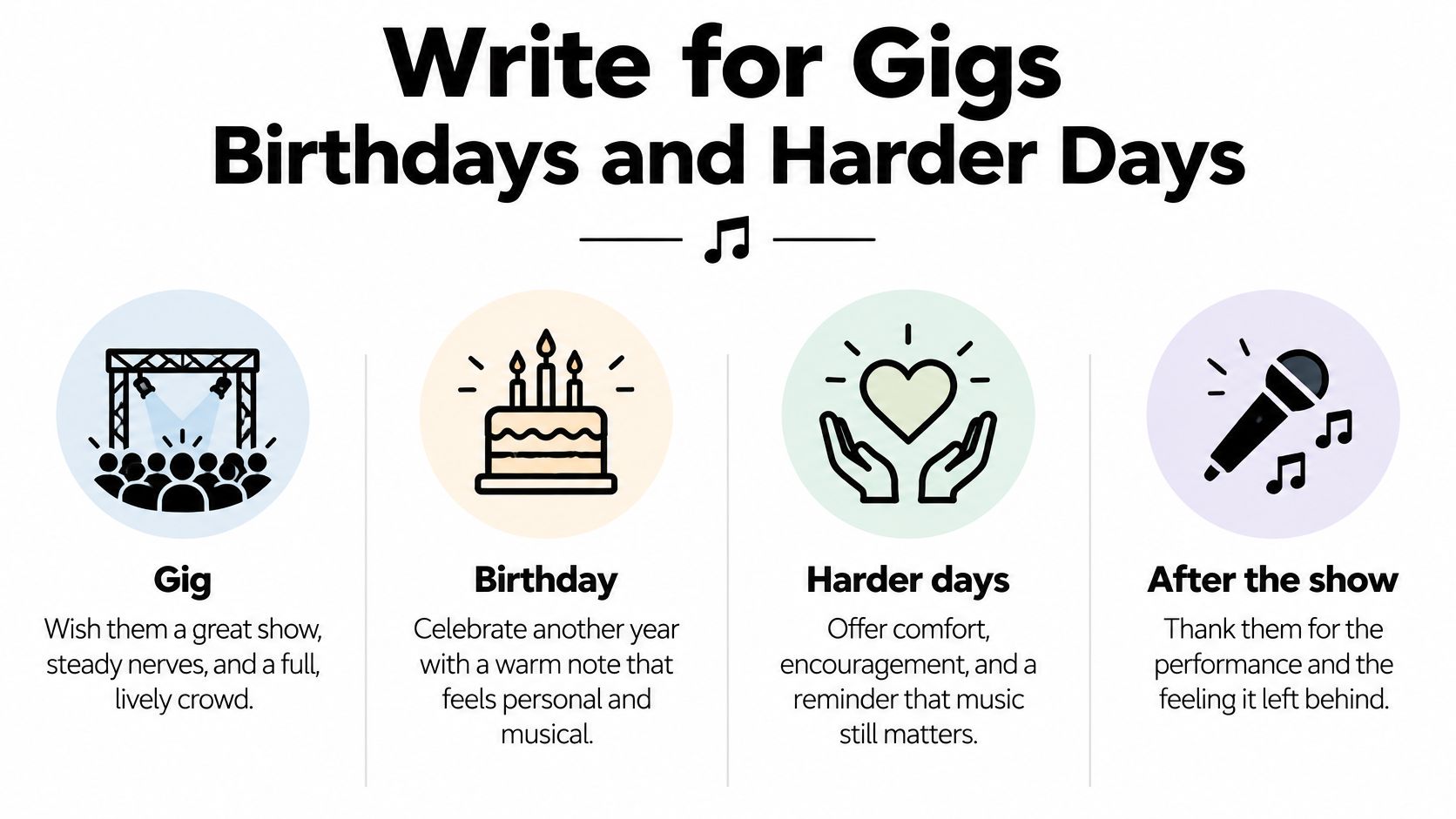
The front gets the first smile. The inside should sound like you, not a greeting-card machine that has been left alone with a thesaurus. Write a short message that ties the occasion to a real detail: the venue, the song, the lesson, the performance, or the small musical habit your friend would recognise.
Pick the line for the occasion
- Birthday: Celebrate another year and add a musical detail only you would choose. “Happy birthday, and may this year include fewer broken strings and more encores” works if that's their sort of humour.
- Gig or album congratulations: Wish them a great show, steady nerves, and a full, lively crowd. If you were there, name the part that stayed with you instead of settling for “You were amazing”.
- Thank-you to a teacher or bandmate: Mention the specific thing they did, whether that was making a tricky passage click or keeping everyone together through rehearsal.
- Support after a rough show, vocal strain, or retirement: Keep it gentle. Acknowledge the hard day, say you're thinking of them, and leave space for them to answer in their own time.
If you need more wording ideas for a hard week, gifts to cheer someone up is a useful place to find thoughtful starting points. Borrow the spirit, not a line that sounds like it came from someone who's never met the recipient.
Live music is joyful, but it isn't a licence to make hearing damage or burnout the punchline. UK-focused reporting on live-music workers, performers, and fans found that 59% of surveyed workers and performers reported permanent tinnitus, 81% received no hearing-safety training, and 92% of fans experienced tinnitus after live events. Of those fans, 40% said the symptoms later became persistent, according to UK reporting on tinnitus and live-music safety.
That's a good reason to skip jokes that glorify dangerous volume, exhaustion, or touring until someone falls over. Celebrate the performance, the crowd, the feeling, and the person who made it happen. Clear lettering and an uncluttered design help keep the message easy to read for anyone who finds visual clutter hard work.
A thoughtful gig card says, “I loved seeing you do your thing,” not, “Hope your ears are still ringing.”
Personalise the Card and Pair the Gift
A blank interior is not a missing feature. It's space to write the message that belongs to the recipient, whether that's a story only two of you understand, a note from the whole band, or one neat line from a sender who isn't secretly auditioning to write a memoir. Handwriting doesn't need to be elegant to feel personal. It needs to sound like you.
Add a small finishing touch without covering the artwork. A strip of washi tape on the spine can give the envelope a bit of character; a set-list scribble on the envelope makes it feel tied to a gig; a photo-booth strip can slip inside instead of being glued across the front. Keep the card readable and the envelope easy to open. This isn't the moment to wedge in a guitar pick, confetti, three photos, and half a festival wristband.
Pair one extra with one good reason
Choose a small gift that follows the recipient clues, rather than buying miscellaneous music-shaped objects until the basket looks convincing. A player might enjoy picks, reeds, or strings. A fan might like a playlist note or a keepsake from a shared show. For someone heading into a long gig week, tea and earplugs show more care than a gag gift about not hearing anyone.
A small music print can also pair naturally with a card, giving them something for the wall at home or in a studio office. Striped Circle makes wall art and greeting cards inspired by music and football, so a card and print can share a visual theme without turning the gift into a pile of unrelated things. A print can bring a favourite musical reference into a room and offer a daily smile long after the envelope is recycled.
Live music often means a trip as well as a ticket. UK music tourism reached £10 billion in audience spending in 2024, a 26% increase from £8 billion in 2023, according to UK Music's report on music tourism. That makes a card about the journey, the venue, or the night itself a fitting way to mark the memory, not just the show.
If you're building a personal present around music, personalised music gifts can help you think beyond the card without losing the connection to the recipient. Keep the pairing simple: one card, one extra, and a clear reason they belong together. Avoid gifts that make hearing loss the joke, and check that everything fits the envelope before you start decorating it like a tour van.
Order a Card and Send It Smiling
Before you order, run through a simple check. Is the card for the performer or the fan? Does the design suit the occasion? Is the inside blank if you want to write your own note? Check the size and envelope, then read the joke aloud. If it sounds awkward in your voice, it probably won't improve when your friend reads it.
For music-inspired cards and prints, Striped Circle offers designs that bring music references into cards and onto walls at home or in an office. Its Sweet Caroline and Feliz Navidad cards are blank inside, giving you room to write the message that fits. The company also offers free delivery on orders over £40, so pairing a card with a print is an option if a wall-worthy gift makes sense for the recipient.
A note for people selling cards
If you sell greeting cards, test a small range of musician designs before ordering a large print run. UK greeting-card expenditure is roughly £1.6 billion including boxed cards, with single cards accounting for about £1.4 billion; the 2024 UK greeting-card channel data reports that bricks-and-mortar sales value rose 3%, while online value fell 8%. Online represented 16% of retail value and 9.2% of volume.
That mix makes it sensible to test designs across your own shop, selected independent retailers, and gig-side placements rather than betting everything on one channel. Track what sells, then reorder based on the costs that shape your margin, including printing, postage, and fees. A design with a funny title isn't automatically a winner; buyers still need to see who it suits and when they'd send it.
For a personal gift, keep the final decision less complicated: pick one person, one occasion, and one card today. Write the line only you could write, then post it before the gig, not after the bunting comes down.
Striped Circle makes music- and football-inspired greeting cards and prints for people who want their walls and messages to show a little more personality. Find a card for your musician, add a print if it suits the occasion, and visit Striped Circle to choose something worth sending.
