
A Music Lover's Guide to Vintage Posters Music and More
Let's face it, blank walls are a tragedy. They’re just sitting there, crying out for a bit of character, a story, a jolt of rebellious energy. This is where vintage music posters come in – they're the ultimate cure for a personality-deprived room. We're not just talking about decoration here; this is about owning a piece of music history that brings a smile to your face every time you walk past.
What Makes Vintage Posters So Special?
So, what’s all the fuss about a bit of old paper? Well, a genuine vintage music poster is like a time capsule. It’s a snapshot of a specific moment, capturing the raw energy of a punk gig, the psychedelic swirls of the 1960s, or the bold, graphic punch of a new wave anthem. These weren't originally designed as high art; they were slapped on venue walls and lampposts to shift tickets, which makes them incredibly authentic slices of music history.
Consider this your official invitation to become the person with the coolest walls on the block. It’s time to ditch the generic and embrace something that truly screams you. These posters are conversation starters, memory triggers, and a daily nod to the soundtracks that have shaped our lives.
More Than Just Decoration
Think of these posters as cultural artefacts for your home or office. They’re a statement about what you love, a visual playlist for your life. They add a layer of personality that a mass-produced print from a big-box store simply can't touch. Every single one has a story behind it – a tale of a legendary gig, a groundbreaking album, or a cultural movement.
A great poster doesn't just decorate a room; it gives it a soul. It's the difference between a house and a home, or an office and a creative space. It’s about surrounding yourself with things that genuinely make you happy.
Why Your Walls Deserve Better
Blank walls are missed opportunities. They’re canvases just waiting for a splash of life, a dose of rock and roll, or a touch of indie cool. And transforming your space doesn’t have to be a massive project. In fact, one single, powerful print can completely alter the feel of a room.
Here’s why investing in cool prints really matters:
- They Reflect Your Identity: Your choice of art tells a story about who you are and what you're passionate about. It's basically your autobiography, but with better fonts.
- They Boost Your Mood: Let’s be honest, seeing a poster of your favourite band is a guaranteed smile-inducer on a dreary Tuesday morning.
- They Inspire Creativity: Surrounding yourself with bold, artistic designs can spark new ideas and keep your mind buzzing.
If you’re ready to start your journey from bland to brilliant, getting some inspiration on how to decorate your walls can provide the perfect creative launchpad. Curing your boring walls is all about making a space that feels uniquely yours, filled with the music and memories you love.
A Sonic Trip Through Poster Design History
Alright, let's fire up the time machine. We’re taking a whirlwind tour through the decades that gave us some of the most iconic vintage music posters. This isn't just about pretty pictures; it’s a look at how the very soul of music—its rebellion, its joy, its sheer attitude—was slapped onto paper and pasted on walls for the world to see.
Each era’s posters are a perfect mirror of its soundtrack. You can almost hear the music just by looking at them. From the mind-bending swirls of the 60s to the safety-pinned snarl of the 70s, the art tells a story that’s as loud and brilliant as the bands themselves.
The Swinging Sixties: A Psychedelic Revolution
The 1960s. What a decade. The music got louder, the hair got longer, and poster art went on one heck of a trip. The British Invasion was in full swing, and it wasn't just The Beatles and The Stones conquering the airwaves; a visual revolution was happening right alongside them.
Poster design exploded in a riot of psychedelic colours, melting fonts, and imagery that looked like it had been lifted straight from a dream. Artists in San Francisco were creating posters for bands like The Grateful Dead that were almost impossible to read. And that was the whole point—you had to engage with them, to lose yourself in the design just like you’d lose yourself in a ten-minute guitar solo.
These posters weren't just adverts for a gig; they were an entry ticket to the counter-culture. They promised an experience, a mind-expanding event that was a world away from your parents’ black-and-white telly.
This period was a huge moment, reshaping not just poster design but the very culture of collecting. The 60s saw a massive revival of the Art Nouveau movement, with its intricate typography and flowing, organic forms becoming the signature style for music posters. Collectors adore pieces from this era because they capture that lightning-in-a-bottle moment when British bands first took over the world. To dive deeper, check out our guide on the beautiful history of Art Nouveau posters.
The Seventies: Anarchy and Glam
If the 60s were about peace and love, the 70s were about… well, everything else. The decade splintered into a glorious mess of sounds and styles, and the posters followed suit. On one side, you had the raw, DIY energy of punk. Think less art school, more ransom note.
Jamie Reid’s work for the Sex Pistols is the perfect example. He ripped up images of the Queen, stuck on letters cut from newspapers, and created something deliberately messy, angry, and unforgettable. It was a two-fingered salute to the establishment, perfectly capturing the spirit of punk rock.
But then, on the other side of the tracks, you had the glitter and spectacle of glam rock. Artists like David Bowie and T. Rex demanded posters that were as theatrical and flamboyant as their stage shows. These designs were sleek, stylish, and dripping with otherworldly cool—a total contrast to punk's gritty realism.
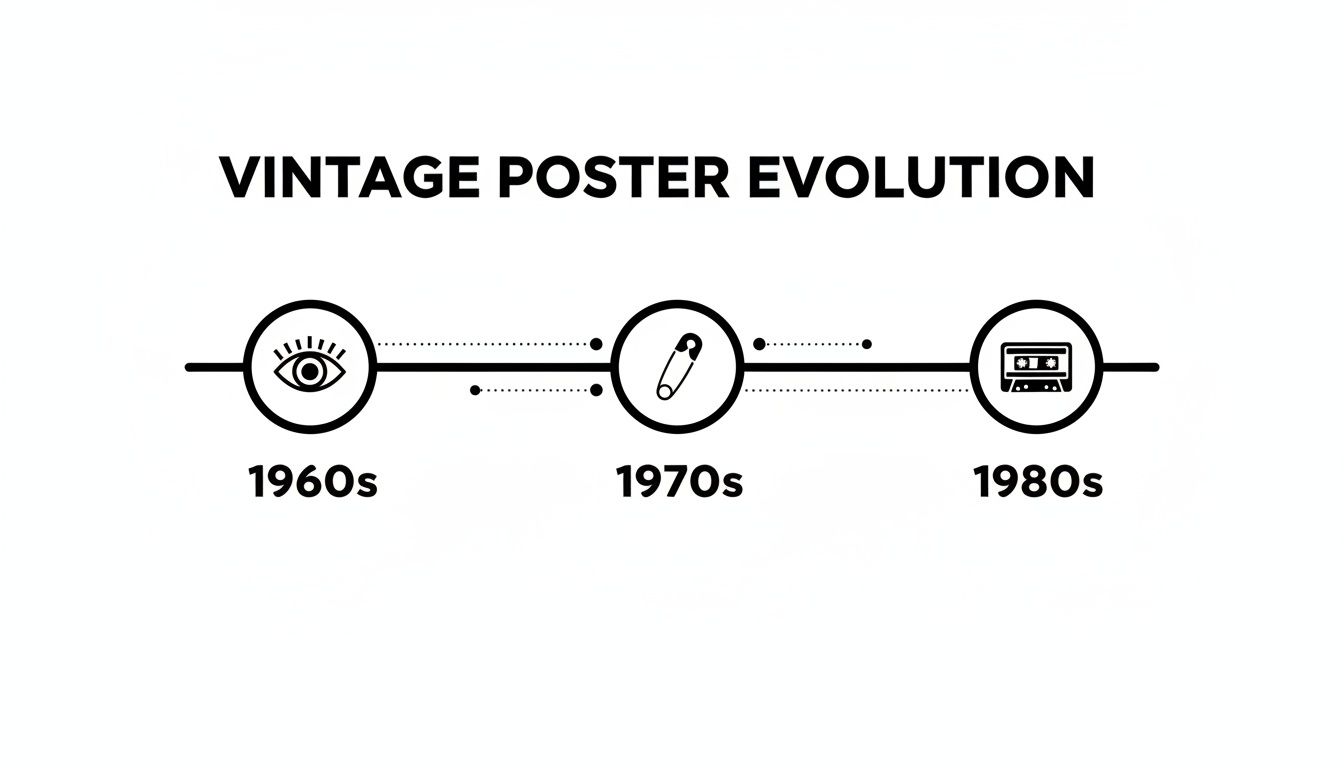
This quick snapshot shows how the visual identity of music posters evolved with the sounds of each decade, from psychedelic chaos to punk's brutalism and the 80s' pop gloss.
The Eighties: Bold, Bright, and New Wave
As we roll into the 1980s, the DIY aesthetic of punk started to give way to something cleaner, sharper, and unashamedly graphic. The rise of new wave and alternative rock, championed by bands like The Smiths, Joy Division, and New Order, brought a new design sensibility. This was the era of the 'Second British Invasion,' and the posters were as bold as the synthesisers.
Designers like Peter Saville, famous for his work with Factory Records, created posters that were works of minimalist art in their own right. They often used stark typography, geometric shapes, and a sophisticated colour palette. These weren't just gig announcements; they were cool, collectible pieces of modern design that you’d want on your wall whether you went to the show or not.
To really get your head around the evolution of these aesthetics, exploring an art history periods timeline provides crucial context. It shows how these movements didn't just happen in a vacuum but were part of a bigger cultural conversation. From swirling psychedelia to punk’s raw cut-and-paste, the vintage posters music lovers collect are a powerful record of how music looked, sounded, and felt.
How to Spot a Genuine Vintage Treasure
So, you’ve found it. A dusty, magnificent poster that looks like it was personally peeled off the sticky wall of a Camden venue back in 1977. But before you remortgage the house, hold your horses. Is it the real deal or just a convincing fake that rolled off a printer last Tuesday?
Welcome to your detective's guide to poster authenticity. Spotting a genuine vintage treasure is a bit like being a rock and roll Sherlock Holmes. You need to look for clues, trust your instincts, and know what you're looking for. Forget CSI; this is all about paper, ink, and the subtle signs that separate a historical artefact from a clever reproduction.
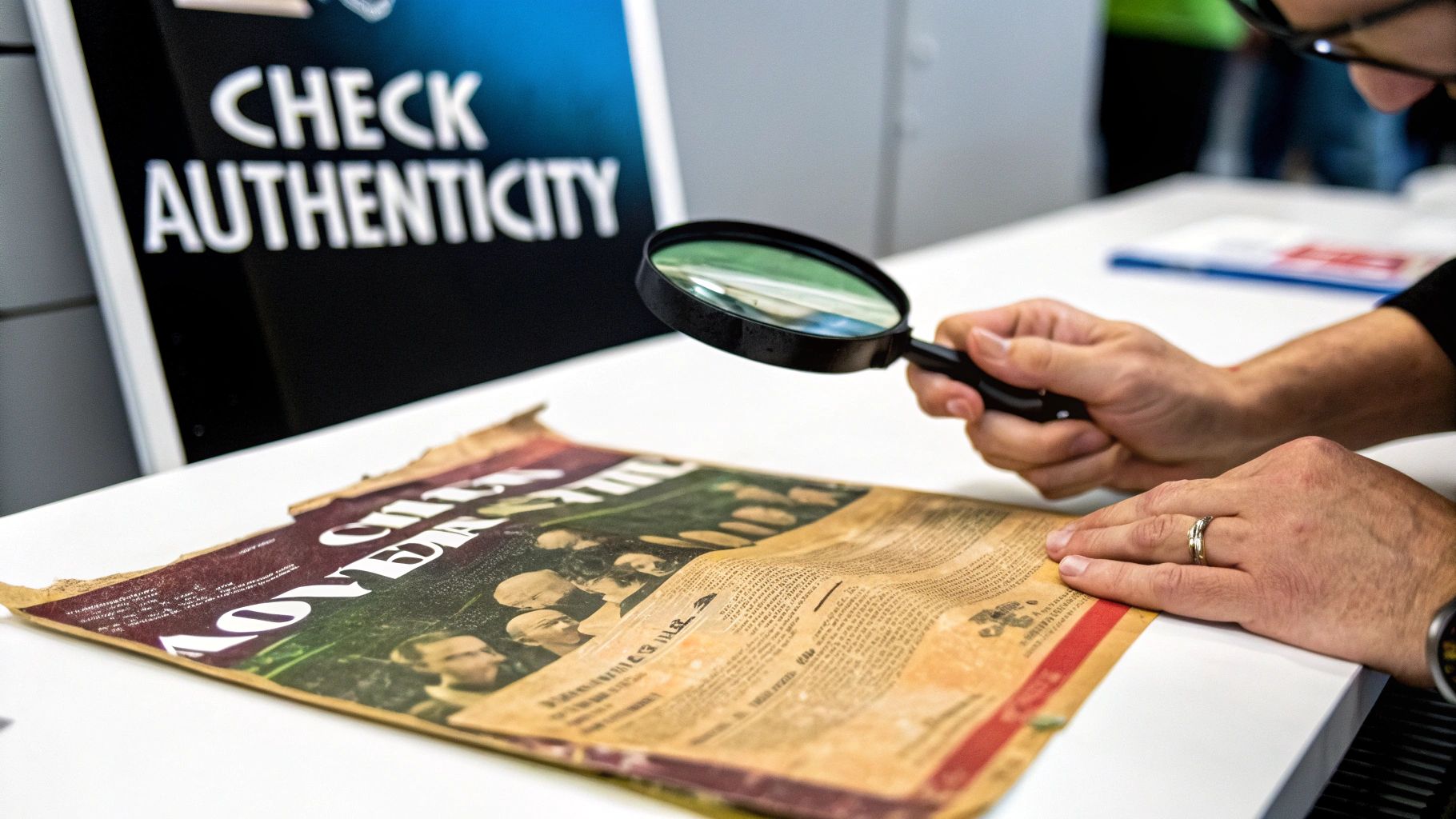
Feel the Paper, See the Print
The first and most important clue is the physical feel of the poster itself. Modern paper is often glossy, smooth, and perfectly uniform. Vintage paper stock, on the other hand, has a bit more character. It’s typically thicker, has a matte finish, and might show signs of natural ageing, like a slight yellowing or a unique texture.
Next, get up close and personal with the printing. Most original vintage posters, especially from the 60s and 70s, were made using old-school techniques like screen printing or lithography.
- Screen Printing: This method layers colours one at a time, creating a thick, tactile ink finish you can often feel with your fingertips. You might even spot tiny imperfections or slight misalignments where the colour screens didn't line up perfectly—these are signs of a handcrafted process.
- Lithography: This process produces rich, deep colours and smooth gradients. Under a magnifying glass, you won't see the tiny dots (or pixels) that are a dead giveaway of modern digital printing.
If you can see a perfect grid of tiny dots, you’re almost certainly looking at a modern digital reproduction. Real vintage prints just have a more organic, analogue feel to them.
What Makes a Poster Valuable
So, you’ve determined it's likely an original. Fantastic! But what actually gives it its value? It’s not just about being old. A poster for your mate’s terrible pub band from 1982 probably isn’t worth much, no matter how 'vintage' it is. The value of vintage posters music collectors seek is a cocktail of several key ingredients.
A poster's worth is a blend of history, artistry, and rarity. It's the story it tells, the artist who told it, and how few copies are left to tell the tale.
Here’s the recipe for a valuable poster:
- The Band's Status: Posters for iconic bands like The Clash, The Smiths, or The Beatles are always in high demand. Naturally, the bigger the band, the bigger the potential value.
- The Artist's Renown: If the poster was designed by a famous artist like Jamie Reid (Sex Pistols) or Peter Saville (Joy Division), its value skyrockets. You're buying a piece of design history as well as music history.
- Rarity: This is a big one. How many were printed? How many survived? Posters for small, one-off gigs are often rarer than those for huge stadium tours. Condition is also key—a poster in mint condition is worth far more than one that’s been used as a beer mat. If you want to dive deeper into what makes some prints rare, check out our insights on what defines limited edition prints.
The Democratisation of the Poster
During the 1970s and 1980s, printmaking became much cheaper and more accessible, which was a game-changer for music culture. The Punk movement, in particular, embraced this with its famous 'do it yourself' attitude, leading to groundbreaking designs like Jamie Reid's chaotic 'ransom-note' posters for the Sex Pistols.
Today, collectors value everything from rare merchandise posters of local bands, which can start around £25.00, to historically significant pieces that fetch much higher prices. With this crash course, you’re now armed with the knowledge to hunt for treasures with confidence. Go forth and become the savvy collector your boring walls have been waiting for.
Styling Your Walls Like a Rockstar
So, you’ve done it. You’ve found some incredible posters, and they’re just waiting to inject some serious soul into your space. Now what? Before you even think about reaching for that dreaded roll of Blu-Tack, let’s talk strategy. Don’t do your new treasures a disservice.
It’s all about turning that collection into a stunning display that screams ‘you’—without having to plaster your walls like a teenager’s bedroom back in 1995. It's time to style your collection like the rockstar you are.
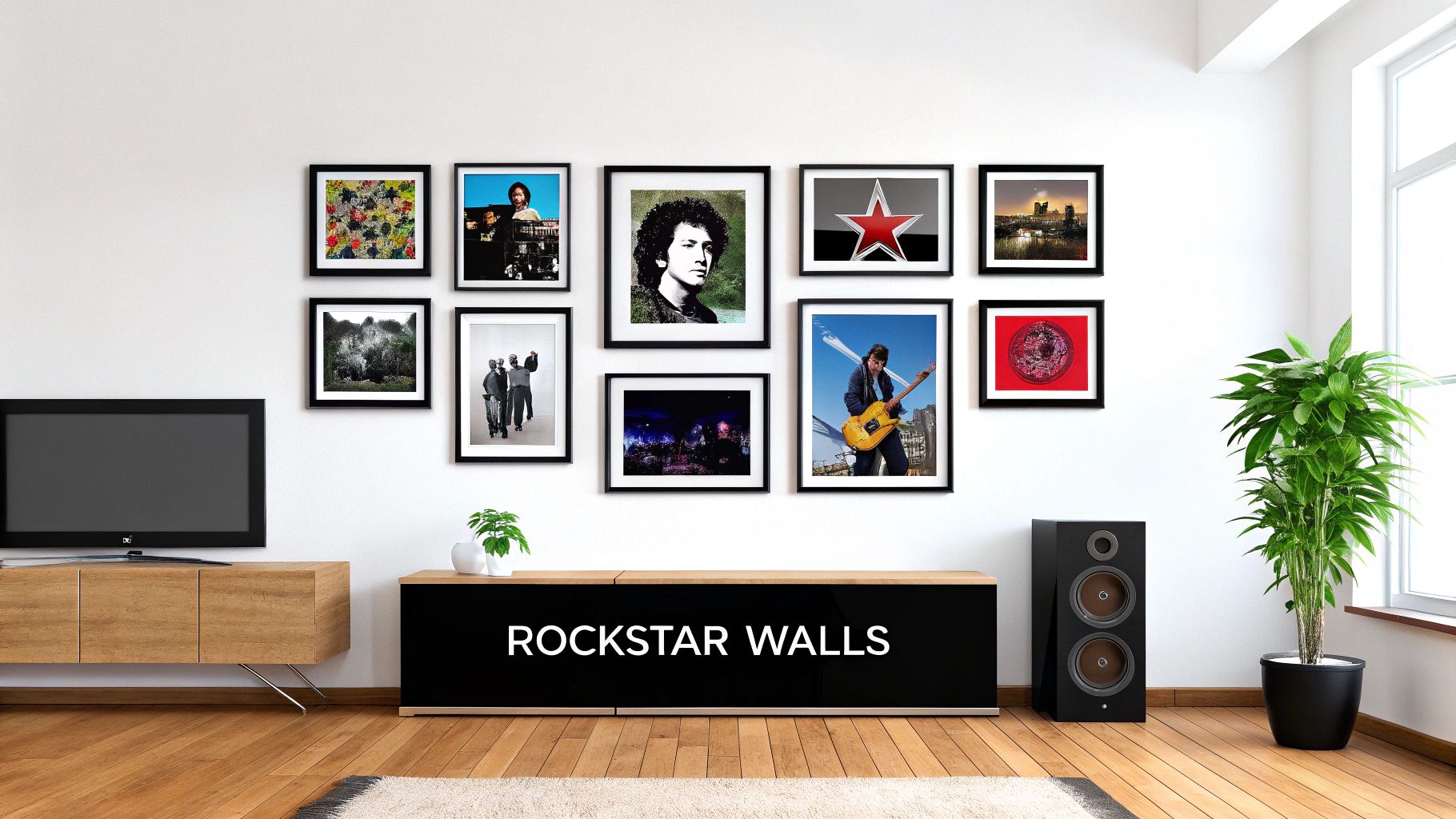
The Mighty Gallery Wall
The gallery wall is a classic for a reason. It's a fantastic way to tell your personal music story, mixing and matching different sizes, eras, and styles to create something totally unique. Think of it as your own personal music festival, curated right there on your wall. While there are no hard-and-fast rules, a little planning goes a long way.
To avoid your wall looking like a chaotic jumble, I always recommend laying everything out on the floor first. This lets you play around with the arrangement until it just feels right. You can create a sense of order by keeping the spacing between frames consistent, or by aligning them along a central horizontal or vertical line.
A gallery wall is more than just a collection of pictures; it's a visual autobiography. It's your chance to put The Smiths next to Oasis, or punk next to Britpop, and show off the brilliant, eclectic soundtrack of your life.
Let One Poster Be The Hero
Sometimes, less really is more. If you’ve managed to get your hands on one absolute showstopper—a huge, rare, or particularly meaningful poster—let it take centre stage. Making a single, massive piece the hero of the room creates an incredibly powerful focal point. It’s a bold statement that says, "Yes, this band is that important."
This approach works especially well above a sofa, a bed, or in a hallway where it can really command attention. The key is to give it space to breathe. Don’t crowd it with other bits and bobs; let the poster do all the talking.
Mix and Match Like a Pro
Here’s a secret the pros know: you don’t need a room full of priceless originals to create a killer look. The best displays often mix genuine vintage finds with high-quality modern prints. This creates a balanced, personal, and seriously cool aesthetic without needing a rockstar's budget.
- Combine Eras: Pair a psychedelic 60s print with a minimalist 80s design. The contrast tells a much richer story.
- Vary the Content: Mix gig posters with album art, lyric prints, or even some abstract pieces that just match the vibe. Our collection at Striped Circle is perfect for finding those complementary pieces.
- Play with Frames: Don’t feel like you have to stick to identical frames. A mix of sleek black, rustic wood, and even ornate vintage styles can add a ton of depth and character.
Choosing the right frame is crucial. A thin, modern black frame can make a gritty punk poster look gallery-worthy, while a natural wood frame might better suit the earthy tones of a folk-rock print from the 70s. Think about the poster’s own style and the overall feel of your room. The frame is the final touch that elevates your poster from a piece of paper into a proper piece of art. Get it right, and your walls will be hitting the right notes every single day.
The Modern Twist on Vintage Music Art
Let's be honest, finding a genuine, mint-condition poster from your favourite band’s first tour can feel impossible. They’re often incredibly rare, command eye-watering prices, and demand more care than a temperamental lead singer. But here's the brilliant part: you don't need a museum-piece original to get that same rebellious spirit up on your walls.
This is where the story gets really interesting. A new wave of artists and designers are keeping the soul of music history alive through contemporary prints. They're grabbing the classic aesthetics we all love and giving them a fresh, witty spin that fits perfectly into a modern home or office. It’s all about capturing the essence of an era, without having to take out a second mortgage.
These creators aren’t just making copies; they’re reinterpreting and celebrating music in completely new ways. It's the same passion, just with a different toolbox.
The New Wave of Music Prints
Think beyond the standard band photo. Modern music prints are all about creative interpretation. You’ll find intricate art built entirely from song lyrics, bold graphic designs that pay homage to legendary albums, and even minimalist prints that capture a band’s entire vibe with just a few clever shapes and colours. The goal is to create a piece of art that makes you smile and connects you to the music you love on a deeper level.
What’s more, these modern pieces look fantastic mixed in with genuine vintage finds. Imagine pairing a classic gig poster with a contemporary lyric print—you get a dynamic display that tells a story about both the music's history and its lasting impact on you. It’s your personal musical journey, mapped out right there on your wall.
The beauty of modern music prints is that they make incredible art accessible to every fan. You don't need to be a wealthy collector to have walls that tell a story and show off your impeccable taste.
Celebrating Design Innovation
Some of the most brilliant modern designs are the ones that completely rethink what a music poster can even be. They're less about advertising a gig and more about visualising music history itself. A fantastic example of this comes from the UK-based design studio Dorothy, which has created a series of prints called ‘Blueprints’ that are absolute genius.
Their 'Alternative Love Blueprint—A History of Alternative Music' poster, for instance, maps out the entire genre like a complex circuit board from an old transistor radio. It cleverly connects major influencers like the Sex Pistols, The Smiths, Joy Division, and The Ramones in an intricate web of influence. It’s a stunning example of how contemporary designers are approaching vintage posters music themes with fresh eyes. If you want a closer look at this incredible piece of design, you can explore the history of alternative music charted on a poster.
It’s precisely this kind of creative thinking that makes the modern scene so exciting. Designers are finding new ways to visualise the data, the connections, and the very feeling of the music we love. Here at Striped Circle, we’re all about that approach—creating art that’s smart, stylish, and full of the passion that makes music so important to us all. Your walls deserve to tell a story, and these modern masterpieces are the perfect way to tell it.
Got Questions? We've Got Answers
Alright, so you're ready to dive in and turn your home into a personal hall of fame. But before you do, you might have a few questions buzzing around. It's completely normal.
Think of this as your backstage pass to poster collecting. We're going to tackle some of the most common queries, from protecting your precious finds to figuring out if that gem you found in the loft is actually worth something. Let's get these sorted so you can get back to the fun part.
How Do I Protect My Vintage Posters from Damage?
Sunlight and moisture are the mortal enemies of old paper. To put it in musical terms, they're the equivalent of a terrible sound mix at a gig you've been waiting ages for. The golden rule is to always frame your prized posters using UV-protective glass or acrylic. This is absolutely non-negotiable if you want to stop those vibrant colours from fading into a pale, sad whisper of their former glory.
Make sure to hang them well away from damp walls, bathrooms, or kitchens where humidity can cause irreversible damage. If you have unframed posters, your best bet is to store them flat in an acid-free portfolio. And for the love of music, never, ever laminate an original poster—it's a cardinal sin in the collecting world that completely tanks its value.
Are Reproductions of Vintage Posters Worth Anything?
This is a great question. While a high-quality reproduction won't have the same monetary value as a genuine original from 1979, they are fantastic for decorating. They give you the chance to enjoy iconic artwork without the hefty price tag or the constant worry of damaging a rare piece. Let's face it, spilling a cuppa on a £20 print is annoying; spilling it on a £2,000 original is a certified disaster.
Think of reproductions as a tribute, not an investment. They're the perfect way to nail a specific aesthetic, celebrate your favourite bands, and fill your walls with art you love without breaking the bank. They deliver the vibe without the vulnerability.
How Can I Figure Out What My Old Band Poster Is Worth?
Working out a poster's value is a bit like being a detective. The final figure really depends on a few key things: the band's fame, the poster's rarity, its condition, and the artist who designed it. A solid first step is to scour online auction sites. The trick is to filter by 'sold' listings to see what people have actually paid for similar posters, not just what sellers are asking for.
If you have a piece you suspect might be quite valuable, it's always worth getting a professional appraisal. Also, any proof of its history – what's known as 'provenance' – can seriously increase its value. That old ticket stub from the gig tucked behind the frame? That’s pure gold.
What Are the Most Collectible Music Genres for Posters?
Certain scenes just have a magnetic pull for collectors. Posters from the 1960s psychedelic rock explosion, with their mind-bending artwork, are always in high demand. In the same way, original UK punk and new wave posters from the late 1970s are incredibly collectible for their raw, DIY aesthetic and cultural significance.
But at the end of the day, the most collectible poster is the one that means something special to you. The real value is the story it tells and the smile it brings to your face every time you see it.
At Striped Circle, we're all about that smile. We create high-quality, witty, and unique prints inspired by the music and football that we live and breathe. Check out our collection to find the perfect piece to start your wall art story at https://www.stripedcircle.com.
