
50 X 70cm Posters: Size, Framing and Room Guide
You're staring at the bare wall above the sofa, holding your phone at arm's length and wondering whether that print will look brilliant or slightly lost. Meanwhile, there's a frame in your basket labelled A2, because that sounds about right.
Stop before checkout. 50 x 70cm posters aren't A2, and getting the frame wrong is a miserable way to discover that paper sizes have more rules than the offside law.
Table of Contents
- Why 50 x 70cm Hits the Sweet Spot
- What 50 x 70cm Really Measures
- Printing, Paper and Resolution Checks
- Framing and Matting Without the Size Trap
- Protecting Your Print From Light, Damp and Fading
- Room Placement and Styling That Works
- Packing and Shipping Without Creased Corners
- Pick Your 50 x 70cm Print and Order With Confidence
Why 50 x 70cm Hits the Sweet Spot
Yes, this is big enough to matter without taking over a room. It's a clear step up from a desk-sized print, but it doesn't demand that you rearrange the furniture and start referring to your lounge as the west gallery.
Say you've got a plain sofa, a reading lamp and a wall doing absolutely nothing. A colourful music print gives that corner a personality without requiring matching cushions, coordinated candles or a degree in tasteful beige.
Familiar format, personal subject
Posters have always done more than fill gaps. The Victoria and Albert Museum describes them as a vital means of communication since the 19th century, and its collection contains more than 26,000 examples. That heritage includes entertainment, transport, advertising and protest: artwork designed to catch your attention and make you feel something.
At home, the subject becomes personal. Portrait orientation suits a tall arrangement of lyric typography; a wide format suits a stadium panorama with room for the stands and sky. Choose the composition that serves the artwork, rather than rotating your plans around whichever frame happens to be on offer.
A memorable wall doesn't need more decoration. It needs something you actually care about.
Generic décor rarely starts a conversation. A knowing musical reference or a football print with a cheeky streak gives visitors something to recognise, debate or smile at. Your wall can express an opinion without requiring a post-match interview.
What 50 x 70cm Really Measures
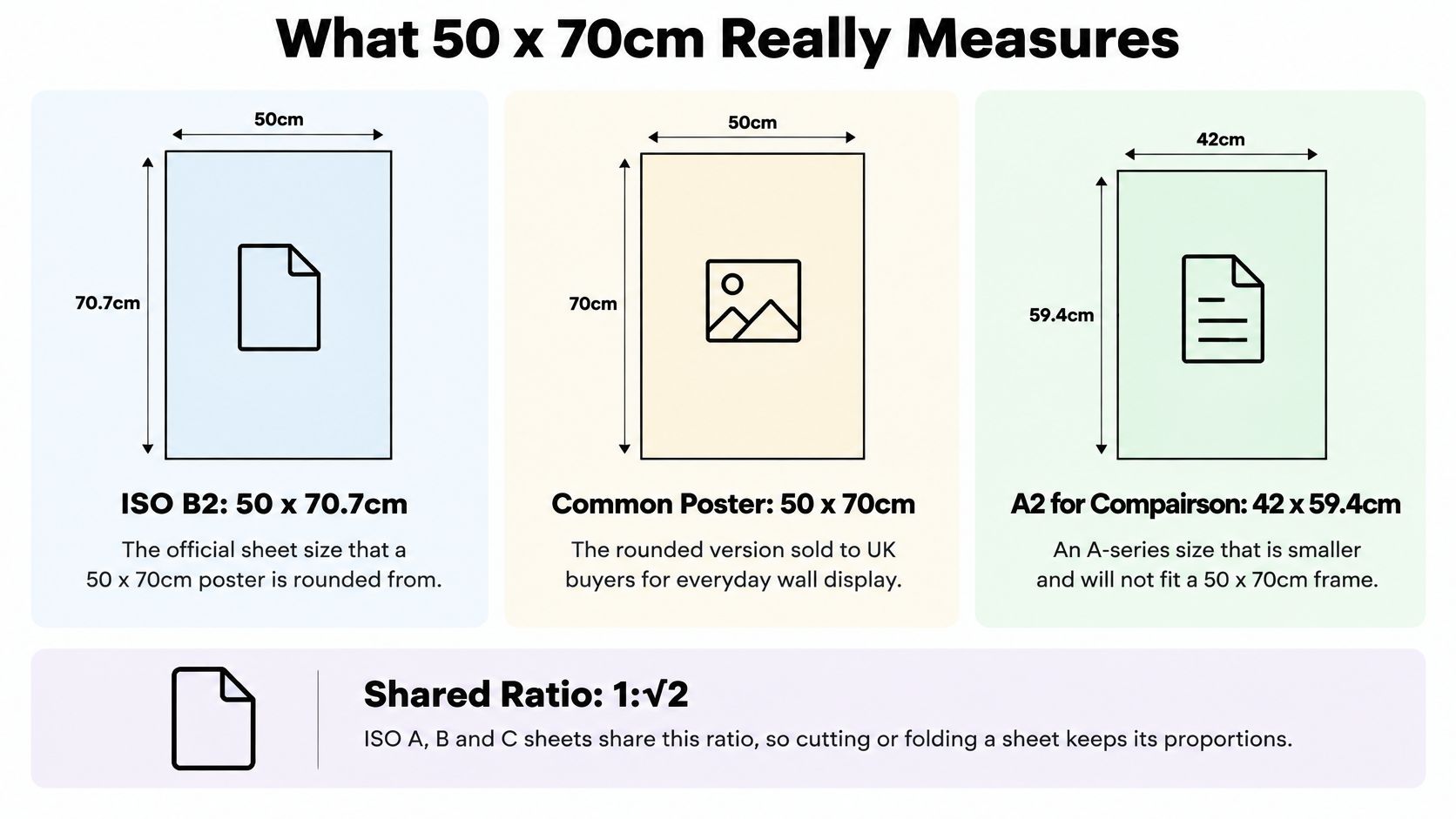
A nominal 50 x 70cm poster closely corresponds to B2, but the labels aren't interchangeable. The Garfnet paper-size reference gives true ISO B2 as 50 x 70.7cm, approximately 19.7 x 27.8 inches, with an area of about 0.354 square metres, or 3,537 square centimetres.
That makes the nominal retail format shorter by 7mm, or 0.7cm. You won't notice that difference from the sofa, but a rigid frame certainly will. Check the actual product specification: a deliberately produced retail sheet isn't automatically a true B2 sheet rounded down in the description.
Common poster sizes compared
Use the metric dimensions for ordering and the placement column for judging your wall. Imperial measurements are rounded comparisons, not instructions for trimming.
| Format | Size (cm) | Size (inches) | Where it fits |
|---|---|---|---|
| A3 | 29.7 x 42 | 11.7 x 16.5 | Desk-level prints and small frames |
| A2 | 42 x 59.4 | 16.5 x 23.4 | Mid-size posters, the frame size many buyers assume |
| 50 x 70cm (nominal retail size) | 50 x 70 | 19.7 x 27.6 | Feature prints and statement walls |
| ISO B2 (true standard) | 50 x 70.7 | 19.7 x 27.8 | Feature prints, press sheets, and matching B2 frames |
| B1 | 70.7 x 100 | 27.8 x 39.4 | Large lobby, office or games-room displays |
| 40 x 30cm | 40 x 30 | 15.7 x 11.8 | Smaller, less imposing wall pieces |
A3 works where you approach closely, such as beside a desk. A2 offers more presence, but remains smaller than the nominal poster format. B1 asks for substantially more uninterrupted wall; the smaller horizontal option is easier to accommodate beside shelving or a doorway.
The comparison makes those differences easier to visualise.
Read the wall, not just the label
The ISO system uses a 1:√2 ratio across its A, B and C formats, so halving a sheet across its longer dimension preserves its proportions, allowing for standard rounding. The B-series fills gaps between A-series sizes; that's enough paper trivia to survive a particularly niche pub quiz.
Orientation changes the result dramatically. For example, on a hypothetical 120cm-wide wall, a centred sheet laid on its long side and measuring 70cm across leaves 25cm either side, while a portrait sheet measuring 50cm across leaves 35cm.
Those are bare-sheet clearances. Add the finished frame before deciding whether the arrangement feels comfortable. Also keep the area comparison honest: the area quoted above belongs to true B2, not the slightly shorter nominal retail sheet.
Printing, Paper and Resolution Checks
A sharp screen preview does not guarantee a sharp poster. For close viewing, aim for 300 PPI at final size, or approximately 5,906 x 8,268 pixels for this format. The University of York's image guidance gives a comparable target of roughly 120 pixels per printed centimetre.
A smaller file can still print, but enlarging it cannot restore missing detail. Interpolation adds pixels, not information, so softness shows first in lyric lettering, badge outlines and faces. Changing the resolution field alone will not turn a screenshot into print-ready artwork.
Choose detail before sheen
Keep the higher-resolution target for fine typography and intricate football imagery. A poster viewed from farther away may tolerate less detail, but small lettering and crests still need to hold up at the intended viewing distance.
Paper finish changes how colours look under room lighting. Choose a finish to suit the subject and where it will hang, rather than assuming a shinier surface is an upgrade.
Paper finish options for a 50 x 70cm poster
| Finish | Look | Best for | Watch out for |
|---|---|---|---|
| Matte | Soft, low glare | Lyric typography and vintage-style prints | Colours can look slightly muted |
| Satin or semi-gloss | Subtle sheen, rich colour | Football photography and bright artwork | Reflections under spotlights |
| Gloss | High shine, vivid colour | Bold graphics and pop-art style designs | Glare and visible fingerprints |
| Textured fine art | Tactile, gallery feel | Premium gifts | Higher price and needs a careful frame choice |
For text-led artwork, choose matte. Satin suits vivid photography, while gloss needs lighting that will not throw reflections across the image. Compare the guide to print paper types before settling on a finish.
Run a pre-print check
- Confirm the colour profile. Ask which profile the printer requires; do not convert blindly.
- Protect important details. Keep lettering, signatures and crests clear of the trim edge and the frame's covering lip.
- Specify the edge treatment. Full-bleed artwork needs the printer's required bleed. Keep any deliberate white margin inside the finished sheet.
- Print a reduced proof. Check spelling, contrast and composition, then inspect a final-size crop for small lettering.
A phone screen can hide what paper reveals. Dark tones may look deeper on screen but turn flatter on matte stock, making nearby details harder to distinguish. Check the proof for those tonal shifts before ordering the full-size print.
Framing and Matting Without the Size Trap
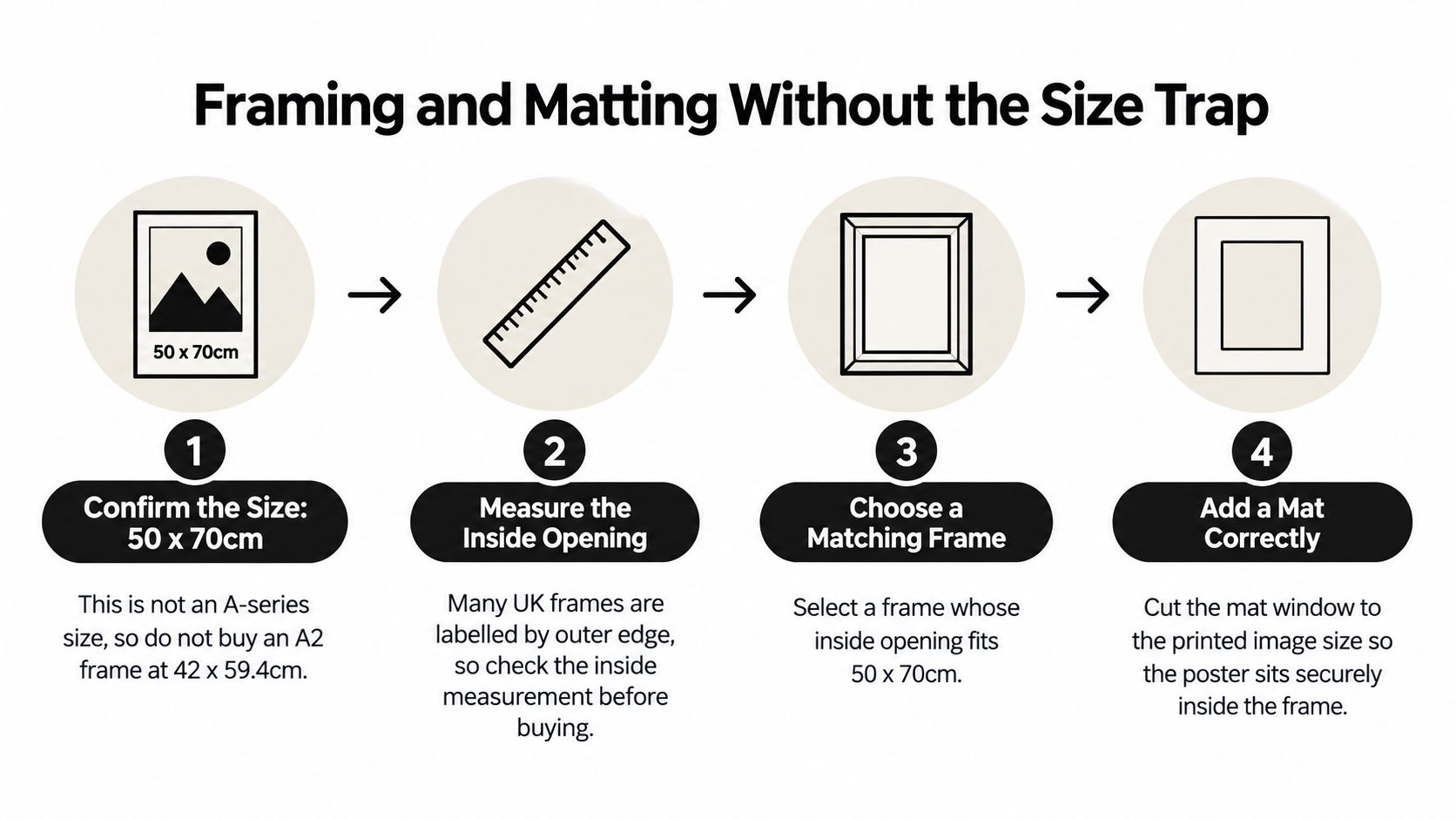
Buy for the sheet, not the word poster. A2 is smaller than this format, and the Frames Plus size guide is a useful reference when checking paper dimensions and avoiding assumptions about frame labels.
The measurement that matters is the frame's internal capacity. Its external dimensions include the moulding, while the visible opening may hide a little of the paper beneath the retaining lip.
Frame sizes for common 50 x 70cm presentations
The thin and wide mount examples below use straightforward arithmetic: add the border to both sides of each sheet dimension. They're planning dimensions; a framer should allow for the mount window's overlap and the frame's construction.
| Presentation | Print size | Mount border | Frame to buy |
|---|---|---|---|
| Borderless, glazed | 50 x 70cm | None | 50 x 70cm frame, checking the rebate depth |
| Thin mount | 50 x 70cm | 2cm each side | Custom frame around 54 x 74cm |
| Wide mount | 50 x 70cm | 5cm each side | Custom frame around 60 x 80cm, or a 70 x 100cm standard frame with a wider mount |
| A2 frame, wrongly assumed | 50 x 70cm | None | Does not fit, because A2 is 42 x 59.4cm |
| Frame listed by outer size | 50 x 70cm | None | Check inside dimensions, not the outer edge |
The larger standard-frame option doesn't preserve the example's equal-width border. It requires a different mount layout, usually with more space above and below the artwork. Mounts create a gallery feel and separate paper from glazing, but they cost wall space.
Use this visual as a starting point, then measure your actual sheet.
Measure before you buy
- Measure the full sheet. Include any printed white margin, not just the coloured image.
- Decide the orientation. Check that the frame's fittings support portrait or horizontal display before cutting a mount.
- Choose direct-fit or mounted. Add the intended border around every edge, then assess the finished footprint.
- Check the internal size and rebate. The rebate is the recessed space holding the glazing, artwork and backing.
- Confirm glazing thickness. Thicker panes leave less usable depth for the remaining layers.
- Size the mount and backing to the frame. Cut the mount window to reveal the intended image while overlapping enough paper to hold it securely.
The poster-frame sizing guide is useful if you're choosing between a direct fit and a mounted presentation.
Buying rule: If the listing doesn't clearly state what sheet fits inside, ask before paying.
Never force an oversized print into a smaller frame. It won't develop conveniently positioned gaps; it will buckle, crease or require cutting. None of those improves the artwork.
Protecting Your Print From Light, Damp and Fading
A 50 x 70cm print can fit the frame perfectly and still fade if it hangs in direct sun or sits in a damp spot. Light bleaches pigments and discolours paper. Damp can encourage mould and make paper ripple, while condensation may form inside a frame against a cold outside wall.
The Institute of Conservation's advice on art on paper recommends 16–19°C and 45–60% relative humidity, protection from daylight and UV-filtering glazing. Aim for a stable, dry place at home rather than trying to create museum conditions.
Turn conservation advice into home habits
- Choose an internal wall. Avoid damp exterior surfaces and spots where condensation appears.
- Keep the print away from heat. Radiators and fireplaces can cause local temperature changes that are hard on paper.
- Limit direct sunlight. North- or east-facing walls may be easier to manage, but follow the sun's actual path through the room.
- Check for warning signs. Rippling paper, misted glazing or a musty smell calls for attention. Don't hide the problem behind furniture.
Keep the print out of direct sun and away from persistent damp. If the wall or glazing feels cold or shows condensation, choose another position. These simple checks matter more than chasing exact room readings.
Choose glazing for the location
Standard picture glass offers clear viewing, but only count on UV protection if the product specification says it has it. UV-filtering glazing can reduce one cause of fading. It does not make direct sunlight harmless.
Acrylic weighs less, which can help when frame weight matters, but it scratches more easily. Clean it with a suitable soft cloth and cleaner, not a kitchen scourer.
A dry, shaded position protects a print better than expensive glazing used to justify hanging it in blazing sunshine.
Use a mount or suitable spacer to keep paper from touching the glazing, and conservation-quality backing to protect it from behind. The National Archives' guidance also advises against placing framed paper directly against cold outside walls. Acid-free board helps protect paper, but it cannot make a damp room safe for a print.
Room Placement and Styling That Works
A 50 x 70cm poster can look right above a bed and cramped above a broad sofa. Let the furniture and the available wall space decide the layout, not the size label. The format is not an A-series size, so check the frame dimensions before buying, then judge how the framed piece will sit in the room.
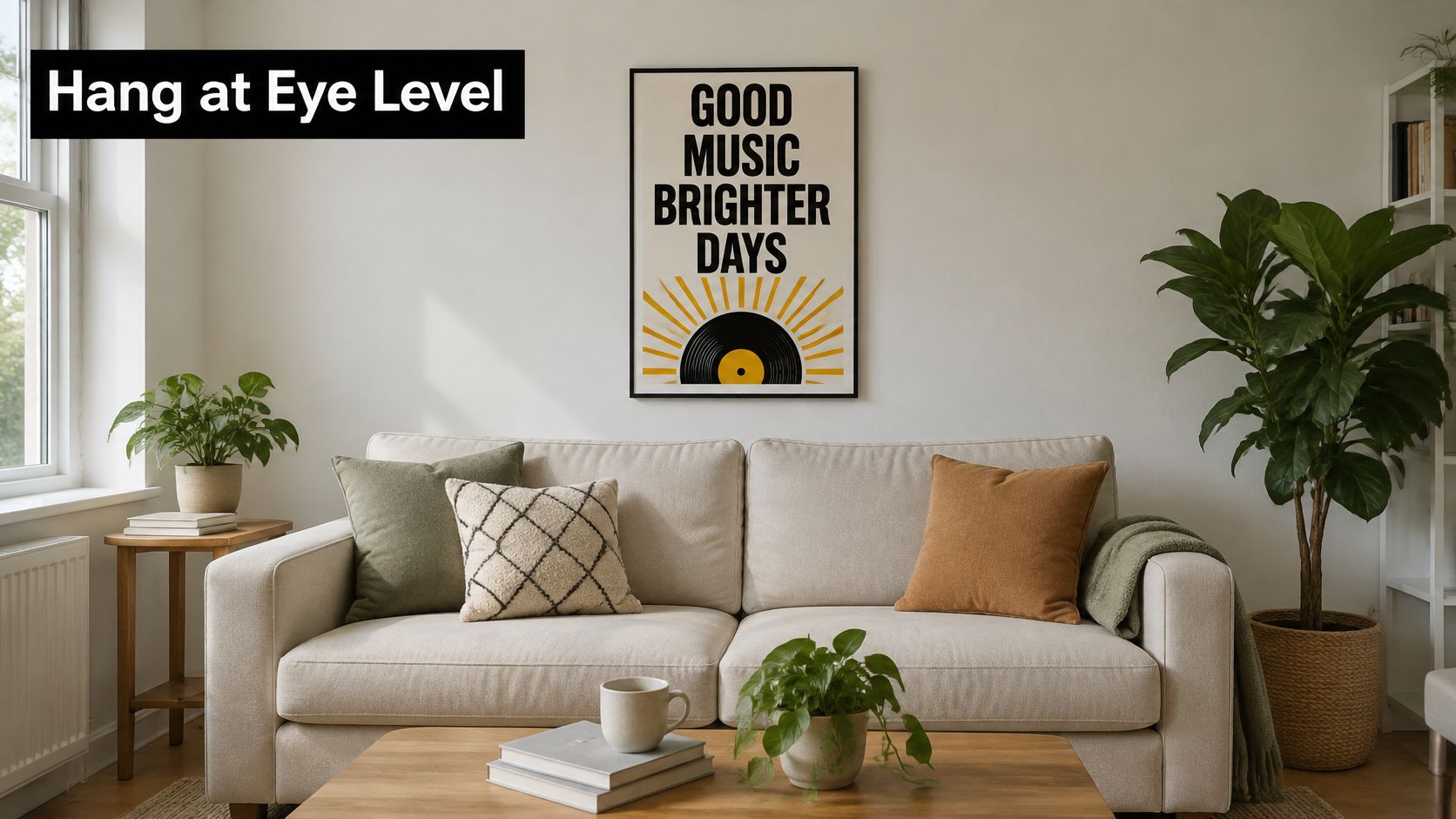
Above a sofa, check the arrangement from both sitting and standing positions. Above a desk, look from your chair. Hang the centre at 145–155cm as a starting point, then adjust to suit the furniture and how you use the room.
A sofa setting shows why the cushions, furniture and surrounding space all matter.
Compare the whole arrangement
These are hypothetical starting layouts to test with a paper template, not fixed installation standards. Tape up the outline first and move it until the print feels connected to the furniture rather than stranded above it.
Where a 50 x 70cm poster works best
| Room | Best orientation | Clearance guide | Styling note |
|---|---|---|---|
| Bedroom above the bed | Portrait or horizontal | Try 20–30cm above the headboard | Centre on the bed and keep it calm with simple bedding |
| Living room above the sofa | Horizontal | Try 15–25cm above the backrest | Test a composition spanning about two-thirds of the sofa width |
| Home office above the desk | Portrait for lyric prints | Try 20–30cm above the monitor | Keep the bottom edge clear of screens and glare |
| Hallway | Portrait | Test 5cm gaps in a gallery group | Works as one bold print at eye level |
| Games room or football den | Horizontal | Try 20–30cm above any console or bench | Group with a club scarf or a framed shirt for a matchday wall |
One poster may not span enough space above a broad sofa. Build a group if the wall calls for a wider composition; don't force a single print to do a whole team's work.
Statement print or gallery group
Choose a statement print when the subject deserves attention and the wall has breathing room. A group of smaller works can suit a long hallway, especially when the frames share a finish or colour. A smaller piece with clear space around it often looks more deliberate than an oversized print squeezed beside a cupboard.
For more ideas on matching artwork to a room, browse this wall art for homes guide. For measuring and positioning, follow this guide on how to hang pictures precisely.
Tape up a full-size paper template and live with the layout before drilling. Choose hardware rated for the complete framed weight, fix into a stud or appropriate wall plug, and check the frame with a spirit level or calibrated level app.
Packing and Shipping Without Creased Corners
The parcel arrives. You've cleared the table, located the scissors and resisted opening it with the enthusiasm normally reserved for a last-minute winner. Good start: careless unpacking can damage perfectly good artwork before it reaches a frame.
Tube or flat package
A sturdy tube suits many unmounted paper prints and keeps the package manageable. The trade-off is curl, so remove the print gently and allow it to relax in a clean, dry space.
Lay it between clean protective sheets beneath a broad, flat board with evenly distributed weight. Don't place a heavy book directly on the printed surface, and don't reverse-roll it tightly to hurry things along.
Flat packing suits mounted work and papers that shouldn't be rolled. A rigid mailer needs enough internal support to resist bending; framed work also needs protected corners, supported backing and cushioning appropriate to the glazing.
For a closer look at the materials involved, Colorado Art Services explains choosing protective materials for artwork. A protective interleaf and rigid inserts should separate the artwork from abrasive packaging surfaces.
Check before discarding the packaging
- Inspect the edges. Look for crushed corners, tears and creases.
- Check the image. Compare against an approved proof where available, remembering that screens emit light and paper doesn't.
- Record any damage. Photograph the packaging and affected area, then contact the seller promptly.
For gifts, include a note about careful unrolling and the intended display spot. It's friendlier than handing someone a curled mystery and announcing that their evening now involves backing board.
Pick Your 50 x 70cm Print and Order With Confidence
A 50 x 70cm label does not guarantee a ready-made UK frame will fit. Choose artwork for the person first, then check its listed dimensions and finish before ordering. The right print earns its place because it means something, not because it matches the rug.
Choose for the person, not the empty patch
- Lyric prints for a music fan's bedroom. Pick a line tied to a shared memory, such as a wedding song, a festival favourite or the track they swear sounds better live. The recognition is the point.
- Album-inspired artwork for the keeper of ticket stubs. A matte mount can echo a treasured record sleeve without making the room feel like a merchandise stall.
- Football artwork for a matchday regular. Choose a crest in a portrait composition or a wide stadium scene. Check the club carefully; a wrong crest is banter nobody asked for.
- Alternative music or witty football designs for an office. Choose humour colleagues will enjoy too. The best office print makes Monday brighter without needing an HR explanation.
- A greeting card alongside the poster. Add a personal message, or choose the card on its own when a full-sized artwork feels like too big a commitment.
Striped Circle offers alternative lyric prints, music artwork and UK football club designs, with new designs added regularly. Treat each product as its own choice: available sizes and finishes can vary, so check the individual listing rather than assuming every design comes in every format.
For a music-themed gift, A Million Love Songs print (Wholesale) offers colourful, nostalgia-led artwork. Choose it for the song and the person it brings to mind.
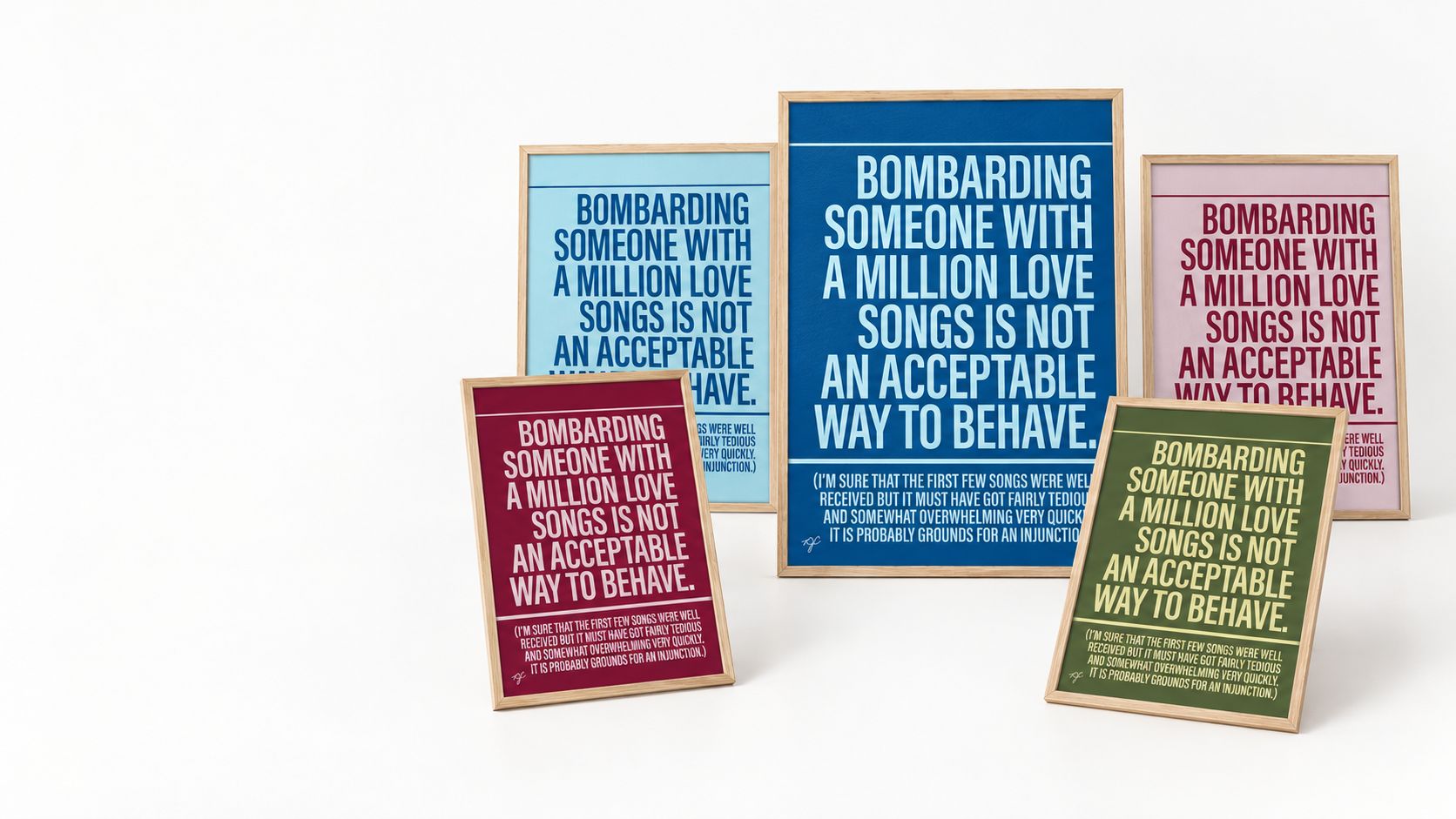
Make the final choice personal. A print that recalls a favourite song, club or shared joke will feel at home long after the latest decorating trend has moved on.
Striped Circle is a family-run business offering music-inspired wall art, football prints and greeting cards for homes and offices. Browse Striped Circle for artwork with personal meaning, and check the product's available size and finish before checkout.
