
A2 Poster Size in Inches: Every Measurement You Need
One A2 poster holds the same paper area as four A4 sheets laid edge to edge.
That tidy maths matters the moment you have a frame listing open in one tab and a tape measure in the other. Millimetres describe the sheet; inches describe the frame, and the two rarely quote each other politely. Once you know which number rules the purchase, A2 becomes simple to buy for, whether the print is a stadium, a favourite band, or something else entirely.
Table of Contents
- A2 Poster Size at a Glance in Inches and Millimetres
- Why A2 Halves Neatly Into A3 and Doubles Into A1
- How A2 Compares With Other Common Poster Sizes
- Where an A2 Print Works Best on Your Walls
- Can People Read an A2 Poster From Across the Room
- Framing an A2 Print Without Overspending
- Preparing an A2 File for Print With Bleed
- Choosing Your A2 Print and Taking the Next Step
A2 Poster Size at a Glance in Inches and Millimetres
One figure settles most A2 debates before they start: 420 × 594 mm. The University of Bristol poster printing page lists that as the finished A2 size, equivalent to approximately 16.54 × 23.39 inches, which product listings and frame shops commonly round to 16.5 × 23.4 inches. In centimetres, the same sheet is 42 × 59.4 cm.
Orientation only swaps the width and height; the sheet itself is unchanged. A frame in horizontal orientation takes the same poster as a portrait one, rotated ninety degrees.
The A Series Ladder
A2 belongs to the ISO 216 A-series, so its neighbours are fixed rather than invented on a Friday afternoon. That predictability helps when the football print you want is priced in one size and the frame you found is measured for another.
| Format | Millimetres | Inches (rounded) |
|---|---|---|
| A5 | 148 × 210 mm | 5.8 × 8.3 in |
| A4 | 210 × 297 mm | 8.3 × 11.7 in |
| A3 | 297 × 420 mm | 11.7 × 16.5 in |
| A2 | 420 × 594 mm | 16.5 × 23.4 in |
| A1 | 594 × 841 mm | 23.4 × 33.1 in |
| A0 | 841 × 1189 mm | 33.1 × 46.8 in |
Practical rule: Use 420 × 594 mm for ordering and artwork, and inches for shopping. Millimetres are exact; the inch figures are rounded.
That rounding trips people up. Artwork built only from 16.5 × 23.4 inches can pick up small errors at the trimming stage, so supply files in millimetres. For judging a wall or picking a frame, the rounded figure is close enough. The exact measurement answers the fit question; whether small text stays readable on a print this size is a separate test of viewing distance.
The same habit applies to anything sized for a space. Measure the spot first, then buy to fit, the way you would choose the right Buddha statue size by checking the alcove instead of trusting the photo. With posters, measure the delivered sheet before framing. A trim can shave a millimetre or two, which is normal. A poster nowhere near 16.5 × 23.4 inches isn't a true A2, however optimistic the listing.
Why A2 Halves Neatly Into A3 and Doubles Into A1
This comparison shows how neatly A2 and A3 share the same proportions on a desk.
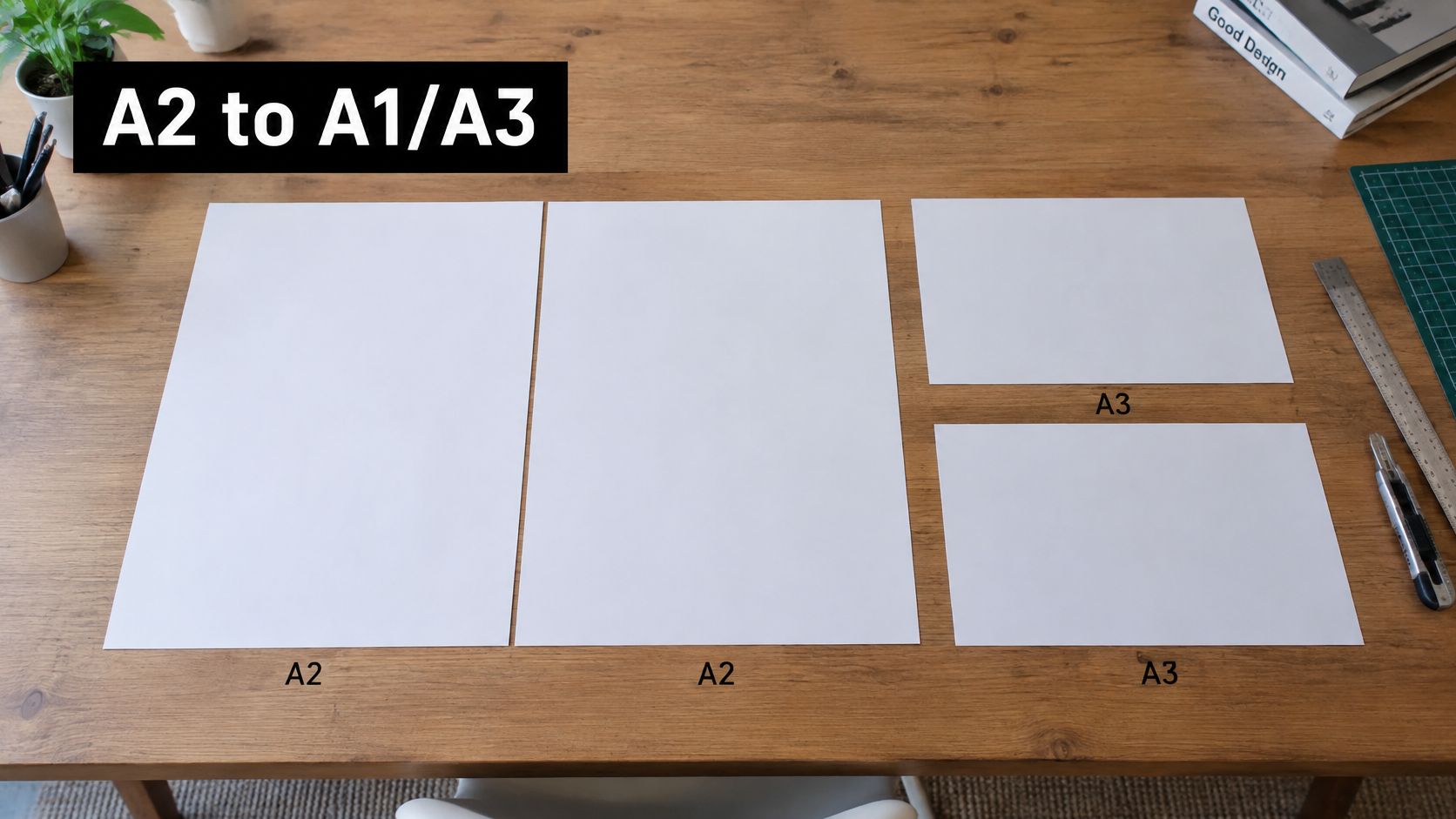
The Adobe guide to the A2 format explains that A2 uses an aspect ratio of approximately 1:√2, or 1:1.414, and that halving an A2 sheet across its longer dimension produces an A3 sheet with the same proportions. In plain English, cut A2 in half the right way and you get two A3 sheets. Put two A2 sheets together and you get one A1.
That ratio turns into a scale factor inside any design tool. Because √2 ≈ 1.414, enlarging A2 artwork to A1 means scaling it to 141%. Shrinking it to A3 means scaling to 71%, since 1 ÷ √2 ≈ 0.707. Apply the percentage to the long edge and the short edge follows automatically, because both sides sit on the same ratio.
There's a practical wrinkle here. Scale a text-heavy print down to 71% and every letter shrinks with it, so artwork that reads beautifully at A2 can turn fiddly at A3.
A2 covers about 0.25 square metres, twice the area of A3 and half the area of A1. Same shape, different size, like the same song pressed on a 7-inch and a 12-inch. That's why a music print designed at A2 can step down to A3 or up to A1 without someone's head, guitar, or club crest getting cropped like a dodgy matchday photo.
This short video is handy if you'd rather watch the folding happen than read about it.
The catch is that this neat scaling only works inside the A-series. US poster sizes use different proportions, so they don't join the family photo. Pick an A-series master file and the whole set of prints can be made from it without a redraw.
How A2 Compares With Other Common Poster Sizes
An 18 × 24 in print looks close to A2, and that small difference is exactly what catches buyers out. UK shops commonly sell A-series prints, while imported and US listings often use inches in the product name. A search for A2 poster size in inches usually means someone is trying to marry those two worlds without buying the wrong frame.
The infographic below puts A2 beside the sizes people most often confuse it with.
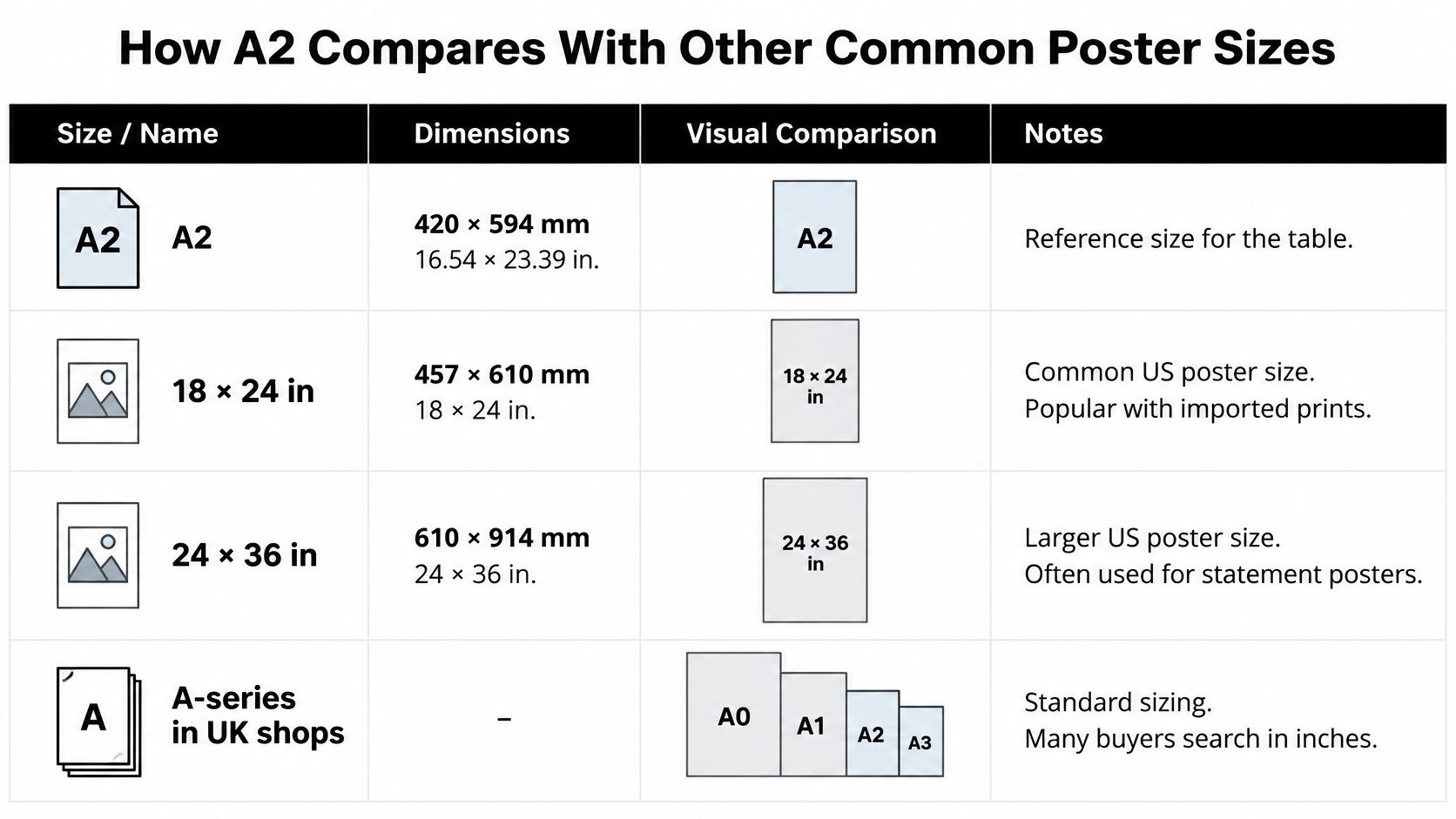
Put an 18 × 24 in sheet in an A2 frame and it won't close at all. Go the other way and an A2 print inside an 18 × 24 frame leaves a gap of roughly 18 mm down each side and about 8 mm top and bottom, a pale stripe of bare wall where the mount should sit flush.
| Size | How It Compares With A2 |
|---|---|
| A2 | Reference size (420 × 594 mm, 16.5 × 23.4 in) |
| 18 × 24 in | About 9% wider and 3% taller than A2 |
| 11 × 17 in | Smaller than A2 in both directions |
| A3 | Half the area of A2 |
| A1 | Twice the area of A2 |
A 24 × 36 in poster is a different beast altogether. It's roughly 45% wider and 54% taller than A2, so it needs its own frame and a chunkier wall. An 11 × 17 in tabloid print, by contrast, suits a desk, noticeboard, or kitchen shelf better than a feature wall.
Size also decides how far back a print can be read. Shrink a text-heavy lyric print or a club honours list down to 11 × 17 and every letter shrinks with it. That's fine at arm's length above a desk, and hard work across a living room.
Match the frame to the exact trimmed dimensions, not the friendly name in the listing title.
That one habit saves returns, bent corners, and the sad ritual of holding a print against a frame while whispering, it'll probably fit.
Where an A2 Print Works Best on Your Walls
Portrait A2 loves narrow, upright spaces. Try it beside a desk, above a console table, or in that tall slice of wall between doors where nothing else quite works. It draws the eye upwards and gives a football stadium, a singer, or one big bold lyric room to stand tall.
Wide A2 behaves differently. It suits the wall above a sofa, a long shelf, or a meeting space where your eye naturally travels sideways. A useful furniture rule is to aim for the print to cover around two thirds of the width of whatever sits beneath it, so the arrangement reads as one unit rather than a floating rectangle. Under a 90 cm console table, the 59.4 cm width of a horizontal A2 lands almost exactly on that mark. Hang the centre near eye level for the people using the room, then follow a guide to hanging pictures straight if a spirit level is not part of your toolkit.
Offices make the case nicely. A UK workplace art survey covered by House Beautiful found that 65% of indoor workers could not see any art from their desk, half said their workplace had no artwork at all, and among those who did have art, 27% said it made them feel happy while 21% said it made them feel peaceful.
An A2 print earns that wall easily.
It is big enough to spot from your chair, yet it will not turn a home office into an art gallery with a laptop in it. A piece such as the "Yellow & Blue Army" - Oxford United Football Club print can bring matchday colour to a desk wall without shouting over every video call, while a lyric print does the same job for anyone who prefers a chorus to a kickoff. If you are planning something larger for the main room, our ideas for large prints for a living room show how scale changes the effect.
Can People Read an A2 Poster From Across the Room
A2 sets the sheet size; the lettering decides whether it reads from the sofa. Size guides tend to stop at the measurements, which is why text heavy music prints either shine on the wall or turn into attractive wallpaper.
The page from Hantsprint at Hampshire County Council recommends that poster text remain legible from 1 to 2 metres, with generous white space, simple layouts and large sans-serif type, a recommendation credited there to the UK National Co-ordinating Centre for Public Engagement. So a long lyric in swirly decorative lettering can look gorgeous in your hands and become mystery soup across the room.
A Quick Readability Check
- Keep the main line short: One punchy title or chorus hook beats a full verse.
- Use strong contrast: Pale grey words on cream may be tasteful, but they're hard work at distance.
- Leave breathing room: Crowded copy makes even big letters feel smaller.
- Put detail where people stand close: Hallways and bedrooms can handle smaller print than a sofa wall.
The bigger your letters, the further back they work, so give the headline line the most height and let supporting detail shrink.
Lighting matters too. A print opposite a bright window can pick up glare, and a dark corner can swallow subtle colours. Check the spot at the time of day you'll be sitting there, not only during a cheerful Saturday morning tape measure session.
Tape a sheet measuring 42 × 59.4 cm to the wall, write your biggest words at the planned size, then go and sit in your usual seat.
If you have to squint or lean forward to make out the words, choose less copy and larger lettering. A bold club nickname, album title, or three word lyric will land. A dense paragraph probably won't, however brilliant the song is.
Framing an A2 Print Without Overspending
The classic framing trap is measuring the outside of the frame. Don't. What matters is the internal opening that holds the sheet. A frame sold as A2 should accept an A2 print, but nominal labels vary, so read the inner dimensions before you click buy.
Next, decide whether you want a mount. A mount is the card border that creates a window around the artwork. It gives a busy football print room to breathe and can make a simple lyric design feel more gallery like. If your print already has plenty of white space, a mount may push the image too far away. Borderless artwork needs a frame that holds it flat with no awkward loose edge waving at visitors.
Glass or Acrylic
- Glass: Crisp and traditional, but heavier and more fragile on a larger sheet.
- Acrylic: Lighter and safer to hang, which helps above sofas, desks, and beds.
- No frame yet: An unframed print is easier to post and lets you live with the design before paying for local framing.
Once the frame arrives, how to hang pictures precisely is worth a look before you start drilling heroic holes in the plaster. Measure twice, because patching filler is nobody's idea of a fun weekend.
Our own run through of what size poster frame you need walks through the same decision in poster terms. Before ordering, measure the trimmed print, confirm the frame's internal size, choose glazing for the room, and check the mount width. Do those four things and A2 framing becomes boring in the best possible way.
Preparing an A2 File for Print With Bleed
If you're supplying your own artwork, start at the finished size and work outwards. The flow below shows how bleed changes the document you send, without changing the poster you'll hang.
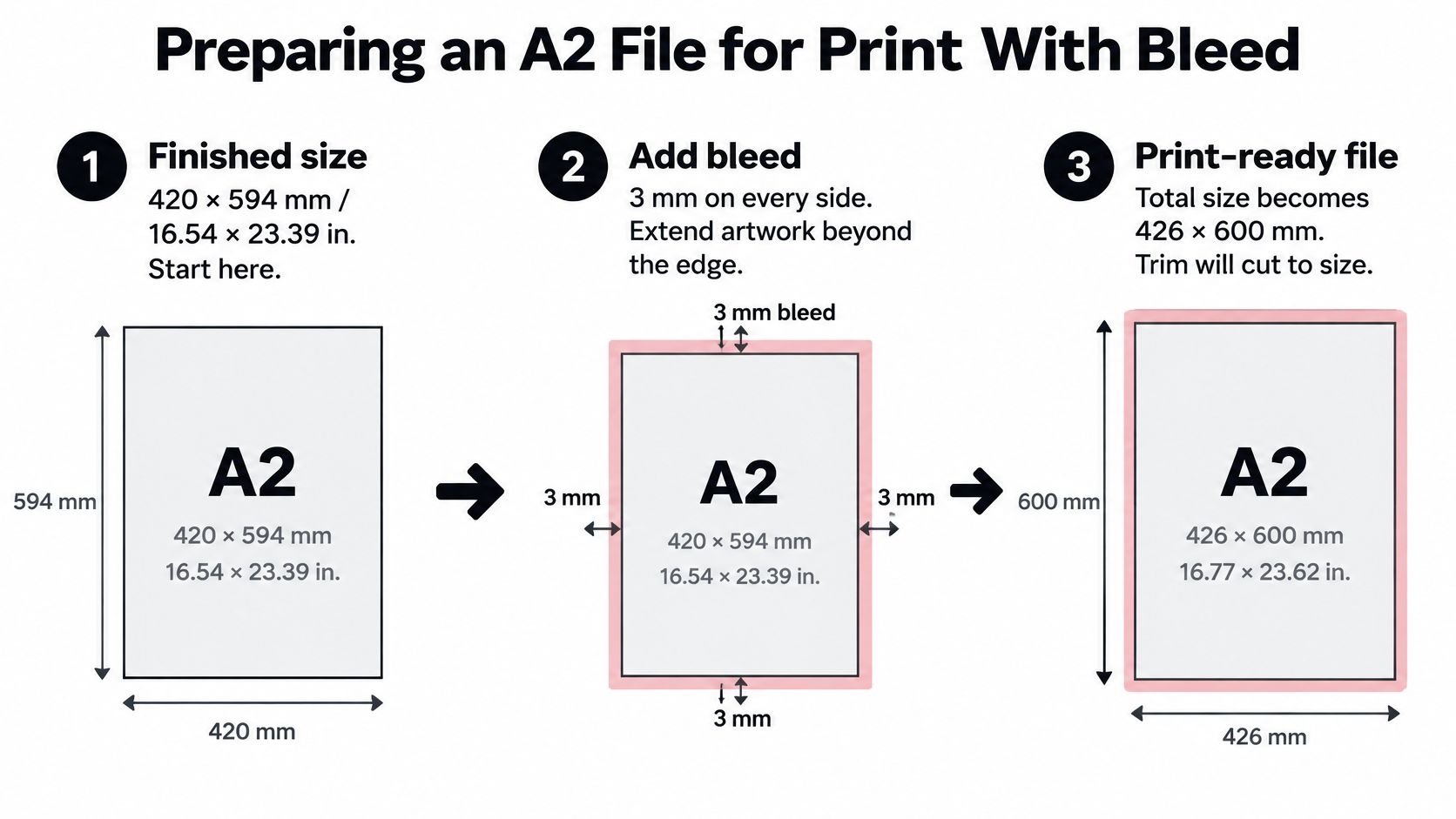
The Sheffield Hallam University print shop guidance explains the oversize and trim logic behind bleed. For A2, a commonly specified 3 mm bleed on every edge turns a 420 × 594 mm document into 426 × 600 mm, about 16.77 × 23.62 inches. That extra artwork is cut away, which stops thin white slivers appearing if the trim shifts slightly.
- Set the page: Create the document at 420 × 594 mm in your chosen orientation.
- Set resolution: Use 300 ppi, which gives about 4,961 × 7,016 pixels for the trimmed size.
- Add bleed: Extend backgrounds and images by 3 mm on each side if your printer asks for it.
- Protect the important bits: Keep faces, logos, and key type at least 5 mm inside the trim line.
- Export carefully: Send a PDF with bleed included and crop marks only if the printer requests them.
- Check the template: Production methods differ, so the printer's specification wins.
You may see the pixel height rounded to 7,008 pixels in some guidance. Multiplying the exact inch height by 300 ppi gives roughly 7,016, so use the calculated figure in your software rather than forcing the rounder number. Tiny maths, fewer surprises.
For a deeper look at resolution and paper choices, see our notes on getting the best print quality. Your future self, holding a sharp A2 instead of a fuzzy one, says thanks.
Choosing Your A2 Print and Taking the Next Step
Your wall either fits 16.5 × 23.4 inches or it doesn't, and now you know which. Our prints run from A5 up to A0, so A2 sits near the middle of the range rather than at either extreme. Two details still deserve a glance at the listing before you order: orientation, and whether that particular design is offered framed. A5 and A0 prints only come unframed, and options differ between designs, so the product page always has the final word.
One habit prevents most ordering mistakes: trust the dimensions written on the listing, not the room mockup. Mockup images are for reference only and do not represent a specific print size or frame. The photo may show a poster that looks perfect above a sofa, but the millimetres in the listing describe what arrives at your door.
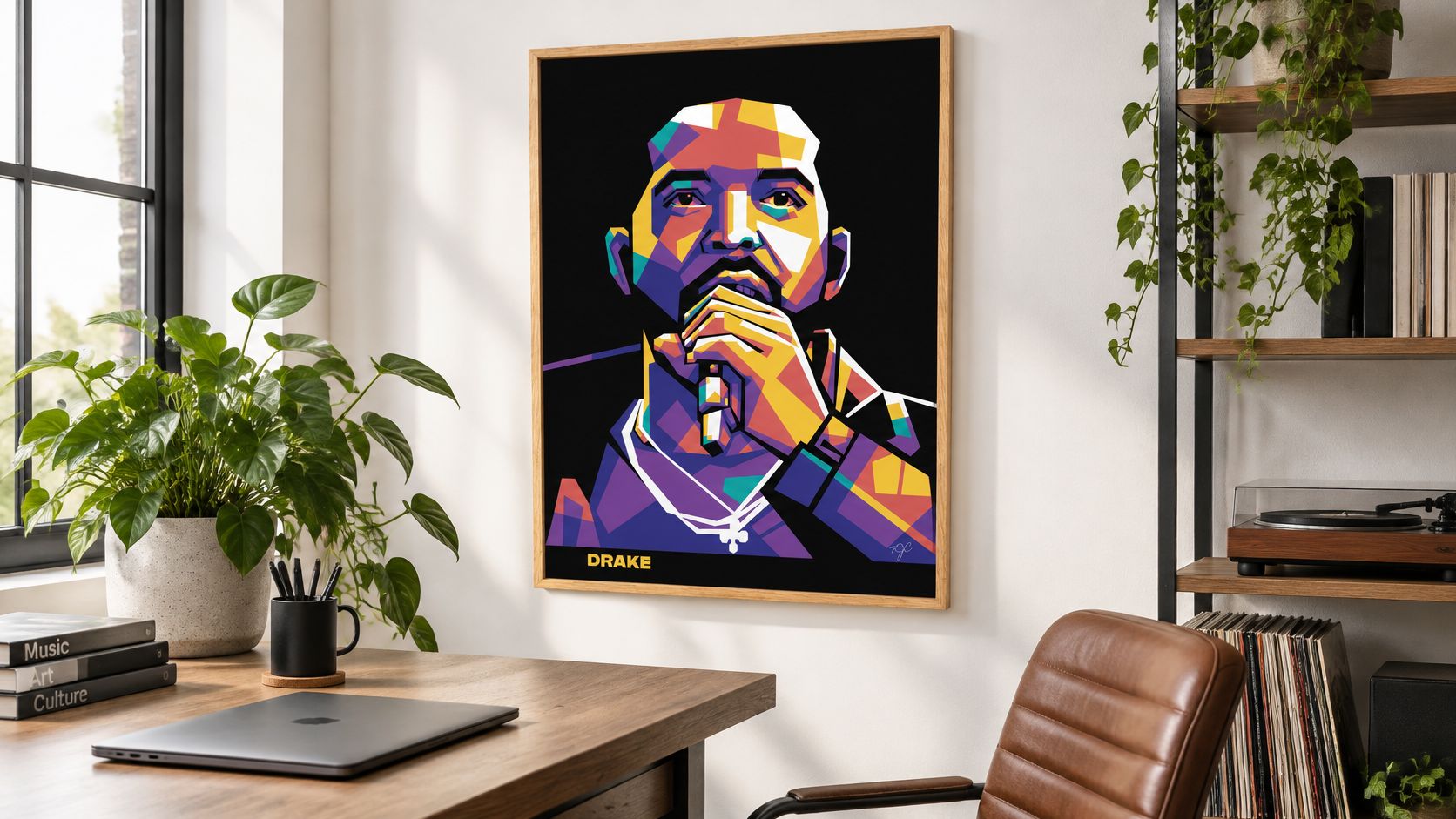
Listings such as the Drake print - Legends Collection and the "Sweet Dreams" wall print lay out their size and frame options on the product page itself, so select A2 there rather than assuming it from a preview image. For a print you'll read from across the room, our premium 250gsm heavyweight matte paper keeps the surface calm under lamps and daylight, which suits text-heavy lyric and typography designs especially well.
The ordering sequence stays simple. Measure the wall, compare it with 42 × 59.4 cm, choose a vertical or horizontal layout, then pick framed or unframed from the listing. And if the artwork passed your readability check at arm's length, the same design scaled up to A2 gives every letter and line more room to breathe. No calculator-induced headache required.
Ready to give that blank wall a bit of matchday noise or musical mischief? Browse the football, music, and pop culture prints at Striped Circle, check the A2 dimensions against your space, and pick the design that'll make you grin every time you walk past.
