
Art Cheap Prints: How to Buy Affordable Wall Art Well
The most common advice about buying affordable wall art is to sort by price, low to high, and grab whatever lands at the top. It's terrible advice. A print that costs less than a round of coffees can still end up the most expensive thing on your wall once you've bought a frame, paid postage twice and replaced the corner that arrived looking like a dropped sandwich. Cheap is a price, not a risk rating. The things that decide whether you'll still like your purchase in two years are total cost, print quality and legal status, and none of them show up in the sticker.
There's also a reason to care beyond the budget. In a survey of 2,000 British adults, Samsung's art of the nation research found 70% displayed artwork at home and 73% admitted judging people by the art hanging on their walls. So yes, your guest is absolutely reading that Craven Cottage print and forming an opinion. Let's make sure it's a good one.
Table of Contents
- What Cheap Art Prints Really Cost
- Picking a Print Size That Fits Your Wall
- Quality Signals That Separate Bargains From Duds
- Protecting Cheap Prints From Light and Damp
- Copyright Checks for Lyric, Football and Band Prints
- Save Money and Build Your Shortlist This Week
What Cheap Art Prints Really Cost
Say you're choosing between two options for the wall above the sideboard. One is a £6 unframed poster in an odd size. The other is a £30 print that arrives framed and ready to hang. The £6 looks like a £24 saving right up until you price a bespoke frame, discover the postage difference, and realise the paper has curled off the wall by February.
The five parts below are where the money goes.
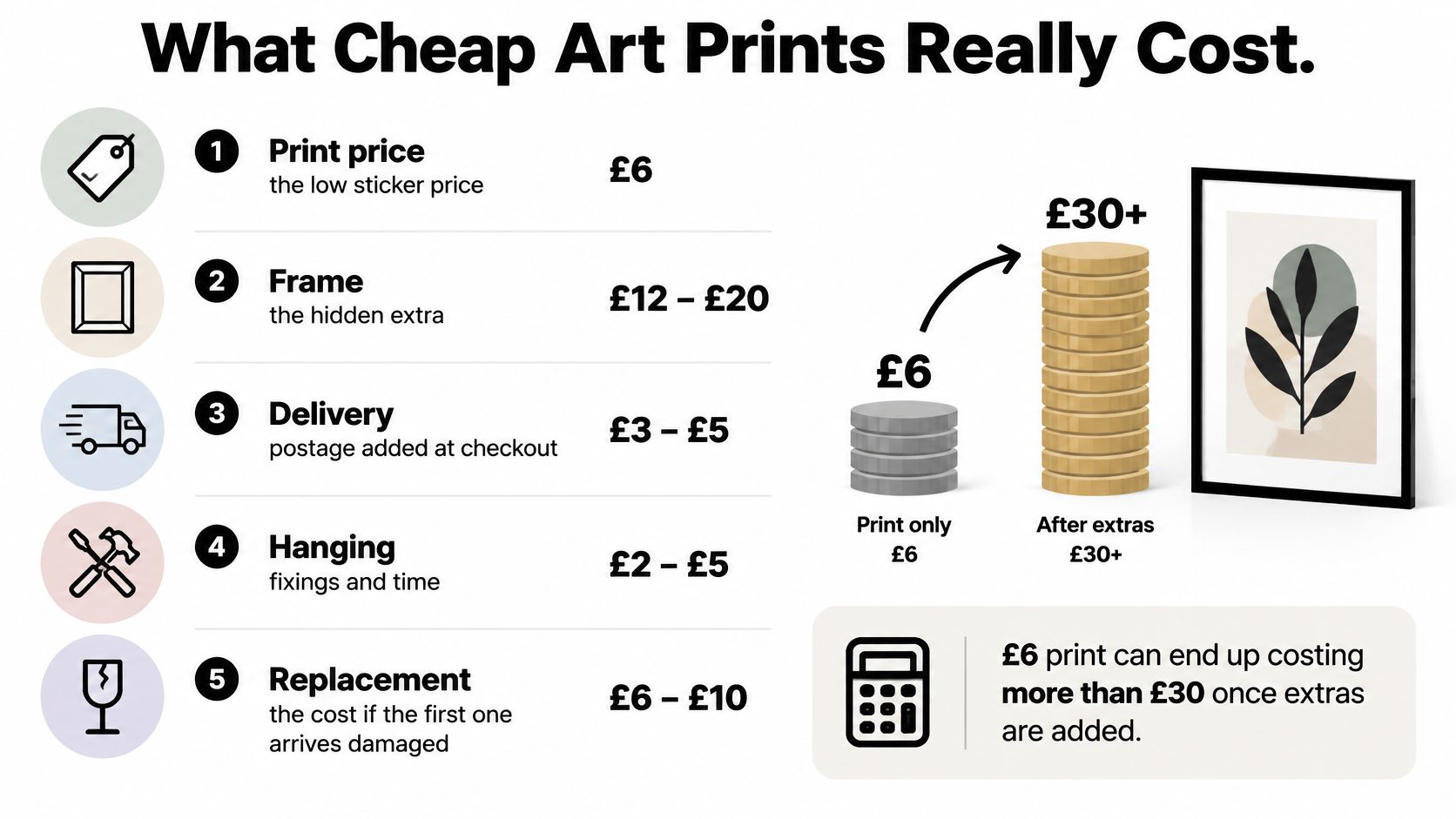
| Cost component | What it covers | How it changes the total |
|---|---|---|
| Print price | Paper, inks and size | The cheapest print can curl or fade, so it may need replacing |
| Frame | Ready-made or bespoke frame | Unframed is cheaper upfront, but the frame often costs more than the print |
| Delivery | UK unframed £2.99, framed £5.99 | A framed order doubles the postage |
| Hanging hardware | Hooks, wire, mount or spacer | Often forgotten, and a poor fix can damage the wall |
| Replacement risk | Transit damage, fading or wrong size | One replacement can wipe out the saving from a bargain |
The five-minute total-cost check
Run this before you click buy, not after the parcel lands.
- Write down the print price. That's the number you've been staring at, and it's the least interesting one.
- Add the frame you'll buy, not the one you imagine finding in a charity shop. Odd sizes mean bespoke, and bespoke means a framer's quote.
- Add delivery. Our UK delivery is £2.99 for unframed prints and £5.99 for framed prints, so framing adds weight and cost at checkout as well as at the workshop.
- Add a hanging kit and a mount or spacer. A mount isn't decoration, it's the gap that keeps paper off the glazing.
- Note what a reprint would cost if the sheet arrives creased or the blacks look grey. Then read the return terms, because that's the line that decides who pays.
Practical rule: compare totals, not sticker prices, and check the returns policy before checkout rather than after the damage.
If you're trying to keep an honest eye on where household money drifts, it helps to track your spending automatically with Compass+, because framing and postage are exactly the sort of small, repeated purchases that never feel like a decision.
Price alone is a weak filter in a market this crowded. Grand View Research's UK wall art outlook puts UK wall-art revenue at approximately US$4.14 billion in 2025, with a projection of about US$6.74 billion by 2033. Thousands of sellers, one wall. Being the cheapest option in that field isn't a compliment, it's a warning to check the spec.
Picking a Print Size That Fits Your Wall
Size changes the price, the framing bill and the visual impact in one move. Go up a rung and you buy more paper, a bigger frame and a greater chance that hanging needs two people, a spirit level and a quiet word with the landlord. Cheap is fine. Cheap and badly sized is where walls start looking like a struggling office raffle.
Here's the A-series ladder and where each size earns its keep.
| Size | Dimensions | Best for | Framing note |
|---|---|---|---|
| A5 | 148mm x 210mm | Shelves, gallery clusters, gifts | Unframed only |
| A4 | 210mm x 297mm | Desks, hallways, small walls | Unframed or framed |
| A3 | 297mm x 420mm | Bedroom or kitchen feature piece | Unframed or framed |
| A2 | 420mm x 594mm | Living room focal wall | Unframed or framed |
| A1 | 594mm x 841mm | Statement wall or office | Unframed or framed |
| A0 | 841mm x 1189mm | Full feature wall, large office | Unframed only |
A5 and A0 are unframed only, so glazing either size means sourcing a frame yourself. That's harmless for an A5 leaning on a shelf. At A0 it becomes a proper budget event, because ready-made frames are harder to find and a framer will quote for the sheet, the mount and the labour. Our guide to UK poster sizes walks through the dimensions if you're matching a print to a frame you already own. Measure the frame rebate before you fall in love with the artwork, because paper does not negotiate.
The "Sorry about the Mess" print is a useful worked example. It is available in A5, A4, A3, A2, A1 and A0, so the same childlike crayon-style kitchen scene with a crossed-out punchline can shift from a hallway smirk to a full sofa-wall gag. At A5, it reads as a small joke you notice up close. At A1, the crossed-out chaos reads from across the room. Pick the scale by viewing distance, not by the size that feels like a bargain.
Matching the print to the furniture
The rule of thumb I use: a print should fill about two-thirds of the width of whatever sits beneath it. Sofa, sideboard, bed headboard, desk. Anything narrower looks like it's apologising for existing, anything wider looks like it's about to fall on you. For a cluster, treat the whole group as one shape and measure that. You are buying the relationship between the print and the furniture, not a random rectangle with good intentions.
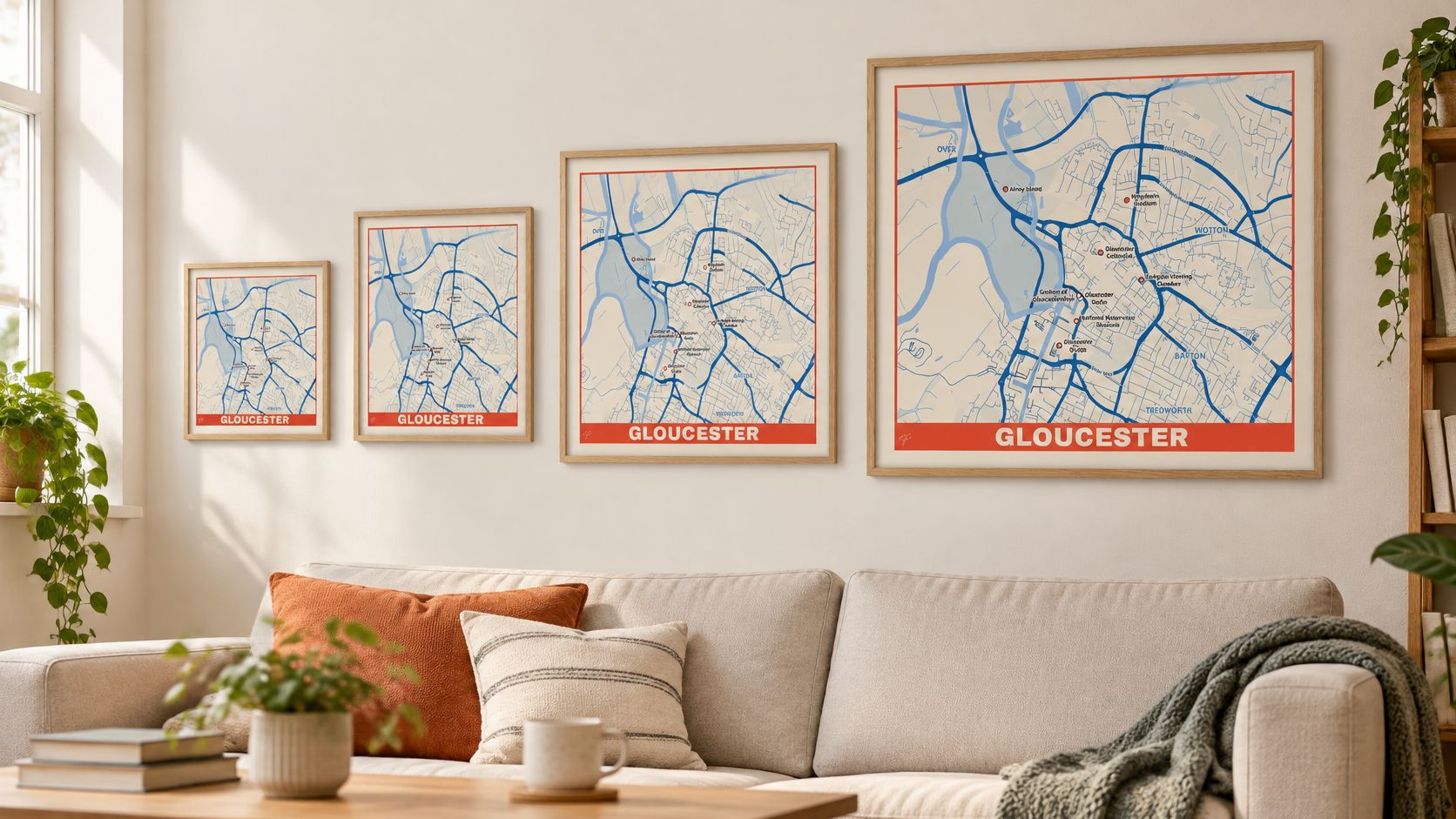
Detail-heavy designs behave differently from bold ones. The Gloucester Map Print is listed with 100 variants across option1, option2 and option3, which tells you the choice lives in the product options rather than in a simple size promise. With maps, size decides whether street names are readable from a normal standing position. If the point is navigation and local detail, go larger than you would for a graphic print. If the point is atmosphere, a modest size in a decent frame often looks calmer.
Offices reward going bigger than people expect. Research involving more than 3,000 office workers across 11 UK cities, reported by Arts Professional, found 39% of employees in offices with art displays and other enrichment felt inspired by their jobs, compared with 24% in lean, functional workplaces. An A1 behind the video calls gives the room a focal point. An A4 pinned near the kettle gives everyone something to squint at while pretending to listen.
One trade-off worth accepting: a huge, flimsy poster on a big wall usually looks cheaper than a smaller, well-printed piece in a decent frame. Measure the wall, pick the viewing distance, then choose the size your framing budget can carry. That keeps the low price from becoming the most expensive part of the decision.
Quality Signals That Separate Bargains From Duds
A bargain and a dud can look identical in a product photo. The difference shows up in your hands, then on your wall months later. Cheap stays cheap only when the sheet keeps its shape, the colour holds, and the seller is clear about what you are buying.
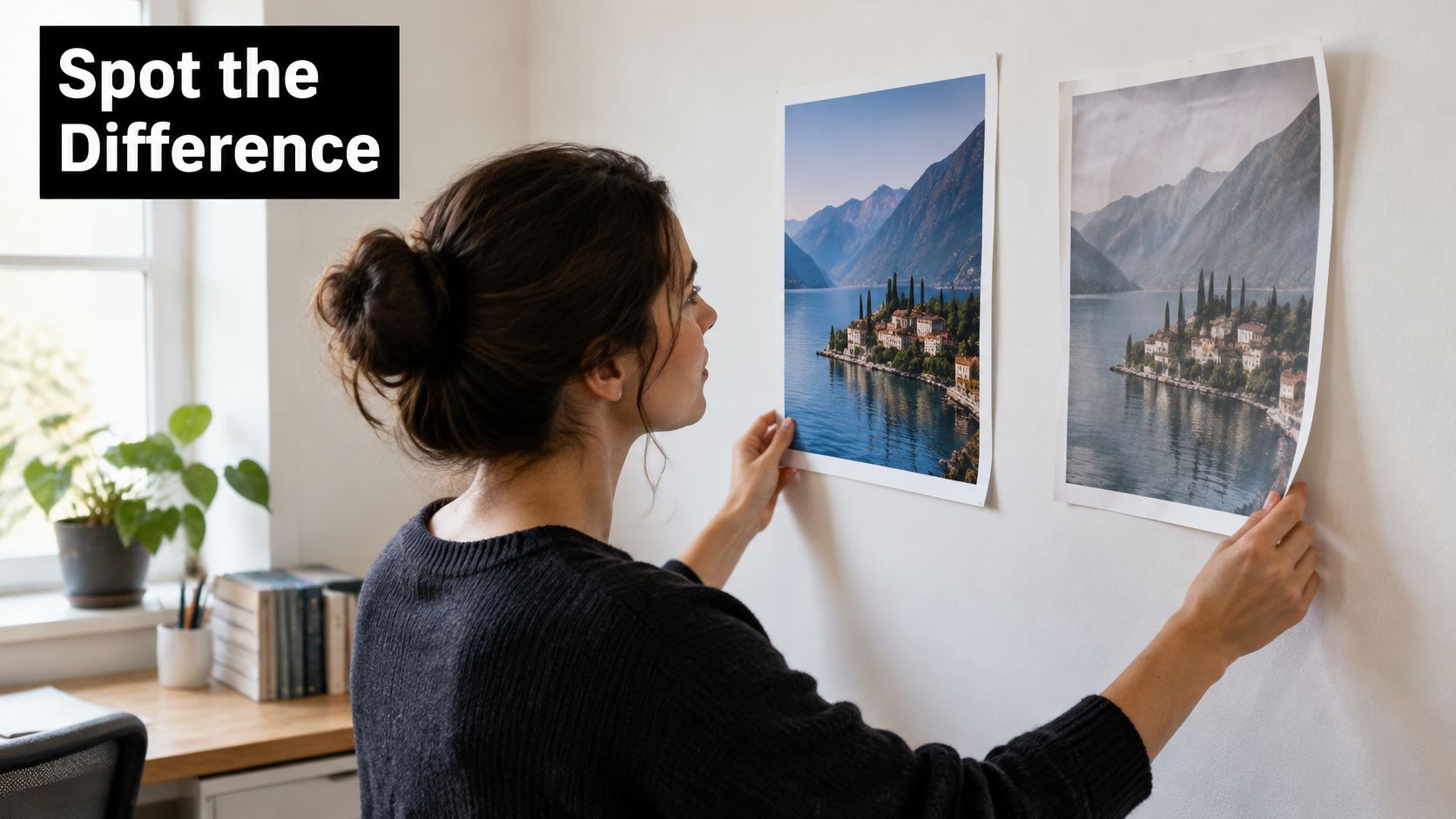
Paper weight is the first tell. Thin poster stock curls at the corners when humidity shifts, which is why unframed thin prints end up waving at you from the wall. I treat an unstated paper spec as a warning: if the seller will not tell you the weight, finish or ink type, you are being asked to fund the surprise. Matt finish earns its keep under ceiling lights, while gloss can look punchy online and turn into a mirror at 4pm.
Five checks before you add to basket
- Paper weight in gsm. Look for a stated weight in the listing or ask before ordering. Heavier art paper resists curling and survives the trip from tube to wall.
- Finish and ink information. Matt versus gloss changes glare, and the ink description tells you whether the reds are likely to survive a couple of summers near a bright window.
- Close-up photos. Compare the styled room shot with a detail crop. You want crisp edges on type and clean lines, not soft lettering that disappears once framed.
- Reviews mentioning colour and curl. Skip the ones about delivery speed. The useful comments say "the blue was darker than the photo" or "it stayed flat unframed".
- Made to order or warehoused. Striped Circle prints are made to order and handmade in the UK, which points to a fresher sheet rather than one that has sat rolled in a rack. Check production time if the print is for a birthday, because printing to order is not the same as shipping today.
If you want the deeper version of what separates a decent print from a disappointing one, our print quality guide goes through the spec in more detail.
Use the clip below as a quick visual pass over the same checks: tilt the sheet under light, watch for glare, and look for movement along the edges.
In hand, a good cheap print has even colour across the sheet, sharp small text, clean cut edges and no tide marks or warped corners. Hold it at an angle to the light. Banding, patchy blacks and a wave along one edge show up fast, and each is a reason to send it back rather than frame it and hope. The low-risk buy is the one with boring specs and consistent feedback, not the loudest thumbnail in the sale row.
Protecting Cheap Prints From Light and Damp
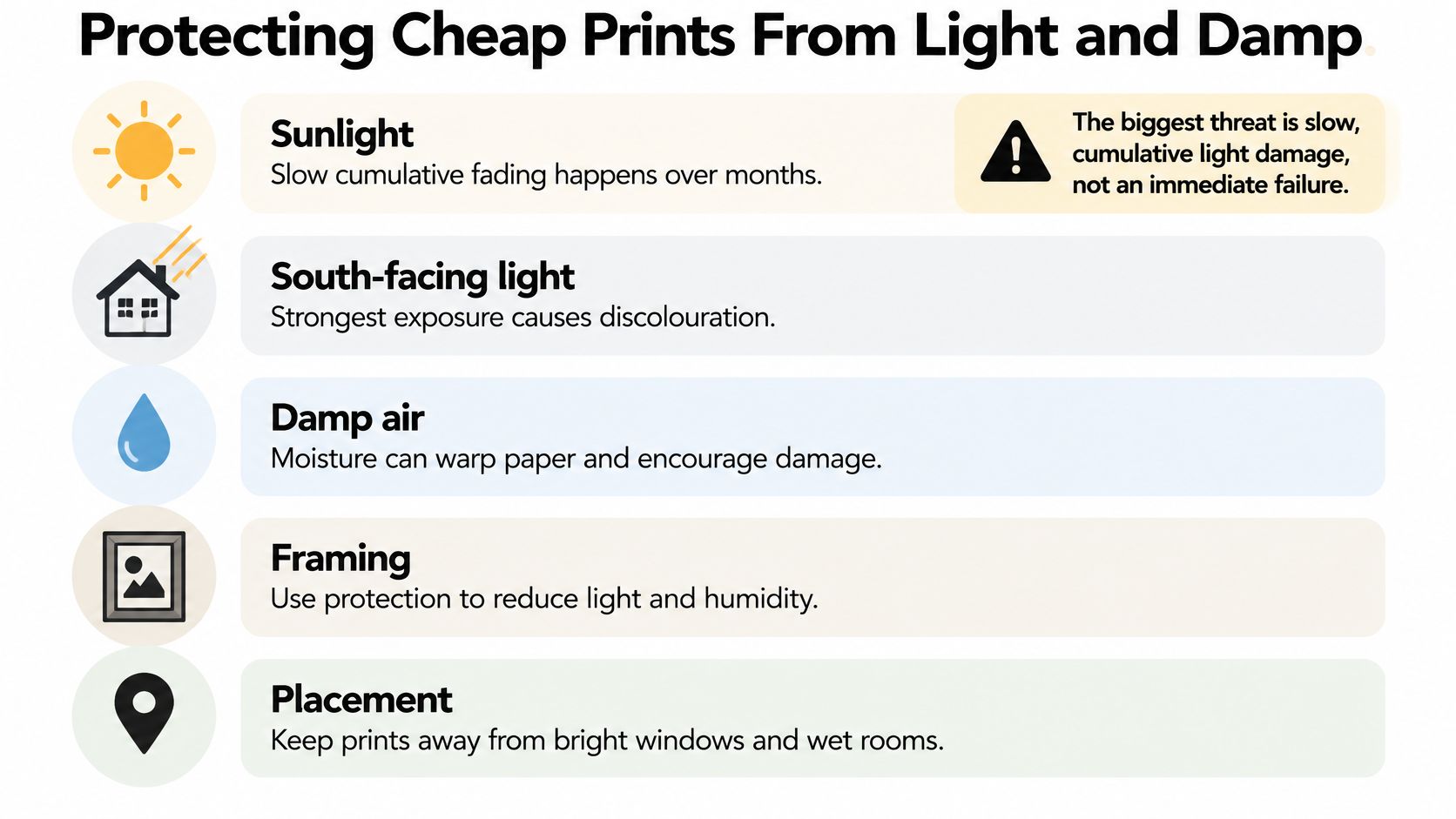
The thing that kills affordable prints isn't dramatic. It's slow, cumulative light damage, and it's irreversible. Nobody watches their favourite band print turn the colour of weak tea over eighteen months, because it happens a shade at a time.
The UK National Archives guidance on caring for prints recommends protecting framed prints from daylight, especially strong south-facing exposure, and using UV-protective glazing. It also advises conservation or museum-grade mount board, ideally solid-core 100% cotton board or purified wood-pulp conservation board, because these reduce the acidic and chemically unstable components that discolour paper from behind.
Where you hang it beats what you paid
A sunburnt print is the wall equivalent of a Monday hangover: entirely self-inflicted, and avoidable with about ten minutes of thought.
- Keep it out of direct sun. The wall opposite a south-facing window is the worst seat in the house. Pick the wall the light reaches indirectly.
- Use UV-filtering glass or acrylic. Standard glazing stops dust, not ultraviolet. Acrylic is lighter and safer for big frames and kids' rooms.
- Never let paper touch the glazing. A mount or a spacer creates the gap. Without it, condensation can bond the print to the glass, and separating them destroys the surface.
- Avoid damp bathrooms and radiator walls. Steam warps paper and heat cycles push moisture around inside the frame. A print above a radiator is living in a sauna.
- Rotate prints on bright walls. If one wall takes the afternoon sun, swap pieces seasonally so no single print absorbs all of it.
A cheap print installed properly will outlast an expensive one hung in a sunbeam. Placement is free, and it does more than any paper upgrade.
Renters, bathrooms and small hands
In a rented flat, use picture rail hooks if there's a rail, or removable adhesive strips rated for the frame's weight if there isn't. Weigh the frame first, follow the strip packet's weight rating rather than your optimism, and clean the wall with rubbing alcohol before sticking anything. Screws and rawlplugs are how you end up negotiating with a landlord about a deposit over a print that cost less than the filler.
For a child's bedroom, hang higher than you think and use acrylic rather than glass. Small hands grab at corners, and a lightweight frame at head height is a climbing invitation. If the room is steamy, put the print in the hallway instead and let the bathroom have a towel rail. Some walls just aren't art walls.
Copyright Checks for Lyric, Football and Band Prints
Cheap is not the same as low-risk. A lyric print costing the price of a pint can carry the same legal problem as one costing fifty times more, because permission does not get cheaper with a smaller invoice. Price matters, but so do total cost, print quality and whether the design has the rights to sit on your wall, especially if you plan to resell it.
The UK government's copyright notice on printed music sets out the basics: song lyrics can qualify as protected literary works, the music itself may be protected separately, and reproducing either generally requires permission or an appropriate licence. Under the same notice, copyright protection in the UK is automatic, with no registration step, and protection for original literary, musical and artistic works commonly lasts for the creator's lifetime plus 70 years. That is a long tail. A song that feels old can still be owned.
Four design types, four different conversations
Most music and football prints fall into one of these buckets, and each needs a different question.
| Design type | What it means | What to ask the seller |
|---|---|---|
| Licensed lyric artwork | Rights holder has granted permission | Can you show the licence for this design |
| Original alternative lyrics | Uses new wording rather than copied lyrics | Did the designer write every line |
| Public-domain material | Work whose copyright has expired | Can you confirm the work is out of copyright |
| Physical copy bought | You own the object, not reproduction rights | Can I reproduce, share or resell it |
That last row catches buyers out. Buying a print gives you a piece of paper for your wall. It does not hand you the right to scan it, print copies, sell them on a marketplace or stick the design on mugs. Ownership of the object and ownership of the rights are separate things.
The alternative-lyric route needs the same care as any lyric design. Striped Circle's Alternative Music prints are its best-selling range of prints, and that makes the rights question more useful, not less. Ask whether the wording is original, whether any verse or fragment has been copied, and whether the design uses a title alone. You get the recognition without assuming permission you cannot see.
Four questions are worth asking any seller before you buy:
- Permission. Do you have it, and for this specific design rather than a general claim about art being "inspired by" something?
- Lyrics or title. Is the design using full lyrics, a fragment, or just a song title? Titles and short phrases sit differently from reproduced verses.
- Badges and faces. Football crests are trademarks and player photographs carry their own rights, so a club-themed design can stack several permissions on top of each other.
- Onward use. Can you reproduce, share or resell it? If you are an independent retailer, this is the question that decides whether you are stocking a gift or a liability.
None of this is about being precious. It is about avoiding a print that gets pulled from a marketplace after you have hung it, or worse, after you have resold it. A cheap print only stays cheap when the rights are clear.
Save Money and Build Your Shortlist This Week
Britain has been doing affordable art properly for a long time, and the playbook has barely changed. In 1940 the Artists' International Association created the Everyman Prints series, and the V&A's record of the series puts it at 52 mass-produced offset lithographs intended "for every home", with coloured prints at 1 shilling and 6 pence and plain ones at 1 shilling. Exhibitions opened simultaneously in London, Bristol and Durham and toured smaller towns. Cheap art was a cultural-access strategy with a proper plan behind it, and that's still the right way to think about it.
The savings moves that actually work
Buy unframed and reuse a frame you already own. This is the single biggest lever: it removes the frame cost and moves you from £5.99 framed UK delivery onto the £2.99 unframed rate in the same decision. Charity shops and car boot sales are full of decent solid-wood frames in A4 and A3, and a fresh mount makes an old frame look intentional.
Use the multi-buy. Add four prints to the basket and the cheapest item is free, excluding framed prints and cards. For a hallway cluster or a stack of gifts alongside your own wall, that's a straightforward saving rather than a gimmick. Orders over £40 ship free, worth knowing before you place two separate orders a week apart.
Watch the sale lines. The "Sorry about the Mess" art print is at £8.49, and the "By the Riverside" Fulham Football Club print starts from £8.49. At that level you can afford to be picky about paper and framing instead of treating the whole thing as a gamble.
Swap one oversized poster for a smaller cluster. Three A4s in matching frames often look more considered than one A0 sheet taped at the corners, and they let you mix a band, a club and a joke without the wall shouting. If you're comparing sellers, our rundown of the best places to buy art covers what to look for beyond price.
Choose the set that ties a room together over the single cheapest thing that fills a gap.
Your shortlist for this week
Five steps, one evening, no impulse purchases.
- Set a total-cost budget. Write the number including frame, postage and fixings. That's your real ceiling.
- Pick three designs that suit the room and really make you smile. Football, music, a daft cultural reference, whatever earns the wall space. If you're stuck for a starting point, our music, football and humour ranges are built for exactly this kind of shortlist.
- Run the checks on each one. Paper weight, finish, made-to-order timing, and the copyright questions. Any design that can't answer the permission question comes off the list.
- Confirm size against the wall and the frame options. Measure first, then check whether your chosen size comes framed or needs sourcing separately. A5 and A0 are unframed only, so plan the frame hunt accordingly.
- Plan the glazing and mount if the print is going anywhere bright. Budget for UV-filtering glazing alongside the frame, so it doesn't turn into an afterthought six months later.
Then pick the one print for the room that needs it most. One print, chosen properly. The blank wall behind your desk, the hallway with nothing but a coat hook and a scuff mark, the office corner that looks like a dentist's waiting area. Sort that one properly, with the right size, a mount and a fixing that leaves the plaster where it is.
If you need several, use the multi-buy and do them together so the frames match and the postage consolidates. The saving only counts if the quality, the size and the display all hold up afterwards. A print that curls, fades or gets taken down is a false saving.
Your walls deserve better than a beige apology and a landlord dispute. Put up something that makes you grin on the way past, and makes your guests stop and read it twice.
We're a family-run studio making high-quality wall art out of music, football and gloriously silly culture, printed to order in the UK, with sizes from A5 to A0 and framed options that arrive ready to hang. If you're ready to swap the blank wall for something with actual personality, browse the alternative lyric, football and humour ranges at Striped Circle, run the total-cost check on your favourite, and get four in the basket so the cheapest one's on us.
