
A Guide to UK Poster Sizes and Finding the Perfect Frame
Right, let's cut to the chase. The most common UK poster sizes come from the standard 'A' series, and you'll find that A4, A3, A2, and A1 are the go-to choices for just about any piece of wall art. If you're staring at a dropdown menu feeling like you’ve stumbled into a maths lesson, don't worry – this guide is your ultimate cheat sheet.
Your Essential Guide to UK Poster Sizes
So, you've found a design that’s absolutely brilliant. Maybe it’s an alternative lyric print of that Oasis tune you belted out at a festival, or a tribute to your football club's finest hour. Now comes the slightly less glamorous part: deciding on a size.
Choosing between an A4 and an A2 can feel like a bigger commitment than picking a new favourite band, but it doesn't have to be a headache. This guide is your quick and easy reference, the 'get in, get sorted, get back to the good stuff' manual for poster sizing. We’ll break down exactly what those A-numbers mean for your wall, helping you choose the perfect print to make a real impact.
UK Poster Size Quick Reference Chart
To kick things off, we've put together a simple, no-nonsense reference chart. Think of it as your at-a-glance guide to poster dimensions.
This table gives you the lowdown on the most common UK poster sizes, showing their dimensions in both millimetres and inches. We’ve even added a handy "Perfect For" column to give you an idea of where each size truly shines, taking the guesswork out of the equation.
| A-Size | Dimensions (mm) | Dimensions (Inches) | Perfect For |
|---|---|---|---|
| A4 | 210 x 297 mm | 8.3 x 11.7 in | Desks, small spaces, and gallery walls. |
| A3 | 297 x 420 mm | 11.7 x 16.5 in | The versatile classic for any room. |
| A2 | 420 x 594 mm | 16.5 x 23.4 in | Making a statement above a sofa or bed. |
| A1 | 594 x 841 mm | 23.4 x 33.1 in | The undisputed king of the feature wall. |
No more getting the tape measure out three times. Just find the size you need in seconds and get one step closer to transforming that blank wall into something that’s uniquely you.
Decoding the A-Series Paper Sizes
Right, let's get into the main event: the A-series paper standard. It might sound a bit technical, like something you’d learn in a design class, but it’s actually a brilliantly simple system that brings order to the world of posters. The whole concept was designed to be perfectly logical, which is a rare treat.
The entire system starts with a single, massive sheet called A0. From there, it's just a game of folding and cutting. Slice an A0 sheet in half, and you get two A1 sheets. Do the same to an A1, and you get two A2s. This clever trick continues all the way down the scale, meaning every single size maintains the exact same aspect ratio. It’s genius, really.
This consistency is a big reason why physical prints are still so popular. In fact, the UK printing industry has remained surprisingly strong, with commercial printing—which includes all the glorious posters we love—accounting for a massive £9.3 billion. It just proves that having a tangible piece of art, whether it’s celebrating a last-minute goal from Cantona or your favourite Arctic Monkeys lyric, is something special. You can find more fascinating stats on the UK's love for print over at vcprint.co.uk.
The A-Team: Your Go-To Sizes
You can forget the entire range for a moment. When it comes to decorating your walls, you only really need to get familiar with the big four. These are the sizes we live and breathe here at Striped Circle, and each one has its own personality and perfect spot in your home.
-
A4 – The Understated Hero: This is your standard letter-sized paper (210 x 297 mm), but don’t write it off. When printed on high-quality art paper, an A4 print can look incredibly sharp and professional. It’s just right for propping on a desk, filling a small gap in a gallery wall, or adding a bit of character to a kitchen noticeboard.
-
A3 – The Versatile Classic: Measuring 297 x 420 mm, A3 is the Goldilocks of UK poster sizes—not too big, not too small. It’s large enough for the lyrics of your favourite song to be easily readable from across the room, but it won’t completely dominate your wall. There's a reason it's our most popular choice; it's the Paul Scholes of poster sizes, quietly brilliant.
This handy visual shows how the main poster sizes compare in a typical home setting.
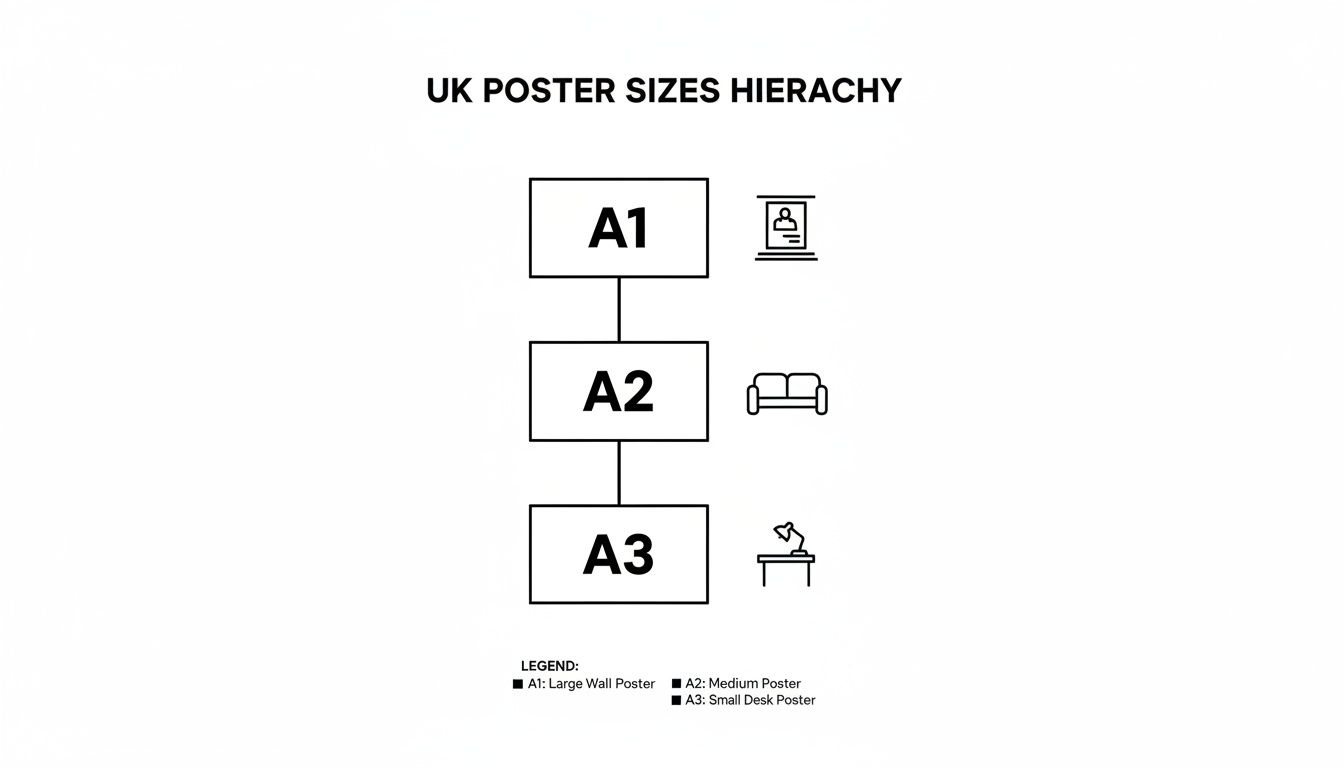
As you can see, the jump between each size makes a real difference to the visual impact in a room.
Making a Bigger Splash
Sometimes, you just need to go big. That's where the heavy hitters of the A-series come into play, ready to turn a blank wall into a proper focal point.
Choosing a larger print isn't just about filling a space; it's about making a statement. Think of it as the difference between whispering your love for a band and shouting it from the rooftops.
An A2 print (420 x 594 mm) is a genuine statement piece. It has enough presence to hang proudly on its own above a sofa, bed, or console table. A poster of this size gives the artwork room to breathe and instantly draws the eye.
Then you have the A1 (594 x 841 mm), the undisputed king of the feature wall. If you’ve got a large, empty space that’s crying out for some attention, an A1 print is your answer. It’s bold, it’s confident, and it turns any design into an immersive piece of art. It’s the headline act at Glastonbury.
Choosing the Right Size for Your Space
Alright, you've mastered the A-series, but knowing the dimensions is only half the battle. Now for the fun bit: deciding which of these UK poster sizes will actually look brilliant on your wall and not like you've stuck a postage stamp above a massive sofa. This is where art meets science—or, more accurately, where your impeccable taste meets a tape measure.
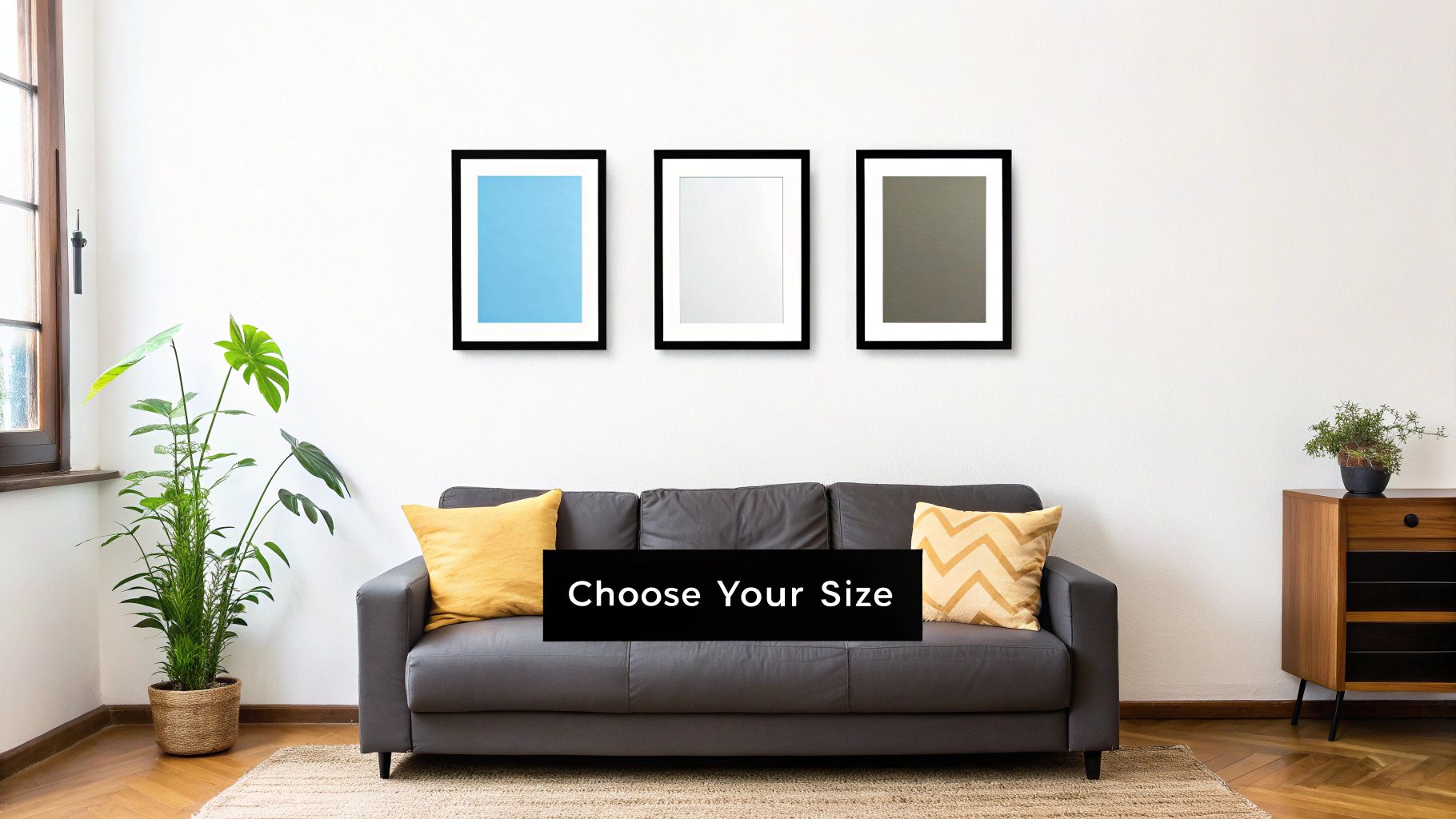
Choosing the right size is all about context. A print that looks epic in one spot might get completely lost in another. It’s like playing your favourite chilled-out indie band at a thrash metal festival—it just doesn't fit. You need to consider the room, the wall, and the overall vibe you're aiming for.
Matching the Poster to the Place
Let’s break it down by location. Not every room needs a colossal A1 print of your team’s crest dominating the space (though the thought is tempting). Sometimes, a bit of subtlety is key.
-
The Small Nook Champion (A4/A3): Got a tight corner, a small patch of wall in the kitchen, or a home office that needs a bit of inspiration? An A4 or A3 print is your best mate. They’re big enough to add personality without overwhelming the space. Think of an A4 lyric print propped on your desk for a bit of mid-afternoon motivation.
-
The Gallery Wall Guru (Mix & Match): That prime real estate above the sofa is perfect for a gallery wall. The secret here is variety. Mix a commanding A2 with a couple of A3s and maybe a quirky A4 to create a balanced, dynamic display that tells a story. Don't be afraid to play with layouts on the floor before you start hammering in nails!
-
The Feature Wall Headliner (A1/A2): For that big, empty wall that’s just begging for attention, you need to go large. An A1 or A2 print acts as the room’s focal point. This is where you put your all-time favourite album art or that stunning football moment. It's a single, powerful statement that says, "this is my turf."
Getting the Visuals Just Right
Beyond the room itself, think about how you'll be looking at the artwork. A poster crammed with intricate details or tiny text needs to be placed where people can get close enough to appreciate it. On the other hand, a bold, graphic design can be admired from clear across the room.
It’s also important to consider the "breathing room" around the print. As a general rule of thumb, leaving a decent amount of blank wall space around your poster helps it stand out rather than feel cramped. This negative space is crucial for making the artwork pop. When planning the visual elements of a specific area, like a home gym, understanding how different sizes impact the overall aesthetic is key; you can find some excellent home gym wall decor ideas that really master this concept.
Remember, a poster shouldn't just fit on a wall; it should own it. Take a moment to stand back and visualise how the size will interact with your furniture and the room's proportions before you commit.
Ultimately, picking the perfect size is the final step before the magic happens. Once you've got your print, the next adventure is framing it correctly. If you're wondering how to get that part spot on, you'll probably find our guide on what size poster frame you need really helpful.
Why Print Quality and Pixels Matter
Right, let's get into the nitty-gritty of what makes a poster look truly spectacular. Ever wondered how a digital image from a screen becomes a stunning, sharp print that brings a wall to life? It’s not magic, it’s all about pixels and a crucial little acronym: DPI, or Dots Per Inch.
Think of your digital image as a mosaic made up of countless tiny coloured squares. These are your pixels. DPI simply refers to how many of these pixels are printed within a single inch of paper. The more dots you can pack in, the clearer, sharper, and more detailed your final poster will be. A print with low DPI? It’s a bit like watching football on a dodgy stream—blurry, blocky, and ultimately, a real letdown.
Pixels: The Building Blocks of a Great Print
For a crisp, professional finish that does justice to the artwork, the industry gold standard is 300 DPI. This high resolution ensures that every line is clean, every colour pops, and every detail is perfectly defined. Anything less than this, and you’re venturing into fuzzy territory, which is something no piece of art deserves.
Here at Striped Circle, we are meticulous about quality. That's why we insist on using high-resolution files for every single print. This commitment guarantees that whether you're ordering a compact A4 or a statement A1 poster, the quality is consistently superb. Your walls deserve better than a pixelated mess! To truly make your posters stand out, understanding the best photo resolution for printing is key for achieving those sharp, vibrant results.
To give you a clearer picture, we've put together a handy table. It shows the minimum pixel dimensions required to achieve a top-notch 300 DPI print for our most popular UK poster sizes.
Pixel Dimensions for High-Quality Printing (300 DPI)
This reference table breaks down what’s happening behind the scenes when we prepare your print. It’s also a great illustration of why that tiny club badge you saved from social media just won't work when you want to create a beautiful, large-format piece of wall art.
| A-Size | Dimensions (mm) | Required Pixels (300 DPI) |
|---|---|---|
| A4 | 210 x 297 mm | 2480 x 3508 pixels |
| A3 | 297 x 420 mm | 3508 x 4961 pixels |
| A2 | 420 x 594 mm | 4961 x 7016 pixels |
| A1 | 594 x 841 mm | 7016 x 9933 pixels |
As you can see, the bigger the print, the more pixels you need to maintain that flawless quality.
The bottom line is simple: great art starts with a great file. We take care of all the technical details so you don't have to, ensuring every print that leaves our studio is something we would be proud to hang on our own walls.
You can rest easy knowing that every design we offer is optimised for the best possible outcome. If you’d like to know more about our commitment, you can read all about our impeccable print quality and the care we put into every order. Now you know the science behind the art, you can be confident your new print will be a proper head-turner.
A Guide to Framing Your New Poster
So, you’ve done the hard part. You've picked out a print that perfectly captures that feeling of seeing your favourite band live or that glorious 90th-minute winner. But leaving a brilliant poster unframed is like owning a classic vinyl record and never playing it—it just doesn't feel right. Framing is that final, essential step that transforms a piece of paper into proper wall art.
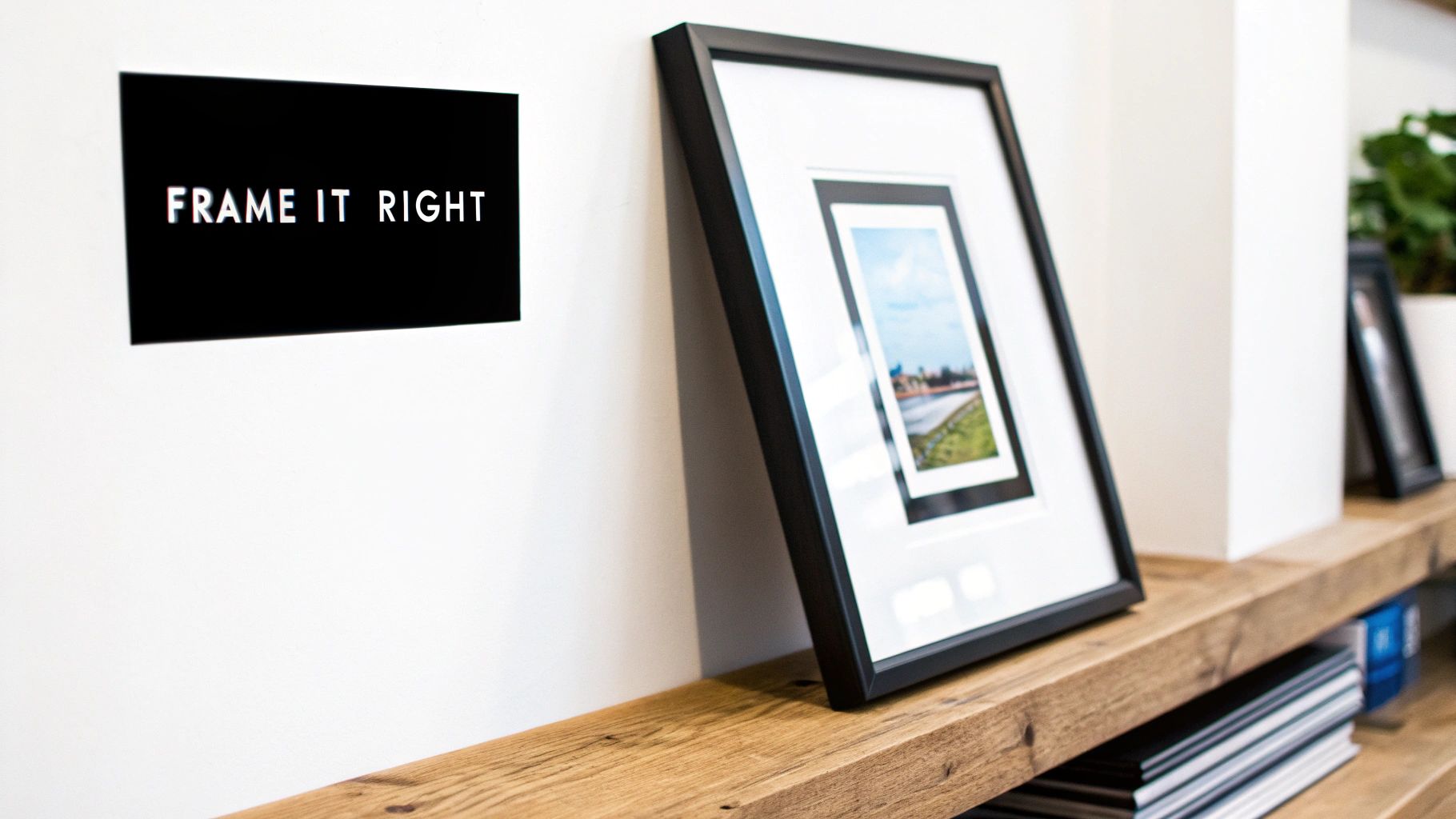
Honestly, it’s the difference between a student digs vibe and a home that looks effortlessly put together. A good frame protects your print from dust, damage, and the dreaded curl of the corners, keeping it looking sharp for years. Think of it as a bouncer for your artwork.
To Mount or Not to Mount
This is probably the biggest question in the framing game. You’ve got two main routes to take when showing off your new print, and both have their place.
-
Going Edge-to-Edge: The most direct approach is to buy a frame that matches your poster’s exact size. Got an A3 print? Pop it straight into an A3 frame. It’s a clean, no-fuss look that lets the artwork itself do all the talking. This method is brilliant for bold, graphic designs that really fill the space.
-
The Power of the Mount: For a more professional, gallery-style finish, a mount is your best friend. A mount (or mat) is simply that thick card border sitting between the print and the frame, creating a bit of breathing room. It naturally draws the eye inward and makes the artwork feel more significant. For example, you could place an A3 print inside a larger A2 frame with a custom-cut mount for instant sophistication.
A mount can elevate even the simplest print, giving it a premium feel that looks fantastic in any setting. It’s a small detail that makes a massive impact.
Choosing Your Frame Style
The frame itself is far more than just a border; it’s a key part of the overall look. The style you choose should complement both the poster and the room you're putting it in.
You can never really go wrong with a classic, minimalist black or white frame. They're the versatile rock stars of the framing world, working with pretty much any decor or piece of art. If you're after something a bit warmer, natural wood frames like oak or pine add a touch of organic texture that’s perfect for prints with earthy tones or a more rustic feel.
The growing demand for custom prints, celebrating everything from iconic bands to football clubs, is a huge part of the UK’s creative scene. In fact, the custom printing market is expected to nearly double to USD 4,243.6 million by 2030. While screen printing has long been the standard for durable, high-quality wall art, the rise of digital printing allows for incredible personalisation—which is perfect for the unique lyric and club prints we specialise in. You can dive deeper into this booming market in this detailed report on the UK commercial printing market.
Ultimately, the goal is to make your new print look like it belongs. By taking a little time to choose the right frame, you’re giving your art the respect it deserves and creating a focal point that will make you smile every time you see it. For more in-depth advice, check out our guide on how to frame posters like a pro.
Our Promise on Quality and Size
Right then, let's talk about how we do things here at Striped Circle. We’re not some faceless corporation churning out prints; we're a family-run outfit obsessed with music, football, and getting top-notch art onto your walls. Our mission is simple: to create designs that make you smile, and that all starts with an unwavering commitment to quality.
Every single one of our designs, whether it’s an alternative lyric print or a tribute to a glorious ninety-third-minute winner, is printed on heavyweight, 200gsm+ satin art paper. This isn't your flimsy, run-of-the-mill poster paper. It’s got a premium feel, a subtle sheen that makes the colours pop, and the durability to outlast your average manager’s career.
Getting It Right Every Time
We stick to the classic UK poster sizes because they’re tried, tested, and dead easy to find a frame for. You’ll find our prints available in A4, A3, A2, and A1, giving you options for everything from a subtle desk accessory to a massive feature wall headliner. There’s no guesswork involved—what you order is precisely what you get.
The UK's commercial printing sector, which is the engine room for all the brilliant posters celebrating our favourite bands and football clubs, is a massive industry. It's projected to hit over USD 21 billion by 2032, driven by the demand for unique, personalised art that brings character to our homes. Digital printing is at the heart of this, allowing for the kind of custom, short-run prints that we specialise in. You can read more about these UK photo printing market trends and see just how much everyone loves a quality print.
We believe a great print deserves a great journey. That’s why we take as much care in our packaging as we do in our printing, ensuring your order arrives in pristine condition.
Finally, we pack every single order with the care it deserves. Smaller A4 and A3 prints are sent out flat in sturdy, board-backed envelopes. The larger A2 and A1 prints are carefully rolled and shipped in super-tough poster tubes. As a small business, getting it right for you is personal. We want you to be absolutely chuffed when your print arrives, ready to take its rightful place on your wall.
Your Poster Size Questions Answered
We get it. Trying to navigate the world of UK poster sizes can feel a bit like trying to solve a puzzle. All those numbers and codes can be confusing when you just want to find a great piece of art for your wall.
So, let's clear things up. Here are some quick answers to the questions we hear most often. Think of this as your go-to guide for those last few details, from figuring out the most common sizes to making an odd-sized frame work.
What Is the Most Popular Poster Size in the UK?
Without a doubt, the A3 size reigns supreme. It’s the Goldilocks of the poster world – not too big, not too small, but just right. It has enough presence to make a real impact and showcase the details of a design, yet it won’t dominate your entire space.
It's the perfect starting point for a gallery wall, a great way to liven up a home office, or a stylish addition to a hallway. This versatility is exactly why we offer so many of our prints in this fan-favourite A3 size.
Can I Use an A3 Print in a 30x40cm Frame?
Yes, definitely! It’s a common question, and the good news is that it works brilliantly. An A3 print measures 29.7 x 42 cm, and 30x40cm is a standard frame size you'll find on the high street. The secret to making them work together perfectly is using a mount.
A mount, which is the cardboard border that sits inside the frame, bridges the gap. The window of the mount will be cut to display your A3 print, while the outer edge fits snugly inside the frame. This not only solves the size difference but also gives your poster a professional, gallery-quality finish.
Does Paper Thickness Matter for Posters?
It matters a great deal. Paper thickness, measured in GSM (Grams per Square Metre), has a massive impact on the look and feel of a print. Thin, flimsy paper is prone to wrinkling, won’t hang straight, and can make colours look flat.
That's why we print on high-quality, heavyweight art paper, typically 200gsm or more. This gives every piece a substantial, premium feel, ensures the colours pop with richness and depth, and makes the print durable enough to last for years. It’s what separates a piece of art from a throwaway flyer.
Ready to transform your walls? Explore the full collection of music and football-inspired prints at Striped Circle and find the perfect piece that makes you smile. Check out our latest designs at https://www.stripedcircle.com.
