
Back to the Future Clock: A Guide for UK Fans
You're standing in the sitting room with a blank wall, a perfectly decent clock on the shelf and the nagging feeling that the room needs more flux capacitor energy. A standard timepiece tells you when dinner is late. A Back to the Future clock tells visitors that you've got excellent taste in films and possibly a strong opinion about DeLoreans.
The choice isn't only whether you like the Hill Valley courthouse clock. It's which version belongs in your home. A working wall clock suits the practical fan, a detailed print rewards the film obsessive, and a watch makes more sense for someone who wants the reference on their wrist rather than above the sofa. The best choice depends on your space, your budget and whether your fandom is a gentle nod or a full "where we're going, we don't need roads" declaration.
Table of Contents
- Why the Back to the Future Clock Still Stops People in Their Tracks
- How the Film's Clock System Actually Works
- What Counts as a Back to the Future Clock Today
- Wall Clocks, Art Prints, Posters and Watches Compared
- Decorating Ideas Using Clock-Themed Wall Art
- Gifting the Right Format for Every Type of Fan
- How Striped Circle Prints Bring It All to Your Wall
- Common Questions Before You Buy
Why the Back to the Future Clock Still Stops People in Their Tracks
At 10:04 p.m. on 12 November 1955, Marty McFly waits for the lightning strike that will send the DeLorean back to 1985. The Hill Valley clock tower stands above the square, the storm gathers, and one exact minute becomes the hinge on which the entire story turns. The lightning supplies the 1.21 gigawatts Doc Brown needs, while Marty has to reach 88 mph at precisely the right moment. The plot doesn't merely feature a clock. It makes the clock responsible for everything.
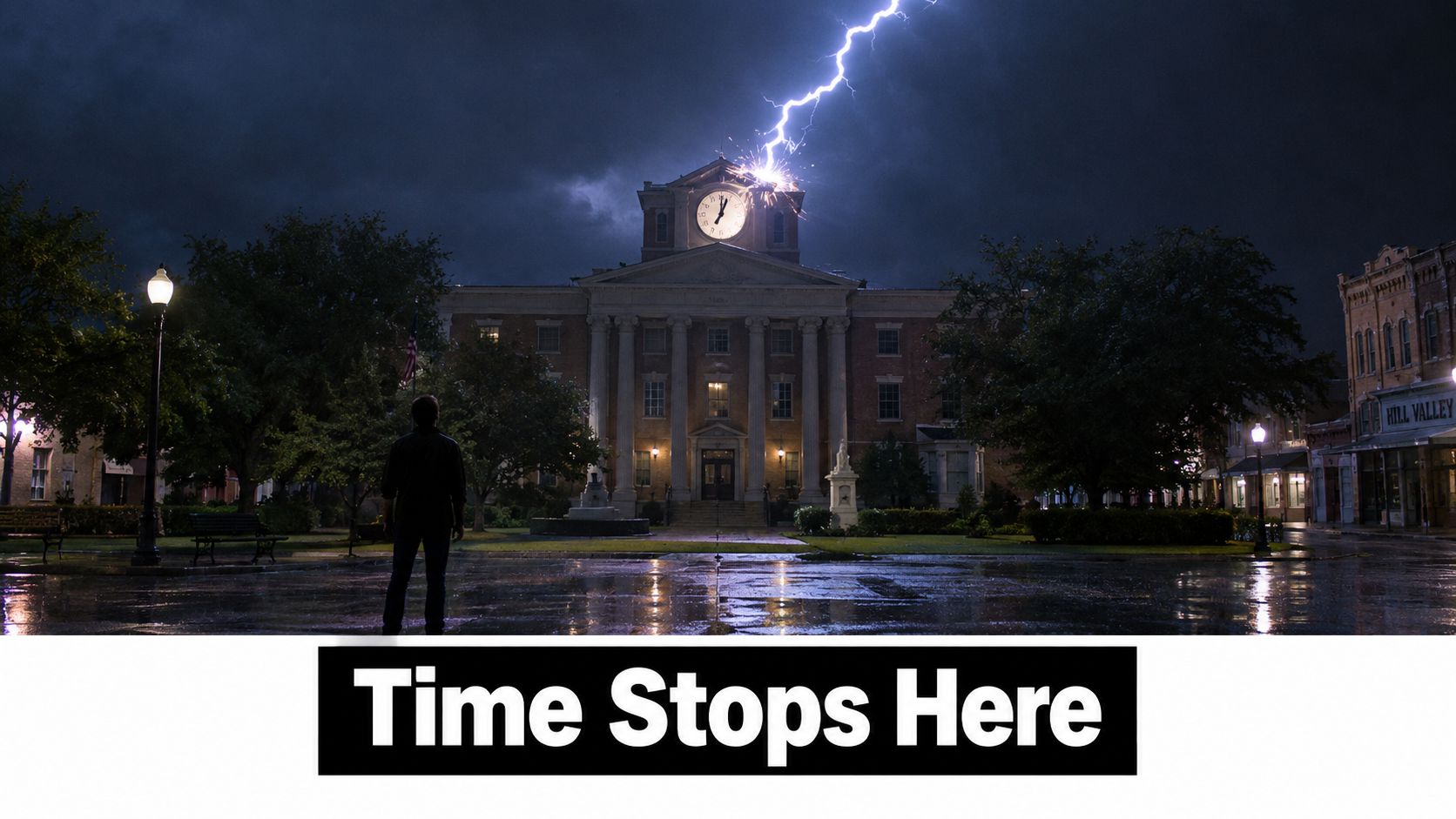
That's why 10:04 carries more emotional weight than an ordinary number on a dial. It recalls the chase, the cable, the storm and Marty's frantic attempt to get home. The damaged clock face remains visible in the altered 1985 timeline, so the tower becomes a permanent visual reminder that one decision can rattle through decades. The story's cause and effect is hanging above the square in plain sight. (Express entertainment coverage discusses the timestamp, the lightning event and the film's time-travel mechanics.)
That image also carries the warm, slightly daft charm of mid-century Americana. The courthouse, the town square and the glowing clock face suggest a simpler version of the past, even while Marty is sprinting through it with the urgency of someone who has just remembered he left the oven on. For cinema lovers, the tower is a shortcut to the whole trilogy, from the first film's 1985 setting to the sequels' increasingly ambitious detours.
The useful test: if you recognise the tower before you recognise the room around it, the design is doing its job.
In a British living room, home office or music room, a Back to the Future clock can work as more than merchandise. It becomes a conversation starter, a nostalgia marker and a small piece of cinema history. The question is whether you want that history to tick, hang as art or travel with you. That choice starts with understanding what the film's clocks are doing.
How the Film's Clock System Actually Works
The film's clock logic is easier to follow if you treat it as a sequence of linked deadlines rather than a single magical bolt.
First, Doc creates a visual time reference
The opening garage sequence establishes Doc Brown's obsession with time before Marty even reaches the DeLorean. His clocks are set 25 minutes behind, creating a deliberate visual motif and hinting that ordinary timekeeping in Doc's world is never entirely ordinary. The detail makes the later tower sequence feel prepared rather than random. (Mental Floss's film commentary covers the clocks in Doc's garage and the time-related details viewers can spot.)
Doc's experiments, his clocks and his calculations all point towards the same idea. Time travel needs a reference point that people can read quickly. The courthouse clock provides that public marker, while the garage clocks show the private, slightly chaotic version of Doc's system.
Then, the tower supplies the power
The plan depends on the lightning strike arriving at 10:04 p.m. on 12 November 1955. Doc must arrange the cable, reconnect the power path and guide the electrical surge towards the DeLorean. At the same instant, Marty must accelerate to 88 mph. If the cable is late, the car is slow or the lightning misses, the experiment fails.
The scene works because several independent actions have to meet at one point. Film analysis of the sequence describes that layered timing chain, with the lightning, cable connection and DeLorean acceleration all operating as separate deadlines. (Casio's Back to the Future collaboration page presents the sequence as a tightly coordinated timing mechanism.)
Finally, Marty returns to the correct year
The lightning is treated as the energy source for the time jump, delivering 1.21 gigawatts through the tower and into the car. The tower isn't just a dramatic background. Its height and exposed structure make it the film's high-voltage capture point, while the stopped clock records the overload after the strike. (Technical film analysis of Doc Brown and the clock tower explains the tower's role in the electrical transfer.)
The other details reinforce the same visual language. The plutonium-powered DeLorean begins the experiment, the Twin Pines location becomes Lone Pine after Marty changes the past, and the photograph shows history changing in a way the audience can understand instantly. Every device turns an abstract time-travel idea into something visible.
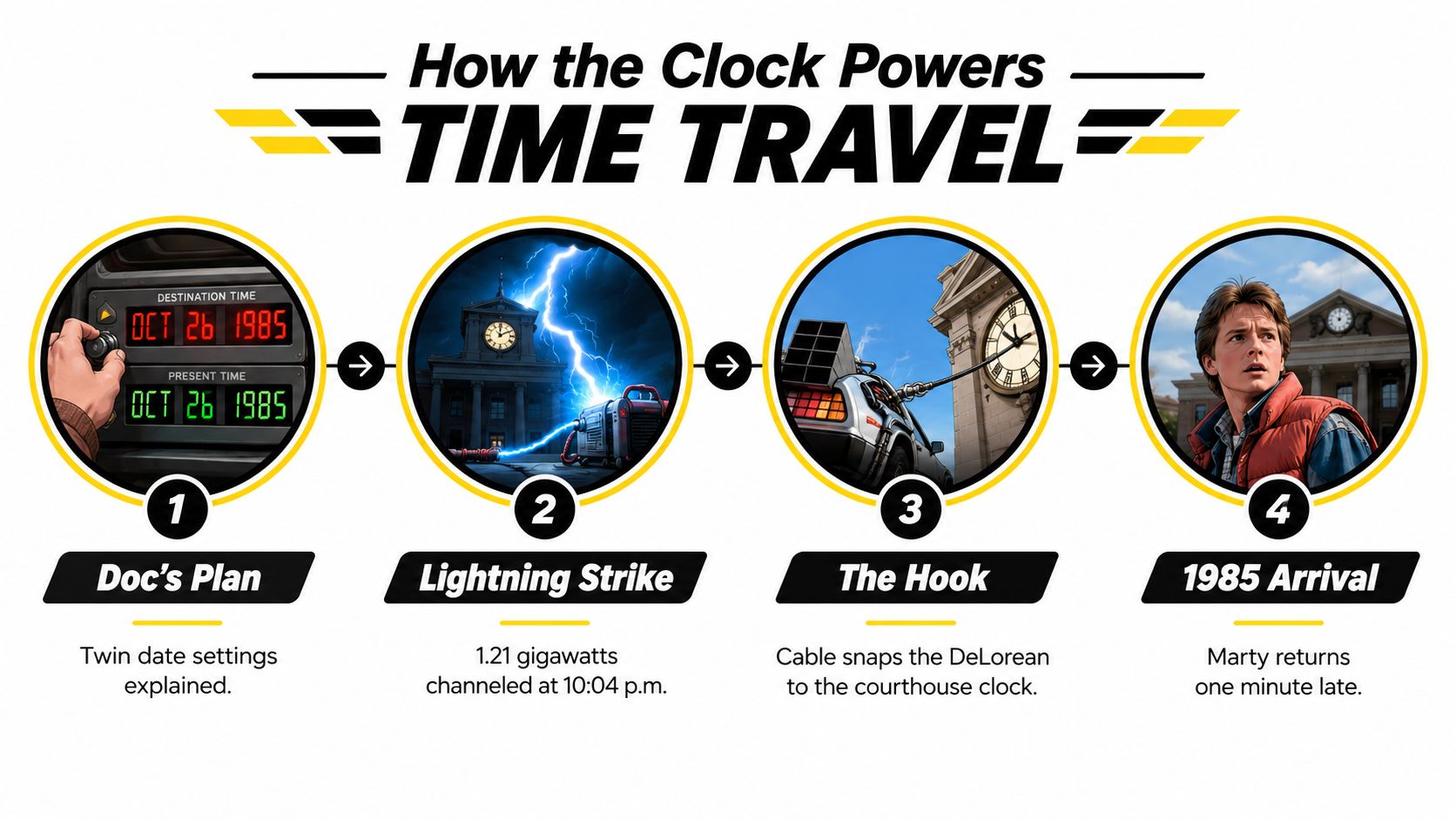
The famous clock face works on a wall for the same reason it works in the film. It compresses a complicated chain of events into one memorable image: 10:04, lightning, DeLorean, home.
What Counts as a Back to the Future Clock Today
A Back to the Future clock doesn't have to be a literal courthouse replica. The search can lead to several different objects, and they serve very different buyers.
A functional wall clock uses the film's visual language while doing a real job. It might feature the Hill Valley tower, a lightning motif or the famous time reference. This is the natural choice for a kitchen, hallway or office where you want the artwork to earn its wall space by keeping time.
An art print behaves differently. It may show the tower frozen at 10:04, frame the lightning strike as a cinematic scene or reduce the reference to typography and numbers. It doesn't need hands or a battery because its job is atmosphere. A good print can feel more like a film still, while a clock feels more like a prop that has escaped from Doc's workshop.
Then there are prop replicas, watches and wearable accessories. A replica suits a collector who wants physical detail. A licensed watch offers a subtler reference, particularly for someone who enjoys the design but doesn't want a courthouse tower dominating the bedroom. In the UK, a Casio collaboration was promoted at £115 for limited availability around Back to the Future Day in October 2025, which shows how licensed timepieces can occupy a more collectible space than everyday decor. (Esquire UK's watch coverage gives that price and promotional context.)
Official or fan-made
Licensed merchandise is produced with permission from the relevant rights holders. Fan-made artwork may take a more interpretive route, using silhouettes, typography, colour and visual jokes rather than reproducing a specific product design. Neither category automatically guarantees good taste. A licensed item can still be too loud for your room, while an independent print can capture the spirit with much more restraint.
The useful questions are practical:
- Does it tell the time, or only depict one?
- Do you want a recognisable film reference or a design that rewards closer inspection?
- Is it for a collector, a casual fan or someone who just likes retro wall art?
- Will the artwork still suit the room when the novelty has worn off?
For broader alternative film and television artwork, browse alternative TV and film wall art and compare the tone of a clock-led design with less literal cinema references. The right Back to the Future clock is the one that fits the person and the wall, not merely the one with the most logos.
Wall Clocks, Art Prints, Posters and Watches Compared
Think of the four formats as four levels of commitment. A wall clock announces the reference every day. A framed print turns it into interior decoration. A poster keeps the cost and commitment lighter. A watch puts the fandom in your personal orbit.
A wall clock is the most practical option. Choose a design with a clear face and readable hands if it's going in a kitchen, hallway or shared office. A quartz movement keeps the mechanism familiar and easy to maintain, while a silent-sweep movement is preferable in a sitting room where a constant tick would eventually become the villain of the piece.
A framed giclée print gives the lightning, architecture and colour more room to breathe. It suits a living room or study where the image should feel like artwork rather than branded merchandise. Poster formats are more flexible for rented rooms, student spaces and office corners, especially when you want to change the display without committing to a heavy frame.
A licensed wristwatch sends a different signal. It says collector first, decorator second. The Casio collaboration mentioned earlier occupied that premium, limited-edition space, while UK listings also show clock-themed prints at around £19.99 to £21.99. (UK-facing clock-tower merchandise coverage records those print prices alongside the continuing reuse of the Hill Valley symbol.)
| Format | Typical UK Price | Common Size | Fandom Signal | Best For |
|---|---|---|---|---|
| Wall clock | Mid-range decor purchase | Compact to medium wall piece | Clear and immediate | Kitchens, hallways and practical fans |
| Framed art print | Mid to premium | Medium or large framed artwork | Stylish and film-focused | Living rooms and offices |
| Poster | Around the accessible gift price point | A3 or A2 style display | Playful and flexible | Students, desks and casual fans |
| Licensed watch | Premium collectible | Wrist-worn | Quiet but highly specific | Collectors and serious enthusiasts |
Room rule: choose the format that matches how often you want to explain the reference.
If you're exploring the visual history of quad format poster collecting, this guide to posters from the 1980s offers useful context for why large cinema artwork still feels so satisfying on a wall. For most UK homes, a print is the easiest compromise. It delivers the tower, the storm and the nostalgia without asking the room to become a themed attraction.
Decorating Ideas Using Clock-Themed Wall Art
The man cave is the obvious first stop, but it isn't the only room that can handle a Back to the Future clock.
The man cave
A large framed print of the Hill Valley tower works above a sofa, especially when the room already contains reclaimed wood, warm bulbs and a few well-loved records. Let the print provide the cinematic centre, then keep the surrounding objects quieter. A DeLorean model, an old radio or a subtle music reference can support the story without turning the wall into a convention stand.
If the room also celebrates rock music, a playful Wyld Stallyns reference can sit nearby. Something like a band man decal for vehicles belongs on a suitable surface rather than beside the framed artwork, but it can extend the joke into a garage or games room.
The home office
An office needs a lighter touch. A smaller clock print near the desk gives clients and colleagues a reason to smile without making the video-call background look like Doc Brown's storage unit. Choose a clean design with strong spacing, then keep the desk itself clear.
For help balancing the artwork around shelves, screens and furniture, this practical guide to arranging wall art is more useful than just buying the largest print available. The aim is a deliberate focal point, not a wall that appears to have lost a bet.
The kitchen diner
A panoramic poster of the courthouse square can work above a breakfast bench. The long shape echoes the town-square setting and gives the eye somewhere to travel while the kettle performs its daily impression of a time machine. Use a frame or rail that can cope with the room's activity, and avoid placing paper artwork where steam and splashes will reach it.
The teen bedroom
A working quartz wall clock paired with a lightning-strike print creates a small display with two jobs. One object tells the time, the other tells the story. Keep the colours consistent so the arrangement feels intentional, then leave enough empty wall around it for the design to breathe.
The clever part is that each room gets a different interpretation. The man cave can be cinematic, the office can be restrained, the kitchen can be playful and the bedroom can lean into the gadgets. Hill Valley doesn't need to look identical in every home.
Gifting the Right Format for Every Type of Fan
Buying for a Back to the Future fan is easier once you stop treating every fan as the same person. The casual viewer, the collector and the parent who watched the film on repeat may all enjoy the clock reference, but they won't want the same object.
The casual fan
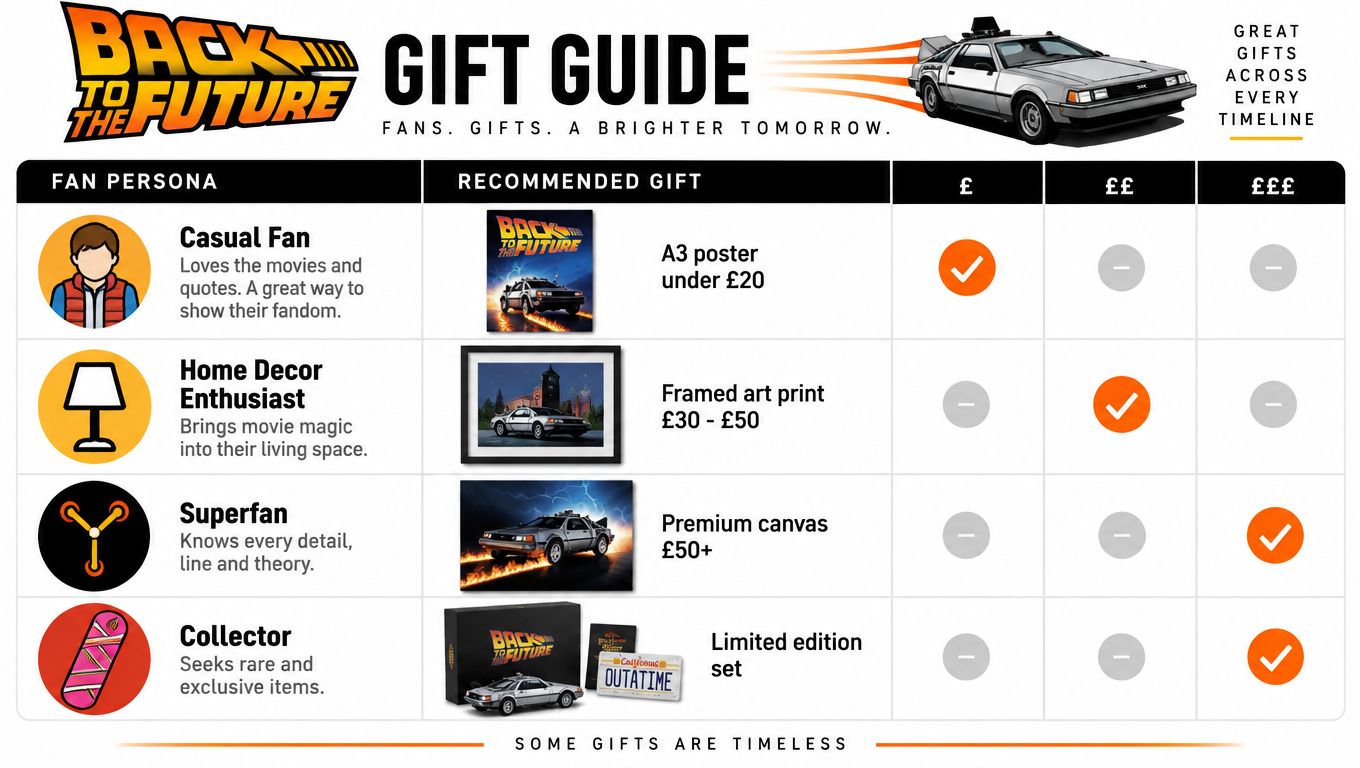
Choose an accessible A3-style poster or small print for someone who likes the film but doesn't catalogue every prop. UK listings place some clock-themed prints around £19.99 to £21.99, making this format suitable for a light-hearted birthday present or a stocking-sized surprise without the commitment of a large framed piece. (The UK clock-tower merchandise reference provides those listed prices.)
The home decor enthusiast
A framed art print is the safer choice for someone who cares about colour, composition and how a present will sit in the room. Pick a design where the tower or lightning forms the focal point, then check whether the recipient already has frames in black, natural wood or metallic finishes. Matching the existing room matters more than buying the loudest available image.
The collector
A licensed wristwatch is aimed at the fan who enjoys rarity, packaging and design history. The limited Casio collaboration promoted in the UK at £115 demonstrates the premium that can attach to an officially licensed, limited-availability timepiece. (Esquire UK's report on the Casio collaboration gives the stated price and context.)
The nostalgic parent
A working wall clock is both useful and affectionate. It can recall the film without requiring a display cabinet, and the recipient can enjoy it every day rather than only when guests ask about it. Add a handwritten note about Doc's clocks being set 25 minutes behind, and the gift suddenly feels chosen rather than grabbed from a search result.
Timing helps too. Back to the Future Day on 21 October is an obvious moment for a themed present, while the UK's clock changes on the last Sunday in March and the last Sunday in October create natural opportunities for practical timekeeping gifts. Check frame requirements before ordering, allow breathing room for Christmas delivery and browse broader fan gift options if you're building a larger pop-culture bundle.
Personal touch: pair the artwork with a note that says, “This one runs 25 minutes behind, but it still knows where it's going.”
How Striped Circle Prints Bring It All to Your Wall
A good clock-themed print doesn't need to reproduce the courthouse tower exactly. It can borrow the visual ingredients that make the reference work, including bold numerals, retro geometry, mid-century architecture, lightning shapes and typography that feels pulled from a film prop.
For a Back to the Future-inspired wall, look across four useful design families:
- Retro clock prints make the time reference the hero, with a face or numeral treatment that immediately recalls Hill Valley.
- Movie-inspired line drawings keep the DeLorean, tower or storm recognisable without filling every inch with colour.
- Mid-century architecture artwork captures the courthouse square and Americana mood for a room that needs something more subtle.
- Typography poster prints use phrases, times and visual rhythm to signal the film to people who know it.
Quality matters most when a print relies on atmosphere. Look for archival paper, pigment-based inks and accurate colour reproduction, particularly if the artwork uses the warm glow of street lighting against a dark storm. A basic poster can be perfectly good for a temporary display, while a premium print should feel considered at close range as well as from across the room.
Choose the wall before the artwork
A standard size can sit above a desk or narrow shelf without overwhelming the furniture. A larger print suits the space above a sofa, while a panoramic format can fill a long breakfast bench or hallway. The decision should follow the wall's proportions, not the excitement of finding a particularly dramatic lightning bolt.
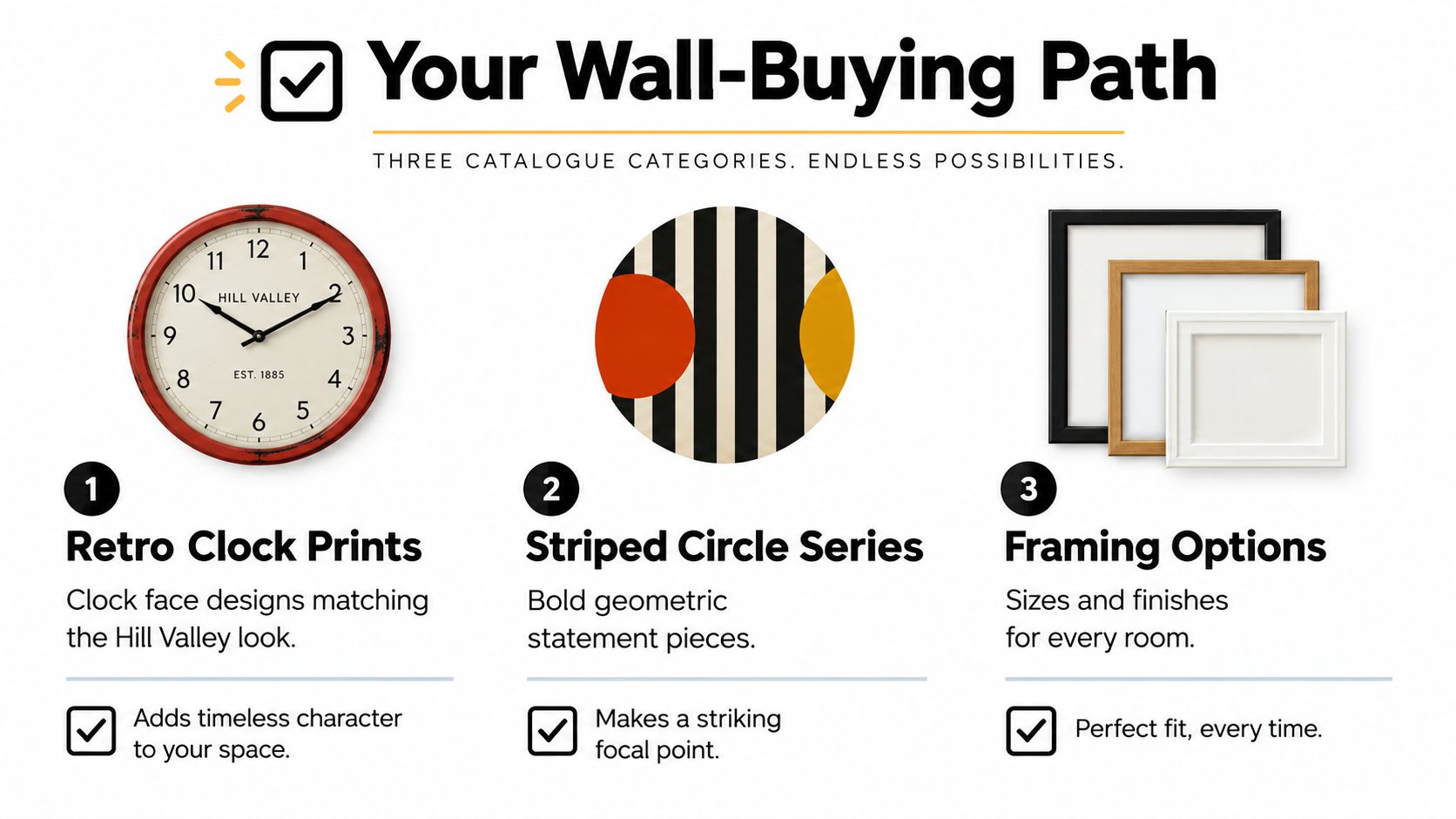
A tower print can act as the hero piece, flanked by smaller designs inspired by time circuits or the flux capacitor. That arrangement gives the eye a main event and a couple of quieter jokes. It also lets a fan build the display gradually instead of buying every reference at once.
The strongest wall art borrows the mood without demanding a themed room. That's why a carefully chosen print can work beside football art, music posters or a simple desk setup. The clock becomes a wink, not a takeover.
Common Questions Before You Buy
Is licensed merchandise worth paying more for?
It can be, if authenticity, packaging and collectability matter to you. A licensed watch or replica gives a collector a clearer connection to the franchise, while an unofficial print may offer a more original composition and better value for everyday decorating. Decide whether you're buying a keepsake or a picture for the wall.
What size works above a sofa or desk?
Above a desk, choose artwork that leaves clear space around the screen, shelves and lighting. Above a sofa, the print should relate to the furniture's width without swallowing the wall. Measure the available area before ordering, and use paper templates if you're unsure how a larger design will feel.
How can you spot a quality giclée print?
Look for clear information about the paper, ink process and colour reproduction. A quality giclée should retain fine lines and tonal detail in the lightning, tower and darker sky. The paper should also feel appropriate for framing, rather than like thin material intended for a temporary noticeboard.
More guidance on paper, inks and finish is available in this explanation of print quality. It's useful when two designs look similar online but are intended for very different levels of display.
Do watches and wall clocks hold resale value?
Don't buy either format purely as an investment. Limited availability and strong collector interest can make a licensed timepiece more appealing on the secondary market, but future value isn't guaranteed. A wall clock or print should earn its place through enjoyment first, with resale treated as a pleasant possibility rather than the plan.
For most first-time buyers, a well-designed print is the flexible choice. It captures the 10:04 reference, suits more rooms than a large replica and can satisfy a committed fan without making the decor feel like a novelty shop. If you want the Hill Valley mood with a cleaner, more adaptable finish, explore Striped Circle for distinctive wall art, posters and giftable designs that bring a bit of film, music and pop-culture joy into the room.
Striped Circle offers thoughtfully designed wall art and posters for people who want their walls to say something, whether that's a love of Back to the Future, music, football or brilliantly daft nostalgia. Visit Striped Circle and find the print that makes your wall feel ready for its close-up.
