
Band Merch Printing UK: The Ultimate Guide
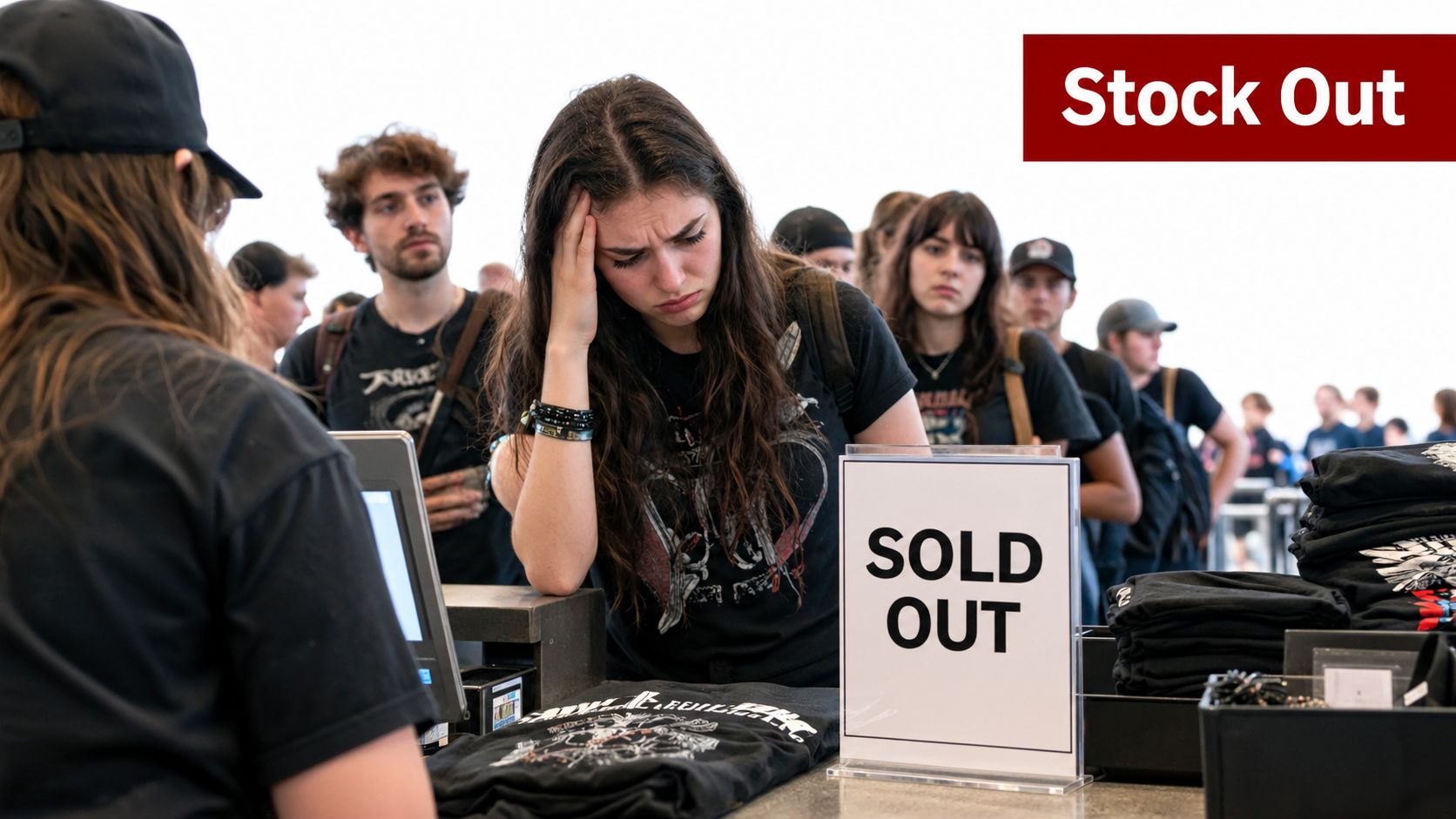
You've just played a sweaty little venue, shifted a decent number of tickets, and arrived at the merch table to discover that every medium has vanished while the large shirts are printed in a shade best described as “bruise with ambitions”. Meanwhile, the beautiful limited design you thought would fly is sitting in a cardboard box, eating your cash.
That's the awkward truth about band merch printing in the UK. A good shirt can keep your band visible long after the last encore, but a bad print, poor sizing decision or uncleared image can turn a cheerful revenue stream into expensive clutter. The trick is to treat merch like part of the show, not an afterthought wedged between the setlist and the petrol receipt.
Table of Contents
- Why Your Merch Stand Could Steal the Show
- Screen Printing vs Digital and Sticker Options
- Choosing the Right Garments and Finishes
- Bulk Stock vs Print on Demand
- Preparing Artwork and Finding Suppliers
- Legal Gotchas and Sustainable Practices
- Your Checklist for a Killer Merch Run
Why Your Merch Stand Could Steal the Show
A fan wearing your shirt carries the band into pubs, rehearsal rooms, football terraces and offices where someone may ask, “Who's that?” A strong design can turn one purchase into repeated exposure, while a poor garment or weak print becomes a reminder of money tied up in stock.
That financial risk deserves as much attention as the artwork. Ordering in bulk can reduce the unit cost, but unsold sizes and designs leave cash sitting in boxes. Print on demand limits that stock risk, although the per-item cost and fulfilment process may leave less room on each sale. Choose the model around expected demand, not optimism after one packed gig.
Merch money follows the live room
UK Music's This Is Music report puts the market's disruption into perspective. UK music merchandise companies generated approximately £185 million in revenue in 2020, down from £320 million in 2019, a 42% fall. The report also says touring would typically generate over 50% of merchandise revenues in a normal year. Gigs, festivals and venue traffic therefore have a direct effect on what sells.
A busy show creates urgency, but it can also tempt a band into ordering far more stock than its audience will buy. An online shop gives fans another route if they miss the table, forget their wallet or discover the band through a mate. Print on demand can support that longer tail without requiring a large upfront order.
UK Music says its merchandise-company revenue estimates were based on Companies House data and interviews with individual music merchandise businesses. The methodology provides useful context for the figures and makes clear how the estimates were assembled.
Artwork licensing is another cost that starter guides often skip. A photograph, illustration, football reference or borrowed typeface may belong to someone else. Getting permission for a venue poster does not automatically cover shirts, prints or online sales. Keep written records of licences and check what products, territories and sales channels they cover before sending artwork to a printer.
Make the purchase feel worth it
Your design needs to work at a glance. A distinctive lyric, odd little mascot or football-adjacent visual joke can be more memorable than a logo spread across the chest like a lower-league sponsor. Art prints can give fans something for the wall, rather than another garment competing for drawer space.
At the table, show the print clearly, label sizes and keep payment simple. If you're learning how to sell DTF print merch effectively, judge the whole buying experience, not only the transfer. A good design needs a clean presentation and a garment that survives the journey home.
Screen Printing vs Digital and Sticker Options
Screen printing remains the dependable workhorse for a band with a clear design and a sensible bulk order. Ink is pushed through a prepared mesh screen onto the garment, producing bold colour and a tactile result that suits tour shirts, club runs and designs with strong shapes.
Digital printing gives you more freedom with detailed artwork. Direct-to-garment printing works more like an inkjet printer for fabric, making it useful for photographic images, gradients and illustrations with lots of colour changes. It's usually more flexible for small batches, but the price per item can be less attractive when you need a table full of stock.
| Method | Works well for | Main trade-off |
|---|---|---|
| Screen printing | Bold artwork, repeatable designs and bulk runs | Setup and colour separation make tiny runs less efficient |
| Digital or DTG | Detailed artwork, gradients and smaller quantities | Per-item cost and fabric interaction need close checking |
| Stickers | Laptop lids, flight cases, water bottles and posters | Adhesive quality and surface preparation affect durability |
Match the process to the artwork
A two-colour skull with chunky lettering is a natural screen-print candidate. A complex album illustration with smoke, shadows and tiny tonal changes may be easier digitally. Don't force a photographic design into a process that wants clean blocks of colour, and don't pay for elaborate digital treatment when a sharp screen print would do the job beautifully.
Screen printing can feel cheaper at volume because the setup effort gets spread across more garments. That advantage disappears if you guess badly and end up with boxes of shirts nobody wants. Before approving a run, ask the printer how the artwork will be separated, how colours will be matched, and whether the print needs an underbase on dark fabric. It's worth taking time to compare screen printing methods before choosing based on a price that leaves out half the technical detail.
Don't forget the humble sticker
Stickers are cheap to carry, easy to add to an order and useful beyond the merch table. Fans slap them on guitar cases, notebooks, bikes and the water bottle that has already survived three festivals and one regrettable kebab. Use a simplified version of the design if the full artwork becomes unreadable at a small size.
For digital shirts and stickers, request a physical sample. Colours displayed on your laptop aren't a reliable substitute for ink on fabric or vinyl. This is particularly important for artwork built around a specific shade, since the difference between rich black and washed-out grey can make a design look intentional or accidentally haunted.
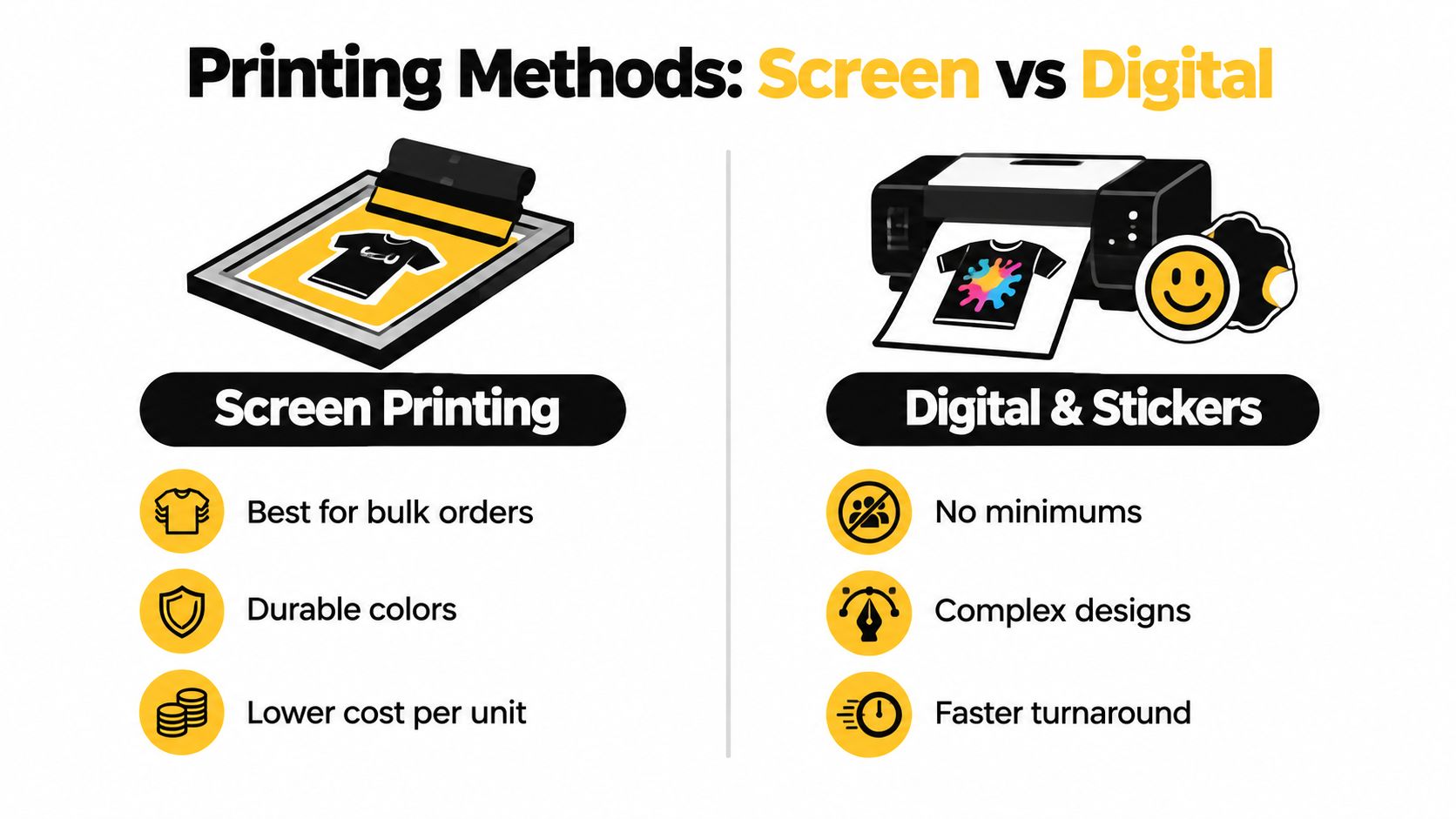
A quick visual guide can help you explain the decision to the rest of the band, especially when the drummer is arguing for glow-in-the-dark ink and the bassist is holding the bank card.
Choosing the Right Garments and Finishes
A brilliant print on a rubbish T-shirt is still a rubbish T-shirt. Start with the blank garment, because fabric weight, cut, neckline and stitching determine whether the finished piece feels like something fans will wear or a promotional item destined for the back of a cupboard.
Start with the wearer
Think about the audience and the setting. A heavyweight, relaxed-fit shirt can suit a vintage rock design and give a premium feel, while a lighter garment may work better for summer festivals or fans who don't want to feel like they're wearing a portable duvet. Check the size chart rather than assuming every manufacturer uses the same fit.
Order samples before committing to a production run. Wash one, wear one for a full day, inspect the seams, and look at the print after it has been folded and unfolded repeatedly. The hand-feel matters. A thick, rubbery print may look striking on a screen but become uncomfortable under a jacket.
Choose finish with intent
Water-based inks can create a softer feel when the printer applies them appropriately, while other inks may produce a heavier, more opaque surface. Matte finishes often suit understated artwork. Glossy vinyl can work for sharp lettering, stickers and selected details, but it can also look more like a football sticker album than an independent band release if you use it without restraint.
| Question | Why it matters |
|---|---|
| Does the blank fit your crowd? | A great graphic won't rescue an awkward cut |
| Can the print handle washing? | Fans judge quality after the first few wears |
| Does the finish suit the artwork? | Texture changes the mood and perceived value |
| Can the supplier repeat it? | Reorders should look like the original run |
Accessories deserve the same thought. Tote bags, caps and patches can extend a design without making fans buy another shirt, and you can browse examples of accessories and apparel when planning a wider range. Keep the line coherent. Five related products usually look more considered than twelve unrelated experiments that suggest the band lost a bet.
Bulk Stock vs Print on Demand
The central question is simple. Do you want a lower unit cost with more financial exposure, or a safer cash position with less margin per sale?
Bulk printing makes sense when you understand the demand, have confirmed gigs and can store the stock without turning the spare room into a damp warehouse. It gives you control at the venue, where fans want to take the shirt away immediately, and it can make each item cheaper to produce. The danger is obvious: money leaves your account before the audience has voted with theirs.
Print on demand reverses that risk. A garment is produced after an order arrives, so you don't need to guess every size, colour and design combination in advance. That suits online sales, niche artwork and bands whose release plans change more often than a festival timetable.
What each model costs you
| Decision factor | Bulk stock | Print on demand |
|---|---|---|
| Cash flow | Pays upfront and ties money to inventory | Reduces upfront stock exposure |
| Gig sales | Immediate handover at the table | Less useful unless you carry samples or stock |
| Online range | Requires storage and fulfilment | Lets you offer more designs with less storage |
| Margin | Often stronger per item at suitable volume | Can be tighter after production and fulfilment |
| Demand changes | Excess stock becomes your problem | Designs can remain available without a pile of blanks |
A hybrid approach usually avoids the worst parts of both systems. Carry the proven shirt, the design everyone asks about and the sizes that reliably move at gigs. Put experimental colours, detailed art and slower online items through a print-on-demand workflow. UK providers increasingly combine printing, stock management, fulfilment and direct-to-fan shipping, as shown by Volcano Merch's service information.
That model also fits the way people shop now. The Office for National Statistics retail sales data treats online spending as a structurally important part of retail activity, so the post-show online sale matters. A fan may not buy at midnight outside the venue, but they might order after seeing a photograph from the gig.
Practical rule: Use bulk stock where immediacy matters, and print on demand where uncertainty matters more than speed.
Before choosing, calculate more than the print price. Include storage, packing time, payment fees, delivery, damaged items and the cost of carrying designs that no longer fit the band. A guide to what print on demand means can help clarify the workflow, but your own sales history should decide which products earn physical space.
Preparing Artwork and Finding Suppliers
Suppliers can't print the picture in your head. They print the file you send, with all its missing fonts, accidental transparency and suspiciously tiny logo. Good artwork preparation prevents arguments later and gives the printer a fair chance to reproduce the design accurately.
Build a production-ready file
For screen printing, vector artwork is usually the cleanest starting point. Files created in Adobe Illustrator, Affinity Designer or similar software can preserve sharp edges and allow colour separations to be handled properly. If you're supplying raster artwork, keep the resolution high enough for the intended print size and ask the supplier what file specifications they require.
A checklist for the artwork desk:
- Create clear colour separations: Identify each ink colour rather than leaving the printer to interpret a flattened file.
- Convert or supply fonts correctly: Missing typefaces can alter the entire design.
- Keep transparent areas intentional: A white background accidentally baked into the file is a classic way to ruin a dark garment.
- Show the placement: Mark chest, back, sleeve or oversized positions so nobody relies on a vague email.
- Save the source file: You'll need it for colour changes, reorders and future formats.
For digital printing, check how the process handles gradients, fine lines and dark garments. Ask whether the supplier needs a transparent PNG, a particular colour profile or a specific maximum print area. Don't assume that a file which looks perfect on a monitor will look identical on cotton.
Question the supplier before sending money
A UK printer should be able to explain its production process without hiding behind “that's just how we do it”. Ask about sample approval, garment brands, print placement, colour matching, reprint policy, packaging, delivery dates and what happens if the supplied blanks are unavailable.
Lead times become more difficult around festival seasons and major touring periods. You don't need a dramatic prediction to know that busy printers need organised customers. Send final artwork early, confirm the delivery address, and get payment terms in writing before the run starts.
The HSE's screen-printing process guidance breaks the work into separate controls, including stencil generation, ink mixing and colour matching, printing, drying and screen reclamation. It distinguishes lower-volatility inks with rack drying from higher-volatility inks requiring extracted rack drying, and points to oven drying or UV curing for higher-volume work. That's a useful reminder that “printing” is several technical stages, not one magic button.
Ask for a physical proof before the full run. A proof catches poor placement, muddy colour and the sort of tiny typo that becomes enormous once it's printed on every shirt.
Legal Gotchas and Sustainable Practices
A band logo isn't automatically safe just because your guitarist drew it during a train journey. Ownership depends on who created the work, what agreements exist, and whether another person supplied artwork, photography, lettering or samples.
UK guidance on unregistered designs says protection lasts 10 years from the end of the year the design was first made available for sale, or 15 years from the end of the year it was created if it was never sold. The same official guidance says copyright in artistic works generally lasts for the creator's lifetime plus 70 years. Those rules don't give you permission to use somebody else's image, nor do they settle every question around commissioned work, branding or contractual ownership.
Clear every borrowed element
Treat artwork licensing like checking the van's oil. It's boring until the consequences arrive.
- Photographs: Get permission from the photographer and check whether identifiable people or brands create additional issues.
- Football imagery: Club crests, player photographs, kit designs and official marks can require permission. A quick redraw isn't a legal invisibility cloak.
- Fonts and samples: Check the licence allows merchandise use, not merely personal or desktop use.
- Collaborator agreements: Put ownership, payment, credit and future usage in writing before the design reaches a printer.
- Band archives: Keep dated source files and agreements so nobody has to reconstruct ownership from an ancient group chat.
For album artwork, posters and wall pieces, keep the same discipline. A resource on album art printing is useful for production thinking, but the legal clearance still belongs with whoever owns the artwork.
Make sustainability verifiable
Fans notice environmental claims, but vague green language doesn't prove much. Ask the printer where garments come from, what the ink system is, how packaging is handled, and what happens to misprints. Choose longer-lasting garments where appropriate, reduce unnecessary packaging, and avoid producing a novelty item that nobody will use after the launch week.
The UK printing sector provides substantial domestic capacity, employing around 105,000 people across about 7,400 companies, with turnover of £11.6 billion and gross value added of £4.8 billion, according to BPIF industry facts and figures. The same source identifies the UK as the sixth-largest producer of printed products in the world, while printed matter contributed £580 million to the UK balance of trade in 2020. That scale doesn't automatically make a job sustainable, but it means bands can ask detailed questions of local and specialist suppliers rather than treating transparency as impossible.
For practical ideas around lower-impact merchandise presentation, FLYP LTD sustainable swag tagging offers a useful place to explore the conversation. The goal isn't to slap a green badge on a polybag. It's to make products people keep, explain what you know, and avoid claims you can't evidence.
Your Checklist for a Killer Merch Run
The best merch runs join creative judgement with boring admin. Both matter. A brilliant print with no stock plan is a headache, while perfect spreadsheets won't save artwork that looks like it was faxed from 1998.
Use this final check before approving production:
- Artwork finalised: Supply clean files, correct placement and production-ready colour information.
- Sample ordered: Wash it, wear it and inspect the print, fit and finish.
- Legal clearance checked: Confirm ownership and permissions for every logo, photo, font and borrowed visual.
- Stock calculated: Separate gig stock from online experiments, and decide what belongs in bulk or print on demand.
- Payment terms confirmed: Put delivery, proof approval, fulfilment and problem-solving responsibilities in writing.
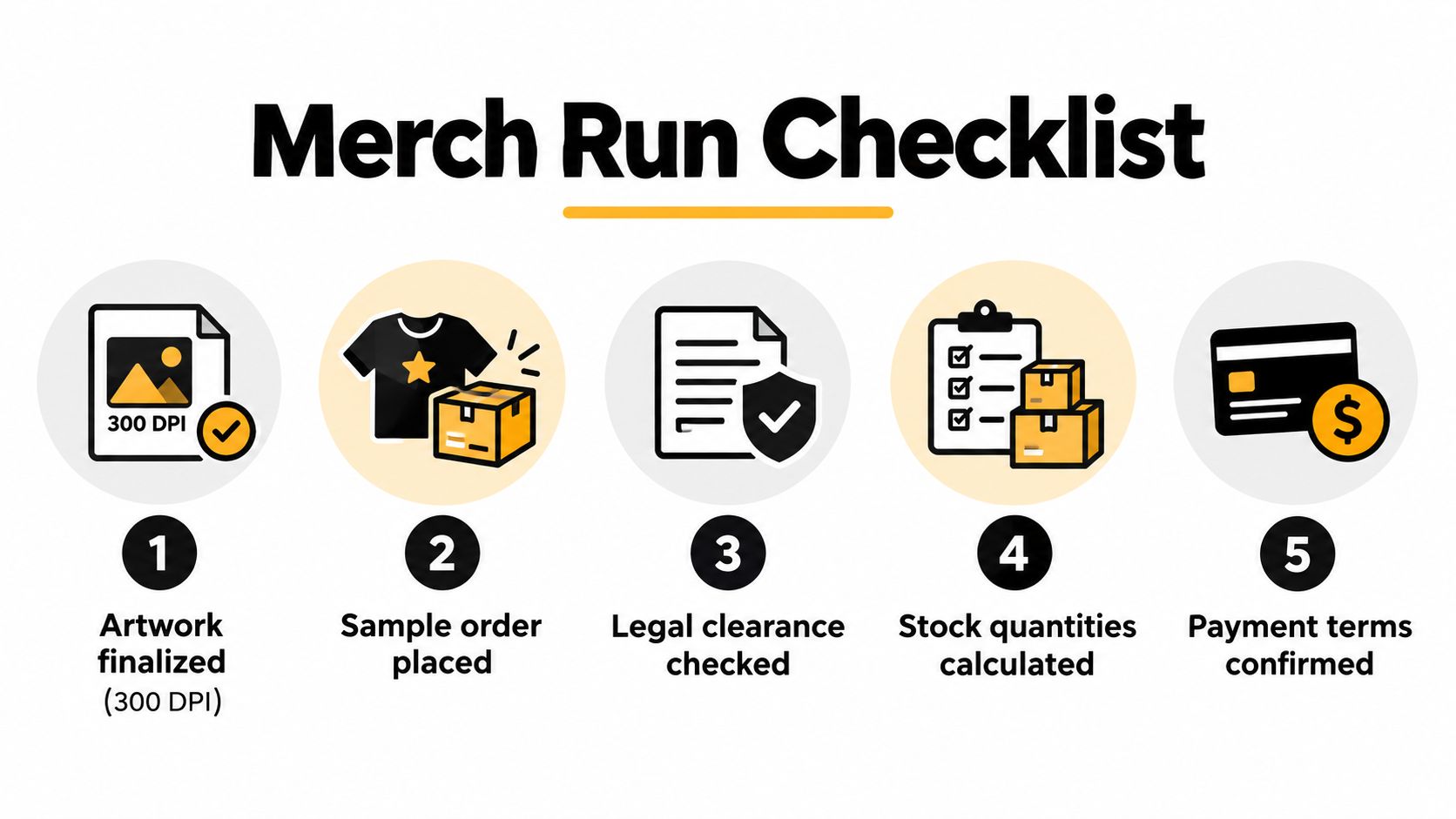
A merch table should make fans smile, not make the band argue beside the till. Sort the artwork, test the garment, protect the rights, and choose stock levels that your cash flow can survive.
Striped Circle offers music and football wall art, posters and greeting cards for fans who want their taste on the wall as well as on a shirt. Browse Striped Circle for distinctive prints that can bring a bit of gig-night or match-day personality to your home or office.
