
Ben Howard Oats in the Water: A Coastal Mystery
A wet Devon clifftop, a green jumper, headphones slightly losing the battle with the wind, and then Ben Howard's “Oats in the Water” arrives. Within seconds, the sea feels less like scenery and more like a suspicious character in a very bleak folk film.
Table of Contents
- The Song That Sounds Like Devon in October
- How the EP Landed on the UK Charts
- The Tuning That Makes the Track Sound Haunted
- What the Lyrics Mean: Probably Nothing Definite
- From Burgh Island to The Walking Dead and The Witcher
- Why a Lyric Print Beats a Shuffled Playlist
- Hanging the Coastal Mystery on Your Wall
The Song That Sounds Like Devon in October
Some songs belong to a place so completely that playing them elsewhere feels faintly dishonest. “Oats in the Water” belongs to a Devon coast in poor weather, preferably with clouds gathering over the horizon and a takeaway coffee going cold in your hand.
Ben Howard, raised in Devon, has always had a knack for making acoustic music feel larger than the room containing it. This track takes that coastal sensibility and stretches it into something darker. It doesn't sound like a pleasant day beside the sea. It sounds like the sea has remembered something about you and isn't planning to explain.
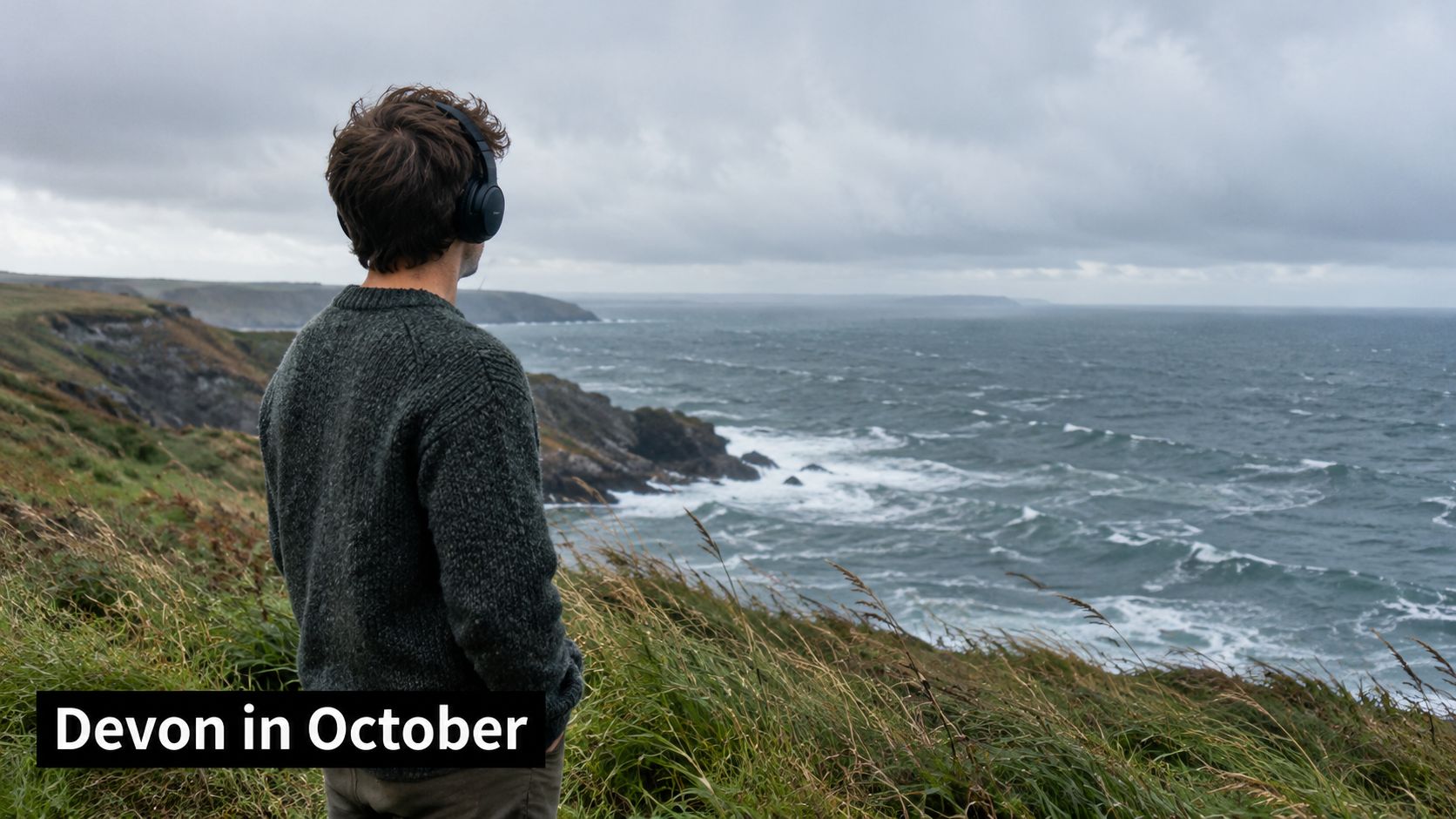
The song appeared on The Burgh Island EP, released in the United Kingdom on 31 October 2012 through Island Records as a digital download, CD and 12-inch vinyl, as documented by Apple Music's UK listing. That puts it neatly inside the early-2010s British folk moment, when Bombay Bicycle Club and Mumford & Sons were helping acoustic instruments stroll confidently into the charts wearing waistcoats.
Yet “Oats in the Water” never sounds designed for a festival singalong. There's no obvious arm-waving chorus, no moment where a field of people can yell the title after three ciders. It moves more like a weather system, beginning in a restrained way and gathering weight until the whole thing feels too large to keep indoors.
Atmosphere first: the song doesn't ask you to understand it before it affects you.
That quality explains why it still works for listeners who discovered it long after the EP arrived. It has the intimacy of a private confession, but the scale of a film scene. If you're building a proper live-music evening around similarly textured performances, The Northcourt LIVE concert guide is a useful place to find the sort of room where a song like this can breathe.
The result is a track that feels both rooted and unmoored. You can hear the British coastline in it, but you can't pin the song down to one village, one relationship or one tidy explanation. That slippery quality becomes important once the charts enter the story.
How the EP Landed on the UK Charts
The cleanest way to understand “Oats in the Water” is to follow its release in order. First came the EP, then the December chart appearances, then the slow realisation that a song can be commercially modest and culturally enormous at the same time.
The release and the first chart picture
The Burgh Island EP arrived in the UK on 31 October 2012. Its physical vinyl edition was limited to 1,000 copies, a detail that turns the record into a defined UK collectible milestone rather than a standard mass-market album issue. The release was available in digital, CD and 12-inch formats, giving listeners several ways into the same windswept little world.
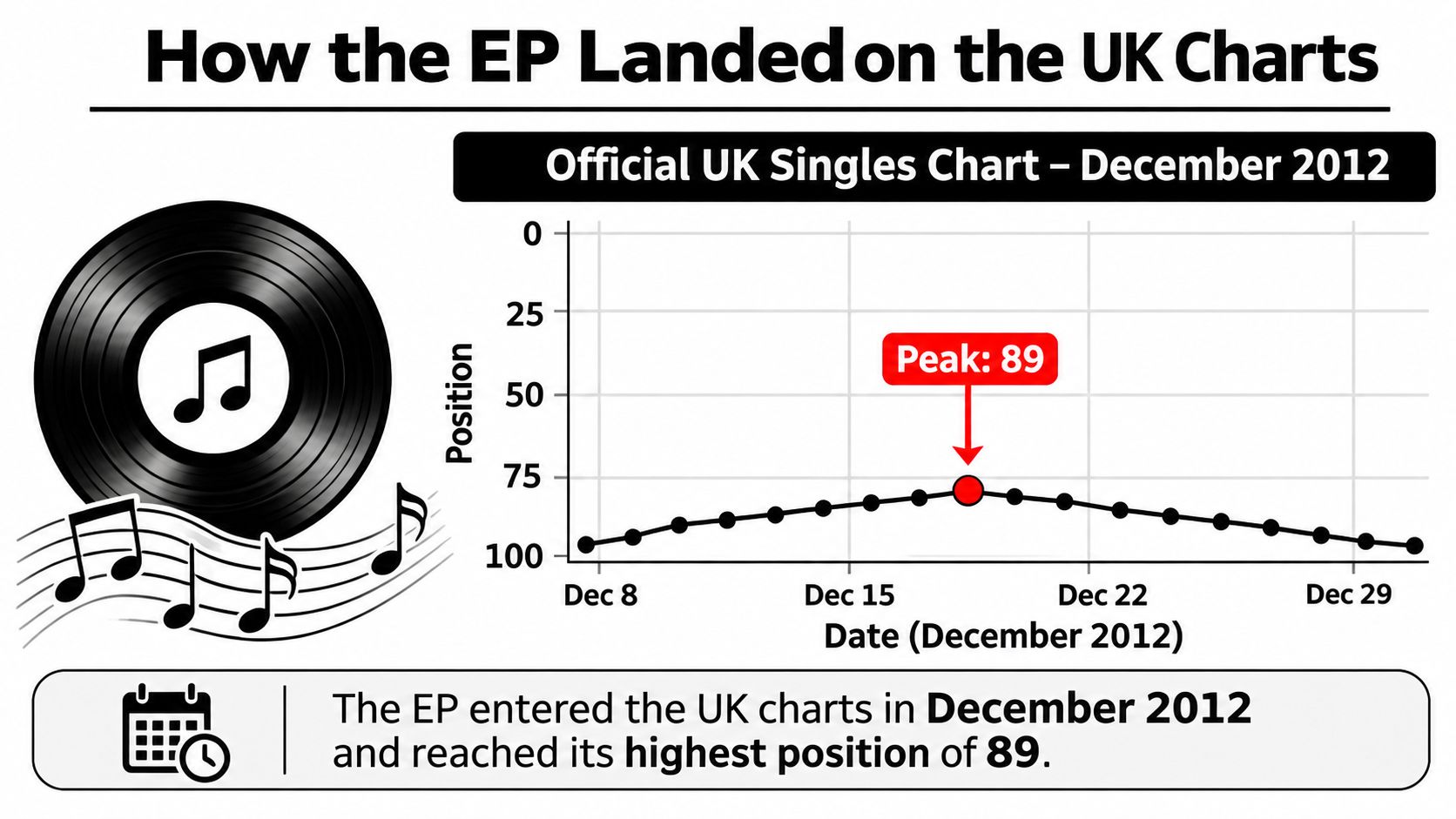
The song subsequently entered the UK Singles Chart in December 2012. Official Charts records two listings for “Oats in the Water”, one peaking at No. 89 for a one-week appearance and another peaking at No. 82 over two weeks, according to the Official Charts artist records.
That isn't the profile of a conventional blockbuster. It is the profile of a track that found its audience without behaving like a conventional single.
The download chart climb
The more specific download story is useful because it shows movement rather than a final position. On the Official UK Singles Downloads Chart dated 23 December 2012, the song reached No. 82, improving from No. 99 the previous week and recording a peak of 82 across two weeks, as shown by the Official UK Singles Downloads Chart.
| Chart | Peak position | Weeks on chart | Chart date |
|---|---|---|---|
| Official UK Singles Chart | No. 89 | One week | December 2012 |
| Official UK Singles Downloads Chart | No. 82 | Two weeks | 23 December 2012 |
Ben Howard's wider UK profile gives those numbers useful context. Official Charts credits him with two UK Top 40 singles, six UK Top 75 singles and one UK Top 10 single. His debut album, Every Kingdom, reached No. 4 on the UK Albums Chart and was later certified triple platinum by the British Phonographic Industry.
So “Oats in the Water” arrived during a genuine breakthrough period, even if it didn't storm the singles chart. It was the brooding cousin at the family gathering, standing in the kitchen while everyone else attempted a communal chorus.
A chart peak measures a moment. It doesn't always measure the life a song will have afterwards.
The 1,000-copy vinyl pressing matters for the same reason. It gives the EP a physical history that streaming alone can't provide. Someone owns an object connected to that exact release moment, not merely access to a file that happens to sit beside several thousand other songs.
That distinction helps explain why the track feels bigger than its chart run. It had a release, a limited physical artefact and a place inside Howard's rise. The numbers are modest, but the story around them has proper staying power.
The Tuning That Makes the Track Sound Haunted
The first few seconds of “Oats in the Water” sound simple until you try to work out why the guitar feels so unusually open. The answer sits under the fingers, in a tuning that lets several strings ring together and creates a constant low-level shimmer beneath the melody.
Open strings doing the heavy lifting
Published guitar analyses identify an open modal tuning of D-A-D-A-A-D, while an alternative arrangement uses C-G-C-G-G-C with a capo at the second fret, as outlined in this guitar analysis of “Oats in the Water”.
That looks like a small technical detail. It isn't. Standard tuning encourages familiar chord shapes, the sort of grips that make a guitar sound like a guitar in the everyday pub-singalong sense. D-A-D-A-A-D changes the furniture.
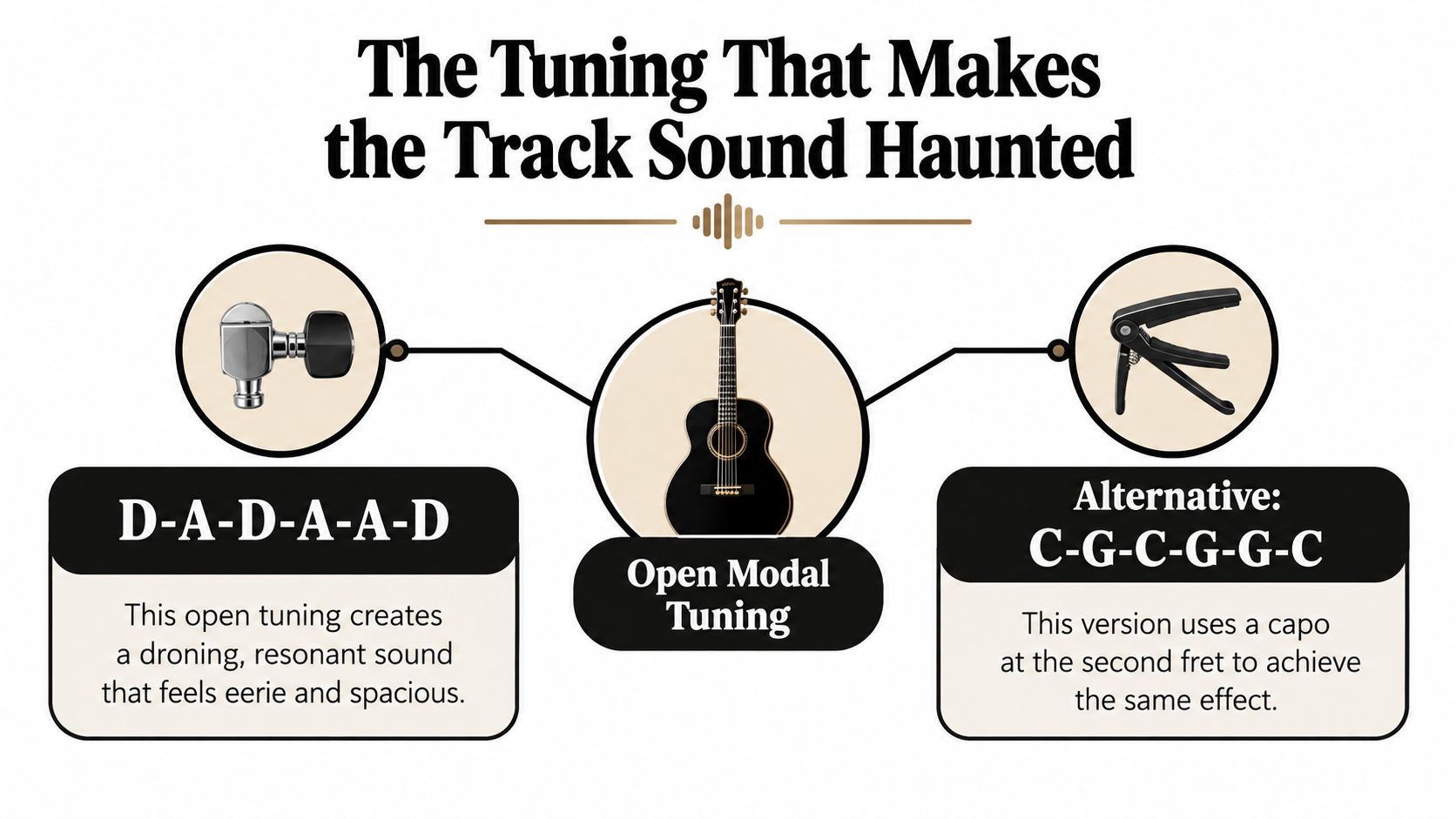
Several strings share related pitches, particularly D and A. Strike them together and they reinforce one another, creating sympathetic open-string drones. You can then move fretted notes above that sustained bed without changing the entire harmonic field.
For a non-guitarist, think of it as leaving several doors open while moving furniture around in one room. The room changes, but the same draught keeps coming through.
Why the arrangement grows teeth
The tuning creates the foundation, but the recording makes the atmosphere develop in stages. Apple Music's editorial description points to the addition of a rhythm section, a grinding organ sonority and increasingly forceful guitar distortion in the arrangement, as noted on the Apple Music track page.
The opening is sparse enough to make every sound feel exposed. Then bass and percussion give the track a body. A BBC live-studio analysis describes India Bourne on bass and Chris Bond on drums, with Bond using mallets and unusual brush-like “broom sticks” instead of standard drumsticks.
That choice matters because mallets and broom sticks don't attack the drums in the same sharp way as ordinary sticks. The rhythm arrives softened at the edges, more like pressure building in the walls than a drummer announcing the next section.
The sequence is almost architectural:
- Open modal tuning: sustained drones keep the guitar spacious.
- Soft percussion: mallets and broom sticks preserve the uneasy hush.
- Bass reinforcement: the arrangement gains weight without suddenly becoming bright.
- Grinding organ: the background starts to feel mechanical and ominous.
- Guitar distortion: the final section increases density and force.
Nothing is accidental about the haunted quality. The track doesn't add an effect and hope for the best. It builds the mood from the strings upward, then lets the band turn that private tension into something much larger.
What the Lyrics Mean: Probably Nothing Definite
People want “Oats in the Water” to hand over a neat answer. They hear gold, cocaine, rust, healing and water, then pin the words to an imaginary detective's wall, hoping the pattern will confess.
The clues resist that treatment. The imagery can suggest despair, death, love, addiction, material decay or the price of comfort, yet the lyric never locks itself to one tidy plot. That refusal is why the song keeps changing shape after repeated listens.
Several readings, none conclusive
One reading hears a confrontation with comfort and its price. Gold can mean wealth, attraction or something precious. Rust brings corrosion and age into the room, reminding us that even valuable things lose their shine. Cocaine adds danger, appetite and a harsher form of escape.
Another follows love and loss. The emotional language feels intimate without naming the relationship, while the images of damage suggest something valuable being worn down. The subject could be a person, a habit, a memory or the narrator trying to survive a difficult stretch.
A darker listener may hear death or emotional collapse in the repeated sense of inevitability. “Time the healer” sounds reassuring until the surrounding images drain that reassurance away. It could be sincere, sarcastic or the phrase someone repeats before they believe it.
Commentary connects gold, cocaine and rust with comfort, love and loss, but offers no settled narrative and identifies no single real-world event behind the lyric. The discussion of the lyrics and their possible meanings leaves the door open, which suits the song better than a forced answer would.
Ambiguity is the point
The clearest answer is that no single meaning can be verified. No confirmed account identifies one event, relationship or literal story behind every image. Treating a fan theory as fact would flatten the song into a crossword clue.
The lyric doesn't fail because it refuses to explain itself. It succeeds because the listener brings a life to the empty spaces.
That openness also makes the words unusually good lyric wall art. A print does not need to settle the argument. It can hold the gold, rust, water and unease in view while your own interpretation shifts around them. Read it on a bright morning and the lines may feel like warnings. Read them at midnight and they may sound like confession.
The same flexibility suits different kinds of listening. Whether the song plays casually through a stream or receives the full attention of a physical record, its words can become part of conversation, display and memory rather than remaining background sound.
You can hear despair, love, decay or survival. You can change your mind on a morning walk, then change it again with the kitchen light on at midnight. That uncertainty is not a puzzle waiting to be solved. It is the reason the lyric keeps meeting you somewhere new, and why seeing it on the wall can feel more personal than finding it shuffled into a playlist.
From Burgh Island to The Walking Dead and The Witcher
The second life of “Oats in the Water” began after the chart story had finished. A song that had made a relatively modest singles-chart impression found new routes into people's ears through television, games and the slow machinery of catalogue discovery.
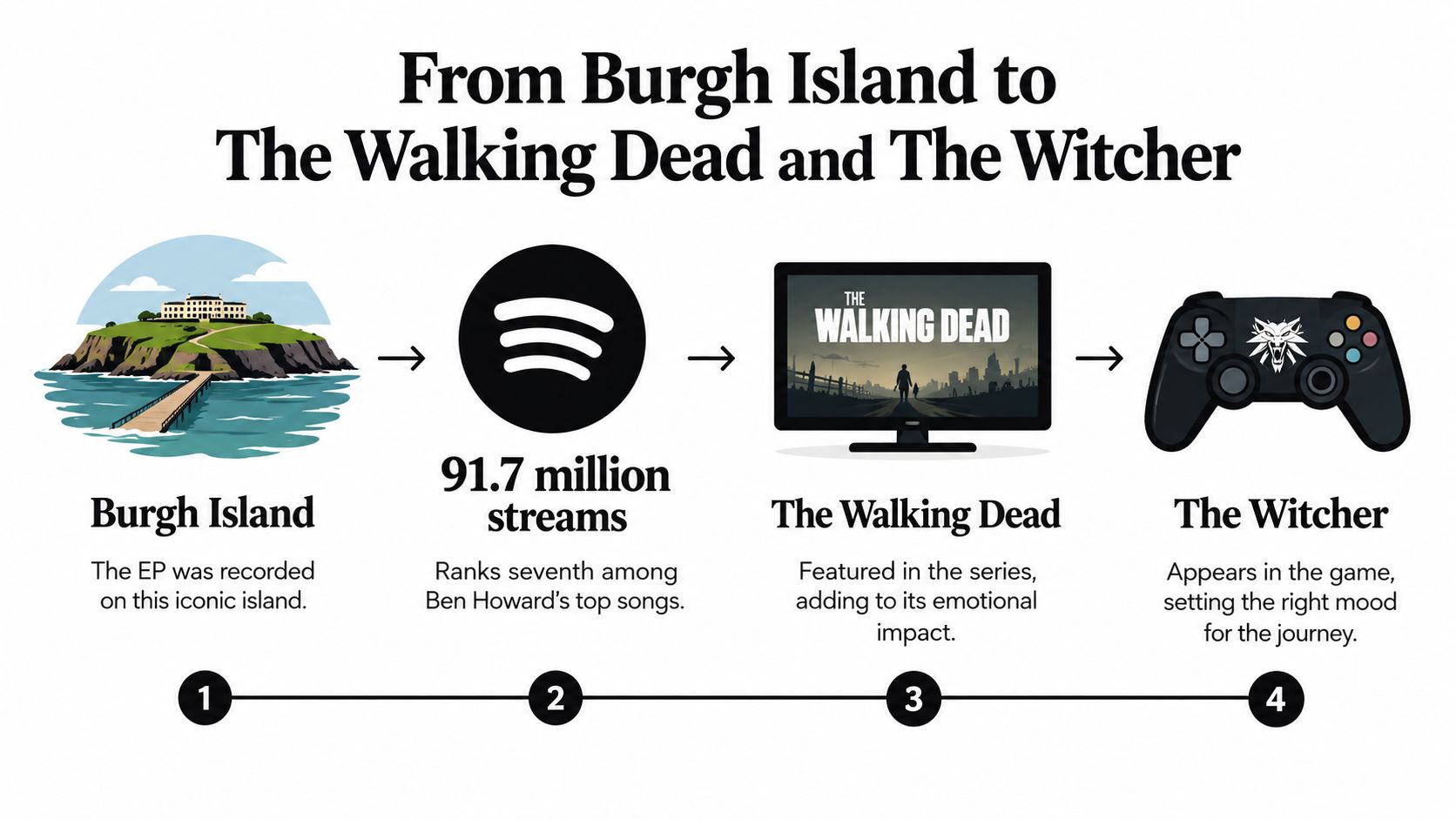
Spotify's listing identifies it as a 4-minute-59-second recording from The Burgh Island EP, released on 31 October 2012, and displays more than 91.7 million Spotify streams, as shown on the Spotify track listing. A separate streaming-data compilation places it seventh among Ben Howard's top twenty songs by Spotify total, with approximately 30,653 daily Spotify plays at the time of that dataset, and estimates 153.8 million audio-on-demand plays across platforms.
Those figures tell a different story from the UK chart positions. The single didn't need to become a radio staple to become a durable catalogue track. It needed to keep finding the right listener, often at the exact moment that a dark, spacious song makes perfect sense.
Television found the right shade of darkness
The track appeared in “Internment,” the fifth episode of season four of AMC's The Walking Dead, in the first episode of season three of Fox's The Following, and in a release trailer for The Witcher 3: Wild Hunt, according to this record of Ben Howard's screen placements.
Those are very different settings, but they share a taste for tension. The Walking Dead brings survival and grief. The Following brings crime-drama unease. The Witcher 3 brings monster-slaying fantasy, muddy roads and the general sense that a cheerful afternoon has gone badly wrong.
The song fits all three because it doesn't dictate one emotion. It supplies dread, sorrow and scale without needing to explain the scene. A director can place it beneath damaged people, dangerous choices or a ruined setting and let the listener complete the emotional wiring.
That's catalogue culture at its most effective. The track doesn't return as a nostalgia act demanding that everyone remember 2012. It reappears because a new scene needs precisely the atmosphere it has been carrying all along.
The result is a curious kind of longevity. “Oats in the Water” remains tied to the Burgh Island release, but it also belongs to viewers who first heard it while watching television or to players who encountered it through a game trailer. The song's journey moved from a limited UK EP to a much wider set of private associations.
Why a Lyric Print Beats a Shuffled Playlist
A playlist can summon “Oats in the Water” whenever you need it. A lyric print does something more patient. It sits there while you make tea, answer emails or stare into the fridge as though the fridge has personally disappointed you.
That suits this song because its appeal isn't based on one bright slogan. The track lives in ambiguity, atmosphere and texture. A framed lyric doesn't need to shout the band name across the room like a pub sign. It can hold a line, an image or a fragment of the song's emotional weather and let you return to it gradually.
The wall remembers differently
A playlist is excellent at repetition, but it disappears into the machinery of the day. A print gives the song a physical address. You notice it from the other side of the room, then again on a morning when the lyric lands differently because your own circumstances have shifted.
That's particularly valuable for a track whose meaning remains open. A lyric print doesn't force a definitive interpretation. It gives your interpretation somewhere to live.
Music prints and lyric prints also make a stronger gift than a generic band logo when the recipient has a genuine relationship with the song. You're not just handing over decoration. You're recognising a particular memory, late-night listen, television discovery or coastal walk.
The same logic applies to choosing art for a home office. A football poster can lift a room with instant colour and tribal energy. A line from “Oats in the Water” does something quieter. It adds a little mystery to the wall, which may be useful during a video call where everyone else has positioned a suspiciously tasteful plant behind them.
For a more personal tribute, music lyric prints offer the right middle ground between album art and ordinary wall decoration. The best version won't explain the song for you. It'll remind you why you cared enough to keep listening.
Hanging the Coastal Mystery on Your Wall
The print works best somewhere ordinary. Put it in the kitchen and the line catches you before the kettle boils. Hang it in the hallway and it becomes the last thing you see before leaving for work, replacing the usual motivational quote with something more honest about weather, memory and questionable decisions.
The song's D-A-D-A-A-D foundation, coastal atmosphere and unresolved lyrics all point towards an artwork that rewards repeated glances. It doesn't need to dominate the room. Like the recording itself, it can begin as a background detail and become the thing you keep returning to.
A dark frame would suit the mood, although the practical job matters more than theatrical gloom. If you're unsure about spacing, alignment or keeping a print from looking like it has been mounted during an argument, this guide to how to frame posters is a sensible companion. For nearby nautical details, the advice on how to hang brass seagull art offers a useful reminder that coastal decoration needn't turn the room into a gift shop at a windswept pier.
Give the song a physical home and it changes character. It's no longer only the track from The Burgh Island EP, or the one that appeared in The Walking Dead and The Witcher 3 trailer. It becomes part of your morning, your wall and your particular reading of what all that gold, rust and water might mean.
Striped Circle makes music prints, lyric prints and football-inspired wall art for people who want their walls to say something more interesting than “we own a sofa”. Browse Striped Circle to find a print that gives your own reading of Ben Howard's “Oats in the Water” a proper place to hang around.
