
Black Box Frame Guide for Music and Football Prints
You've got the print. Maybe it's a favourite lyric, maybe it's your club's ground looking glorious, maybe it's both and your other half has questions. It's currently in a tube, on a sideboard, or Blu-tacked like a teenager's bedroom circa 1997. You want it on the wall looking proper, not curling at the corners by Christmas.
That's where a black box frame earns its keep. It gives flat paper a bit of theatre, and chunky keepsakes somewhere safe to live. The trick isn't buying the deepest, fanciest thing you can find. It's matching depth, glazing and mounting to what you're framing.
Table of Contents
- What Is a Black Box Frame
- Shadow Box vs Box Frame - What's the Difference
- Materials, Finishes, and Depth Explained
- When a Black Box Frame Shines for Music and Football Prints
- Mounting, Glazing, Sizing, and Matting Made Simple
- Styling, Hanging, and Caring for Your Black Box Frame
- Black Box Frame FAQs
What Is a Black Box Frame
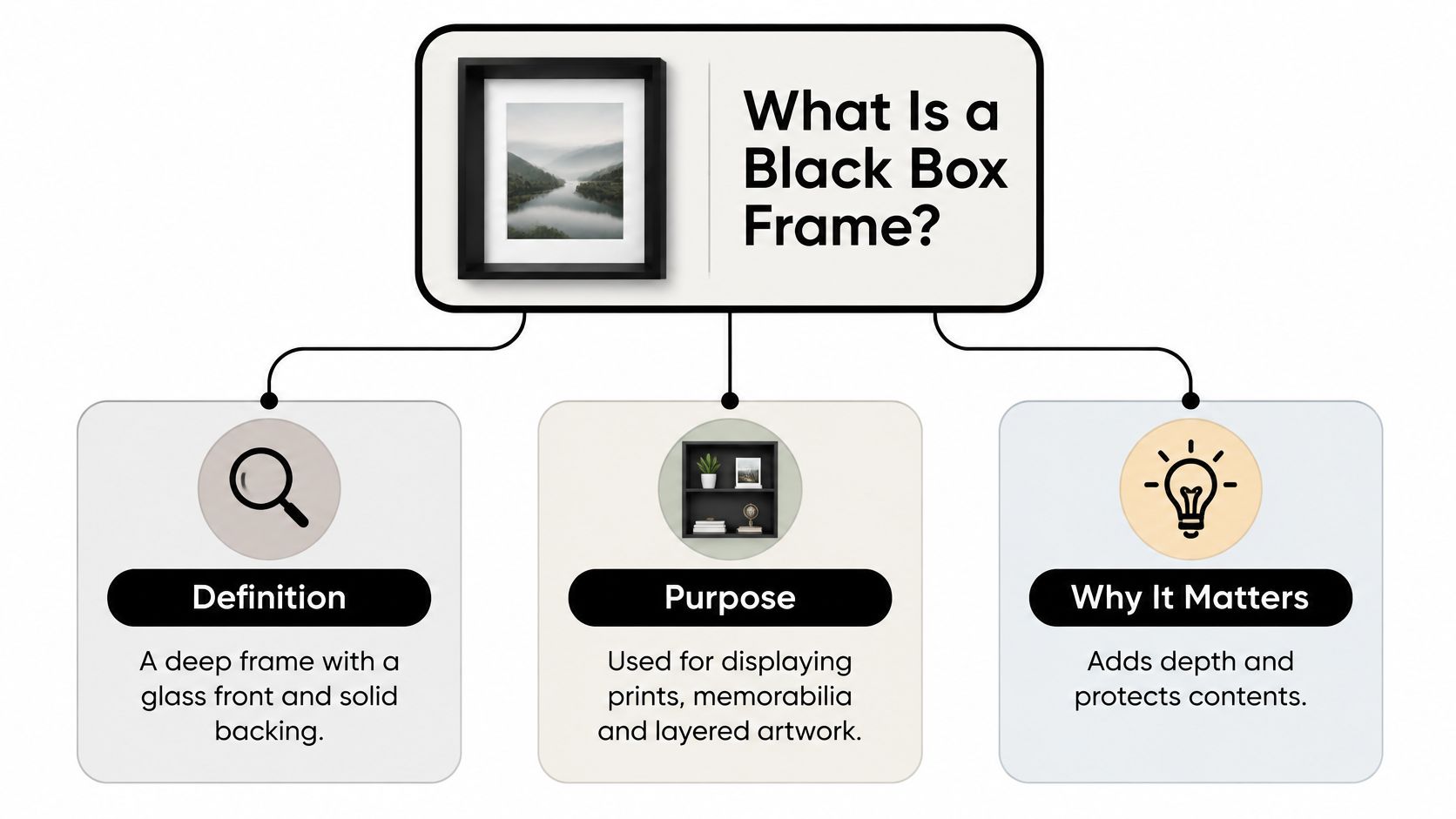
Think of a normal picture frame as a sandwich. Print, glass, backing, done, all squashed together. A black box frame is more like a mini stage. There's a deep border, a glazed front and a solid back, with empty space in between so your print or object can sit back from the glass and cast a little shadow.
That gap is the whole point. In the UK, it's commonly understood as a deep or shadow-box style frame designed for three-dimensional objects rather than only flat prints, and Hobbycraft's black frame listings describe them for photographs, keepsakes, 3D crafts, memorabilia and layered artwork. A concert ticket doesn't get pressed flat. A badge doesn't scrape the glazing. Layered paper gets room to look layered.
Why black, specifically
Black does two useful jobs. It sharpens contrast, so pale mounts and colourful prints pop, and it doesn't fight with club colours, album art or whatever questionable sofa choice preceded it. It's also forgiving in a busy gallery wall, where mixed wood tones can start arguing with each other.
A box frame isn't just protection. It's presentation, with breathing room built in.
You'll see the same idea used well beyond music and football. If you're browsing equestrian displays for rosettes and stable photos, you might find horse photo frames helpful for seeing how people pair a flat image with a small object.
Do you need one for every print? No. A simple flat poster can be perfectly happy in a shallow frame. Choose a black box frame when you want depth, when you're adding a mount and spacer, or when the thing you're framing has any thickness at all. If it would feel cramped in a sandwich, give it the stage.
Shadow Box vs Box Frame - What's the Difference
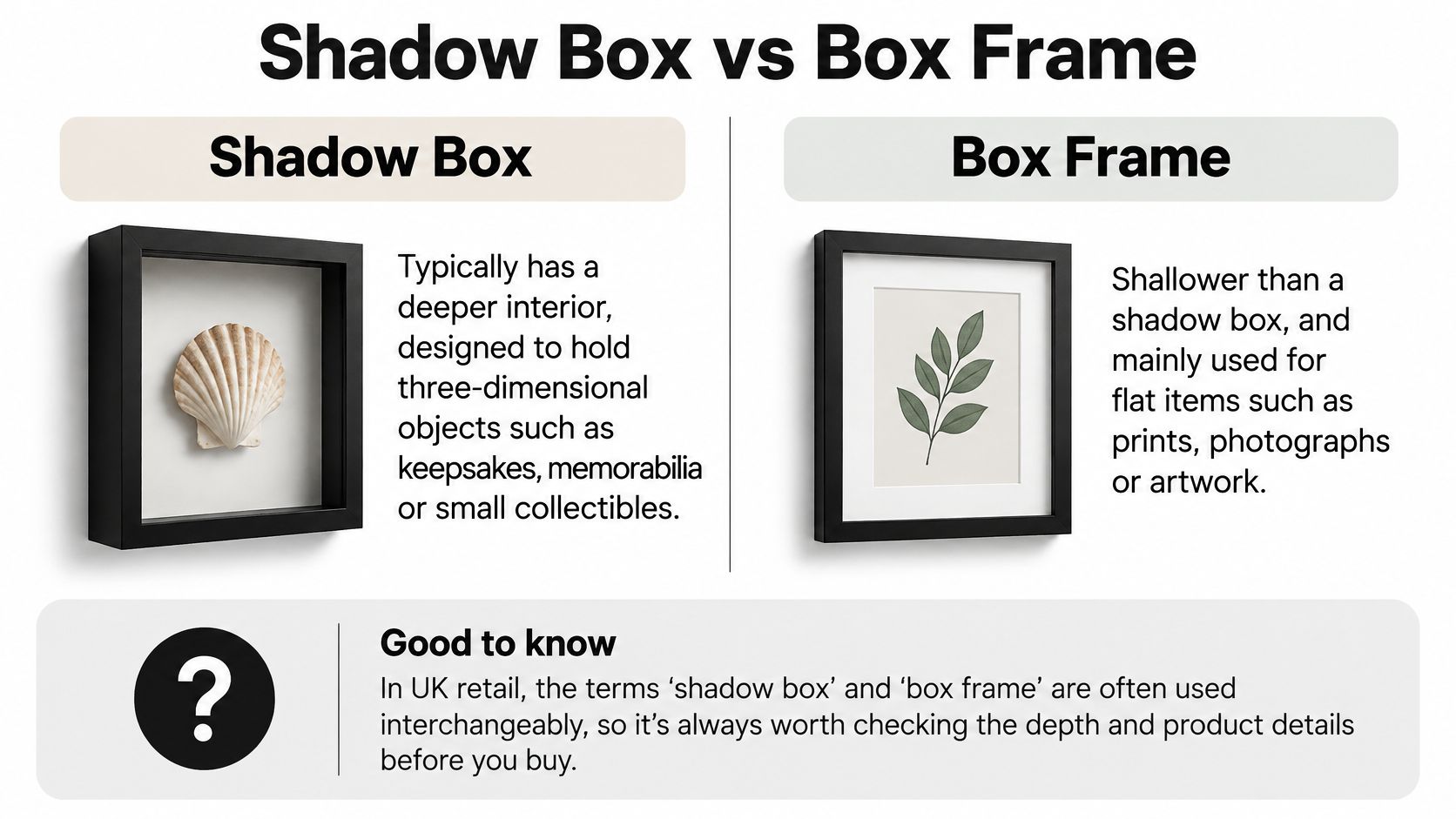
Short answer, UK shops often use the names interchangeably, which is unhelpful when you're standing in an aisle holding a tape measure. The useful distinction isn't the label. It's usable internal depth and what the frame was built to hold.
Side by side
- Shallower box frame: Suits prints, photos and layered paper where you mainly want separation from the glazing and a stronger shadow line.
- Deeper shadow box: Suits objects with real bulk, such as medals, folded fabric, flowers, small shirts or a ticket mounted on foam board.
UK listings show how wide the range gets. One black shadow-box model measures 11 × 14 inches, approximately 27.9 × 35.6 cm, has an internal display depth of 1.5 inches, approximately 3.8 cm, an overall thickness of 2.5 inches, approximately 6.4 cm, and a 1-inch border, approximately 2.5 cm, for wall or tabletop use in portrait or horizontal orientation, according to that model's UK product specification. The same retail context lists uses from concert tickets and medals to flags, jerseys and baby items, so it's clearly aimed at keepsakes, not just decoration.
Size ranges help you shop sensibly. Hobbycraft listings in the earlier section cover square shadow boxes at 10 × 10 cm, 18 × 18 cm, 25 × 25 cm and 30 × 30 cm, and deep-box formats at 15 × 15 cm, 20 × 20 cm, 28.5 × 28.5 cm and 40 × 40 cm, priced from £2.15 to £18 for the examples shown. Those listings also carry 99, 119 and 121 reviews for individual sizes, which doesn't prove national demand, but it does show people keep buying and reviewing them.
If you're framing something bulky and sentimental, the Graduation Cap and Gown shadow box tips are a handy parallel, even if your treasured textile is a scarf rather than a gown. Measure your object first, then pick the name that fits.
Materials, Finishes, and Depth Explained
Depth is where most first-time buyers get caught out. A frame can look chunky from the front and still offer very little room inside. You need the rebate depth, which is the usable internal space from glazing to backboard, not just how far the frame sticks out from the wall.
One UK specification makes the trap obvious. A frame advertised at 33 mm overall depth has a 30 mm rebate, a detail noted in the context of UK framing guidance on shallow and deeper box frames. Those few millimetres sound trivial until your mount, spacer and backing board eat them and your badge is suddenly kissing the acrylic.
A measuring formula that works
Add it up before you buy:
- Item thickness: Measure the thickest point, not the edge you'd prefer to believe.
- Mounting layers: Include mount board, under-mount, backing and any foam spacers.
- Clearance: Leave extra room so nothing touches the glazing.
Deeper isn't automatically better. Extra depth creates a bolder shadow and handles bulk, but it projects farther into the room and adds weight, especially with glass. On a narrow hallway wall, that's a hip-bruise waiting to happen. In a living room, a moderate depth usually looks intentional rather than architectural.
Finishes and materials
Matte black hides fingerprints and suits most modern rooms. Satin black gives a soft sheen under lamps. Gloss black can look sharp with bold pop culture prints, but it shows dust and reflections more readily. Wood and composite mouldings both work if the corners are tight and the frame stays square.
If black feels too stark against warm furniture, compare it with options in our guide to dark wooden frames and when they suit a room better. The right finish should flatter the print, not win an argument with it.
When a Black Box Frame Shines for Music and Football Prints
Football and music prints aren't neutral filler. They're identity on a wall, and the numbers behind that aren't small. Official data records approximately 45.8 million attendances across domestic football competitions during the 2024–25 season, as shown in English football attendance tables for 2024-25. That's a lot of Saturday afternoons, scarves and questionable pies turning into memories worth framing.
Music tells a similar story. UK recorded music consumption reached 210.3 million albums or album-equivalents in 2025, up 4.9%, streaming passed 200 billion plays for the first time at 210.3 billion and accounted for 89.3% of consumption, overall physical sales grew 1.4%, and vinyl LP sales increased for an eighteenth consecutive year, according to the BPI's analysis of Official Charts data. We stream invisibly, then buy the tangible thing anyway. A print does the same job on a wall.
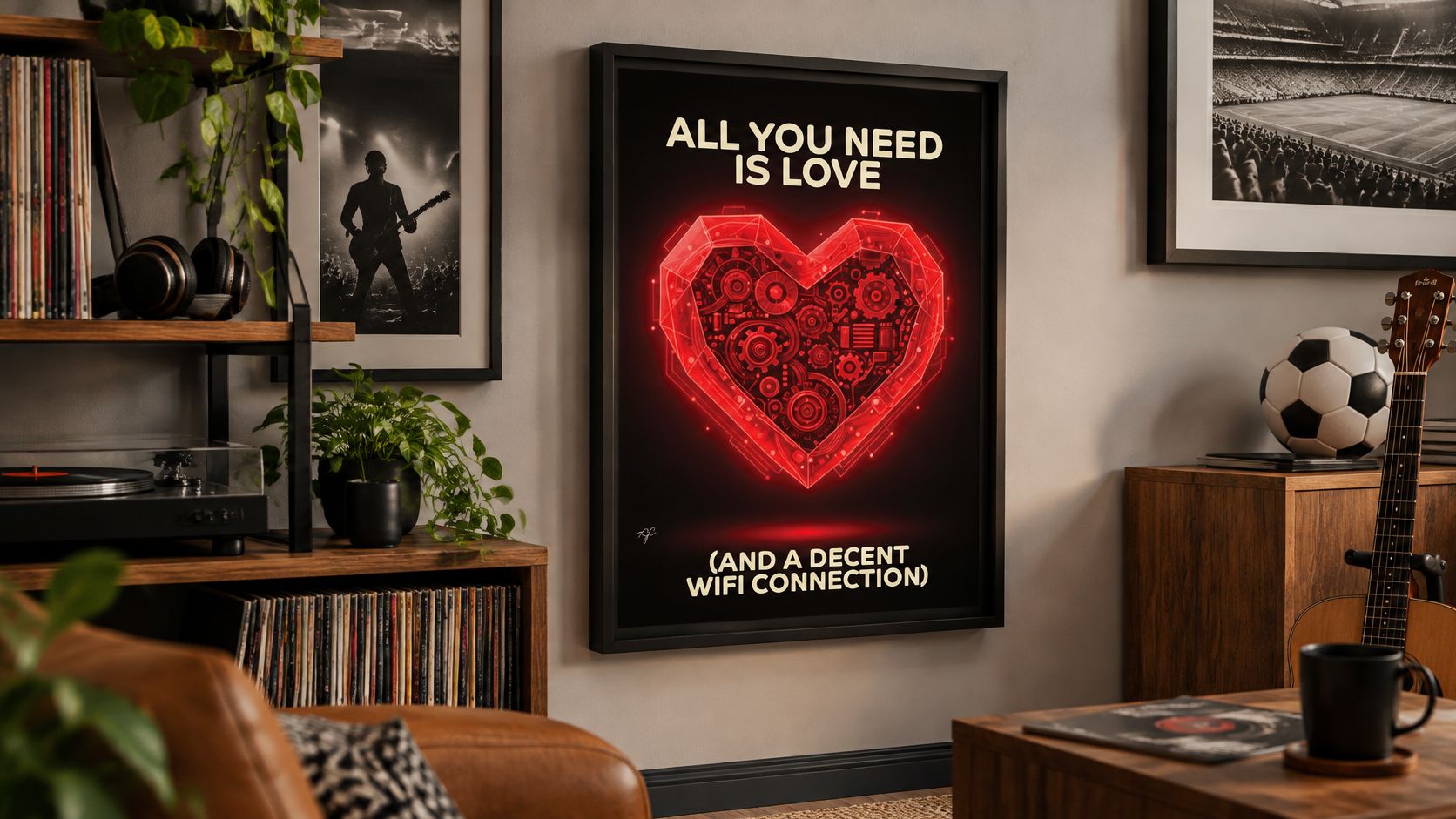
Take "All You Need is Love..." - Wall Art Print as an example of the format. If you love a witty art print or you're just trying to add a splash of colour, humour & character to your home or office wall, this print will give the look you're going for. Available in sizes A5, A4, A3, A2, A1 & A0. Make yourself and others smile with printed wall art from Striped Circle.
A black box frame suits that kind of recognisable, talk-about-it imagery. A survey of 1,000 UK and US homeowners found 62% selected photography when asked what art they preferred to hang at home, while landscapes appealed to nearly half, according to Buildworld's homeowner art survey. People like a clear subject. A stadium, a lyric, a beloved venue, all give guests something better to discuss than the weather.
When to skip the depth
Choose a standard frame for a single flat poster in a tight space, or a temporary display you'll swap often. Choose the box when you're combining a print with a ticket stub, wristband or programme, or when you want a mounted print to feel like an object rather than wallpaper.
Mounting, Glazing, Sizing, and Matting Made Simple
You don't need museum training to mount a print sensibly. You do need to stop the glazing touching the paper, avoid sticky shortcuts you'll regret, and spend on protection in proportion to the print's value and location.
The layers, in plain English
The Institute of Conservation recommends sufficient rebate depth for glazing, a window mount or spacer, an under-mount, an isolating layer and a backboard, with artwork attached to the under-mount using reversible paper hinges rather than adhesive or staples, in its guidance on caring for art on paper. It also advises UV-filtering glass or acrylic, especially near south-facing windows.
Translation, your print should float safely in a layered sandwich, held by hinges you can undo, with air between paper and glazing. Sellotape is not a conservation strategy, however confident it feels at midnight.
- Measure the print: Size the frame to the mount's outer dimensions, not just the image area.
- Add a window mount or spacer: This creates the gap and gives the image visual breathing room.
- Hinge, don't glue: Attach the top edge to an under-mount with reversible paper hinges.
- Close it cleanly: Check for dust and hairs before sealing the back. There will be one hair. There always is.
For the wider step-by-step on flat posters, see our practical guide on how to frame posters without wrinkles or regrets.
Glass or acrylic, and how much UV is enough
A UK framing guide advises leaving approximately 5 mm between glazing and artwork so condensation is less likely to be absorbed by paper, and describes glazing from standard to anti-reflective and museum grades with UV protection ranging from roughly 50% to 99.9%, via Picture Frames Express guidance on box frames. That range is exactly why you should match spend to risk.
Simple pathway: Low for replaceable prints away from sun, medium for valued prints in bright rooms, high for irreplaceable or signed items.
Low means correct spacing, clean mounting and standard glazing away from direct light. Medium adds UV-filtering acrylic or glass and better boards. High means conservation materials throughout and possibly a professional framer. For a replaceable poster in a hallway, spacing and stable mounting can matter more than a pricey museum upgrade.
Acrylic is lighter and safer for large frames, kids' rooms and above sofas. Glass can suit smaller, stable displays and resists scratches well. If you're unsure whether the frame can carry glass, don't guess, because weight changes everything that follows.
Styling, Hanging, and Caring for Your Black Box Frame
A frame can be perfectly built and still look lost if it's hung like an afterthought. Give a black box frame enough wall around it to let the shadow do its work. One strong piece above a desk or sideboard often beats three timid ones squeezed into a corner.
That personal touch is the point for many. The Buildworld survey noted earlier also found 68% of respondents decorated to make the space feel personal rather than increase financial value, and nearly half used art as a finishing touch, a finding referenced alongside Luminate's discussion of UK music at home and abroad. You're not staging a show home. You're telling visitors who lives there before you've made the tea.
Hang it like you mean it
Weight decides the fixing, not optimism. Museums Galleries Scotland advises that only a qualified framer, art technician or conservator should fit glazing, because glass adds significant dead load, and that acrylic is a practical alternative when a frame cannot support glass weight, in its advice on caring for paintings and frames. It also recommends laminated or toughened glazing where impact protection is needed, and low-reflecting glazing under artificial lighting.
- Fix into the frame: Check hanging fittings are secured into the moulding, not only into the backboard.
- Check it's square: Corners shouldn't shift once the layered contents are in.
- Use two fixings for larger pieces: It spreads load and stops the slow, wonky tilt.
Renters, acrylic keeps weight down, but it doesn't make a large frame weightless. Use fixings your wall and tenancy allow, and lean smaller tabletop-friendly formats on shelves if drilling is off limits.
If you're mixing frame colours across a wall, our notes on picture frame colours and combinations that work can help you keep black as the anchor rather than the bully.
For care, dust the top edge regularly, because deep frames collect it like a trophy shelf. Clean glazing gently, keep prints out of direct sun and damp-prone walls, and open the back only when you need to. Every opening is another chance for dust, fingerprints and that one mysterious hair.
Black Box Frame FAQs
Is ordinary glass safe for a print
It can be, provided it doesn't touch the paper and the print isn't in harsh sunlight. Spacing, a proper mount and a sensible wall matter first. Upgrade the glazing when the print is valuable, signed, irreplaceable or living in a bright room.
Glass or acrylic in a child's bedroom
Pick acrylic. It's lighter, and it avoids the worst risks if the frame gets knocked during an indoor penalty shootout. Secure the fixings properly and hang it out of climbing range, because no glazing choice fixes a bad fixing.
Will a deep frame look too bulky in a small flat
Not if the proportions are right. A slimmer rebate with a clean mount usually looks sharper in tight spaces, hallways and above desks. Save the deepest shadow boxes for objects that genuinely need the room, or for a single statement piece with clear wall around it.
Do I need UV glazing for a replaceable poster
Probably not at museum grade. If it's cheap to reprint and hangs away from direct sun, spend your effort on correct spacing and reversible mounting. If you'd be gutted to lose it, treat it as irreplaceable and protect it accordingly.
How do I clean inside the frame
You mostly shouldn't. Dust the outside, and only open it on a clean, flat surface if something has slipped. Work slowly, keep fingers off the print surface, and recheck the layers before resealing.
Ready to give a favourite song, stadium or in-joke the wall space it deserves? Browse music and football inspired wall art, posters and greeting cards at Striped Circle, pick the print that makes you grin, and pair it with a black box frame that lets it steal the room properly.
