
Bob Dylan Posters: How to Buy, Frame and Display Them
The usual advice is to buy the poster with the best-looking picture. That's how you end up with a striking print that's too big for the wall, wrong for the room, or described as “rare” by a seller who can't tell you who printed it. Choose by purpose first, then match the size and style to the person who'll live with it, and check the provenance before you pay collector prices.
Bob Dylan posters can be historical artefacts, affordable wall art or a personal nod to a favourite record. Those are different jobs, so they need different buying rules. A tour original and a modern lyric print don't have to compete: one tells a story about music history, the other can make a bare office wall look as if someone there has heard a song before.
Table of Contents
- Four Bob Dylan Poster Types and Who Each Suits
- Spotting Originals, Reissues and Reproductions
- Sizes, Print Specs and Where to Hang Them
- Where to Buy Safely and Find Your Dylan Print
- Framing and Caring for Your Dylan Poster
- Buy With Confidence and Make the Wall Smile
Four Bob Dylan Poster Types and Who Each Suits
The picture is only half the decision. A poster should suit the room and the person who'll look at it, while its provenance should make sense for the price. Original album art connects a record collector to a release; concert and tour posters evoke a particular event; lyric and typographic prints put the words first; fan art offers a newer interpretation rather than a period artefact.
| Type | What it is | Price reference | Best for |
|---|---|---|---|
| Original album art | Sleeve or poster artwork from a record release, such as the 1964 The Times They Are A-Changin’ poster, measuring 630 × 890 mm | Period examples vary in price; check the item's provenance and condition | Collectors and record-shelf fans |
| Concert and tour posters | Promotional sheets such as a 1965 UK tour blank | Rare examples can be hard to price | Concert-goers and history buffs |
| Lyric and typographic prints | Lyrics or titles as the main design | Check the individual listing | Home and office walls, first-time decorators, gifts |
| Fan art and contemporary interpretations | New artwork inspired by Dylan | Prices vary by artist and edition | Decorators who want something unique, including football-and-music fans |
Album art can have a life beyond the record sleeve. The British sleeve of Bob Dylan's Greatest Hits was released in the UK in December 1966, according to this account of the British sleeve and Glaser design. It used a psychedelic-style image derived from a Milton Glaser poster printed by Push Pin Studios that year. The image drew on a Jerry Schatzberg photograph taken on January 28, 1966, as the same account explains. Whether the original poster was sold independently remains uncertain, so don't treat a familiar image as proof that a print is a particular edition.

Match the format to its owner. A completist will get more from original album art or a tour-style print than a generic lyric design. A football-and-music fan may enjoy a lyric print or fan art with a football nod, much as football shirts range from match-worn originals to replicas and fan-made designs. For a first-time decorator, a modern lyric print is an easy, low-risk choice; a typographic print can suit an office, while a tour-style print makes a keepsake for a concert-goer. If the budget is tight, start with a modern print rather than paying a premium for a period artefact.
For a witty, contemporary option, “All You Need is Love...” - Wall Art Print is listed at 8.49 and marked in stock. Check the listing for the details before buying. Choose the design that fits the recipient and the room, then pay for history only when the provenance supports it.
Spotting Originals, Reissues and Reproductions
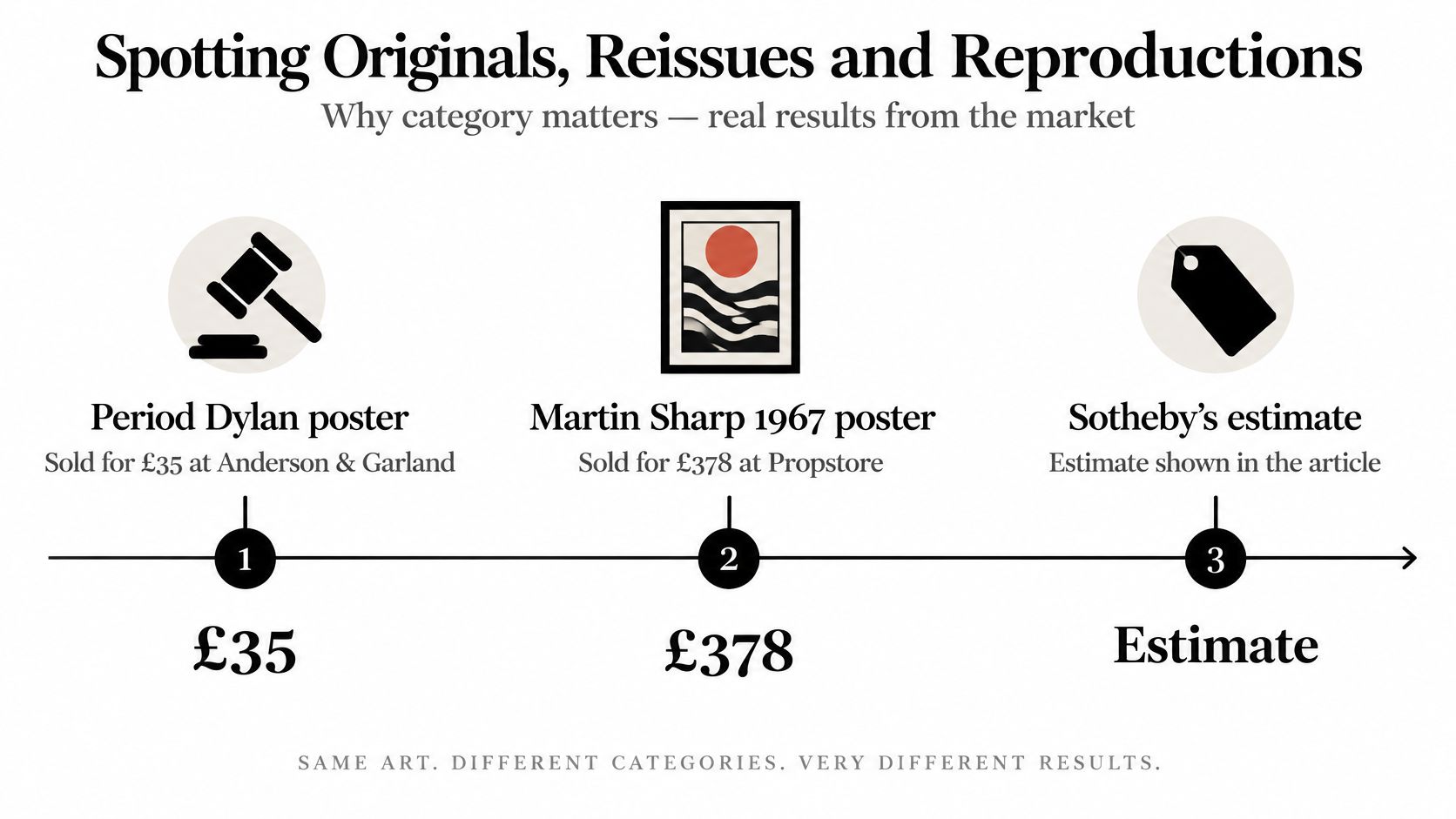
Auction prices reflect attribution, rarity, condition and provenance. A period Dylan poster sold for £35 at Anderson & Garland, a Martin Sharp 1967 poster sold for £378 at Propstore, and Sotheby's estimated another Martin Sharp poster at £1,000–£1,500. These are examples, not promises of future value. The Anderson & Garland auction listing gives one useful price reference. Match the poster to your room, the recipient and your budget, then check the provenance before paying a premium.
Start with what the seller means by “original”
An original first-edition poster was produced for its first release or promotion. A later authorised reissue was made afterwards with permission. An unlicensed decorative print can still look the part on a wall, but it belongs in a different category. Ask which one is for sale, and request evidence for the seller's answer.
The 1965 UK tour blank offers a useful comparison. A surviving example measures 13.5 by 18.125 inches, on thin, textured stock associated with UK wheatpaste or “sniping” posters, according to the archive record of the 1965 UK tour poster. It uses Daniel Kramer's portrait of Dylan and leaves space for a promoter to add a venue and date. The record notes that only a very small number of examples had been encountered, including one from Ken Pitt, Dylan's UK publicist between 1964 and 1966. Compare those details with any poster being sold as an example of the same design.
Use this checklist before paying
- Compare the item with a catalogue record. The V&A's 1966 Glaser poster is accessioned as E.381-1968, a documented reference point.
- Check the publisher and printing process against the record, not just the seller's description.
- Verify the dimensions. Ask for measurements and compare them with the catalogue entry, not merely the listing title.
- Inspect the paper and edges. Look for the expected stock, texture and signs of handling. “Classic” in a title does not give new paper an old history.
- Check the condition. Look for folds, tears, foxing, fading and restoration, especially near the edges and printed text.
- Treat a certificate as supporting evidence. It may help, but it does not prove authenticity or ownership history by itself.
Collector's rule: Pay extra for evidence you can check, not adjectives you can't.
A modern decorative print may be the right buy when you want colour on the wall rather than an item to catalogue. An auction estimate, meanwhile, is not a guaranteed sale price or a sound investment case. Before bidding, compare the seller's provenance details with this guide to vintage music posters in the UK, and spend the premium only when the evidence holds up.
Sizes, Print Specs and Where to Hang Them
| Size | Typical placement | Practical note |
|---|---|---|
| A5, 148 × 210 mm | Desk, bathroom, small gift | Easy to frame and replace |
| A4, 210 × 297 mm | Back of a door, small hallway | Standard frame sizes are widely available |
| A3, 297 × 420 mm | Bedroom or one wall of a living room | Good balance of impact and cost |
| A2, 420 × 594 mm | Above a sofa or desk | Common size for lyric prints |
| A1, 594 × 841 mm | Statement wall or office | Needs sturdy hanging and framing |
| A0, 841 × 1189 mm | Large open-plan space | Check framing and postage costs |
Treat these sizes as a starting point and measure your wall before ordering. A print that fills roughly half to two-thirds of the wall's width usually has enough presence without overwhelming the room. Small prints can disappear above a long sofa, while a large one needs clear space around it.
Protect the proportions
The V&A's record for the Glaser poster identifies Milton Glaser's 1966 Dylan poster as a colour offset lithograph on paper measuring 83.8 × 55.9 cm. Its aspect ratio is about 1.50:1, compared with about 1.41:1 for A-series paper. The formats do not match, so an A-size version needs a crop or a margin. Choose the margin. Cropping the artwork can cut into Glaser's silhouette and psychedelic hair pattern, with no improvement to the design.
For a reproduction, specify 300 dpi, which gives an image area of roughly 9,900 × 6,600 pixels before bleed. Keep any added border outside the artwork. The V&A record also gives the poster's accession number, E.381-1968, a useful reference when checking what a seller means by a faithful reproduction.
The 1964 The Times They Are A-Changin’ poster has different proportions. The V&A describes it as a photolithographic print on paper or card measuring 630 × 890 mm. Its aspect ratio is about 1.41:1, so it fits A-series proportions more neatly than the Glaser image. Use a separate template for each design rather than forcing both into the same crop.
Give the print a proper place
Ask the printer for the paper weight. Heavier stock is generally easier to handle and frame than a thin glossy sheet, particularly if you are fitting it yourself. For advice on finishing your furnished room with artwork, consider placement alongside the frame. Put the poster where people can see it, not behind a door like a midfielder left out of the starting eleven.
A UK survey of 301 respondents found that 68% decorated to make their homes feel personal. It also found that 86% of people with art in every room reported greater happiness with their home's overall state than people who displayed art in only a few rooms, according to Buildworld's survey on art at home. Give the print a deliberate place instead of treating it as an afterthought.
- Centre it at eye level. Aim for the centre of the print to sit about 145 to 150 cm from the floor.
- Leave breathing room. Keep 5 to 7 cm between frames in a gallery wall.
- Choose a viewing spot. Hang it where you will see it from the sofa or desk, rather than behind a door.
- Let one print lead. Give a statement piece a plain wall instead of making every surface compete for attention.
A Dylan lyric print above a record cabinet makes a clear living-room focal point. A tour-style poster can give a home office character without making it feel like a museum gift shop.
Where to Buy Safely and Find Your Dylan Print
Choose a Dylan poster for the room, the recipient and your budget, then check its provenance before paying. A family room may suit an easy-to-replace modern print; a collector may put more weight on a vintage poster's condition and history. Fragile paper can also mean more display risk and framing expense. The Omega Auctions poster listings show the range of items available at auction, where prices can differ sharply. Don't pay a premium for a dramatic auction story if the print itself isn't right for the wall.
Rights matter, especially for commercial reproductions. The V&A's guidance says commercial use of a museum-held image requires licensing, with factors including print run, image size, territory and digital rights. Ask who granted the licence and what use it covers. A vague “it's all over the internet” is no answer.
Ask the seller two questions
- Is the image licensed, and who licensed it? Ask the seller to explain the rights behind a commercial reproduction.
- What happens if the print arrives damaged? Check the damage-in-transit terms before paying, particularly for paper that could be creased or torn in delivery.
For the other checks on authenticity and condition, use the checklist in the section on spotting originals, reissues and reproductions. A specialist memorabilia dealer or a UK print shop selling its own designs should be able to say plainly whether a piece is an original, a licensed print or a contemporary interpretation. If the answer stays murky, keep your money.
Compare the options by affordability, display risk, framing cost, legality and emotional significance. An affordable print that suits the room can be a better buy than a delicate original that needs careful handling. The right choice is the one the recipient will enjoy seeing, not merely the one with the grandest backstory.
For more places to compare, browse this guide to websites for posters. Search with specific phrases such as “1965 UK tour poster,” “Bob Dylan lyric print A2” or “unframed Dylan poster”. Filter by size first, then compare the format and rights information in each listing. That beats scrolling through pages of titles that all seem to mean “old-looking bloke with guitar”.
Framing and Caring for Your Dylan Poster
A good frame protects the print and makes it look intentional. Choose a frame that fits the artwork, then leave room for a mount so the paper doesn't touch the glazing. If the print will hang near a window, choose UV-filter glazing; sunlight is the main threat to colour longevity, and a faded poster has all the presence of a damp ticket stub.
Frame it without damaging it
For vintage paper, use acid-free mounting and keep glue and tape away from the image. Don't let a framer stick the poster directly to a backing board, however much they promise it'll be “fine”. For modern prints, a standard A4, A3 or A2 frame is usually straightforward to find and replace if it gets knocked or the room's look changes.
The frame itself can be part of the style. If you're weighing up warmer wood finishes, this guide to rustic frames for family photos offers ideas that can also suit a relaxed music-print display. For a cleaner finish, stick to a simple black or neutral frame and let the artwork do the singing.
- Keep it out of direct sun. Rotate a bright-hall print into a quieter room if the light is bleaching the wall around it.
- Avoid heat and steam. Don't hang paper near radiators, in a steamy kitchen or in a bathroom where humidity can warp it.
- Handle it by the edges. Use clean, dry hands and don't touch the printed surface.
- Store it flat. Keep an unframed print in an archival sleeve rather than rolling it.
- Check the fixings. Inspect hanging wire and wall fixings once a year; a frame hitting the floor is a particularly brutal review.
The print will probably be sung along to, mostly off-key. That's part of the charm. Keep the poster itself out of harm's way, and use this guide to framing posters if you want to work through the practical details before the print arrives.
Buy With Confidence and Make the Wall Smile
Choose the print that works for the room, recipient and budget, then check who made it and what you're paying for. Provenance should come before price. A clear description and sensible terms matter more than an impressive label.
For example, say you're choosing between a large decorative Dylan print and a smaller authorised reissue for a modest home-office wall. The larger print may dominate the space, while the reissue could suit the room and leave budget for framing. For a gift, make the same call from the recipient's taste and home, not your own record collection. The right choice is the one they'll want to keep on display.
Ask the seller a direct question if the listing leaves you unsure about the print's status or what is included. If the answer is vague, keep your money in your pocket. A bargain that arrives creased, or turns out unlike its description, is no bargain at all.
Striped Circle offers music- and football-inspired wall art and posters, including alternative lyric prints and themed artwork for home and office walls. Browse Striped Circle for a print with enough character to make a blank wall feel less like it's waiting for a team talk.
