
Digital Art Prints Explained for Music and Football Fans
You've found a print you love, there's a blank wall above the record player, and you're already imagining how smug you'll feel when someone recognises the reference. Then the options appear: download, paper size, finish, frame. Suddenly buying wall art feels like negotiating a football transfer, only with more questions about glazing.
Judge digital art prints by the finished result on your wall, not the price on the listing. The right artwork should look sharp, keep its colour, fit the room and make you smile. A cheap file that needs printing twice and a surprise framing bill isn't much of a bargain.
Table of Contents
- What Digital Art Prints Are and How They Differ
- File Types, Resolution and Colour Profiles Explained
- Papers, Inks and Finishes That Last
- Sizing and Framing Without the Guesswork
- Choosing Music and Football Prints That Fit Your Room
- Caring for Your Print So It Lasts
- Choose a Print and Order It With Confidence
What Digital Art Prints Are and How They Differ
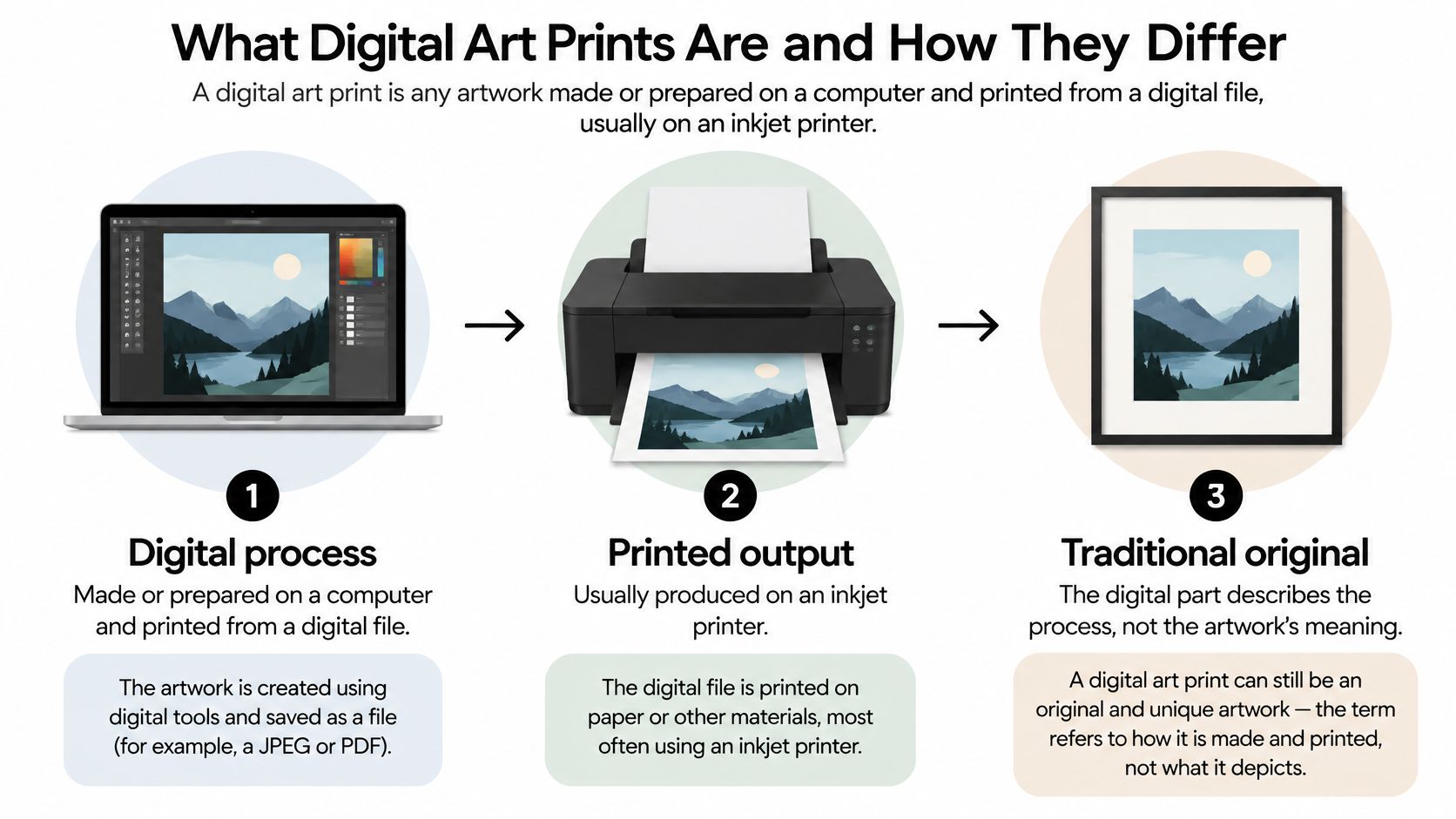
A digital art print is artwork made or prepared on a computer and printed from a digital file, usually using an inkjet printer. A tablet illustration, an edited photograph and a collage assembled in design software all qualify. Digital describes the production process, not whether the artwork has meaning, originality or decent taste.
Think of the file as the recipe and the print as the meal. The same recipe can produce different results depending on the ingredients and equipment. Likewise, the same artwork can look crisp on smooth matte paper, softer on textured stock or rather unfortunate on whatever's been sitting in the office printer.
The process is straightforward, but each stage affects the result.
Print formats compared
These formats overlap in places. Canvas prints, for example, can also be digitally printed. Use the comparison to choose the physical result you want, rather than treating every label as a separate artistic species.
| Format | How it is made | Typical finish | Best for |
|---|---|---|---|
| Digital art print | Digital file printed by inkjet on demand | Matte or textured fine-art paper | Bespoke designs, lyric prints and small runs |
| Screen print | Ink pushed through stencils, one colour at a time | Flat, slightly textured ink on paper | Bold graphic designs in larger runs |
| Offset poster | Plates on a press, cheap per copy at volume | Glossy or matte coated paper | Mass-market posters in big quantities |
| Photo lab print | Exposed onto photographic paper by a lab printer | Glossy, satin or lustre | Photographs and family snaps |
| Canvas print | Inkjet onto stretched canvas | Textured, often gallery-wrapped | Large statement pieces and rooms without glass |
Digital printing makes small runs practical. An artist can offer a niche music reference or a ground-inspired design without commissioning a warehouse full of identical posters. That's useful when your taste is more obscure B-side than supermarket greatest-hits compilation.
Digital artwork isn't a recent invention that arrived with online shopping, either. The Victoria and Albert Museum's history of collecting digital objects dates its earliest acquisitions to 1969 and explains that digital works were often collected as prints, with their physical materials and appearance influencing acquisition decisions.
For any listing, establish what you're buying: a downloadable file, a physical print or a framed piece. If artwork is printed from a digital file on demand, it's a digital art print. The important question is how well the seller turns that file into something worth hanging.
File Types, Resolution and Colour Profiles Explained
A print can be beautifully made and still disappoint if its source file lacks detail or its colours shift during production. Format, resolution and colour management decide whether the finished image looks right at the size you choose.
For flat colour, typography and linework, PNG or TIFF preserves detail without lossy compression. A high-quality JPEG suits photographs. Keep editable vector artwork where possible, and avoid social-media downloads: compression can leave fuzzy lettering and blocky edges that become obvious when enlarged.
Check the file at its final size
Use 300 pixels per inch at the intended print size as a practical preparation target, especially for lyrics and fine linework. Large artwork viewed across a room can tolerate lower resolution. Enlarging a small file does not restore detail, much like an amplifier cannot improve a recording made inside someone's coat pocket.
Pixel dimensions needed for 300 ppi at each size
The pixel counts below are calculated from the listed dimensions and rounded up. They're preparation targets, not a guarantee that the source image contains sharp detail.
| Print size | Dimensions (mm) | Pixel dimensions at 300 ppi |
|---|---|---|
| A5 | 148 x 210 | 1749 x 2481 |
| A4 | 210 x 297 | 2481 x 3508 |
| A3 | 297 x 420 | 3508 x 4961 |
| A2 | 420 x 594 | 4961 x 7016 |
| A1 | 594 x 841 | 7016 x 9934 |
| A0 | 841 x 1189 | 9934 x 14044 |
Check proportions as well as pixel count. Stretching artwork to fill a differently shaped sheet can turn a football into a rugby ball. Choose a crop that preserves the original shape.
Make colour predictable
Screens create colour with RGB light; printers reproduce it with ink on paper. A print's appearance depends on the output conditions, so ask the printer which ICC profile matches the specific printer, ink and paper. Use that profile to soft-proof the artwork before ordering.
The Centre for Fine Print Research at UWE Bristol developed custom colour profiles for pigmented inkjet output on artist-quality, pH-neutral papers. Its work demonstrates why the specific ink and paper combination affects colour range, density and hue.
Use this production routine:
- Keep a wide-gamut master. Preserve colour information before making an output-specific copy.
- Soft-proof with the printer's paper profile. An ICC profile lets suitable software simulate the intended print conditions.
- Calibrate the monitor and use neutral viewing light. A screen set too bright can make the print look disappointingly dark.
- Approve a physical proof before a substantial order. Inspect lettering, shadow detail and important colours on the actual stock.
Our guide to getting the best print quality explains what to check in the finished output. If a proof looks muddy, check the profile, paper settings and viewing conditions before blaming the artwork.
Papers, Inks and Finishes That Last
A print's real value shows up on the wall: colour should stay convincing, the paper should suit the image, and the finish should work with your room's light. Judge ink and paper together, because each affects how the other performs.
The results below compare colour change in four ink-and-paper combinations during conservation testing. Lower ΔE means less change from the original colour.
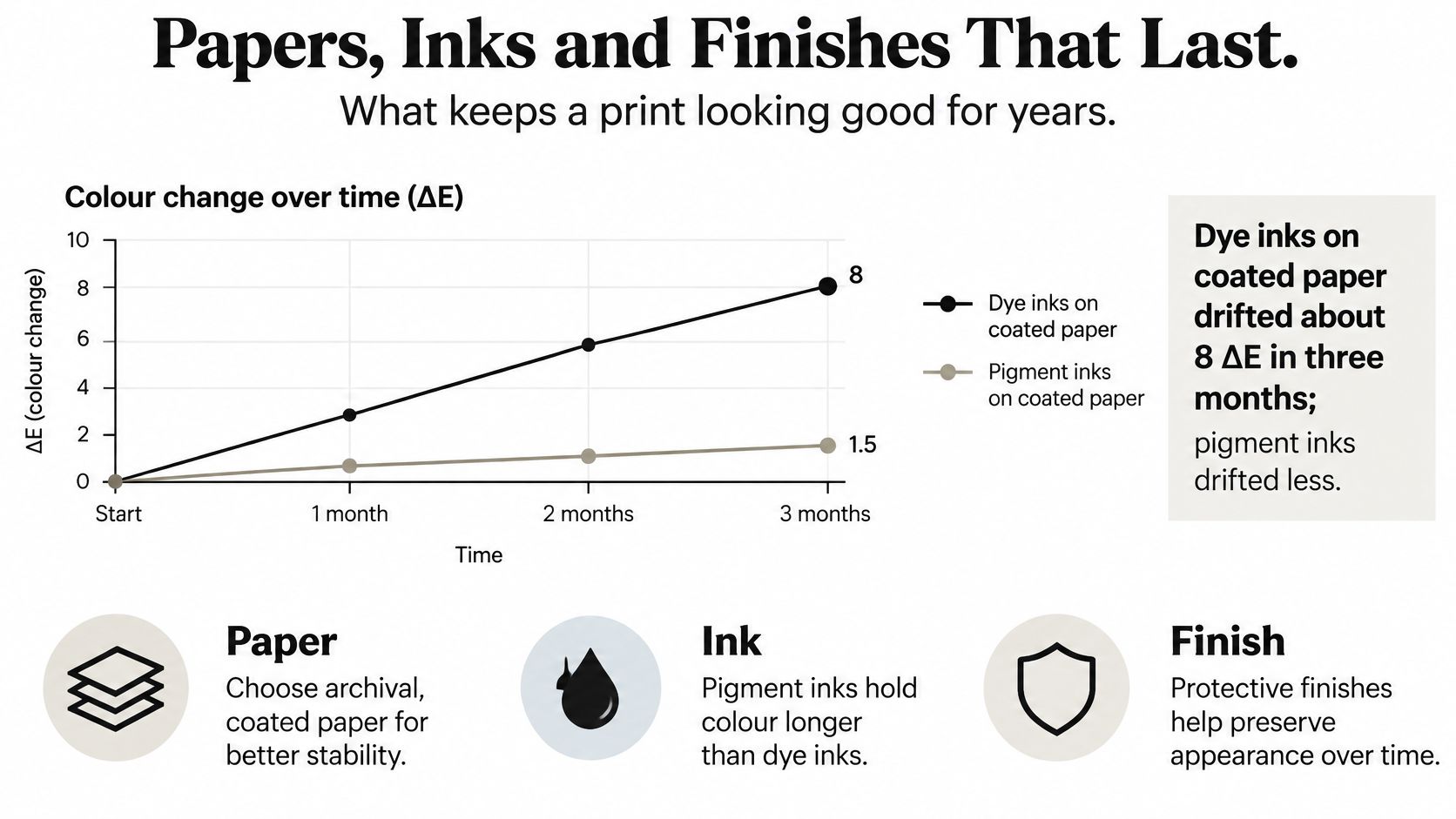
Colour drift by ink and paper after three months
These results apply to the combinations tested, not every print carrying the same ink label.
| Ink and paper | Average colour change (ΔE) | What it means on the wall |
|---|---|---|
| Dye ink on coated paper | 8.05 | Greater drift, with vulnerable magenta contributing to a green-blue cast |
| Dye ink on uncoated paper | About 2 | More stable than the tested coated dye combination |
| Pigment ink on coated paper | 1.12 | Colour held comparatively well in this test |
| Pigment ink on uncoated paper | 1.23 | Colour held comparatively well in this test |
Fading can affect colours unevenly. If magenta fades from a saturated image, reds and purples may shift towards green or blue. For artwork built around precise colours, choose a print made with materials suited to keeping those colours stable.
Choose a finish for the artwork
Striped Circle prints on brilliant-white, 250gsm heavyweight matte paper that is smooth, glare-free and acid-free. Acid-free paper avoids the deterioration risk associated with acidic stock, though no paper is immune to ageing.
Matte is a strong choice for typography and rooms with awkward lighting. Gloss can give photographs extra punch, but reflected light may compete with the image. Textured paper can suit painterly work; pronounced texture may interrupt small lettering.
For a closer look at surface choices, read our guide to print paper types. This video offers another look at print production.
UV-filtering glass or acrylic adds protection, but direct sunlight can still harm a print. Keep moisture away from frame edges and choose mounting materials suited to preserving the artwork.
- Ink: Prefer pigment for long-term colour display.
- Paper: Choose acid-free stock suited to the image.
- Glazing: Add UV filtering in bright rooms, then position the frame away from direct sun.
Sizing and Framing Without the Guesswork
Choose the wall before the size. A print can look enormous on your phone and disappear above a sofa. Conversely, an oversized portrait in a narrow passage can make walking to the kitchen feel like entering a manager's disciplinary meeting.
As a visual starting point, let the artwork occupy a generous proportion of the furniture beneath it without reaching its edges. For a gallery group, keep gaps consistent and judge the arrangement as a whole, including mounts and frame mouldings.
Print size and where it works best
Our size options are A5, A4, A3, A2, A1 and A0, with unframed or natural wood, black wood and white wood framing where offered. A5 and A0 are unframed only, so include separate framing in your plan.
| Print size | Where it works | Framing note |
|---|---|---|
| A5 | Gallery clusters, downstairs loo, shelf | Unframed only |
| A4 | Desk, kitchen shelf, gallery set | Natural, black or white wood frame where offered |
| A3 | Hallway, over a sideboard, office desk | Natural, black or white wood frame where offered |
| A2 | Above a sofa, bedside wall | Natural, black or white wood frame where offered |
| A1 | Statement wall, large office, bed head | Natural, black or white wood frame where offered |
| A0 | Double-height hallway, office feature wall | Unframed only |
Measure the opening, not just the outside
Match the paper to the frame's internal capacity, then check the mount opening separately. A mount overlaps the print to hold it in place, so lettering near the edges needs enough breathing room. Don't assume the dimensions on a frame label describe the visible artwork area.
Our poster frame sizing guide helps untangle those measurements. For a practical explanation of fitting and presentation, Famous Movie Posters also explains how to find the right UK poster frame.
Say you have a 1.2 m-wide wall area above a compact sofa. You could mock up a portrait A1 or a pair of portrait A2 prints, but check the outer frame dimensions before committing: mounts and mouldings make the arrangement wider. In a narrow hallway, a single A3 may feel calmer and be easier to appreciate at close range.
Before drilling: Mark the complete outer frame shape with painter's tape, stand at the doorway and assess it from your usual seat.
Leave the mock-up in place for a day. Move it if it feels cramped, competes with a lampshade or requires visitors to perform neck exercises.
Choosing Music and Football Prints That Fit Your Room
A ground-inspired print can make a hallway feel personal before anyone reaches the living room. Ipsos research for the Independent Football Regulator found that 88% of surveyed fans of clubs in the top English and Welsh men's divisions considered football important to national culture and identity, while 64% considered it important to their personal identity. Choose a familiar stadium or matchday route for a room where you want that connection to be visible.
Match the reference to the room
Music belongs where you'll enjoy the association. A lyric above the record player creates a natural connection; a favourite band reference behind your desk makes the office feel less like somewhere you've been sentenced to answer emails. Pick wording you'll still enjoy after reading it repeatedly.
For football, a stadium silhouette, familiar approach to the ground or matchday reference can suggest your club without turning the sitting room into a merchandise counter. Choose the place you care about, such as the ground or your matchday route.
Humour suits the spaces where people pause. Kitchens, home bars, hallways and downstairs loos give visitors time to notice a visual joke without making it the centrepiece of every conversation.
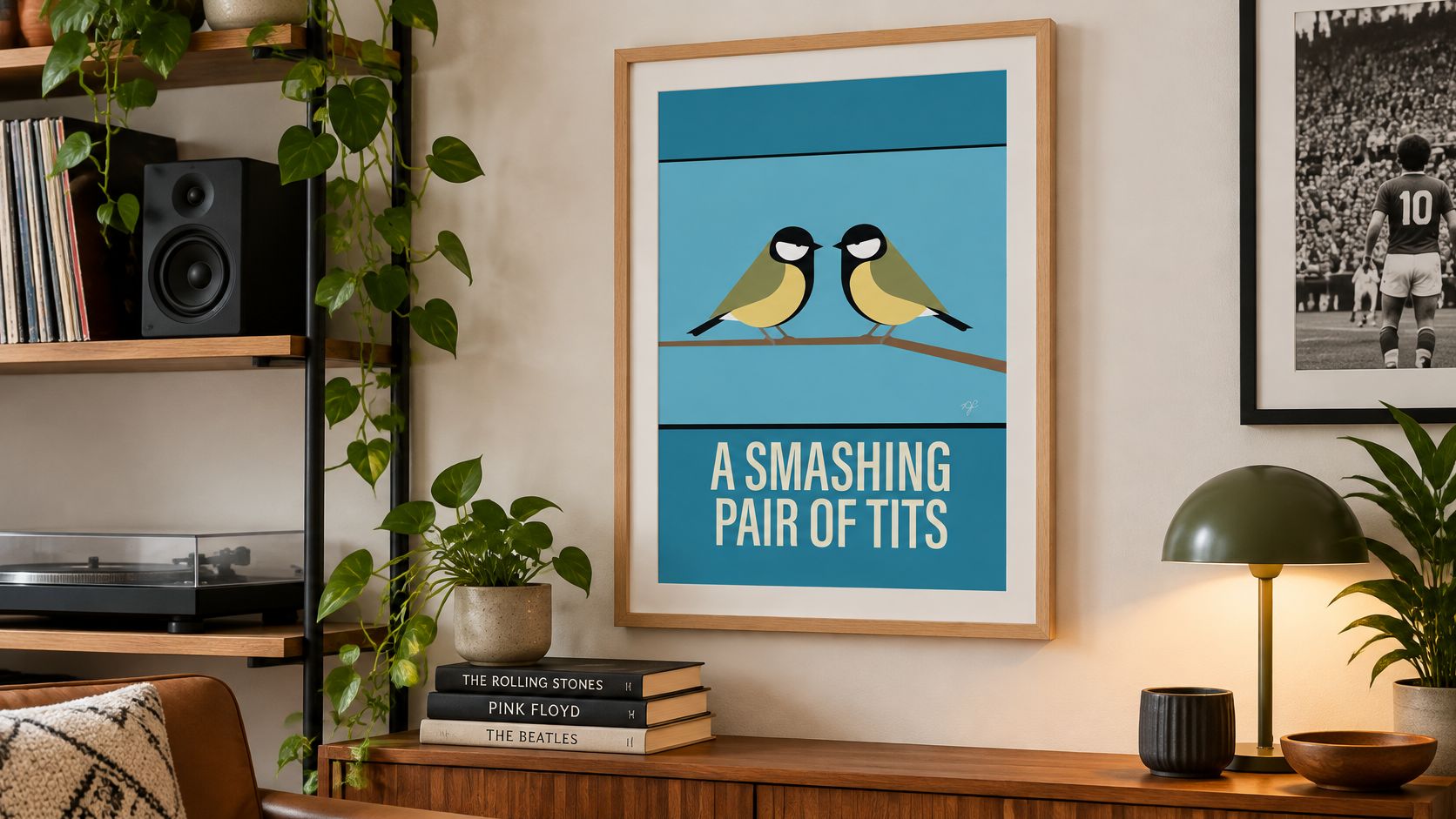
Our “A Smashing Pair of Tits” wall art print features a pair of great tits in a clean, modern style. It's a bird joke with enough restraint to survive being introduced to your parents.
The clean composition shows how a cheeky subject can still look considered.
Keep the room in charge
- Borrow a colour: Pick a shade already present in cushions, furniture or a rug.
- Give bold artwork space: Let a strong design lead rather than surrounding it with competing statements.
- Consider the mood: A break-up anthem might be excellent songwriting and questionable bedroom diplomacy.
For furniture-level inspiration, Gorins Furniture & Mattress offers home decorating ideas for sports fans. Start with the room's existing arrangement, then choose a print that belongs in it. The sofa should still get a look-in.
Pick the room first and the theme second. Your wall should reveal something about you, not look as though an algorithm emptied your interests into a shopping basket.
Caring for Your Print So It Lasts
A print doesn't need museum-level fuss, but it does need sensible treatment. Light, moisture and handling are the problems to manage. Most damage is easier to prevent than disguise behind an optimistically large mount.
Keep these everyday care priorities in mind.
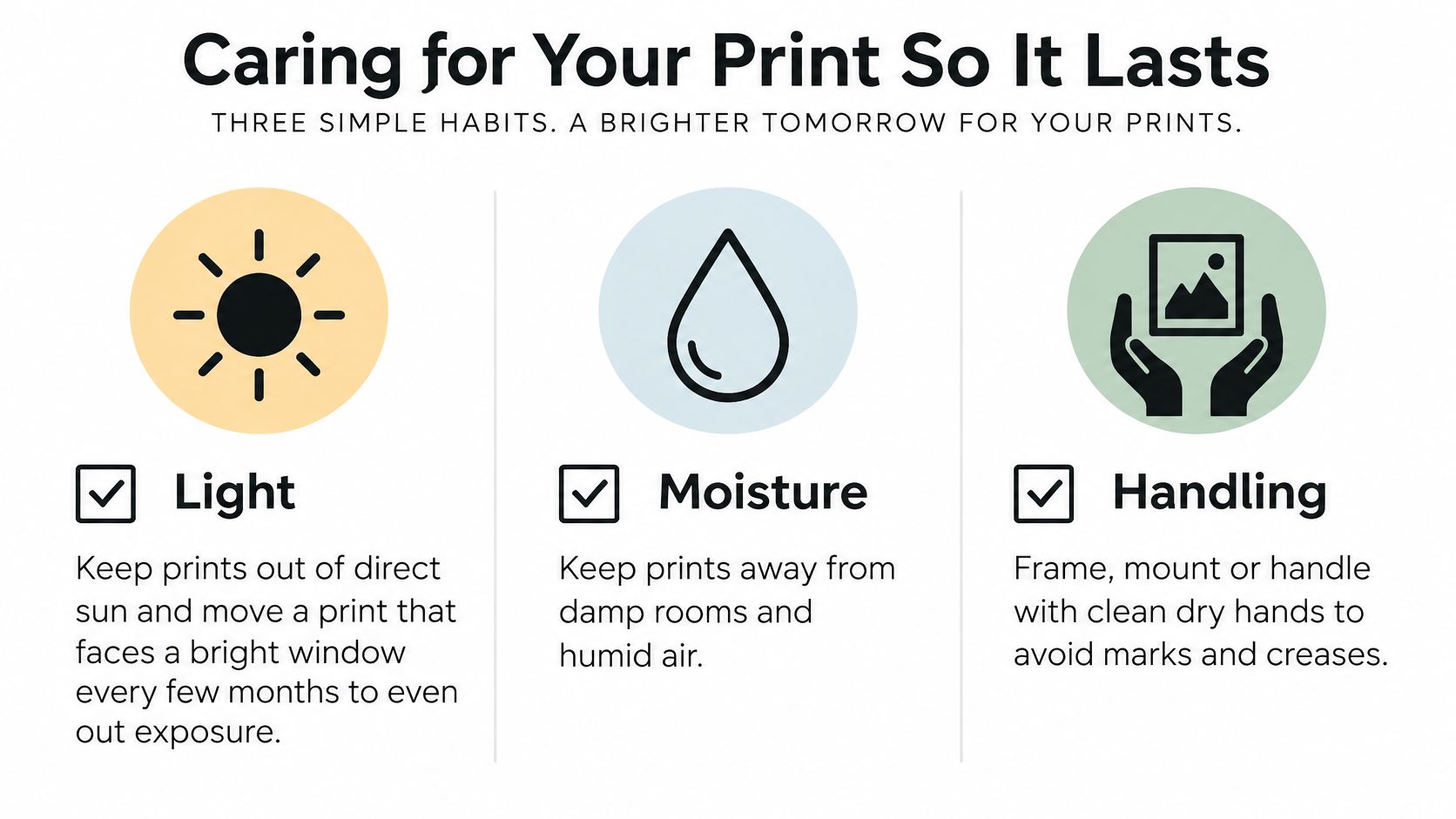
Control the display environment
Watch where daylight lands as the seasons change. If a print faces a bright window, reassess its position periodically rather than leaving it to receive prolonged exposure. Moving it elsewhere reduces further exposure; it won't reverse fading that's already happened.
Avoid persistently damp walls, poorly ventilated bathrooms and kitchen positions beside the hob. Steam, grease and fluctuating humidity are poor companions for paper. Keep frames clear of radiator heat rather than hanging them directly above it.
Choose picture hooks rated for the complete framed weight. Use a spirit level and a paper spacing template for groups, and check the view with the lamps switched on before fixing the final position.
A wall can be convenient for hanging and still be a terrible place to display a print.
Handle and clean it properly
- Hold the edges: Use clean, dry hands and support the sheet so it doesn't buckle.
- Store it flat: Use a clean protective folder or board sleeve, and don't force a flat print into a narrow tube.
- Dust gently: Use a clean, soft brush on an exposed surface without scrubbing.
- Keep liquids away: Never apply household sprays or a wet cloth directly to the artwork.
- Clean glazing separately: Use a dry microfibre cloth, taking care not to push moisture or debris into frame edges.
For a move, protect an unframed print inside a clean sleeve between rigid boards. Put bubble wrap around the rigid outer protection, not against the printed surface. Protect framed pieces at the corners and prevent neighbouring objects from pressing against the glazing.
Make a seasonal inspection part of your normal tidy-up. Check corners each spring for curling, look for damp marks around the backing and reassess anything that has spent winter near a radiator. A small change in position is preferable to discovering your favourite print has developed the texture of a pub crisp packet.
Choose a Print and Order It With Confidence
Compare the total landed cost: artwork, printing, frame, glazing, mounting and postage. For a download, include professional printing and any proof or replacement you might need. A physical print's headline price isn't the finished-room price either.
Aviva reported in 2025 that 24% of UK adults had bought affordable art during the previous year, spending an average of £476 each. Affordable art attracts mainstream buyers, but a sensible budget still needs to cover the whole purchase.
Check the rights and the practical details
- Understand what you own. Buying a physical print doesn't normally transfer copyright. Treat personal display as the default, and check the terms before scanning, reproducing or commercially exploiting the design. Reselling the physical object is different from producing copies for resale.
- Check third-party material. Lyrics, club badges and player imagery can involve separate rights. A seller's rights in their composition don't automatically clear every element within it.
- Confirm the deadline. Our prints are made to order. Check the stated production and delivery information against the date you need, especially for gifts.
- Know who prints it. We print everything in-house on professional Epson printers. That keeps file preparation and physical production with the same business, rather than leaving you to coordinate separate suppliers.
- Choose for the room. Our prints are offered in 9 colours. Select the option that works with your furnishings rather than assuming your usual favourite will suit every space.
- Read the proof and returns terms. Establish whether a proof is available, how damage should be reported and what applies to personalised purchases before paying.
Digital doesn't mean copyright-free
The National Archives' guidance on AI and copyright explains that the Copyright, Designs and Patents Act 1988 applies to computer-generated artistic works, with section 9(3) identifying the author as the person making the necessary arrangements. Protection still raises originality questions, so purely automated output shouldn't be assumed to carry strong exclusive rights.
Digital art and AI-generated art aren't interchangeable. Human drawing, editing, typography and composition matter, and no buyer should interpret an AI label as permission to copy freely.
For broader room planning, decorating with Guynn Furniture & Mattress provides another way to consider wall art alongside furniture. Keep that complete outcome in mind when comparing purchase routes.
A download avoids shipping a finished print, but unsuccessful home printing can consume extra sheets and ink. Professional printing may avoid those trial runs; it doesn't automatically prove a lower environmental footprint. Choose a route you can complete well.
Choose one wall, measure it, select the size and theme, then check the complete cost before ordering. The best print is the one you'll enjoy seeing every morning, not the one with the most persuasive sale badge.
Striped Circle offers music, football and playful wall art, made to order and printed in-house for homes and offices with personality. Visit Striped Circle, choose a design that means something to you, and give that blank wall something better to do than hold up the ceiling.
