
Don't Let Your Family Business Go The Way Of Oasis: A Guide To Succession Planning
Running a creative family business is a bit like being in a band; the chemistry is everything. But family business succession planning is all about deciding who takes lead vocals when the original frontman hangs up the mic. It’s less about dusty paperwork and more about making sure your brand’s legacy continues for a second, third, and fourth album. It's the difference between being The Rolling Stones and... well, Oasis after 1997.
Why Succession Planning Is Your Next Headline Act
Let’s be honest, "succession planning" sounds like something for corporate giants in glass towers, not a family-run print shop that started in a spare room. But thinking about the future isn't selling out; it's making sure the music never stops. It's the moment you stop being The La's with one perfect album and start building a back catalogue.
It’s about setting the stage for the next generation to remix your greatest hits and create their own. This ensures the business you’ve poured your heart into doesn't just become a one-hit wonder.
We get it. Here at Striped Circle, we’re a family operation through and through—you can learn a bit about who we are and how our dynamic shapes the brand. Thinking about a handover feels a million miles away when you’re busy designing a new Northern Soul print or debating whether Noel or Liam was the real talent. The day-to-day hustle just takes over.
More Than Just a Niche Scene
It's easy to think of family businesses as small players, but we're the festival headliners of the UK economy. The UK family business sector is a powerhouse, with around 5 million family-owned firms generating a staggering £2,805 billion in revenue in 2023.
That accounts for nearly half of the entire UK private sector's turnover and supports 15.8 million jobs. It’s a massive contribution, as highlighted in these findings on the economic impact of family businesses.
Despite this, a surprising number of creative businesses stumble when it comes to passing the torch. The same passion that built the brand can sometimes make it difficult to let go or to plan for a future you're not steering. It's the classic 'difficult second album' syndrome.
Succession planning isn’t an exit strategy; it's a continuity strategy. It’s the ultimate act of confidence in what you’ve built, proving it’s strong enough to thrive with new hands at the tiller. Or, in football terms, it's less 'end of an era' like Fergie leaving and more 'smooth transition' like Liverpool replacing Klopp.
This flowchart breaks down the journey from protecting your legacy to embracing the future remix.
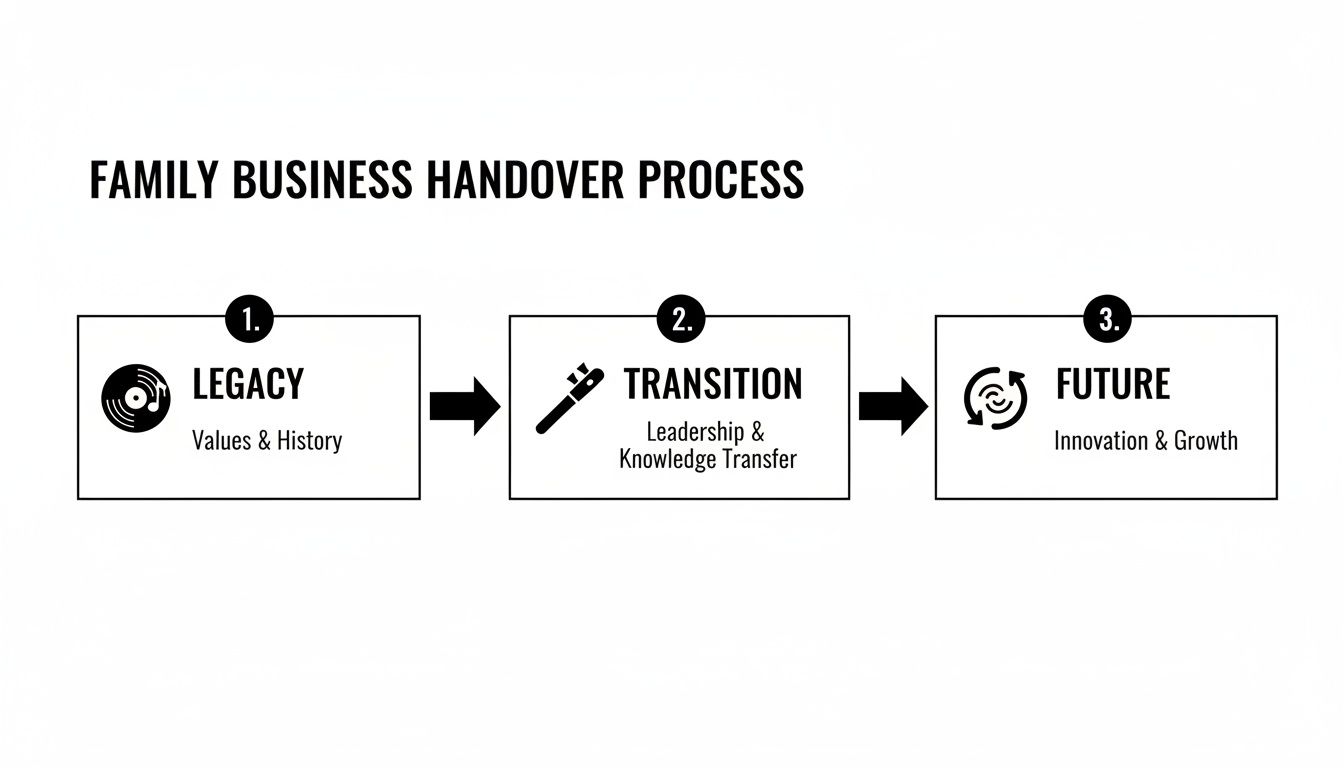
The process shows that handing over the business isn't a single event but a journey. It’s about preserving the original vibe while empowering a fresh take, creating a roadmap to keep the brand relevant and successful for years to come.
Choosing Your Next Frontman or Frontwoman
Right, you’ve poured your heart and soul into building something special. It’s got a loyal following, a distinct vibe, and it’s paying the bills. But like any legendary band, there comes a time when you have to think about the future lineup. You’ve got talent waiting in the wings—a kid with a sharp eye for design, a nephew who’s a wizard with social media, a daughter who could sell ice to a penguin. But who’s really ready to take centre stage in your family business succession plan?
Let's ditch the old-school rule where the eldest child automatically gets the keys to the kingdom. That’s like making Ringo the lead singer just because he was there first. Choosing a successor is less about birth order and more about spotting genuine passion, skill, and a vision that respects the original hits while adding a killer new solo.
It's a tricky balance, for sure. A recent survey of family businesses found that 10.5% of owners put off planning simply because they're worried the next generation isn't truly ready to lead. This isn't just about technical ability; it's about seeing if they have the heart for the gig. Do they want to be on the tour bus for the next 20 years?
More Than Just a Famous Last Name
At Striped Circle, this is a conversation we're having in real-time. We’re a family operation through and through, and our teenage sons are already part of the mix. They’re constantly bringing fresh ideas to the table, whether it's debating which Oasis lyric will make the best new print or suggesting a TikTok strategy that sounds completely bonkers to us but probably isn’t.
Involving them now isn’t about forcing them into the business; it’s more like a long-term audition. We’re getting a real sense of where their talents lie naturally. One might have the creative spark for design, while the other might have the commercial brain to manage the tour bus. The key is to observe without pressure.
Your job isn’t to clone yourself. It's to find someone who can take your sound and play it in new stadiums you never even dreamed of. It’s about evolution, not repetition. It's The Beatles going from 'Love Me Do' to 'Sgt. Pepper's'.
Mentoring the next in line is absolutely crucial, but it shouldn't feel like a boot camp. You want to nurture their creativity, not squash it with a rigid "this is how we've always done it" attitude. It’s like handing over a classic Fender guitar—you teach them the chords, but you have to let them write their own songs.
Assembling The New Lineup
So, how do you decide who fits where without causing a family feud worthy of a Gallagher brothers documentary? Start by looking at the roles your business actually needs, not just the family members you have available. It's staggering, but 45.9% of family businesses don't have a formal plan, often because these conversations just feel too awkward to start.
To get around this, think of your business as a band with different instruments:
- The Lead Singer (The Visionary): This is the creative force, the one who sets the tone and connects with the audience. They live and breathe the brand. The Liam.
- The Lead Guitarist (The Songwriter): Flashy, but with substance. The one writing the hits, handling the strategy, the marketing, and getting your name out there. The Noel.
- The Bassist (The Operator): The steady hand that holds it all together. They manage the day-to-day—printing, shipping, customer service. The groove is everything.
- The Drummer (The Financial Guru): The backbone of the operation. They keep the rhythm, manage the money, and make sure everything stays on beat.
Once you’ve defined the roles, you can have honest, albeit slightly awkward, chats about who has the aptitude and desire for each part. Framing it this way turns a difficult personal decision into a practical, team-building exercise.
This table breaks down how different personalities might slot into key roles within a creative setup like ours.
Successor Roles: Who Fits Where?
| Role | Key Skills | Best Suited For | Potential Pitfall |
|---|---|---|---|
| The Creative Director | Visionary, artistic flair, deep understanding of the brand's aesthetic. | The family member who is always sketching, suggesting new designs, and lives for the culture your brand represents. | Can be resistant to commercial pressures or "selling out" the artistic vision. |
| The Operations Manager | Organised, practical, detail-oriented, and unflappable under pressure. | The one who loves spreadsheets, creates systems for everything, and gets a weird satisfaction from a perfectly packed order. | May struggle with the chaotic, fast-moving nature of a creative environment. |
| The Marketing Lead | Outgoing, tech-savvy, great communicator, understands trends. | The nephew who built a huge following for his meme account or the daughter who instinctively knows what will go viral. | Might chase trends that don't align with the core brand identity. |
| The Finance Head | Analytical, risk-averse, good with numbers, strategic thinker. | The quiet one who always asks "but is it profitable?" and enjoys making the numbers work. | Could be too cautious, potentially stifling creative risks that could pay off. |
Ultimately, choosing your next frontman or frontwoman is about finding the right blend of talent to keep your band on the road. It's about building a lineup that can take your brand on a world tour, not just keep playing the same old set at the local pub.
Writing Your Band's Manifesto
Even the most rebellious punk bands had a code. The Clash had a strict 'no flares' policy, and The Ramones wouldn't be seen without their uniform of leather jackets and ripped jeans. For your family business, it’s far better to get these rules down in writing. It creates a solid framework to ensure family drama doesn't derail the business, Oasis-style.
This is your backstage pass to building a structure that can handle any creative differences or family feuds. Think of it as your band's manifesto, or what the corporate world calls a family charter. This document clearly lays out the ground rules: who gets a say, how big decisions are made, and the process for joining or leaving the business. It’s your pre-emptive strike against future arguments.

This isn't about being stuffy or overly formal; it’s just about being clear. A well-written charter is the difference between a band that tours for decades and one that implodes on stage after two albums. It's the absolute bedrock of good family business succession planning.
Assembling Your Producers And Sound Engineers
Every great band needs a solid team behind the scenes. Think George Martin for The Beatles or Rick Rubin for… well, just about everyone. For your family business, this means putting together a board of advisors—your trusted producers and sound engineers who can offer an objective perspective when you're too close to the music.
This doesn't have to be a formal boardroom affair. Your advisory board could simply include:
- A trusted accountant: Someone who can keep you honest about the numbers.
- A long-term supplier: They know your business from the outside in.
- A mentor from another creative business: Someone who has already navigated these choppy waters.
These advisors aren't there to run the show, but to offer guidance and hold you accountable. They're the ones who can tell you when a creative idea is a chart-topper or a B-side best left in the vault. Having this external input is absolutely vital for making unbiased decisions.
Separating The Business From The Family Sunday Roast
One of the biggest hurdles is separating ownership from day-to-day management. Just because someone is part of the family doesn't automatically mean they should be running the company's finances. It's crucial to define roles based on skill, not just your surname.
This professional approach is something businesses are adopting worldwide. For instance, in Central and Eastern Europe, where a massive 64% of family-owned firms are still under first-generation leadership, there's a huge push to establish proper governance. PwC's 2023 survey found that these businesses are creating formal communication rules and systems to transfer knowledge—a lesson UK businesses can definitely learn from.
As you write your family business's manifesto, establishing the right legal framework is essential. You might want to explore resources on understanding business structures like an LLC in Canada to see how different setups provide clarity and protection. While the legal specifics might differ, the principle of creating a clear legal entity is universal.
Your family charter should be a living document, not a dusty rulebook. Revisit it annually to make sure it still reflects where the business—and the family—is heading. Think of it as remastering your classic album for a new audience.
Creating this structure might feel like a lot of work, especially when you're busy running the day-to-day. But it's the single most important thing you can do to ensure your legacy survives. After all, you’ve put in the hard graft to get this far; it's worth taking the time to write a killer final track that ensures the band plays on. And if you're just starting out and dreaming of this stage, our guide on how to start a print-on-demand-business can help you build the foundations right from the very beginning.
Navigating The Legal and Financial Maze
Alright, let's get into the part of the process that’s a bit less glamorous than designing a new print but is, without a doubt, the most critical. This is where we tackle the legal and financial maze—the nuts and bolts that hold your entire succession plan together. Getting this right is the difference between a seamless handover and a family fallout that could make a Christmas dinner with the Gallaghers look positively serene.
Honestly, this is the section most people drag their feet on. It feels complex, a bit morbid even, and certainly isn't as exciting as picking out new colour palettes for next season. But putting it off is like a band heading out on a massive tour without a roadie or a sound engineer. You’re just setting yourself up for chaos.
A shocking number of UK business owners are doing just that. Research shows that less than half—just 47%—of family business owners have even started a formal succession planning process. It's even more concerning when you look at personal estate planning, where a mere 32% have an up-to-date will. You can discover more insights about this planning gap and see why it’s so vital to get ahead.
Gift, Sale, Or A Bit of Both?
So, how do you actually hand over the reins of the business? Picture it like passing on a prized vintage record collection. You could gift it, sell it, or find a middle ground. Each path has a totally different impact on your tax bill and the long-term financial health of the business.
- A Straight-Up Gift: This is a generous move, but don't think HMRC won't be interested. Gifting shares can trigger both Capital Gains Tax now and Inheritance Tax implications later on. It’s often a better strategy for a gradual transfer spread over several years.
- An Outright Sale: This is the cleanest route. You agree on a price, they get the business, and you can enjoy a clean break. The downside? It can saddle the next generation with a hefty amount of debt if they need to borrow to fund the buyout.
- The Hybrid Approach (Management Buyout): For many, this is the sweet spot. The next generation buys the business from you, but the purchase is often funded by the company's future profits over a set period. You get a steady retirement income, and they get a manageable route to full ownership.
Choosing the right structure is a cornerstone of a solid family business succession plan. There's no one-size-fits-all answer; it's all about finding what works for your family's financial situation and your vision for the company's future.
Your Legal Backline Defence
Now, let's talk about the paperwork. These documents are your ultimate defence against future disagreements and fallouts. Think of them not as boring legal jargon, but as the agreed-upon rules of the road that keep everyone on the same page, especially when emotions might be running high.
A shareholder agreement is your band's pre-nup. You really hope you'll never need it, but you'd be absolutely mad to go on tour without one. It clearly outlines what happens if someone wants to leave, gets sick, or has a massive falling out over creative direction.
Your legal toolkit should, at a minimum, contain these three essentials:

- An Up-to-Date Will: This is completely non-negotiable. Without one, the laws of intestacy will decide who gets your shares, and that might not be the person you intended. A scenario like that can plunge the entire business into utter chaos overnight.
- A Shareholder or Partnership Agreement: This document is your official rulebook. It defines how shares can be transferred, how key decisions are made, and what happens in worst-case scenarios. Crucially, it protects the business from being torn apart by personal disputes.
- Trusts and Powers of Attorney: A trust can be a very smart way to hold shares for the next generation, helping to protect assets and manage tax liabilities effectively. A Lasting Power of Attorney ensures someone you trust can make critical business decisions if you're ever unable to do so yourself.
Putting these legal instruments in place is probably the most important investment you can make in your business’s future. It’s what protects the legacy you’ve poured your heart into, ensures a fair process for everyone involved, and lets the next generation get on with what they do best—making great art, not fighting legal battles.
Managing The Big Announcement
You’ve done it. You've navigated the legal maze, crunched the financial sums, and your chosen successor is ready to take centre stage. But now for the tricky part—telling everyone. Once your family business succession plan is locked in, you can't just let the news leak out. You need to manage the big reveal.
Getting the communication right is everything. A clumsy announcement can stir up rumours, create uncertainty, and turn what should be an exciting new chapter into something that feels more like a messy band break-up. This is your chance to own the story and frame the handover as a positive step that reinforces your brand’s commitment to its legacy.
This isn’t about sending out a single press release. It's about having a series of thoughtful, well-managed conversations with three very different groups: your family, your team, and your customers. Each one needs to hear the news in a slightly different way.
The Family Huddle
First things first: you talk to the family. Before a single whisper gets out, you need to gather your inner circle. This isn't a job for a group text; it's a proper, sit-down conversation, ideally with everyone together.
The goal here is to manage expectations and emotions. Let's be honest, some family members will be thrilled, others might be anxious, and a few could be put out that they weren't chosen. You need to be ready for the full spectrum of reactions.
- Present a United Front: The outgoing and incoming leaders need to deliver the news together. This projects confidence and stability from the get-go.
- Explain the 'Why': Don't just state what is happening. Walk them through why this is the best move for the business and the family's long-term future.
- Acknowledge Their Feelings: Make space for questions and let everyone express how they feel. This is more than a business deal; it's a major family milestone.
Getting this initial conversation right sets the tone for everything else. When the family is on board, it's so much easier to project confidence to everyone else.
Reassuring The Crew
Your team comes next. These are the people who keep the show on the road day in, day out. The last thing you want is for them to worry that the new boss is going to change the setlist, sell the tour bus, or replace them all with synths.
Call an all-hands meeting to share the news personally. Your message should be one of stability and opportunity. Reassure them that the ship is steady and heading for exciting new places, not steaming towards an iceberg.
Your team’s biggest question will be, "What does this mean for me?" You need to address this head-on. Stress that the company's core values and mission aren't changing and that their roles are secure.
This is also a great moment to signal a fresh start. A quick refresh of the office can do wonders for morale. If you’re stuck for ideas, our guide on choosing prints for offices has some brilliant tips for livening up the walls. It’s a small touch, but it can make a big difference in showing that positive changes are underway.
Broadcasting To Your Fans
Finally, it’s time to tell your customers—your loyal followers who buy your art and love what you do. For a brand like Striped Circle, this is a fantastic storytelling opportunity. You aren't some faceless corporation; you're a family business, and this transition is part of your authentic journey.
You want to frame the announcement as a natural evolution. This isn't an ending; it’s the next verse in the brand’s song. Use your blog, social media channels, and email newsletter to share the news.
- Introduce the New Leader: Don't just name them—tell their story. Why are they passionate about the business? What's their vision? Let your customers get to know them.
- Honour the Founder's Legacy: Pay tribute to the person stepping back. Share a few career highlights and thank them for building something so special.
- Look to the Future: Get people excited about what’s coming next. Maybe tease a new product line or a fresh project to show that the creative energy is stronger than ever.
Handled well, the announcement doesn't just prevent uncertainty; it becomes a powerful marketing moment that makes everyone feel like they’re part of your brand’s next big thing.
Your Succession Planning Questions Answered
So, you’ve scouted the talent, written the manifesto, navigated the legal minefield, and even planned the big announcement. Yet, like the last few minutes of a tense cup final, a few nagging questions might still be swirling around. Don’t worry, we've got you. Here are the answers to some common queries about family business succession planning in the creative world.

When Is The Right Time To Start Succession Planning
Honestly? About five years ago. But since we haven't invented a time-travelling DeLorean powered by screen-printing ink, today is your next best option.
The ideal time to start is 5-10 years before you actually plan to step back. This gives you a proper runway to get the business prepped, train your successors, and handle all the legal stuff without a last-minute panic.
For us at Striped Circle, involving our sons early wasn't officially "planning," but it absolutely laid the foundation. It’s less about your age and more about the business's stability. When things are good and the rhythm is steady, that's the perfect moment to plan for the encore.
What If My Kids Don't Want To Take Over
This is a big one, the emotional equivalent of your favourite band's lead singer announcing a solo career. The absolute worst thing you can do is force it—that’s a recipe for resentment and a business run without passion. Start with an open, honest chat, completely free of pressure.
If they're just not feeling it, your plan simply shifts gears. It's not a disaster; it's a different route.
- Promoting a key, long-serving employee who already bleeds your brand colours.
- Exploring a sale to a third party who respects your legacy.
- Arranging a management buyout with your trusted team.
Your legacy isn't just about the family name on the door; it's about the business thriving and the art continuing to make people smile. Having a Plan B is essential, not a sign of failure.
How Do We Put A Fair Value On The Business
Valuing a family business is part spreadsheet wizardry, part family therapy session. The most important step you can take is getting an independent, professional valuation. This is non-negotiable. It takes the emotion and guesswork out of the equation and gives you an objective number to start from.
The "fair" part comes into play with how you structure the deal. It doesn't have to be a simple, lump-sum cash sale that could cripple the new leadership.
The goal isn't just to get a good price; it's to create a deal that feels right for everyone and allows the business to flourish without being saddled with enormous debt. Think of it as a transfer fee paid in instalments, not all at once.
Consider a gradual buyout paid from future profits or retaining a minority stake for a few years. For a comprehensive overview on ensuring a smooth transition for your company, you might find a practical guide to small business succession planning helpful. It's all about finding a creative solution that works for your unique family dynamic.
Can We Have Two Of Our Kids As Co-Leaders
Absolutely, but it needs a crystal-clear script. Think of it like a band with two lead singers—it can be legendary like Lennon and McCartney, or a complete disaster waiting to happen. To make it work, you must define their roles with surgical precision.
Who has the final say on creative direction? Who handles the money and the boring-but-important stuff? Their skills should complement each other, not compete. A formal shareholder agreement isn't just a good idea here; it's essential. It needs to lay out decision-making powers, how to resolve disputes (because there will be disputes), and what happens if one wants to leave the band.
With a strong framework in place, co-leadership can be an incredible asset, blending different strengths to create something truly special. Without one, you're just setting up a future headline act for a very public, very messy break-up.
At Striped Circle, we believe in building something that lasts, whether it’s a high-quality print of your favourite album lyrics or a business that can be passed down with pride. We hope this guide has given you the confidence to start planning your own legacy. Check out our collection at https://www.stripedcircle.com and find a piece of art that tells your story.
