
How to Start a Print on Demand Business from Your Sofa
So, you want to know how to start a print on demand business? At its heart, it’s a beautifully simple loop: create a design, sell it online, and let a partner print and ship it for you. You get to focus on the fun, creative parts, while they handle all the logistics. That means your spare room stays a spare room, not a makeshift warehouse.
Your Guide to Becoming a Print Mogul
Welcome to the glorious world of print on demand (POD). Think of it as the perfect side hustle for creatives who'd much rather be designing than wrestling with rolls of packing tape. Forget sinking your life savings into a mountain of unsold t-shirts. POD is the rockstar of e-commerce—all the glory, none of the logistical headaches. It's the ideal setup for artists, designers, and frankly, anyone with a cracking idea for a poster that just needs to exist.
Here at Striped Circle, we started as a lockdown family project, fuelled by a shared love of music and football. That little project quickly turned into a mission to plaster the UK's walls in unique, cool art. We’re living proof that if a family obsessed with iconic goal celebrations and obscure indie lyrics can do it, so can you.
What Is This POD Magic Anyway?
Print on demand is a refreshingly straightforward business model. Instead of buying stock upfront and hoping it sells, products are only created after a customer actually buys one. It’s a wonderfully low-risk way to sell custom products without the faff of managing inventory.
Here’s a simple look at the process. It's less complicated than VAR but infinitely more rewarding.
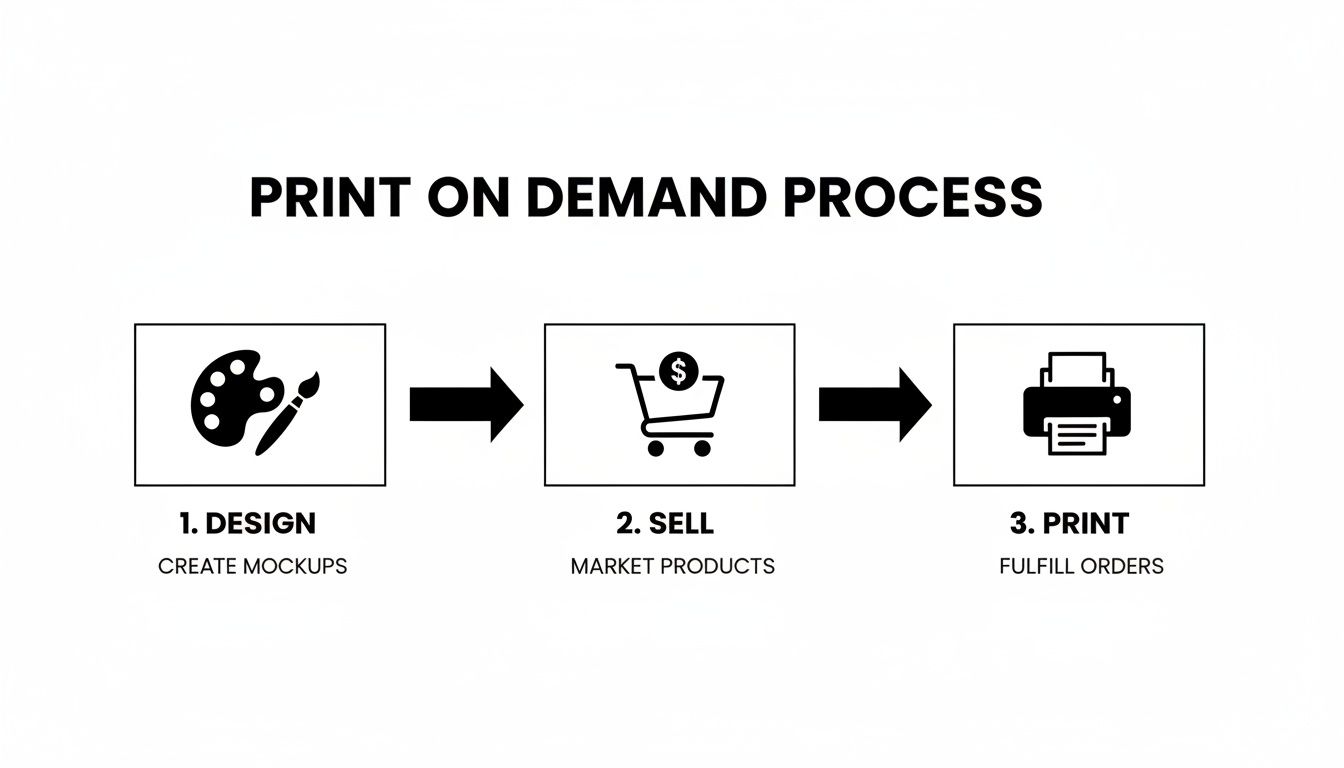
The real beauty of this model is that your primary job is to create incredible artwork—like our template for prints—and market it to your tribe.
And the market for this stuff is absolutely massive. The UK print-on-demand scene pulled in a whopping USD 587.3 million in 2024 and is tipped to explode to over USD 3.6 billion by 2033. This growth is driven by people wanting unique, personalised things that truly reflect their passions.
Think of yourself as the manager of a band. You don't have to play the instruments or drive the tour bus; your job is to create the vision and find the fans. The POD supplier is your road crew, making sure the show goes on flawlessly behind the scenes.
This hands-off approach to fulfilment is exactly what makes getting started so accessible. For a really solid overview before you dive in, check out this complete guide to starting a print on demand business. It's a fantastic resource for getting the full picture.
Finding Your Niche Without Losing Your Mind
Choosing a niche for your print-on-demand business is a bit like picking a favourite album. It has to be something you genuinely love, because you’re going to be living, breathing, and probably dreaming about it for the foreseeable future.
Just saying "I sell cool posters" is as useful as a band saying "we play music." Right, what kind? For who? Is it thrash metal for toddlers or sea shanties for accountants? To avoid shouting into the void, you need to find your tribe.
For us at Striped Circle, it was a total no-brainer. Our house runs on two things: music and football. Trying to build a brand around anything else would have felt like Oasis trying to write a dubstep album—forced, awkward, and ultimately doomed. Your passion is your secret weapon; it's what stops this from feeling like a job and keeps it feeling like a proper creative outlet.
From Vague Idea to Solid Ground
So, where do you start? Grab a notebook (or the nearest napkin) and jot down everything you’re into. Seriously, nothing is too weird or too specific.
- Your Passions: Are you obsessed with 90s indie bands? Do you know every iconic FA Cup goal from the last three decades? Maybe you're a connoisseur of brutalist architecture or have an encyclopaedic knowledge of obscure sci-fi films. Write it all down.
- Your Communities: Where do you hang out online? Are you part of a subreddit dedicated to Gaelic football? A Facebook group for Northern Soul collectors? These are your people, and they’re already gathered in one place.
- Your Problems: What print do you wish you could find but can't? Maybe you've always wanted a minimalist print celebrating a specific lyric from a Manic Street Preachers B-side. If you want it, chances are someone else does too.
Once you have a list, it's time to play detective and see if these passions have legs. This isn't about ditching your brilliant idea if it’s not mainstream; it’s about figuring out how to frame it so people can find it. The first foundational step to success is mastering how to find profitable niches that have real staying power.
Validating Your Niche Like a Pro
Having a passion is one thing; knowing if other people will actually spend money on it is another. You need to do a bit of research, but don’t worry, this isn’t about creating complicated spreadsheets. It’s more like digital people-watching.
Start by heading over to marketplaces like Etsy. Type in your ideas and see what comes up. If you search for "post-punk lyric prints" and get thousands of results, that’s great—it means there's a market.
The trick is to then go deeper. Look for gaps. Maybe everyone is doing Joy Division, but nobody is making prints for The Chameleons or The Sound. That’s your angle.
Think of it like this: You’re not just selling a poster. You’re selling a knowing nod to a shared memory, a piece of a subculture, an inside joke. Your niche isn’t just ‘football’; it’s ‘that unbelievable last-minute winner that only true fans remember.’
Social media listening is another goldmine. Search for relevant hashtags on Instagram or Pinterest. What are people sharing? What’s the vibe? If you see loads of people posting pictures of their memorabilia or sharing quotes from their heroes, you’re onto something.
This process helps you carve out a unique space so you’re not just another face in the crowd but the go-to shop for a specific, passionate audience. This is how you start a print on demand business that lasts.
Right, let's get to the main event. Your designs are your headline act, your star striker—the reason people show up in the first place. No pressure, then!
Whether you’re a seasoned graphic designer who speaks fluent Adobe Illustrator or just someone with a brilliant idea scrawled on a napkin, this is where the magic happens.
Think of this section as your creative bootcamp. We’re going to run through the tools of the trade and, crucially, how to celebrate your passions without receiving a sternly worded letter from a lawyer.
Your Design Toolkit
First things first, you need something to create your masterpiece on. Don’t panic; you don’t need to sell a kidney to afford top-tier software. There's a tool for every budget and skill level.
- The Pro Gear (Adobe Illustrator & Photoshop): These are the Premier League players of the design world. Illustrator is your go-to for vector graphics (logos, typography) that can be scaled to any size without losing quality. Photoshop is the undisputed master of pixels and textures. They come with a learning curve, but the creative freedom they offer is immense.
- The User-Friendly Heroes (Canva & Kittl): Think of these as the incredibly talented Championship teams pushing for promotion. Canva is brilliantly intuitive, packed with templates and easy-to-use features that can get you creating quality designs in minutes. Kittl is another gem, especially for the vintage, retro, and typographic styles that are hugely popular right now.
- The Free Agents (GIMP & Inkscape): If your budget is tighter than a defensive back four, these open-source alternatives are fantastic. GIMP is the free equivalent of Photoshop, and Inkscape is a solid vector alternative to Illustrator. They absolutely get the job done without costing you a penny.
Whichever tool you choose, the non-negotiable part is ensuring your final design files are high resolution. You're aiming for 300 dots per inch (dpi) to avoid your prints looking blurry, like a dodgy VAR decision.
The Elephant in the Room: Copyright
Now for the serious bit. You can't just find a picture of Liam Gallagher, stick a quote on it, and start selling it. Likewise, slapping a Manchester United crest on a poster is the fastest way to get your online shop shut down. This is where you need to be clever, creative, and, above all, original.
You're aiming for 'inspired-by' artwork, not blatant copies. This is your chance to show your artistic flair and create something truly unique that captures the spirit of your subject.
Think of it like a brilliant cover song. You're not just playing the same notes; you're offering a fresh interpretation. Your design should be a tribute, a parody, or an artistic take that stands on its own two feet.
This is exactly how you turn a potential legal headache into a genuine creative opportunity.
Creating Legally Sound, Inspired-By Art
So, how do you make art about your favourite band or football moment without infringing on copyright? You focus on what makes your interpretation unique. For anyone specifically looking to capture the vibe of their favourite artists, we've got a whole guide on creating unique music poster designs that delves deeper into this very topic.
Here’s how to stay on the right side of the line:
- Focus on Typography: Instead of using a band's logo, create a beautiful typographic print of a lyric that resonates with you. A powerful line from a song, presented in a unique font and style, can be far more evocative than a simple logo.
- Embrace Parody and Satire: This is a classic approach. Think of a funny, satirical take on a famous player's celebration or a manager's infamous quote. The key here is that it must be transformative—your work needs to add a new, humorous meaning.
- Go Minimalist and Abstract: Can you represent a football club's historic kit using just a series of coloured stripes? Could you illustrate an album's concept using abstract shapes and colours? This approach is all about suggestion and artistic expression, creating a piece that fellow fans will instantly recognise and appreciate.
- Create Original Illustrations: Draw your heroes. Paint a scene. Create a digital portrait. Your original artistic rendering of a person or moment is your own work. You're not using their official photos; you're creating something new from scratch.
By channelling your fandom into original art, you not only sidestep legal trouble but also create something far more valuable and interesting. Your customers are buying your unique vision, and that’s what will make your print-on-demand business a roaring success.
Choosing Your Platform and Print Partner
Alright, you’ve got your designs ready to go. Now, you need two crucial components: a "roadie" and a "stage". Think of your print partner as the roadie—the behind-the-scenes hero who ensures your art is printed perfectly and shipped without a hitch. Your online platform is the stage—the place where you showcase your work to the world.
Choosing these partners is as critical as a band picking its lead guitarist. Get it right, and you're on your way to selling out arenas. Get it wrong, and you might find yourself playing to an empty room. Let's break down how to build the operational core of your new print-on-demand business.
Finding Your Trusty Roadie (The Print Partner)
Your print-on-demand supplier handles all the heavy lifting. They're the ones with the industrial-grade printers, the stacks of high-quality paper, and the logistical expertise to get your art from a digital file onto a customer's wall. Your reputation for quality rests entirely on their shoulders, so choosing wisely is non-negotiable.
When you're vetting potential UK-based partners, you need to put on your detective hat. Don't just glance at their prices; dig into the details that truly matter for your business.
- Order Samples, Always: I can't stress this enough. Before you commit to any supplier, order samples of your own designs. Feel the paper weight, check the vibrancy of the colours, and examine the sharpness of the print. If it doesn't impress you, it certainly won't impress your customers.
- Product Range: Do they offer the specific products you have in mind? If you’re dreaming of selling A3 giclée prints on beautifully textured art paper, you need to make sure they actually stock it and can produce it to a high standard.
- Integration: How smoothly does their service connect with your chosen online store? A seamless integration means orders flow automatically from your shop to their print queue, which is exactly the kind of hands-off automation you want.
Your supplier is your silent business partner. Their reliability is your reliability. A partner who delivers crisp, vibrant prints on time, every time, is worth their weight in gold records.
Choosing Your Stage (The E-Commerce Platform)
Now, where are you going to sell these masterpieces? This decision usually comes down to a classic dilemma: do you join a bustling marketplace with a built-in audience, or do you build your own branded empire from the ground up? It’s like choosing between playing a festival set or booking your own headline tour.
Both paths have their advantages, and the right choice really depends on your budget, your long-term goals, and how much control you want over your brand. Let's look at the two main contenders: Etsy and Shopify.
A Tale of Two Venues: Etsy vs Shopify
Deciding where to set up shop is a big first step. To make it a bit clearer, here’s a quick head-to-head comparison to help you weigh the options for your new print-on-demand venture.
Choosing Your Selling Platform Etsy vs Shopify
A quick comparison to help you decide where to set up your print on demand shop, based on key factors for new sellers.
| Feature | Etsy | Shopify |
|---|---|---|
| Audience | Huge, built-in audience of millions actively looking for unique, creative goods. | You build your own audience from scratch through marketing and SEO. |
| Ease of Use | Incredibly simple to set up. You can have a shop live in under an hour. | More of a learning curve, but offers immense customisation and control. |
| Branding | Limited. Your shop exists within the Etsy framework, so it looks like an Etsy shop. | Total control. Your store, your brand, your rules. It’s your own domain. |
| Fees | Lower upfront cost (listing fees are cheap), but transaction fees per sale add up. | Monthly subscription fee, but lower transaction fees (if you use Shopify Payments). |
| Best For | Beginners wanting to test ideas quickly with minimal risk and a ready-made audience. | Serious entrepreneurs aiming to build a long-term, scalable brand. |
Ultimately, there isn't a single "best" answer. Many successful sellers actually use both. They leverage Etsy for its massive reach to find new customers while simultaneously building their own Shopify store as the official home for their brand.
And the timing couldn't be better. This market is set for explosive growth. Globally, print on demand is projected to rocket from USD 11.0 billion in 2025 to a staggering USD 89.4 billion by 2035. The European market is a huge part of that, showing that people's appetite for unique, personalised art is only getting stronger. You can explore more detailed market projections to see the full scale of the opportunity.
Whether you start with a marketplace, your own site, or both, the key is to pick the platform that feels right for you and just get started. You can always expand your empire later.
Marketing Your Art Without Selling Your Soul
Right, you’ve got your niche sorted, your designs are looking sharper than a Gallagher brother's haircut, and your online shop is officially live. Brilliant. Now for the slightly terrifying bit: getting actual human beings to see it.
This is where you swap your designer's hat for a promoter's cap. But don't worry, you won't have to become some slick, soulless marketing guru.
Marketing your art is less about shouting "BUY MY STUFF!" and more about finding your people and having a proper chat. It’s about building a community of fans who get what you’re doing, whether that’s a shared love for a last-minute FA Cup winner or the genius of a particular Pulp lyric.
Get Social Without Being Sleazy
Think of social media as your virtual pub, your record shop, your stadium terrace. It’s where your tribe already hangs out. Your goal isn't just to flog prints; it’s to start conversations. Think less "30% OFF TODAY!" and more "Remember this absolute classic goal? What a moment."
Pick a couple of platforms where your audience lives and breathes. For visual products like ours, Instagram and Pinterest are the top dogs.
- Instagram: This is your gallery. Post high-quality mockups showing your prints in real-life settings—hanging on a wall above a record player or in a cool home office. Use Reels to show a sped-up video of your design process, or pair a print with the perfect song snippet. It's all about the vibe.
- Pinterest: This platform is essentially a massive digital mood board where people go to plan, dream, and discover. Create boards that align with your niche—"Indie Music Art," "Minimalist Football Posters," "90s Britpop Aesthetic." When someone is looking for ideas on how to decorate their walls with cool art, you want your prints to be the first thing they see.
The key is to post content that adds to the culture, not just advertises a product. Share trivia, ask questions, and celebrate the moments that inspired your art in the first place.
The Magic of Showing Up in Searches
Now for a term that sounds way more technical than it is: Search Engine Optimisation (SEO). All this really means is helping Google understand what your shop is all about. When someone types "unique Stone Roses print" into the search bar, you want your store to strut onto the stage like it owns the place.
You don't need to be a tech wizard. Just think like your customer. What words would they use to find your stuff?
Your product titles and descriptions are your secret weapon. Instead of calling a print "Oasis Poster," try something more specific like "Oasis Champagne Supernova Lyric Print - Britpop Wall Art." You're not just selling a picture; you're selling a feeling, a memory, a piece of cultural history.
Sprinkle these keywords naturally throughout your product pages, your 'About Us' story, and even your blog posts if you have one. SEO is a slow burn, not an overnight miracle, but getting it right is like having a secret roadie who works 24/7 to bring fans to your door.
Tell Your Story
Finally, don’t be afraid to be you. People buy from people, especially from small businesses. We started Striped Circle as a family during lockdown, bonding over our shared passions. We put that story front and centre because it's authentic, and it connects with people who feel the same way about music and football.
Share behind-the-scenes glimpses. Talk about the song that sparked a new design. Explain why a certain goal deserved to be immortalised in print.
Your story is your unique selling point; it’s the one thing no competitor can ever copy. By being genuine, you’ll attract customers who aren't just buying a print—they're buying into your brand and what it stands for. And that's how you build a fanbase that sticks around for the encore.
Answering Your Burning POD Questions
Right, you’ve made it this far, which means you’re probably either incredibly inspired or your brain is buzzing with a few last-minute questions. That’s completely normal.
Think of this part as the post-match interview, where we clear up some lingering thoughts before you head off to build your empire. Here are the answers to some of the most common queries we see from aspiring print moguls.
How Much Money Do I Need to Start a Print on Demand Business?
Honestly, you can get started for very little, and that’s the real beauty of it. This isn't like trying to buy a Premier League football club; the barrier to entry is refreshingly low. You’re not buying stacks of inventory, so your main outgoings are things like your e-commerce platform subscription (Shopify, for example), maybe some design software, and whatever you decide to put into marketing.
You could genuinely get a basic store up and running for less than £100.
The magic of the POD model is that you only pay your supplier for the product after a customer has already paid you. This massively lowers the financial risk, meaning you can test out that bonkers design idea without remortgaging your house.
This setup lets you be agile and test out new ideas without the fear of being left with a garage full of unsellable posters of a long-forgotten one-hit wonder.
What Are the Most Common Mistakes New Sellers Make?
Ah, the classic banana skins. We’ve seen a few, and some are more painful than watching your team concede in the 94th minute. Here are the big ones to sidestep:
- Ignoring Copyright: This is the absolute number one. It’s a surefire way to get your shop shut down faster than you can say "cease and desist." Be inspired, but always, always create original art.
- Forgetting to Order Samples: You absolutely must see, feel, and inspect your products before you start selling them. How can you rave about the quality if you’ve never even held the print in your own hands?
- Being Too Vague: A niche like "cool prints" is just too broad. You need to find your tribe. At the same time, don't just design what you think is cool without checking if anyone else on the planet agrees.
- Dodgy Customer Service: Even though a supplier handles the shipping, the customer relationship is 100% yours. If something goes wrong—and occasionally it will—it’s on you to make it right.
Avoiding these common pitfalls is a massive step towards building a business that lasts. When learning how to start a print on demand business, think of these as the golden rules.
How Should I Price My Products?
Pricing can feel like a dark art, but there’s a simple formula to get you started. First, work out your total cost. That’s the base cost of the item from your supplier (say, £8 for an A3 print) plus their shipping fee.
Once you have that total cost, you need to decide on your profit margin. A healthy margin is typically somewhere between 30-50%. So, if your total cost to produce and ship a print is £12, you might price it somewhere between £18 and £24.
Next, have a good nosy at what your competitors are charging for similar quality items. This gives you a solid sense of what the market will bear. You don't want to be the cheapest—that's a race to the bottom—but you also don't want to price yourself out of the game entirely.
A cracking little tactic is to offer free shipping over a certain order value, like £40. This encourages people to add an extra print or a card to their basket. Just make sure you’ve factored that potential shipping cost into your overall pricing structure so you don’t end up out of pocket.
We hope this guide has given you the confidence to turn your passion for music, football, or whatever makes you tick into something real. At Striped Circle, we’re all about creating art that puts a smile on your face, and we believe everyone with a great idea deserves the chance to do the same. Check out our collection for a bit of inspiration at https://www.stripedcircle.com.
