
Large Football Posters: Sizes, Prints and Display Tips
You're standing in the living room with a mug going cold, staring at a wall that has been blank since the last coat of paint. A tiny framed photo sits near the skirting and nobody notices it. The sofa has hosted more half-time arguments than actual guests, the playlist is already too loud, and the room still looks like it belongs to someone who never picks a side.
A big print fixes that faster than a new sofa. Large football posters turn a spare stretch of plaster into a matchday moment, whether you follow a Premier League side or you're still arguing about last Sunday's offside. Before you buy the biggest sheet on the menu, measure the wall, check the print and the paper, and only then pick a size. The blank patch you've been eyeing for months will not decorate itself.
Table of Contents
- Why Big Football Posters Still Turn Heads
- Football Poster Sizes from A5 to A0
- How to Test a Size on Your Wall
- Print Quality and Materials That Hold Up
- Styles That Suit Different Walls
- Hanging, Caring and Keeping Your Poster Sharp
- Confirm Your Size Before You Order
Why Big Football Posters Still Turn Heads
That tiny photo stays invisible. Put a large football poster on the same wall and the room starts talking before anyone sits down. Mates clock the ground. A partner clocks the line of type in the corner. Anyone walking past gets the humour, the loyalty and the taste in one glance, at home or in the office.
A striking print is the cheapest way to give a room a personality. The wall is already there, and it costs nothing until you decide what hangs on it. If you've been collecting club photos with QR codes from a Sunday league or a works five-a-side, those snaps belong in the group chat. The wall wants something you can read from the doorway.
Stick to six jobs and you'll buy with a clear head:
- Size chart: A5 through A0, and the job each one does.
- Wall test: tape, sightlines, and the view from the sofa.
- Print and paper: sharpness, finish, and what you can recycle.
- Styles: grounds, crests, lyrics, retro type, portraits, and the women's game.
- Hanging and care: fixings, rented walls, sunlight and dust.
- Buying: framed or loose, once the width is settled.
Grab the tape measure and find that blank wall. The group chat can wait.
Football Poster Sizes from A5 to A0
ISO 216 is the grown-up way to stop guessing in centimetres you half remember. Printways lists A1 at 594 × 841 mm and A0 at 841 × 1189 mm, and treats both as standard large-format poster sizes. Bigger sheets are meant for longer viewing distances, not for a wall you can touch from the armchair.
Each step doubles the area of the one below. A4 to A3 feels modest. A2 to A1 fills a wall. Every A-size shares the same proportions, so artwork scales between A0, A1 and A2 without cropping, as long as the file stays in proportion. Our UK poster sizes notes sit beside this chart if you want the domestic picture while you compare.
A0 has twice the area of A1. Blow an A1 design up to A0 without redesigning it and you gain space, but text and fine crest details look tiny. I would keep A1 for most living rooms and save A0 for a feature wall, an office or a fan room where you stand a few metres back.
Build the artwork at the exact output size. Late enlargement softens player silhouettes, club badges and small type. A frame, mount or border sits outside these numbers. The table is the print itself, not the finished display.
| Size | Dimensions (mm) | Area compared with A5 | Best job |
|---|---|---|---|
| A5 | 148 × 210 | 1× | Desk, pinboard or gift |
| A4 | 210 × 297 | 2× | Shelf or small frame |
| A3 | 297 × 420 | 4× | Hallway, kitchen or home office |
| A2 | 420 × 594 | 8× | Bedroom or living room wall |
| A1 | 594 × 841 | 16× | Statement wall |
| A0 | 841 × 1189 | 32× | Feature wall or fan room |
Say the clear wall is a modest terrace living room. Jumping from A2 to A1 is not a polite upgrade. It is eight times an A5 sheet versus sixteen times. That is the gap between a print that sits with the sofa and one that argues with the ceiling rose.
A5 (148 × 210 mm) lives on a desk, a pinboard or inside a card. A4 suits a shelf or a small frame. A3 holds a hallway, a kitchen or a home office. A2 earns a bedroom or living room wall. A1 is the statement. A0 is the feature wall or the fan room, and only when the tape says so.
How to Test a Size on Your Wall
Buying the largest poster because the product photo looks heroic is how a ground print swallows the bedside table. Test the size on the wall first.
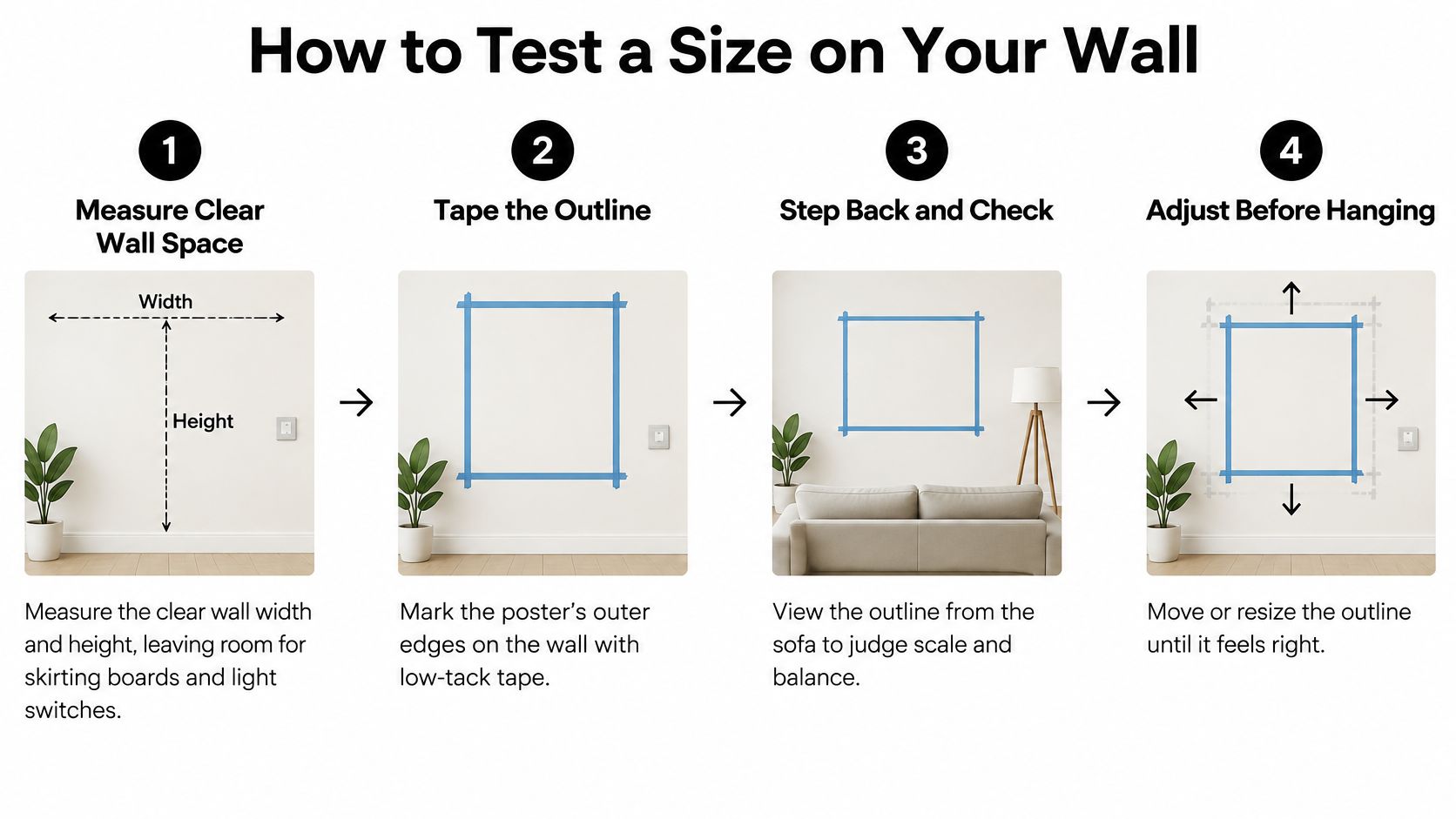
- Measure the clear wall. Take width and height, not the whole room. Leave skirting and light switches out of the usable patch, or the print will fight the electrics.
- Shortlist from the width table. One or two sizes, not five. A narrow pier between a door and a window is not an A0 moment, however much you love the club.
- Mark the footprint with masking tape. Use the print dimensions and low-tack tape. Photograph it if you want a second opinion before the card comes out.
- Stand where you look. Sofa, desk or doorway. A stadium or heritage print needs enough distance for the stands, the floodlights and a riverside walk to read. Too close and it turns into a blur of ink.
- Leave about 5 cm clear of sockets, radiators and furniture tops. That gap stops the sheet looking jammed against the sofa back, which is a very unglamorous way to lose an argument with a three-piece.
- Add the frame or border to the taped outline and check again. Glass and a mount can push you into the next footprint and add weight you did not budget for.
- If you rent, confirm the hanging method and the weight rating before you pay. A heavy sheet on plasterboard is a different problem from a pin on a pinboard.
A UK survey reported that 86% of supporters consider their home ground important to their connection with the club, including 43% who called it "absolutely vital", in coverage from London Loves Business. That feeling does not mean the biggest print. An oversized design can dominate a small bedroom, hallway or home office, which is where a lot of stadium sheets now end up.
Lighting and the furthest seat
Place the taped outline where a lamp will light it, not in direct window glare. Judge it under evening lighting, not only at noon when the room looks bigger than it is. Then stand at the furthest seat. A poster that works from the sofa can still look cramped from the doorway, like a full-back who seemed fine until the camera pulled wide.
Practical rule: If the tape already feels loud, the ink will feel louder.
| Clear wall width (portrait) | Largest sensible size | Clearance to leave | Watch out for |
|---|---|---|---|
| Under 40 cm | A4 | 5 cm from skirting and switches | Looks lost on a big wall |
| 40 to 50 cm | A3 | 5 cm from sockets and furniture | Frames add width fast |
| 50 to 70 cm | A2 | 5 cm from sofa or bed tops | Check the view from the sofa |
| 70 to 104 cm | A1 | 5 cm from ceiling and doors | Heavy prints need proper fixings |
| Over 104 cm | A0 | 10 cm from ceiling, doors and corners | Can overwhelm a small room |
The table is a shortlist, not a dare. Over 104 cm of clear width can take A0, and it can also overwhelm a small room if the ceiling is low. Drop a size when the tape crowds a door, a corner or the top of the sofa.
Print Quality and Materials That Hold Up
Pay for the file and the paper, not the lifestyle photo. Four checks sort the serious sheets from the blurry ones.
- Ask for artwork at the exact output size. Stretched files soften silhouettes, crests and small type. If the only file is a small image blown up at the last minute, walk away.
- Look at the sharpest detail. A crest edge or a line of lettering on a sample, or on a close product image, tells you more than a moody shot of a sofa.
- Compare colour. Screens rarely match ink. Reds that scream on a phone often settle on paper, which is usually a relief next to a yellow wall.
- Compare paper weight and finish. Heavier stock feels more premium in the hand. A matt finish cuts glare under room lights, which matters when the telly is the other lamp in the house.
What the sheet is made of
Finish and disposal travel together. Antalis treats FSC-certified paper as a recognised sustainability credential and says paper-based substrates suit indoor displays where outdoor durability is not required. Large-format printing still carries worries about energy, ink waste and PVC media. Newer choices include PVC-free, recyclable and fibre-based substrates, though those alternatives do not match PVC on cost, durability and versatility in every job.
For an indoor football poster, an unlaminated, responsibly sourced paper print you can keep lightweight is often more credible than a plastic-backed sheet sold as tough. Our notes on print quality show how that standard is handled on the sheets we sell.
Laminate the surface and you usually take the poster out of ordinary UK paper recycling.
| Material | Feel and finish | Recycling and disposal | Best for |
|---|---|---|---|
| Standard poster paper | Matt, lightweight | Usually suits ordinary paper recycling | Indoor walls and bedrooms |
| Laminated paper | Glossy and wipeable | Usually not suitable for paper recycling | Hallways and kitchens |
| Synthetic paper | Tear and water resistant | Not accepted as ordinary paper recycling | Damp rooms and rental homes |
| Rigid board or mounted print | Stiff, premium finish | Mixed waste once mounted, not paper recycling | Offices and feature walls |
Standard poster paper is the everyday indoor choice. It is light, it takes a matt surface, and it can usually go out with the paper recycling when you redecorate. Laminated paper shrugs off scuffs and a splash, which is why it earns a hallway or a kitchen, and why it fails that recycling test.
Synthetic paper resists tears and water, which helps in a rental where the print may move house with you. It is not a kerbside paper item. Rigid board looks premium on an office feature wall, weighs more, and leaves you with mixed waste once it is mounted. A matt print you can recycle beats a glossy one you cannot, once the wall needs a change and the club has signed someone new.
Styles That Suit Different Walls
A poster has to fit the room's job before it fits the club. A stadium panorama asks for a long viewing distance, while a crest in a hallway gets three seconds at most. Get the function right first and the badge picks itself.
- Stadium and ground prints want architectural detail: a stand, a riverside walk, a floodlit night. They need distance, the way a chorus needs a room that is not a cupboard. Hung too close, the floodlights turn into dots and the joke dies.
- Club crest and graphic prints are bold colour and simple shapes. Hallways and offices suit them because the allegiance reads at a glance, between the coat hooks or over a desk. Nobody needs a paragraph of small print in a corridor.
- Lyric and typography prints suit bedrooms and music rooms, where you read the line again on a quiet night. A wall that only shouts a scoreline gets old. A line you can sing does not, which is why song sheets outlast a lot of fixture lists.
- Retro matchday prints lean on faded colour and old-school type. Kitchens and games rooms love them. They look like a programme you meant to keep and, for once, kept.
- Player portraits want a feature wall with clear space around the figure. One player, one pose, nothing else competing for the eye. A portrait earns its wall by standing alone, so give it the biggest uninterrupted stretch you have.
- Women's football prints earn a feature wall of their own. In the 2023/24 England figures, women's football was recorded at 10% among adults attending live sport, in the Participation Survey quarterly table. A share that size deserves real wall space, and these prints carry A1 or A0 confidently.
A stadium sheet can bully a small room. A crest behaves in a corridor. If the room is for cooking, eating and arguing about VAR, retro type beats a full-bleed night match. If the room is for working, a graphic crest still reads between calls. Measure the clear width before you choose, then decide how loud that stretch of wall can go.
The badge is the easy part. The wall decides the rest.
Hanging, Caring and Keeping Your Poster Sharp
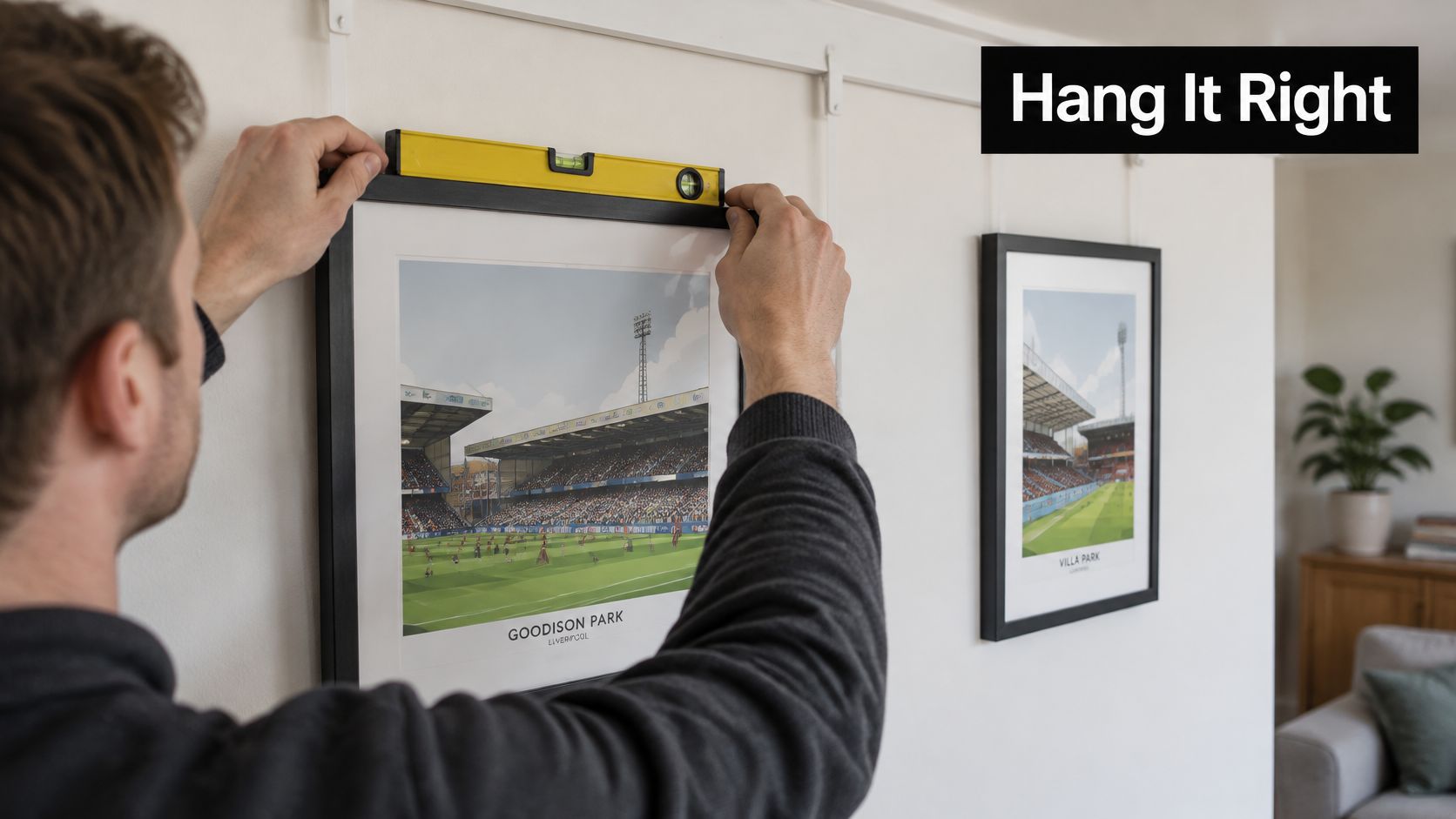
Good prints go wrong at the fixings, not in the design file. A level, a pencil and hardware that can take the weight will do more for the room than another hour of scrolling.
- Use hardware rated above the poster's weight. Two fixings for anything over A2. One nail and a hopeful spirit is how prints tilt by the time the second half starts.
- In a rented home, use a picture rail or strip hooks and read the lease before you drill. Styling a rental without losing deposit is worth a look if the tenancy reads like a yellow-card list. Rails and strips keep the plaster intact.
- Hang at eye level for the room. Put the centre of the print around 150 cm from the floor, lined up with the sofa or the desk, not with the ceiling. Ceilings in UK houses lie. Furniture does not.
- Keep it out of direct sunlight, and away from radiators and steamy kitchens. UV fades ink the way a long season fades a squad. Heat buckles paper, and a buckled crest is nobody's idea of a limited edition.
- Dust with a dry microfibre cloth. Skip spray cleaners on laminated prints. They mark the surface and leave a halo that no one asked for.
- If you move, roll prints into a tube. Keep flat prints dry and out of the sun. A tube in a damp shed is not storage. It is a plot twist you will regret in August.
Glass, glare and the no-frame option
Framed prints need a little extra clearance because the glass throws light back at you. Shift them off the brightest window, even if the tape looked fine at dusk. If a frame is more hassle than you want, hanging posters without frames keeps the sheet light and the wall simpler, which matters in a rented box room.
A short clip on getting a frame level saves a lot of squinting with a spirit level in your teeth:
A poster kept dry, flat and out of the sun still looks sharp years later. That is the whole care plan. No ritual, no special spray, no speech at the unveiling.
Confirm Your Size Before You Order
Your measured width is the ceiling, and the frame counts towards it. If the moulding would push the footprint past that width, drop a size. Squeezing it in anyway is how you lose the gap you left for the socket.
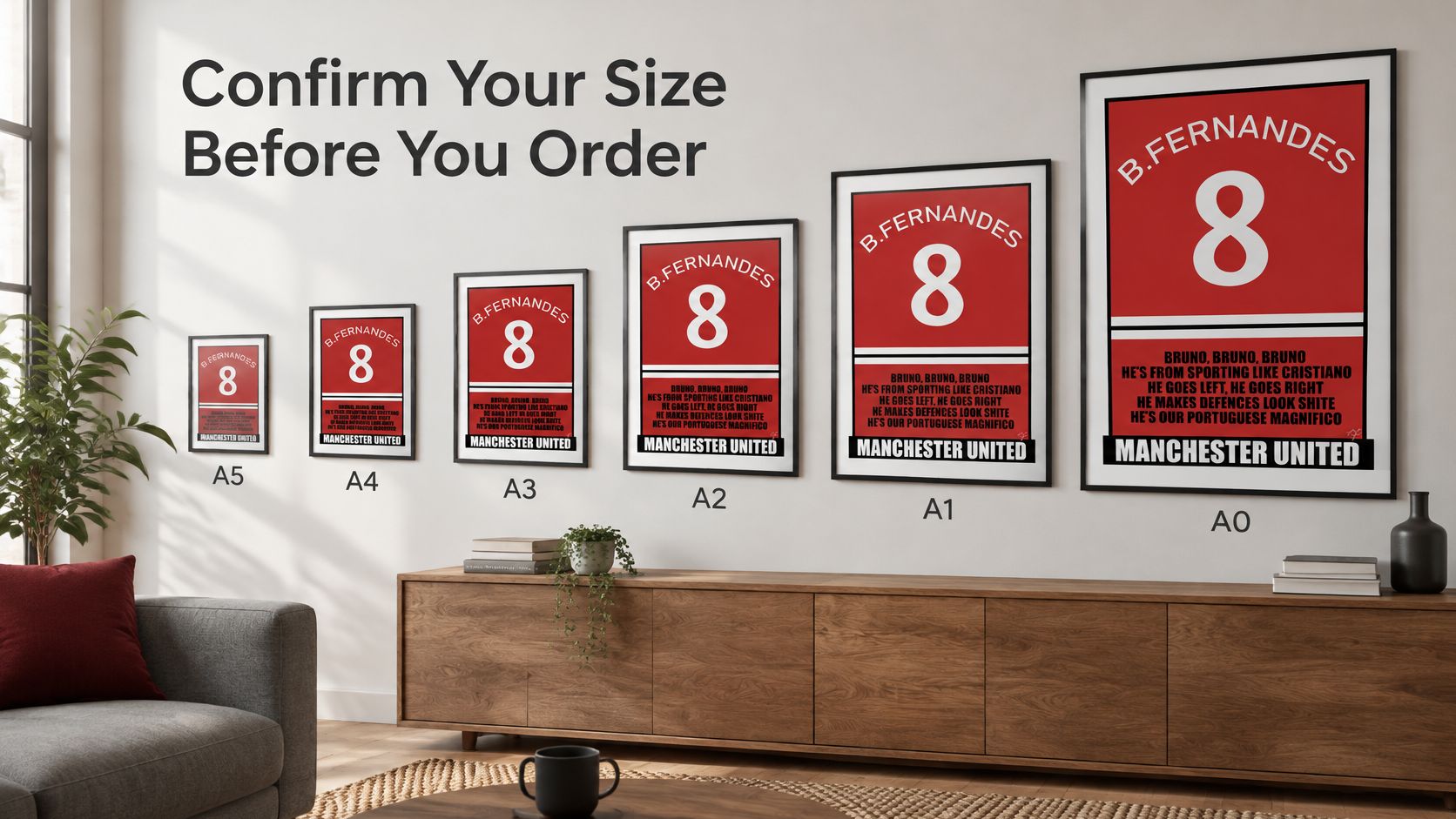
The range covers clubs in the Premier League, Championship, League One, League Two and the Scottish Premiership, and The Beautiful Game Stadium Art Collection celebrates football's most iconic grounds. The Fulham print comes in sizes from A5 up to A0, unframed or framed, with one catch: A5 and A0 prints are only available unframed. If your heart is set on a frame, the run stops at A1.
A single-player sheet is the easier fit when the wall is already busy. The Bruno Fernandes Manchester United - Football Print suits a home office or a living room, and the Newcastle United Sean Longstaff Football Print does the same job under a different badge.
Add the print to the basket, then send a wall photo to a mate. If the reply is anything other than "that's too big", you're probably fine.
Striped Circle prints football, music and the odd line you already know by heart, from small sheets up to the ones that take a feature wall. If you've measured the gap and you want a ground, a lyric or a player that makes you and everyone else smile, have a look through Striped Circle. Pick the size that passed the tape test.
