
Level Up Your Walls With Limited Edition Artwork Prints
 Limited edition artwork prints are your ticket to owning something genuinely special—a piece of art with a strictly limited production run, making it far more exclusive than a standard poster. Think of it as getting a backstage pass instead of just buying a concert t-shirt; it’s a tangible piece of the magic, reserved for proper fans.
Why Your Walls Deserve More Than Generic Posters
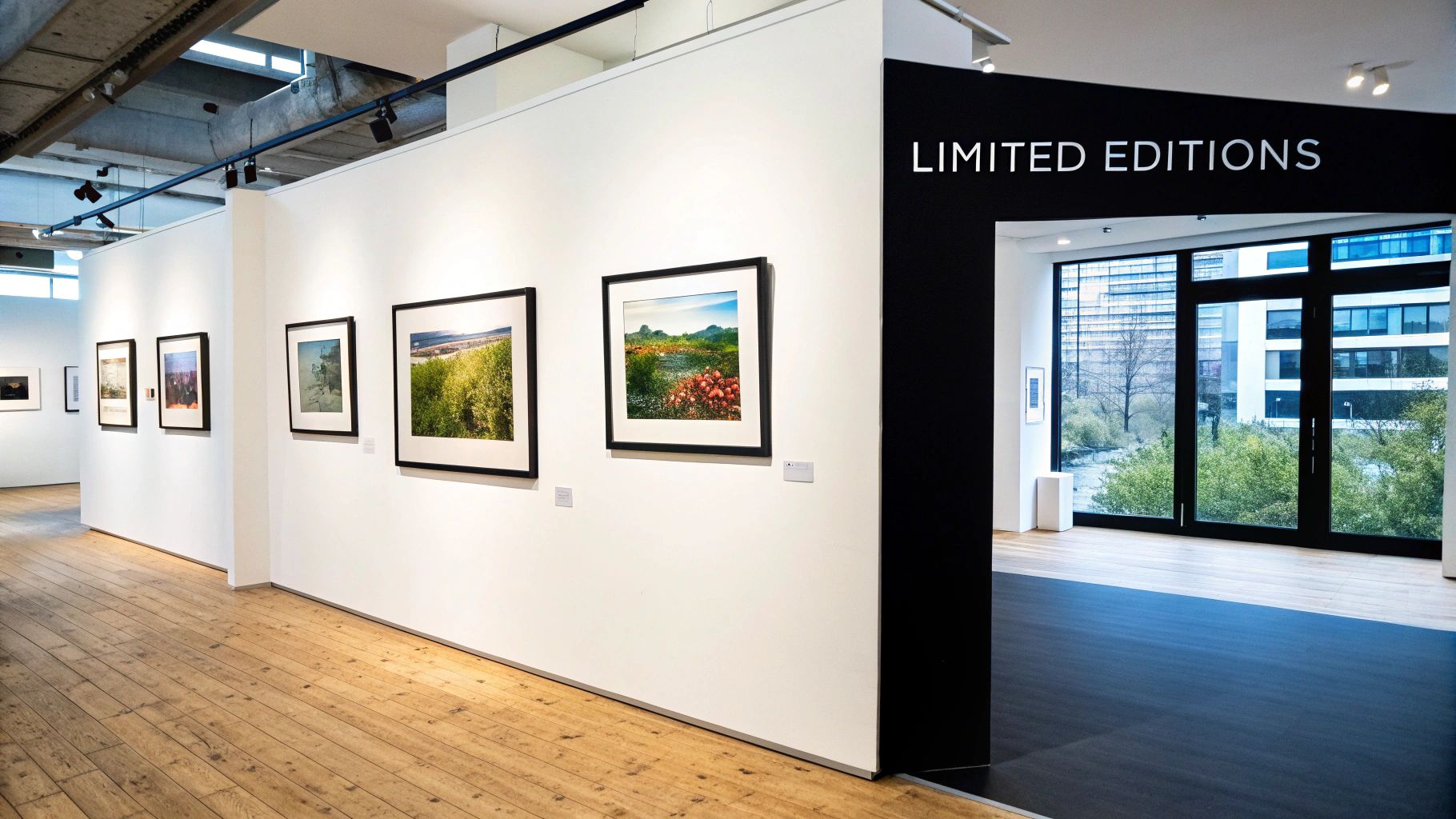
Right, let’s have a word. Take a look at your walls. Are they a bit… beige? A bit boring? Are they still sporting that dog-eared poster you’ve had since uni, held up with a sad piece of Blu Tack? If so, consider this an intervention from your friendly neighbourhood art enthusiasts. Your walls are crying out for a promotion, and we’re here to help you give them one.
Your home or office is a reflection of you. It’s the backdrop to your life, your personal highlights reel. So why on earth would you decorate it with the same generic, mass-produced tat that’s hanging in thousands of other homes? That soulless, big-box store "Live, Laugh, Love" print isn't fooling anyone. It says nothing about your passion for that last-minute winner at Wembley, that life-changing festival set, or that film quote you drop into every other conversation.
The Antidote to Bland
This is where limited edition artwork prints come storming in, like a frontman kicking over a mic stand for dramatic effect. These aren't just pictures; they're statements. They’re a celebration of the things you actually care about, designed by artists who are just as obsessed as you are.
Think of it this way: a standard poster is like hearing your favourite song on a tinny radio. A limited edition print is like being in the front row, feeling the bass drum in your chest. It’s an entirely different experience.
Owning a limited edition print is about more than just filling a blank space. It’s about joining an exclusive club of people who share your impeccable taste. When the print run is finished, that’s it—no more will be made, ever.
This scarcity is what makes them cool. You’re not just buying a piece of paper; you’re securing a small piece of history. You're getting that 'I was there' feeling, even if 'there' was just discovering an amazing artist online while eating toast on the sofa.
More Than Just Decor
Let's be clear, these prints do more than just look good. They are bona fide conversation starters. When your mate comes round and spots a slick, minimalist print of their team's iconic stadium, you've instantly got a connection. When a colleague notices a clever design based on lyrics from a legendary band, you’ve just found your new work bestie.
Here’s why making the switch is a game-changer:
- Injects Personality: It’s the easiest way to stamp your identity on a room. Forget magnolia walls; think of them as a blank canvas for your passions.
- Supports Artists: You're often buying directly from independent creators and small businesses (like us!), not a faceless corporation. You’re funding creativity, not a CEO’s third yacht.
- Feels Exclusive: Knowing only a handful of other people on the planet own the same piece of art is a pretty good feeling. It's the art equivalent of knowing a secret B-side that only true fans appreciate.
Ultimately, surrounding yourself with things that make you smile is a no-brainer. If you're looking for inspiration on how to start, our guide on how to decorate walls offers some brilliant tips to get you going. It’s time to give your walls the personality they deserve and make your space uniquely, unapologetically you.
Decoding the Art World Lingo
Right then, let's pull back the velvet rope on the art world's VIP lounge. It can feel a bit intimidating, full of fancy words that seem designed to make you feel like you've turned up to a black-tie event in your team's home kit. But don't worry, it's mostly smoke and mirrors. Understanding a few key terms is all it takes to go from a confused punter to a savvy collector.
First up, the big one: limited edition artwork prints. What does it actually mean? Think of it like a rare vinyl record pressing. When a band releases a special version of an album—say, on coloured vinyl and limited to only 500 copies worldwide—that’s it. Once they’re gone, they’re gone. The record label doesn’t just fire up the machines and press another thousand next week.
A limited edition print works the same way. The artist decides on a fixed number of prints to create, and this is called the print run. Once that run is complete, the digital file is metaphorically retired, like a legendary striker hanging up his boots. This scarcity is what makes it special; it’s a promise between the artist and you.
What’s in a Number?
You'll often see a fraction scrawled at the bottom of a print, like 15/100. It's not a failed maths test; it's the print's unique identity. The bottom number (100) is the total number of prints in the edition—the size of the print run. The top number (15) is the specific number of that individual print.
It’s just like the serial number on a limited-run retro football shirt. While print number 1/100 might feel a bit more special to some, every print in the edition is of the same high quality. It’s simply a way of cataloguing each piece.
So, what about those other fancy terms you might see floating about? Let’s break them down.
- Giclée Print: This sounds like something you’d order in a posh French restaurant, but it’s just a high-quality printing method. It uses archival inks and acid-free paper to create a print that won’t fade when it sees a bit of sunlight. It’s the difference between a top-of-the-range sound system and playing a tune through your phone speaker.
- Artist's Proof (AP): Before the main print run starts, the artist will run a few test prints to get the colours and details spot on. These are the Artist's Proofs. They are usually kept by the artist but are sometimes sold and are considered extra collectible—the art equivalent of a band’s secret demo tape.
This next infographic shows how these elements of exclusivity, artistic quality, and value all connect to make limited edition prints so desirable.
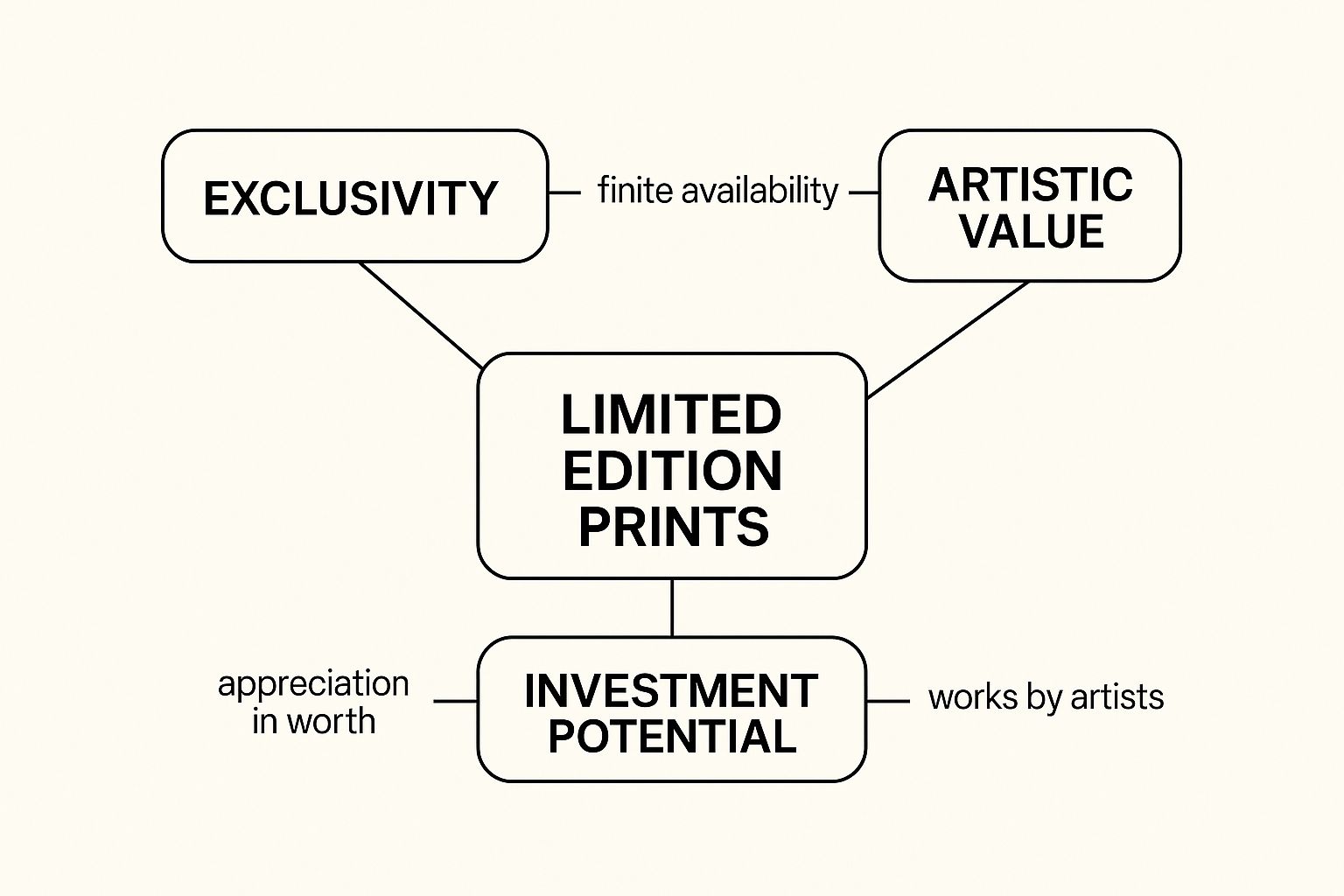
As the visual shows, the controlled scarcity (Exclusivity) directly enhances both the perceived Artistic Value and the long-term Investment Potential of the piece.
Limited Edition Lingo Translated
Feeling a bit lost in translation? Here's a quick-glance guide to common terms so you sound like an art pro.
| Term | What It Actually Means | Pop Culture Analogy |
|---|---|---|
| Print Run | The total, fixed number of prints made in one edition. | The number of limited edition trainers released in a single "drop." |
| Giclée | A fancy French word for a top-quality inkjet printing process. | Watching a film in 4K HDR instead of on a dodgy pirate stream. |
| Artist's Proof (AP) | A small batch of test prints made before the main edition. | The "unreleased demo track" on a deluxe album reissue. |
| COA | Certificate of Authenticity. Your proof it's the real deal. | The holographic sticker on a rare Pokémon card. |
With these terms under your belt, you’re already well on your way to navigating the gallery with confidence.
The Stamp of Authenticity
Finally, let's talk about the essentials: signatures and certificates. A signature from the artist is their seal of approval. It confirms they’ve inspected the print and are happy for it to represent their work.
Then there's the Certificate of Authenticity (COA). This is the print's official passport. It's a document that includes details like the print's name, the edition size, and the date it was created, all signed by the artist.
Think of a COA as the holographic sticker on a rare trading card or the official merch tag on a tour t-shirt. It’s the ultimate proof that what you’ve bought is the genuine article, not a knock-off from a dodgy market stall.
With this knowledge, you can navigate the world of limited edition artwork prints with confidence. You'll be able to spot quality, understand value, and avoid being bamboozled by arty buzzwords, ensuring the piece you hang on your wall is a true classic.
Finding Your Perfect Pop Culture Print

Right, this is where the real fun begins. You’ve ditched the generic, dog-eared posters and you now know your giclée from your elbow. It’s time for the main event: the treasure hunt for 'the one'. This is your quest to find that perfect print that captures the roar of the crowd after a 90th-minute screamer, the opening riff of a song that defined your youth, or a movie quote that lives permanently in your head, rent-free.
Think of yourself as a pop culture archaeologist, digging for gold. The internet is your sprawling, digital excavation site, and it’s filled with gems. Your first port of call should always be specialist online shops (like, ahem, ours) and artist-direct websites. This is where you'll discover the most unique, passion-driven work from creators who love the same stuff you do.
You're not here to trawl through endless pages of generic art. You're on a mission for something that truly speaks to you—the art equivalent of hearing a DJ drop your favourite obscure B-side in a packed club. It’s all about that instant, joyous recognition.
Nailing Down Your Style
Before you dive headfirst into the digital crate-digging, take a moment to figure out your personal style. It’s the difference between curating a legendary festival line-up and just booking a load of random bands. Are you a minimalist at heart, drawn to clean lines and subtle nods? Maybe a stark, architectural print of a brutalist football stadium is your jam.
Or perhaps you’re more of a maximalist, someone who wants their walls to scream with the chaotic energy of a Glastonbury weekend. In that case, a vibrant, multi-coloured print celebrating your favourite band might be just the ticket.
Don't overthink it. Just ask yourself a few simple questions:
- What colours make you happy? Do you prefer moody monochrome, or are you all about bold, saturated hues?
- What's the vibe of your room? Is it a chilled-out den or a vibrant social space? The art should feel at home.
- Subtle nod or loud and proud? Do you want a design that makes people look twice, or one that’s an immediate declaration of your fandom?
There's no right or wrong answer here; this is about finding something that feels like you. The goal is to find a piece that doesn't just match your sofa, but matches your soul. A print that makes you grin every single time you walk past it is a certified winner.
The Head vs The Heart Dilemma
So, you’ve found a print you absolutely adore. It’s a masterpiece celebrating your team’s treble-winning season. The only problem? It’s bright orange, and your living room is a calm, Scandinavian-inspired oasis of muted blues and greys. This is the classic battle between what you love and what actually works in your space.
The good news is, you can usually have both. Great art doesn’t always need to match the decor perfectly. In fact, a contrasting piece can often become the standout feature of a room—a bold statement that draws the eye and starts conversations.
Think of it like a classic football kit clash – sometimes the most unexpected combinations are the most memorable. A bold, punchy print can be the perfect 'away kit' for a neutral-toned room, adding a splash of energy and personality.
However, if you're aiming for a more cohesive look, consider how the print can be integrated. A clever frame choice can work wonders, bridging the gap between the artwork and your existing decor. A simple black or white frame can anchor a vibrant print, while a natural wood frame can warm up a cooler-toned piece. And if you need a bit of guidance on creating a gallery wall that flows beautifully, our expert tips on how to arrange wall art can help you pull it all together like a pro.
Ultimately, the best limited edition artwork prints are the ones that tell your story. They're a visual playlist of your life's greatest hits. Whether it’s a tribute to a footballing hero, a legendary album, or an iconic film, the right print doesn't just decorate a wall—it brings it to life. Happy hunting.
Are Limited Edition Prints a Smart Investment?
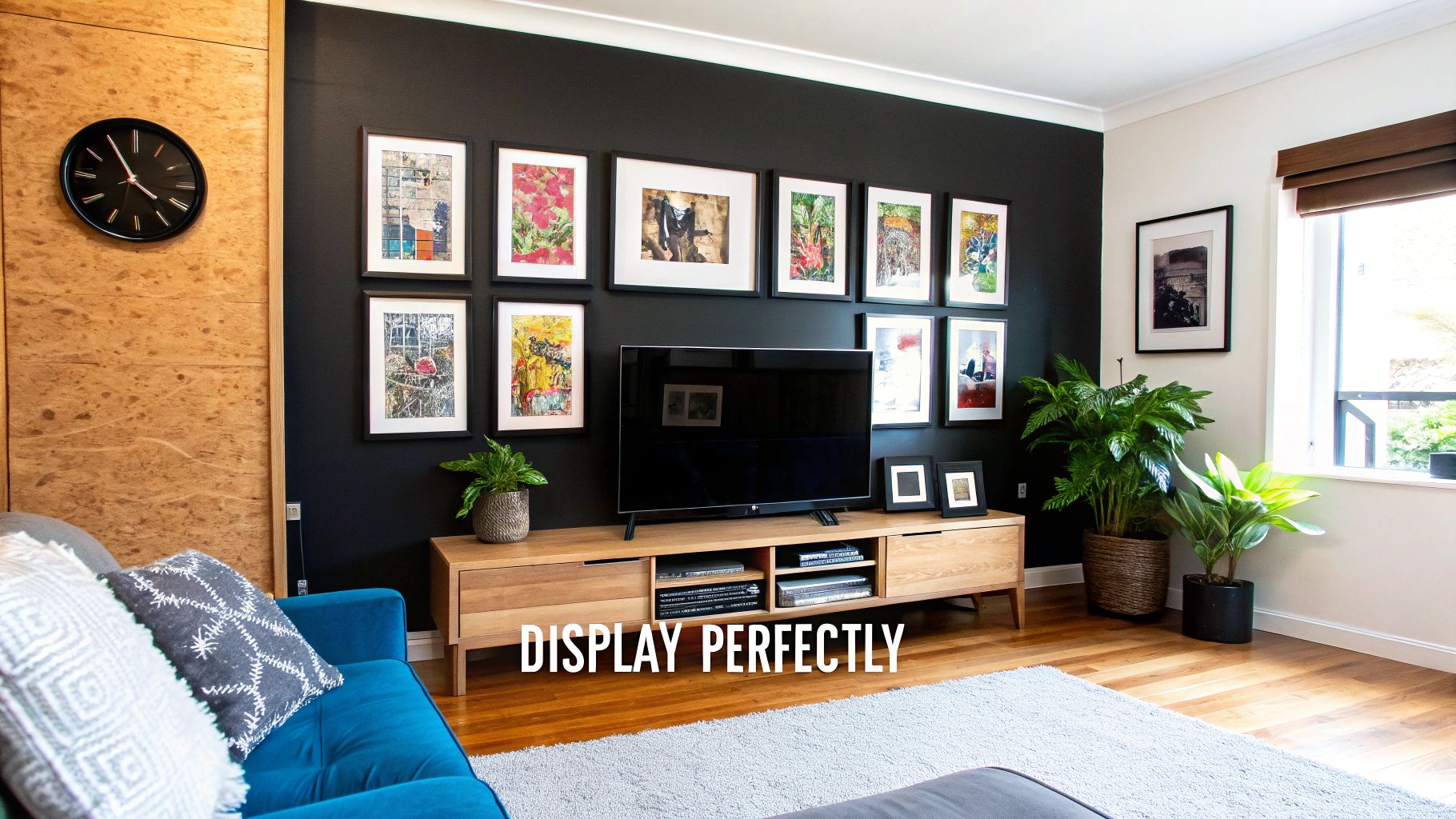
Alright, let's get down to it. You've found a print that perfectly captures your team's glory days or a band's legendary album. You love it, it looks brilliant, but there’s that little voice in your head wondering, "Could this actually be worth something one day?"
It's a great question. While the number one rule of buying art should always be to buy what you love, it certainly doesn't hurt if your brilliant taste also turns out to be a savvy financial move.
Think of it like buying a vintage football shirt. You get it because it reminds you of that unbelievable goal Cantona scored, but there's also a quiet satisfaction in knowing it’s a rare classic that's now worth more than you paid. Limited edition artwork prints can occupy a similar sweet spot, blending pure passion with a bit of potential.
Let's be crystal clear: we’re not licensed financial advisors. This isn't a get-rich-quick scheme, and not every print you buy will have art dealers banging down your door in a few years. But it’s fascinating to understand what gives a print its potential value.
What Makes a Print Valuable?
So, what separates a future classic from something that just looks nice on the wall? A few key factors come into play, and it’s not just random luck. It’s a bit like scouting a young footballer; you're looking for those early signs of future greatness.
- The Artist's Reputation: Is the artist already a big name, or are they an up-and-coming talent with a growing buzz? An artist’s rising profile is often the single biggest driver of a print's value on the secondary market.
- Edition Size: This is a big one. A print from a tiny run of 25 will almost always be more sought-after than one from a much larger run of 500. Scarcity is king.
- Cultural Relevance: Does the print capture a significant moment in time? A piece celebrating a historic title win or a legendary festival performance can become a highly desirable slice of nostalgia down the line.
- Quality and Condition: A top-notch giclée print on archival paper, kept out of direct sunlight, will hold its value far better than a cheap poster that’s starting to fade like your team's hopes in a penalty shootout.
A perfect example is the trajectory of an artist like Banksy. Early on, you could pick up his prints for a relatively modest sum. As his fame exploded, the value of those very same prints soared into the stratosphere, turning early fans into accidental investors.
Keeping It Real About Returns
It’s easy to get swept up in stories of prints selling for thousands, but it's important to keep a level head. The art market can be as unpredictable as a VAR decision. While some prints see their value climb steadily, others might just hold their initial value—and that’s perfectly fine.
The real return on your investment is the daily joy you get from seeing a piece of art you genuinely love hanging on your wall. If it happens to appreciate in value, consider it a brilliant bonus, like finding a forgotten tenner in an old coat pocket.
The UK's art scene is a major global player, and that creates opportunities. In fact, the UK art market accounted for 18% of global art sales by value, reaching approximately $10.4 billion. Major auction houses now run dedicated sales for giants like David Hockney, showing just how seriously the art world takes limited edition prints. You can discover more insights into key art market predictions at myartbroker.com.
Ultimately, your goal should be to build a collection that reflects you. Buy that print of your favourite album cover because it brings back amazing memories. Choose the one of your football ground because it gives you a buzz every time you see it. If you focus on buying what you’re passionate about, you’ll always have something of immense personal value. And that's an investment that never fails.
How to Care for Your New Artwork
Right, you’ve done it. You’ve found the one, clicked ‘buy’, and now a tube of pure, unadulterated joy has landed on your doorstep. Your new limited edition art print is here, and it looks magnificent. Before you get carried away and slap it on the wall with the nearest bit of Blu Tack, let’s talk about keeping it looking mint.
Think of it like this: you wouldn’t leave a rare vinyl record out in the sun or use a classic football shirt to clean the car. Your new print deserves the same level of respect. A bit of TLC now will ensure your art looks just as sharp in ten years as it does today.
First things first, let's talk about the arch-nemesis of all great art: direct sunlight. Sunlight is to your print what a dodgy VAR decision is to your weekend accumulator—it will absolutely ruin it. The UV rays are brutal and will fade those vibrant colours quicker than your team’s title hopes after a bad run in December.
To Frame or Not to Frame
So, you’ve unrolled the print (carefully!), and it’s time to decide on its new home. Getting it framed is less of a suggestion and more of a non-negotiable rule if you want it to last. An unframed print is vulnerable to dust, moisture, and accidental spills—like an open goal just waiting for a disaster.
Now, you’re at a crossroads: a DIY job from the high street or calling in the professionals. A cheap, off-the-shelf frame is better than nothing, but it's often the equivalent of a League Two defender marking a Premier League striker. It might do the job for a bit, but it’s not a long-term solution.
Professional framing, on the other hand, is like having a world-class centre-back protecting your art. They use acid-free materials that won't yellow your print over time and can offer UV-protective glass—the art world’s version of a top-class goalkeeper. It costs a bit more, but it’s a sound investment to protect your investment.
Choosing a frame isn't just about protection; it’s about presentation. The right frame should complement the artwork, not compete with it. A simple black or natural wood frame often works best, letting the print be the rockstar it was born to be.
Hanging and Maintenance
Once it's framed and ready, picking the right spot is crucial. We’ve already blacklisted sunny spots, but you should also avoid hanging it directly above a radiator or in a humid room like a bathroom. Extreme temperature changes and moisture can cause the paper to warp over time. For more tips on this, our deeper dive into limited edition prints has some great advice you can check out.
When it comes to cleaning, keep it simple. A gentle dust of the frame with a soft, dry cloth is all you need. Never, ever spray cleaning products directly onto the glass, as the liquid can seep behind it and damage the print.
Here's a quick checklist to keep your new pride and joy in top form:
- Location, Location, Location: Choose a spot away from direct sunlight and heat sources.
- Frame it Right: Invest in a quality frame with acid-free mounting to prevent long-term damage.
- Handle with Care: Always handle your print with clean, dry hands to avoid transferring oils and dirt.
- Keep it Clean: A light, regular dusting of the frame is all the maintenance required.
Follow these simple rules, and your new artwork will continue to bring a smile to your face for years to come—a timeless tribute to your impeccable taste in music, football, and all-around cool stuff.
Your Limited Edition Print Questions Answered
Still got a few questions rattling around? No worries. Think of this as the quick-fire round at a pub quiz, but instead of dodgy trivia about 80s one-hit wonders, we’re tackling the most common queries about buying limited edition artwork prints. I’ll keep it straight-talking, so you have all the info you need to start your collection with confidence.
Let’s be honest, the art world can sometimes feel a bit exclusive, like you're trying to get into a VIP area with the wrong wristband. But it doesn’t have to be that way. Owning a piece of art you love should be simple and enjoyable.
Is My Print Number Important?
I get asked this one a lot. You’ve got your eye on a print, and you see it’s numbered 48/50. Does that make it less special than number 1/50 or the coveted 50/50? In a word: no.
Think of it like this: every player in a title-winning squad gets the same medal. The striker who scored the winning goal and the third-choice keeper both get the same prize because they were part of the same, limited group. Every single print in an edition is created to the exact same high standard. The number is just for cataloguing; it’s an admin tool, not a quality ranking.
What If I Can’t Afford an Original Painting?
This is precisely where limited edition prints shine. They are the great equaliser. For most of us, owning an original painting by a favourite artist is about as likely as getting called up to play for England. It’s a lovely dream, but let’s be realistic.
A limited edition giclée print is the most accessible way to own a genuine piece of that artist’s work. You get the same creative genius, the same incredible detail, and the same passion, all authenticated by the artist, but at a price that doesn’t require you to remortgage your house. It’s the art world’s equivalent of a festival headliner playing an intimate acoustic set in your local pub—all of the talent, none of the ridiculous ticket prices.
Buying a limited edition print isn't a compromise; it's a smart, savvy way to become an art collector. You're getting an authentic, high-quality piece of work that democratises the joy of owning art you truly connect with.
Will My Print Be a Good Investment?
We touched on this earlier, but it’s worth repeating. While some prints absolutely can increase in value, you should never buy a piece of art purely as a financial investment. That’s like going to a gig just to record it on your phone instead of actually enjoying the music. You’re missing the point.
The real value of a print is the smile it puts on your face every day. That said, the market for these prints is definitely growing. The limited edition print sector is forecast to expand globally at a rate of around 6.1% annually between 2025 and 2033. Here in the UK, the art market has bounced back strongly, with sales hitting $11.9 billion in 2022. This shows a real and growing interest in collecting, so your print could well become more sought-after in the future. You can discover more insights about art market predictions at madeinbed.co.uk.
Why Buy From a Specialist Like Striped Circle?
You could probably find a generic football poster on a massive online marketplace, but where’s the fun in that? When you buy from a specialist shop run by genuine fans, you’re getting so much more.
Here's what sets a specialist apart:
- Passion and Curation: We don’t sell anything we don’t love ourselves. Every print is designed and chosen because it celebrates an iconic moment we’re genuinely passionate about.
- Unrivalled Quality: We obsess over the details, from the archival paper to the rich, vibrant giclée inks, ensuring every print is a masterpiece.
- Supporting a Small Business: You’re not lining the pockets of a corporate giant; you’re supporting a family-run business that pours its heart and soul into every design.
Buying a limited edition print is an experience. It’s about finding a piece that speaks to you, tells your story, and makes your space feel more like you. It’s a statement of your passions, a nod to your impeccable taste, and a guaranteed way to make your walls the best-dressed in town.
Ready to transform your walls from bland to brilliant? Dive into the Striped Circle collection and find a print that celebrates your favourite music and football moments. Your walls will thank you. https://www.stripedcircle.com
