
A Guide to Limited Edition Printing for Wall Art
Right then, let's clear something up. Limited edition printing is basically the art world's equivalent of a backstage pass. It's a solid-gold promise that the brilliant print you’ve got your eye on won’t be plastered on every wall from here to John o' Groats. It’s a deliberate decision to produce a fixed, small number of prints, making each one feel like you've found a rare Panini sticker.
What Is This Limited Edition Printing Thing Anyway?
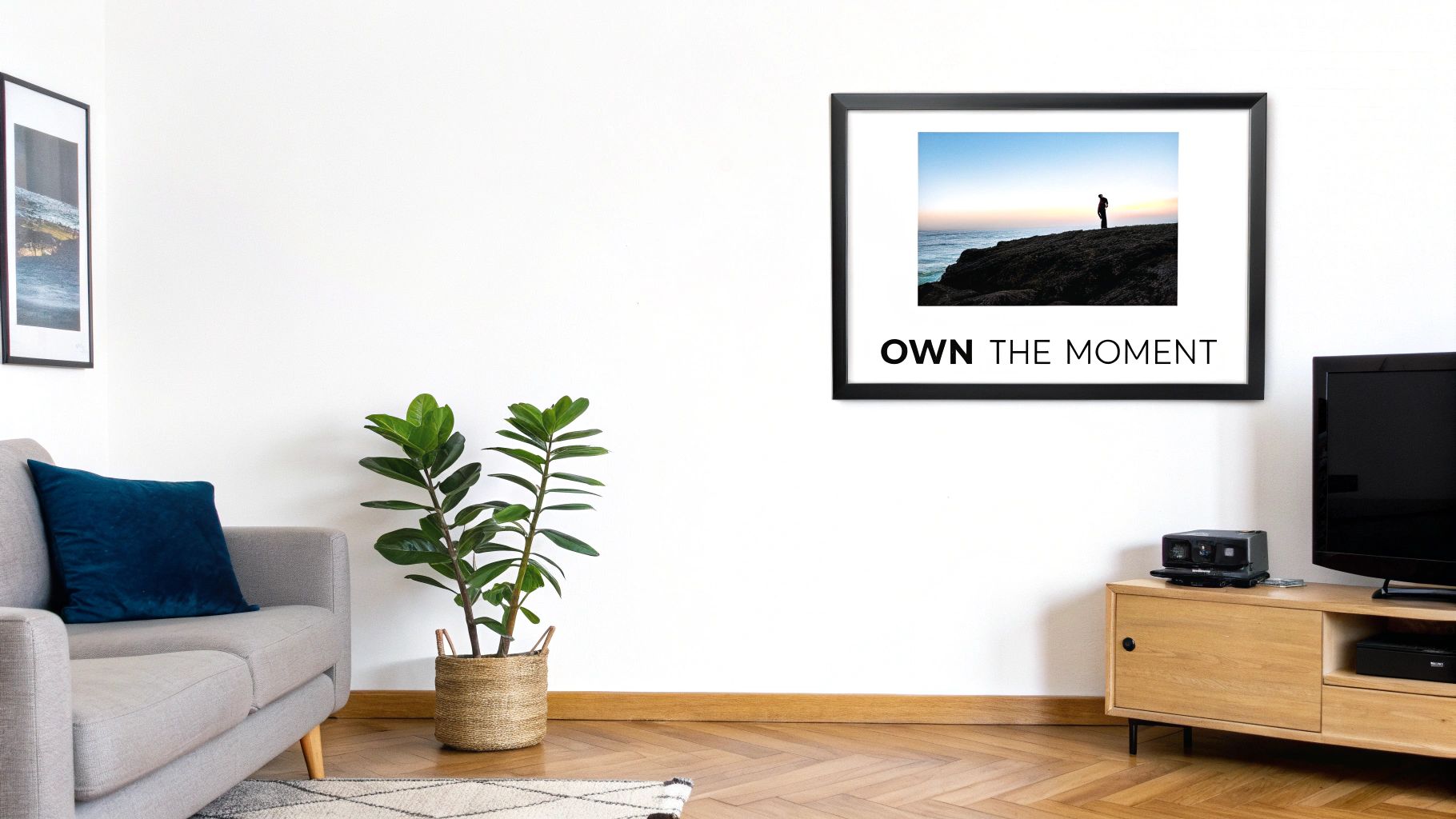
Let's not get bogged down in stuffy, gallery-whispering jargon. Think of it like this: you wouldn't want your favourite band to release a "limited edition" vinyl that’s sold in every supermarket next to the cat food, would you? The whole point is the scarcity. It’s the difference between a mass-produced poster you can find anywhere and a piece of art that feels like it was made just for you.
This is the secret sauce that turns a great image into a proper collector's item. By capping the number of prints, we're making sure that what you hang on your wall has a story and a bit of swagger. It's for those who get that owning something unique makes it that much more special.
Why It's More Than Just a Poster
So, why does any of this matter? Because your home or office shouldn't look like a generic hotel room. It should be a reflection of your personality, your passions, and the things that make you grin like an idiot. A limited edition print does exactly that.
Here’s the breakdown of what you're really getting:
- Guaranteed Scarcity: Once the edition is sold out, that's it. Finito. No more will be made in that size or format. It's the art equivalent of being at that legendary gig everyone wishes they’d seen.
- A Connection to the Art: You're not just buying a product; you're buying a piece of a creative moment. Whether it's a tribute to a last-minute winner or an iconic album, you're part of a select club. The cool kids' table, basically.
- Enhanced Quality: Artists and printers often save their best gear for a limited run, knowing each piece is meant to be treasured for years. It’s the first team, not the reserves.
In short, limited edition printing is about making art accessible without sacrificing what makes it special. It's a statement that says, "I've got great taste, and my walls prove it."
It transforms your space from just a room with walls into your personal gallery of awesome. Whether you're a die-hard footy fan or a music aficionado, these prints are a way to celebrate those passions without compromise. If you're keen to understand how we put these principles into practice, you can explore more about our limited edition print process and what makes each piece unique.
Decoding the Printing Methods
Alright, let's pull back the curtain on how these prints are actually made. Choosing a printing method is a bit like a manager picking his formation; the technique they use completely changes the final result. Don't worry, you don't need a lab coat for this—just a love for great-looking art.
We're going to break down the big three printing methods without it feeling like a stuffy art history lecture. Think of it as meeting the band, where each member brings a totally unique sound to the studio.
Giclée: The HD Remaster
First up is Giclée printing. If a limited edition print was a remastered album, Giclée would be the deluxe, 4K, high-fidelity version. The word itself sounds fancy (it’s French, pronounced zhee-klay), but what it really means is incredible, jaw-on-the-floor detail.
This method uses high-end inkjet printers that spray microscopic dots of pigment-based ink onto archival-quality paper. The result? Mind-blowing colour accuracy and depth that captures every subtle texture and gradient. It’s the reason our prints of intricate album art or detailed stadium illustrations look so crisp you feel like you could step right into them and smell the Bovril.
- Best For: Designs with complex colour palettes, photographic details, and subtle gradients.
- The Vibe: Sophisticated, precise, and gallery-quality. It’s the art equivalent of watching your favourite film in crystal-clear HD for the first time.
- Our Go-To For: Capturing the intricate details in a celebratory football crowd or the subtle colour shifts in a classic album cover design.
Screenprinting: The Rock ‘n’ Roll Method
Now, let's talk about Screenprinting. This is the punk rock of the printing world—it’s hands-on, a bit messy, and has a raw, tangible energy you just can't fake. Each colour is pushed through a separate mesh screen, one layer at a time, building up the image with bold, vibrant blocks of ink.
This process gives the final print a unique texture. You can often feel the layers of ink on the paper, giving it a handcrafted quality that feels authentic and full of character. It’s perfect for graphic designs, bold typography, and artwork with a strong, punchy aesthetic—think vintage band posters or minimalist football crests.
Think of it this way: Giclée is like listening to a perfectly mixed studio album on high-end headphones. Screenprinting is like being in the front row at a live gig—it's loud, visceral, and you can feel the energy.
This method is incredibly versatile and has been the backbone of pop culture art for decades, from Andy Warhol's iconic soup cans to countless gig posters that have adorned bedroom walls. It’s a classic for a reason.
Lithography: The Classic Album
Finally, we have Lithography. This is the respected elder statesman of the group, the classic vinyl album that sounds just as good today as it did 50 years ago. It’s a more traditional technique based on the simple principle that oil and water don’t mix.
An image is drawn onto a stone or metal plate with an oil-based crayon, and the rest of the plate is treated to attract water. When ink is rolled on, it only sticks to the greasy drawing, which is then transferred to paper. This process allows for rich, deep tones and a beautiful, slightly soft quality that’s hard to replicate. It’s a testament to timeless craftsmanship. While not as common for the pop-culture prints we specialise in, it's a cornerstone of the fine art world.
Printing Methods at a Glance
Feeling a bit overwhelmed? Not to worry. Here’s a quick comparison to help you figure out which printing style sings to you.
| Printing Method | Best For | The Vibe | Our Top Pick For... |
|---|---|---|---|
| Giclée | Fine detail, photos, complex colours | HD Remaster, Crisp, Gallery-Quality | Detailed stadium illustrations |
| Screenprint | Bold graphics, strong typography | Rock 'n' Roll, Tactile, Handcrafted | Vintage-style band posters |
| Lithograph | Rich tones, classic art | The Classic Album, Timeless, Rich | Fine art reproductions |
This table should give you a good starting point for understanding the character each method brings to the finished artwork.
Of course, these are just the headliners. There are other methods out there, from digital presses to techniques involving heat and pressure. For a deeper dive into some of these other methods, you can check out this helpful guide to heat transfer printing to see how other items get their cool designs.
Here at Striped Circle, we predominantly use Giclée printing because it perfectly captures the vibrant spirit and detail of our music and football designs. To get the full picture of our commitment, you can learn more about our high-quality printing process and see why every piece we create is built to make you smile for years to come.
The Numbers Game: Edition Sizes, Signatures, and What They Mean
Ever looked at the bottom corner of a print and seen what looks like a cryptic maths problem scribbled in pencil? Something like ‘27/100’? Don't worry, you don’t need a calculator. This is the secret handshake of the limited edition world, and it’s your first clue that you’re holding something a bit special.
Those numbers are the heart and soul of what makes a limited edition, well, limited. The first number (27, in our example) is the unique number of that specific print in the series. The second number (100) tells you the total number of prints created in that entire edition. Simple as that. It’s a transparent promise from the artist and printer that only this many will ever exist.
Big Gig or Backstage Pass?
I like to think of the edition size like tickets to a concert. A larger edition, say 1/750, is like getting a ticket to a massive festival. You're there, you're part of the experience, and it's brilliant. But there are thousands of other people there with you. It’s accessible and still feels great.
A smaller edition, maybe 1/50, is a completely different beast. That’s not a festival ticket; that’s a backstage pass to hang out with the band. It’s exclusive, it’s rare, and it makes you part of a very small, very cool club. For collectors, smaller edition sizes often mean higher value because the scarcity is dialled right up.
So, when you see those numbers, you immediately get a feel for just how exclusive that piece of art is. It’s the difference between being in the crowd and being on the guest list.
This handy decision tree can help you visualise which printing style might be right for your taste, from the highly detailed to the bold and graphic.
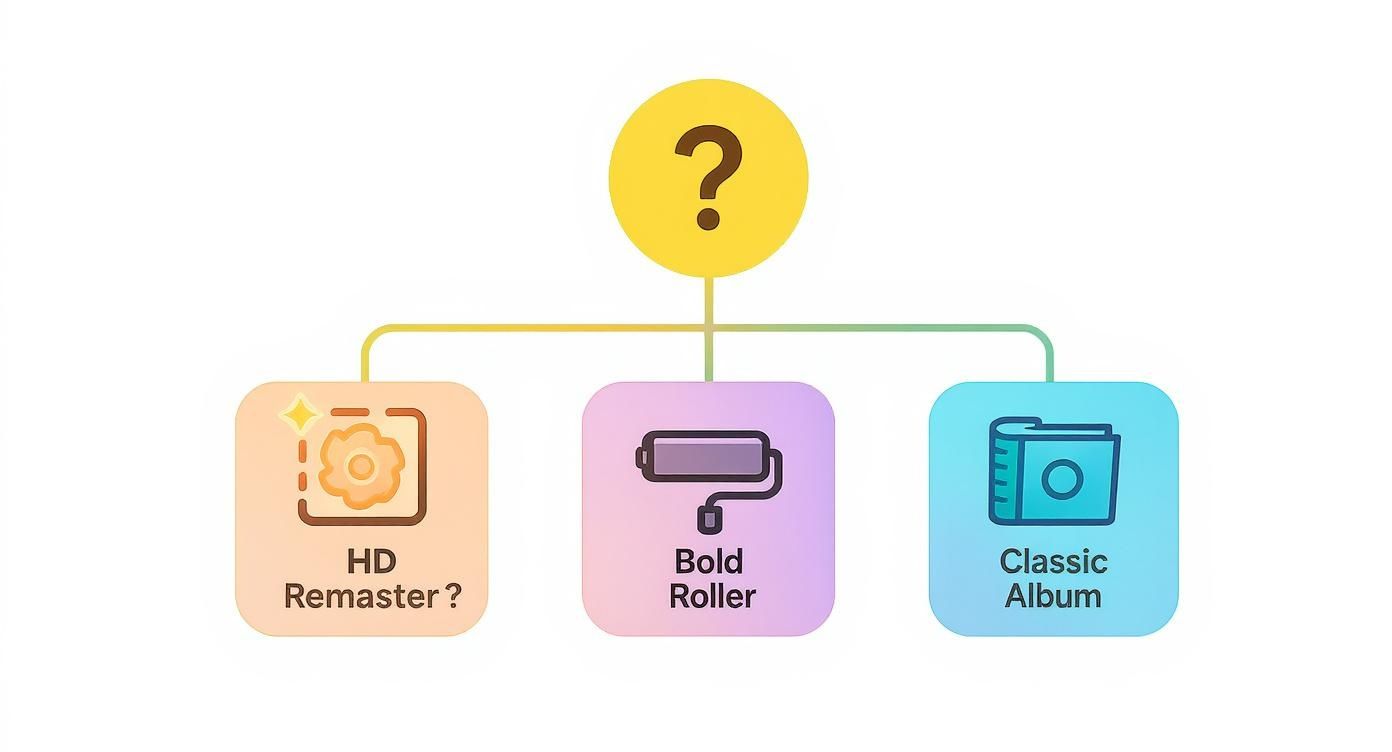
This flowchart neatly illustrates how different artistic goals lead to choosing a specific printing method, whether you're after a perfect "HD Remaster" or a classic, timeless feel.
The All-Important Signature
If the edition number is the print's ID, then the artist's signature is its passport stamp. A signature, typically done in pencil so it won't fade or bleed into the paper, is the artist's personal seal of approval. It’s them saying, "Yep, I've seen this, I'm happy with how it turned out, and it meets my standards."
Without that signature, you’ve essentially got a very nice poster. With it, you have a verified piece of their work. It's the ultimate mark of authenticity, connecting the print directly back to the creator. It’s the equivalent of getting your favourite album signed by the band—it just means more.
An artist's signature transforms a reproduction into a collectible. It's the final, crucial touch that validates the artwork and confirms its place within the limited edition.
Occasionally, you might spot other letters alongside the numbers, like 'AP', which stands for Artist's Proof. These are a small number of prints, usually around 10% of the main edition size, that are set aside for the artist. They’re often the first ones off the press and are used to check quality. Because they're even rarer than the main edition, APs are often highly sought after by serious collectors. Think of them as the manager’s private stash.
Your Print's Official Passport: The COA
To complete the trifecta of authenticity, many high-quality limited edition prints come with a Certificate of Authenticity (COA). Think of this as your print's birth certificate. It’s a document that officially declares the print is legitimate and provides all the key details in one place.
A proper COA should always include:
- The name of the artwork and the artist.
- The final edition size and the specific number of your print.
- The date the print was created.
- Details about the printing method and the type of paper and ink used.
This certificate is your paper trail. It proves the work’s history, or provenance, and gives you complete confidence that you own a genuine piece. It’s your guarantee that the run is truly limited and that you've invested in a piece of art with integrity. So, when you get a print with a COA, keep it somewhere safe—it's a vital part of its story and its value.
Ensuring Authenticity and Future Value
https://www.youtube.com/embed/v-f4tGAH4Pg
So, you’ve found a print that speaks to your very soul. It’s got your team’s colours, lyrics from that song, or a design so cool it makes your walls instantly more interesting. But how do you know you've bagged a future classic and not just a pretty poster that’s had a fancy number slapped on it?
This is where authenticity and value come into play. Don’t worry, we’re not about to get all stuffy and start talking like auctioneers. Think of it more like spotting a rare rookie football sticker in a pack of chewing gum—you need to know what to look for to realise you’ve got something special.
Your Art's Backstory Matters
In the art world, a piece's history is called its provenance. It’s a fancy word, but the idea is simple: it’s the story of where your print has been. For a brand-new limited edition, that story starts with the artist and the printmaker, and it’s their reputation on the line.
A good printmaker guarantees the integrity of the edition. They’re the bouncers at the door, making sure that once the advertised number of prints is made, that’s it. No sneaky extra copies, no “one more for the road.” This promise is crucial because scarcity is what gives a limited edition its edge. It’s the difference between a one-off legendary gig and a band’s endless farewell tour.
Think of it this way: a print's value is built on trust. You're trusting the artist created it, the printer produced it to the highest standard, and that the edition size is the real deal. It's this chain of trust that makes your investment in cool wall art a sound one.
This commitment to exclusivity is everything. In the UK, a limited edition isn't just a marketing term; it's a defined practice where the original plate or digital file—the matrix—is retired after the run. This guarantees no more can ever be made. As the British Print Industry Federation (BPIF) points out, serious collectors often gravitate towards smaller runs, typically of 100 or fewer, to maximise that feeling of rarity. You can get more insights into the standards of the UK printing industry on Britishprint.com.
The Certificate of Authenticity: Your Proof of Legitimacy
We touched on the Certificate of Authenticity (COA) earlier, but it’s so important it deserves another shout-out. This isn't just a piece of paper; it’s your iron-clad proof that you own the genuine article. It’s the log book for your new piece of art, confirming all the vital stats.
A solid COA is like a signed contract between you and the creator. It officially documents the print’s name, edition number, and production details. It’s your guarantee against fakes and your key to proving the print's legitimacy if you ever decide to pass it on. Keep it safe—tucking it in an envelope on the back of the frame is a classic move.
From Your Wall to the Resale Market
Let's be honest, while we buy art because we love it, it’s nice to know it might be worth something down the line. The resale value of a limited edition print is driven by the same thing that makes a vintage band t-shirt or a retro football shirt so desirable: scarcity and demand.
When an edition sells out, the only way for someone else to get their hands on one is through the secondary market. If the artist or the subject becomes more popular, demand can rocket. Suddenly, that print you bought for the price of a round of drinks could become a sought-after collector's item. It's the simple, beautiful logic of supply and demand.
You’re not just buying a print; you're buying a small stake in a moment of cultural history. Whether that's celebrating a treble-winning season or the anniversary of a game-changing album, you own a piece of that story. And that, my friend, is a value that goes far beyond any price tag.
How to Frame and Care for Your Art
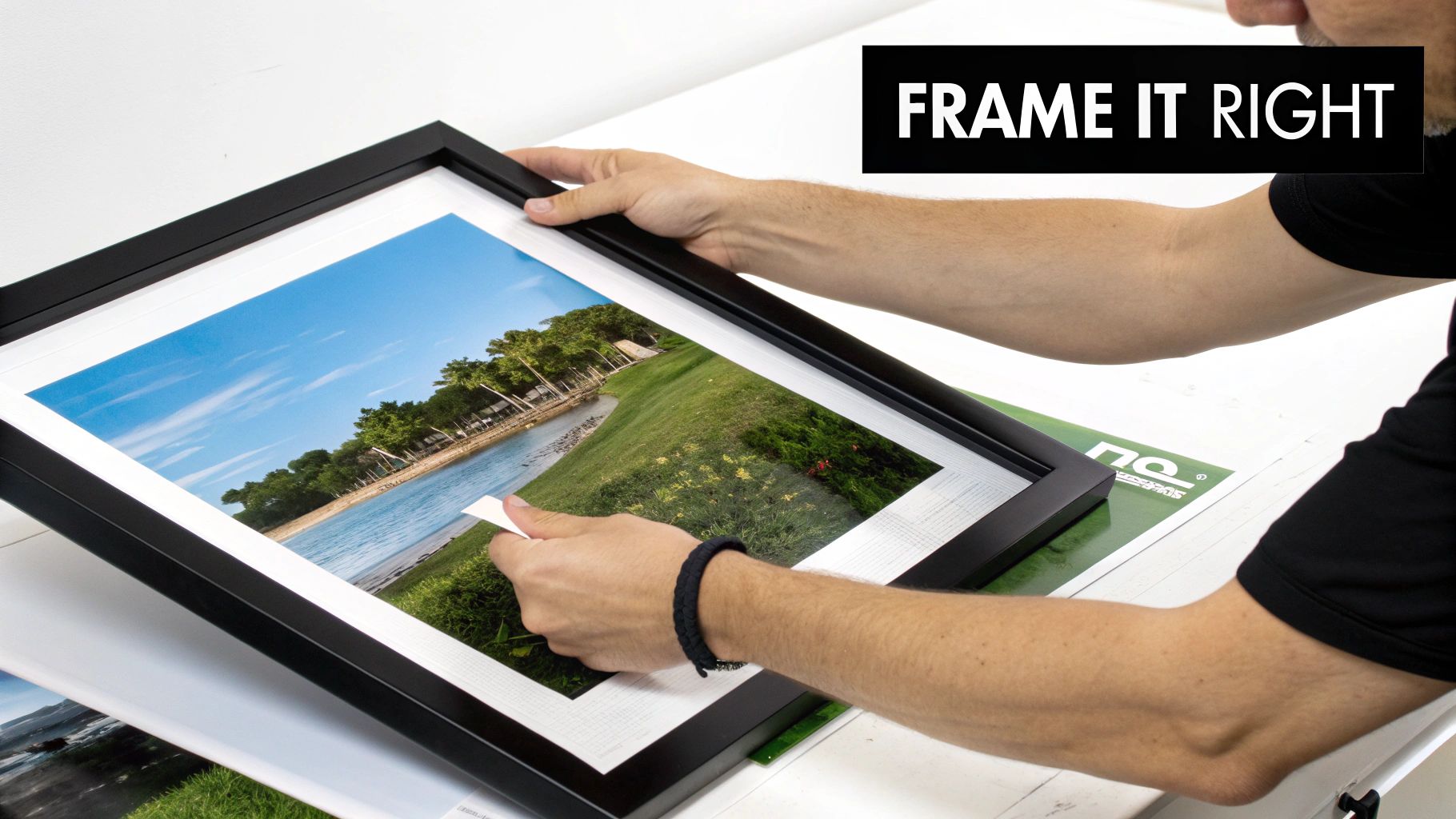
Right, you’ve done the hard part. You’ve navigated the world of limited edition printing, chosen a piece that speaks to you, and it's finally arrived. Don't fall at the final hurdle and treat it like a takeaway menu you shove in a drawer. This isn't just a print; it's your new pride and joy, so let's make sure it looks the business and lasts for years to come.
First things first: the frame. Popping your new artwork in a cheap, flimsy frame is like putting a superstar striker in a pair of dodgy knock-off boots. It might look okay from a distance, but it’s going to cause some serious damage over time.
Choosing the Right Armour for Your Art
Cheap frames often come with acidic backing boards that can yellow your print, a process grimly known as 'acid burn'. It’s the art world's equivalent of a horror movie. To avoid this tragedy, you need to look for frames that use acid-free, archival-quality materials. These are specifically designed to preserve the paper and ink, keeping your print looking as fresh as the day it was made.
Another thing to consider is the glass. Standard glass is fine, but if you want to give your print superpowers, go for UV-protective glass. Think of it as Factor 50 sunscreen for your art. It blocks the harmful ultraviolet rays that cause colours to fade faster than a one-hit wonder's career. It’s a small investment that pays off massively in the long run.
Your frame isn't just a border; it’s a life-support system for your art. A good one protects against dust, moisture, and the dreaded colour-fading rays of the sun, ensuring your print stays vibrant for years.
If you’re looking for a deeper dive into the nitty-gritty of getting it just right, our guide on how to frame posters and prints has all the tips you need to make your artwork pop.
Location, Location, Location
Now that your print is safely framed, where do you hang it? Picking the right spot is crucial. There are two main villains you need to avoid at all costs: direct sunlight and dampness.
Hanging a print in direct sunlight is a one-way ticket to Fadesville. Even with UV-protective glass, constant exposure will eventually take its toll. Find a wall that doesn’t get blasted by the sun all day. Think of your print as a vampire from a 90s film—it much prefers the shade.
Equally, avoid damp or humid rooms like bathrooms or kitchens. Moisture is the arch-nemesis of paper, causing it to warp, ripple, and generally have a very bad time. Your print of a legendary goal doesn't want to get steamed up every time you have a shower. Proper installation is key, and once framed, you'll want this expert guide on how to hang pictures perfectly to ensure it’s both secure and perfectly placed.
Get these simple steps right, and your home or office will be transformed into your own personal gallery. Your walls are about to get a whole lot cooler.
Starting Your Own Legendary Art Collection
Right then, you’ve made it this far. You know the lingo, you can tell your Giclées from your screenprints, and you can spot a proper artist's signature from fifty paces. The only thing left to do is dive in and start building a collection that’s so uniquely you, it’ll make your walls sing. Forget stuffy galleries and confusing art-speak; this is about having fun and curating a space that puts a massive smile on your face.
The first rule? It’s simple: buy what you love. Seriously. Don't chase trends or buy something just because you think it might be worth a fortune one day. Your collection should be a tribute to your passions. If that’s a print celebrating your team’s impossible FA Cup win, brilliant. If it’s a design inspired by the album that defined your university years, get it on the wall.
This is your personal highlight reel, a visual playlist of your life’s best moments.
Where to Find Your Masterpieces
Okay, so where do you actually find these gems? The internet is your best mate here, but it pays to know where to look. A great starting point is with artists and print houses you already admire (like us, for example). Give them a follow on social media, as that's often the first place they'll announce a new limited edition printing run.
Beyond that, here are a few other places to scout for quality prints:
- Artist-Run Shops: Many independent artists sell directly through their own websites. It's the best way to ensure your money goes straight to them.
- Specialist Online Galleries: Websites dedicated to pop culture art are treasure troves for finding unique pieces related to music, film, and sport.
- Print Fairs and Comic Cons: There's nothing quite like seeing the prints in person. These events are fantastic for discovering new artists and getting a real feel for the quality before you buy.
How to Spot the Real Deal
When you’ve found a print you’re buzzing about, take a moment to do a quick spot-check. This is your pre-match warm-up, ensuring the piece is a genuine limited edition and not just a glorified poster. You want to avoid scoring an own goal.
Just ask yourself, or the seller, these simple questions:
- Is it numbered and signed? This is the most basic hallmark of a legitimate limited edition. Look for that pencil-written fraction and the artist's signature.
- Is there a Certificate of Authenticity (COA)? While not every artist provides one, a COA is a massive plus. It’s your official guarantee of the print’s provenance.
- What’s the paper and print quality like? Does it feel like high-quality, archival paper? A genuine fine art print feels substantial, not like a flimsy flyer you’d pick up at a gig.
Think of it like this: a mass-produced poster is like hearing a song on the radio. A limited edition print is like owning the signed, gatefold vinyl. Both are great, but only one is a true collector’s item you’ll treasure forever.
Ultimately, building your collection is a joy. It’s about surrounding yourself with art that tells your story. So go on, find that print that captures the roar of the crowd or the opening riff of your favourite song. Your walls are waiting for their legendary lineup.
Your Limited Edition Printing Questions Answered
Still got a few questions rattling around? Perfect. Let's tackle some of the most common queries that pop up when you're starting a collection. Think of this as the final piece of the puzzle, giving you the confidence to dive in.
This is your quick-fire round to becoming a collecting connoisseur.
Is a Limited Edition Print a Good Investment?
This is the big one, isn't it? While some prints can certainly increase in value over time, my honest advice is always the same: buy what you love. The real return on investment is owning a piece of art that brings you joy every single day.
Think of any future value increase as a welcome bonus—like your team bagging a winner in the 94th minute. The primary goal should always be the love of the art itself.
What Is an Artist's Proof, Anyway?
You might occasionally see 'AP' next to an edition number instead of the usual fraction. This stands for Artist's Proof, and it’s one of a small batch of prints set aside for the artist's personal use. They’re pulled from the main run for quality checks and are usually identical to the numbered editions.
Because there are so few of them, APs are highly sought after by serious collectors. It’s like getting your hands on the original demo tape of a classic album—a rare piece of the creative process.
An Artist's Proof is the ultimate collector's piece. It's identical to the prints in the limited edition run but is rarer and often more desirable due to its direct connection to the artist's quality control process.
Can a Digital Design Be a Limited Edition?
Absolutely. In fact, most contemporary art, including the highly detailed Giclée prints we produce at Striped Circle, begins its life as a digital file. The "limited" aspect has nothing to do with how the art was created; it's all about the fixed number of physical prints made from that master file.
Once the edition is fully printed, that's it. The digital file is effectively retired for that specific run, which is how we guarantee its exclusivity in the modern art world.
Ready to start a collection that truly means something to you? From football icons to musical legends, Striped Circle has the unique prints your walls have been waiting for. Find the perfect piece to make you smile right here.
