
Your Ultimate Guide to Pop Art Prints for Kicking Boring Walls to Touch
Pop art is basically art with a bit of swagger. It takes everyday stuff—comic strips, soup cans, famous faces—and turns it into something bold and brilliant for your wall. Born in the rebellious 50s and 60s, this style uses vibrant colours and instantly recognisable images to make you look twice. It's the art world's equivalent of a perfect guitar riff or a 90th-minute winner—energetic, iconic, and guaranteed to grab your attention.
What Exactly Makes Pop Art Prints So Iconic?
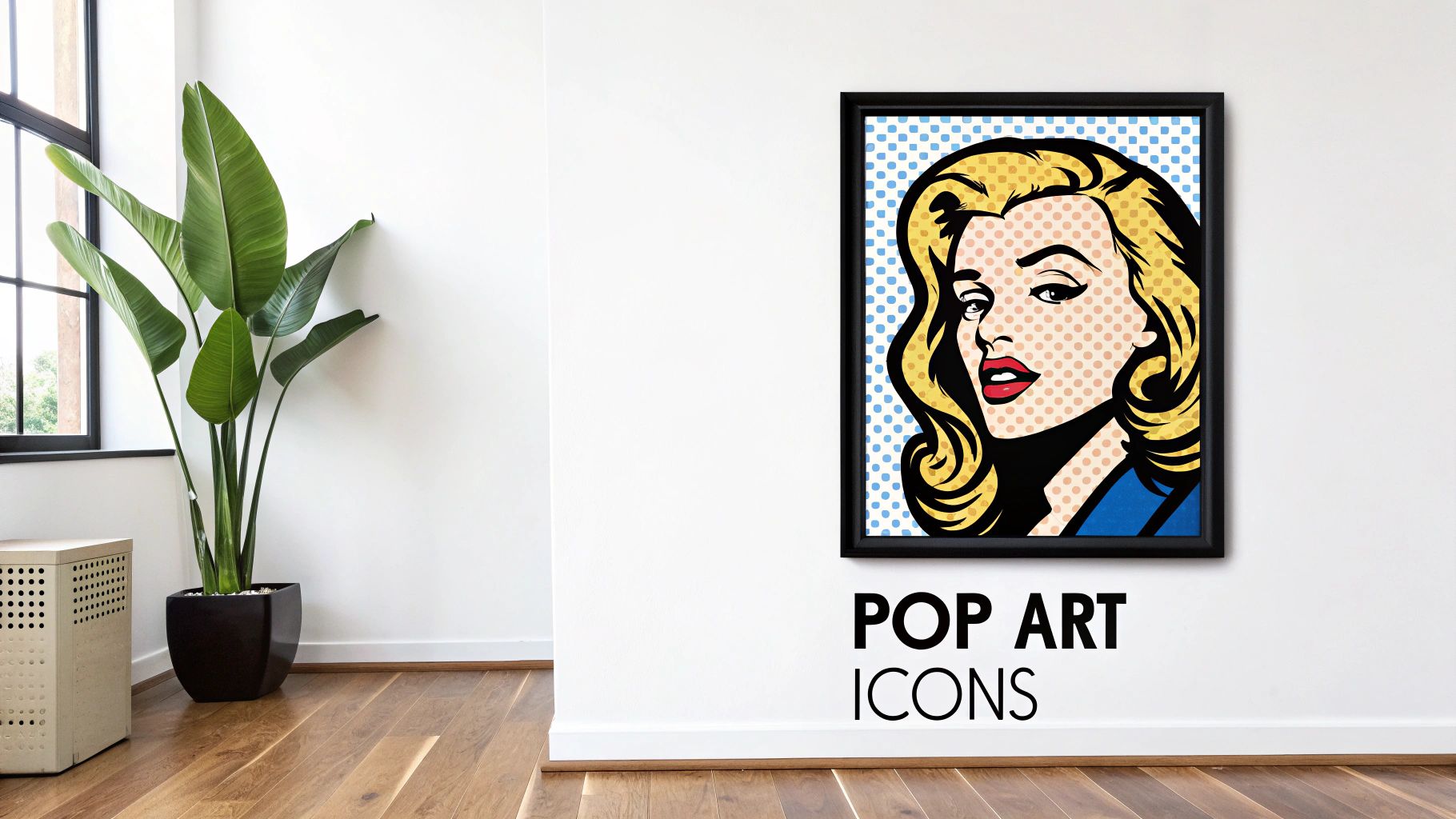
Right, let’s get one thing straight: pop art isn’t some stuffy, chin-stroking affair reserved for silent galleries. It's the complete opposite. It’s the art of the people, born from a time when rock 'n' roll was taking over the airwaves and mass culture was exploding.
This was a movement that threw out the old rulebook that said fine art had to be about historical figures or bowls of fruit.
Instead, artists like Andy Warhol and Roy Lichtenstein looked at the world around them and asked, "Why can't a can of Campbell's Soup be art? Why can't a comic book panel be hung in a gallery?" They took the everyday, the mass-produced, and the popular, and elevated it. Think of it as the ultimate mash-up, sampling bits of culture and turning them into a brand-new hit.
The Key Ingredients of a Proper Pop Art Print
So, what are the tell-tale signs you’re looking at a classic pop art piece? It’s a pretty simple recipe, really. The artists behind this movement weren't shy, and their work reflects that with a few core ingredients that make it instantly stand out.
You can usually spot a pop art print from a mile off thanks to these signature moves:
- Bold, Bright Colours: We’re not talking subtle pastels here. Pop art is famous for its in-your-face colour palette—think vibrant reds, electric blues, and sunshine yellows. The colours aren't always realistic; they're used to create impact and energy. You can learn more about the power of colour psychology in interior design to see how these shades affect a room's mood.
- Recognisable Imagery: This is art you don't need a degree to understand. It features things everyone knows, from celebrities like Marilyn Monroe to brands like Coca-Cola or even everyday objects.
- A Healthy Dose of Wit: There’s often a playful, sometimes cheeky, tone to pop art. It celebrated popular culture but also poked a bit of fun at it, questioning the lines between commercialism and fine art.
Why It Still Feels Fresh Today
Decades later, pop art prints haven't lost an ounce of their punch. The reason is simple: they celebrate the things we love. That same spirit of turning a cultural icon into a piece of art is exactly what we do with our music and football prints.
It’s about capturing a feeling—the roar of the crowd at a gig, the euphoria of a goal, the lyrics that defined a generation—and putting it on your wall. It’s a visual reminder of the moments and heroes that make us tick. That energy is timeless.
A Quick Kickabout Through Pop Art History
To really get what pop art prints are all about, you need to understand where they came from. Forget stuffy museum tours; this story starts in a dreary, post-war Britain back in the 1950s. Life was a bit grey, rations were still a thing, and a new generation of artists were absolutely desperate for a splash of colour.
They cast their eyes over to America, with its shiny Cadillacs, Hollywood glamour, and endless Coca-Cola ads, and saw a world fizzing with energy. These British artists, part of the Independent Group, started lifting images straight from American magazines and ads, using them in their work almost as an inside joke. It was a rebellious, cheeky two-fingers up to the traditional art establishment.
Hopping the Pond to Warhol's Factory
If Britain lit the fuse, America was the explosion. By the 1960s, the movement had landed in New York and went properly mainstream. This is where artists like Andy Warhol and Roy Lichtenstein became the new rock stars of the art world, turning the whole scene on its head.
Warhol, with his iconic silver wig, opened "The Factory," a studio that felt less like a place for quiet contemplation and more like a non-stop party for artists, musicians, and A-listers. He famously said, "In the future, everyone will be world-famous for 15 minutes," and his art perfectly captured this new obsession with fame and mass production. He didn't just paint one can of soup; he screen-printed 32 of them, creating art that looked like it had been pulled directly from a supermarket shelf.
At the same time, Roy Lichtenstein was taking dramatic comic book panels and blowing them up into massive, impactful paintings. He used thick, bold outlines and his signature Ben-Day dots—the same tiny dots used in newspaper printing—to perfectly mimic the look of mass-produced media. It was clever, it was loud, and it forced people to see the art in things they'd previously dismissed as throwaway culture.
The genius of Pop Art was its simplicity. It just held up a mirror to the world and showed people what they already loved—Marilyn Monroe, a can of soup, a comic strip. It wasn't asking for deep intellectual analysis; it just wanted you to look and feel something.
From Rebellious Roots to a Global Phenomenon
This new, democratic way of looking at art was infectious. It spread across the globe because it spoke a universal language: the language of popular culture. Suddenly, art wasn't about dusty old myths or boring landscapes; it was about the now.
The movement’s influence quickly bled into everything:
- Music: Album covers became works of art in their own right. Just think of The Beatles' Sgt. Pepper's Lonely Hearts Club Band cover, designed by pop artist Sir Peter Blake. It was a collage of famous faces—a perfect visual summary of the pop art ethos.
- Fashion: Designers like Yves Saint Laurent created dresses inspired by Piet Mondrian's bold, blocky style, while others fully embraced the vibrant, graphic patterns straight out of pop art prints.
- Advertising: The line between art and adverts became beautifully blurred. Brands pinched the bold colours and punchy graphics of pop art to sell their products, a trick that's still massively popular today.
This connection between pop art and popular culture is precisely what keeps it so relevant. The original artists celebrated Campbell's Soup and Elvis Presley. Today, that same spirit is alive and kicking in prints that celebrate the lyrics of Oasis, the magic of David Bowie, or the hallowed grounds of Anfield. It's the same idea, just with a different set of icons. The core principle—turning our shared passions into something brilliant for our walls—hasn't changed a bit. It just goes to show that a great idea, much like a classic tune, never really goes out of style.
How to Find the Perfect Pop Art Print for Your Pad
Right, let's get down to the fun bit. Choosing art for your walls shouldn't feel like revising for an exam; it’s more like putting together the ultimate pre-match playlist. You're looking for something that gets you buzzing every time you walk into the room.
Picking the perfect pop art print is all about tuning into your own personal style. It’s a chance to turn a bland, boring wall into a statement about who you are and what you love. Whether that’s the lyrics to a song that defined your youth or a stylised tribute to your football club's hallowed ground, the right print makes a space truly yours.
Sizing Things Up: No More Postage Stamp Art
First things first, let's talk size. We’ve all seen it: a magnificent, sprawling wall with a tiny, lonely picture frame floating in the middle like a lost ball boy. It’s a classic mistake. The size of your print needs to match the ambition of your wall.
Think of it like this: a massive wall needs a statement piece, an Oasis-at-Knebworth-sized print that commands attention. A smaller nook, however, is perfect for a more intimate, acoustic-set kind of print. Before you buy, grab a tape measure and mark out the dimensions on your wall. This simple step can be the difference between a work of art and an awkward afterthought.
To get started, the flowchart below can help you pinpoint which side of the pond your pop art tastes lie.
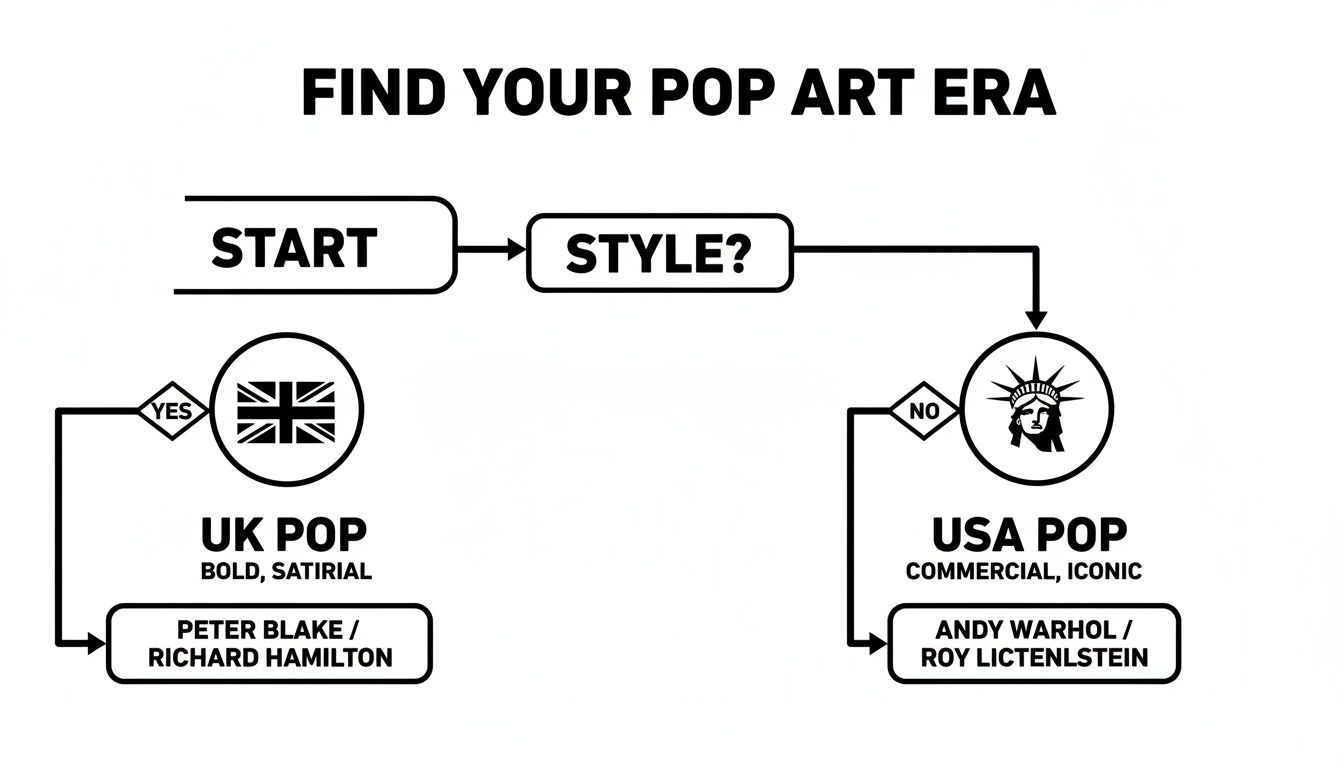
This breaks down the core differences between the cheeky, satirical UK style and the bold, celebrity-obsessed US movement, helping you find your tribe.
Choosing Your Subject: The Heart of the Matter
This is where your personality really comes into play. The subject of your pop art print should be something that genuinely makes you smile. Don't pick something just because it looks "arty"—choose something that means something to you.
At Striped Circle, we're all about celebrating the icons of music and football because we know how much they matter. It’s about more than just a picture; it's a nod to a shared culture and personal history.
- For the Music Obsessive: Think about the artists who soundtracked your life. A print featuring lyrics from The Smiths, the swagger of Liam Gallagher, or the otherworldly genius of David Bowie is a brilliant way to honour your heroes.
- For the Football Faithful: Your club is more than a team; it’s part of your identity. A print of your home stadium or a tribute to a club legend is a classier alternative to a standard club shop poster.
Choosing a print is like picking a song for the jukebox. It has to be a tune you’ll never get tired of hearing—or in this case, seeing. It should reflect a passion, a memory, or just a bloody good feeling.
Nailing the Colour Scheme
Colour is the lifeblood of pop art. These prints are meant to be vibrant and energetic, but that doesn't mean they have to clash with your sofa. Look for prints that pick up on an existing colour in your room—a cushion, a rug, or even a book spine can provide the perfect accent colour to tie everything together.
Alternatively, go for a bold, contrasting colour to create a real focal point. A bright yellow print in a grey room, for example, can inject instant energy and personality. The art market in the UK is booming, with the wall art sector generating over $3,597.2 million in 2022 and sales of affordable prints surging. It just shows that more and more of us are getting confident with using art to express ourselves.
Choosing Your Pop Art Print Style
Still not sure which direction to go in? This table should help you match your personal style with the perfect type of pop art for your home.
| Your Vibe | Pop Art Style to Match | What to Look For |
|---|---|---|
| Cool & Minimalist | Abstract Pop | Graphic shapes, bold typography, simple colour palettes. Think stadium architectural lines or clean-cut lyric prints. |
| Bold & Eclectic | Classic Pop (Warhol-esque) | Bright, repeating images of iconic figures, vibrant and clashing colours, a sense of fun and mass culture. |
| Nostalgic & Witty | UK Pop (Hamilton/Blake style) | Satirical collages, cultural references, a slightly more critical and humorous take on consumerism. |
| Passionate & Proud | Tribute Art | Stylised portraits of heroes (music or sport), iconic symbols like club crests or album art, bold statements of loyalty. |
Hopefully, that gives you a clearer idea. The best approach is simply to browse and see what speaks to you.
Ultimately, finding the perfect piece is a personal journey. Dive into our collections and see what catches your eye. Whether you're a die-hard music fan or a lifelong football supporter, there's a pop art print out there waiting to turn your pad into a proper home. To dig deeper, check out our full guide on how a pop art print can transform your space.
Framing and Hanging Your Prints Like a Pro
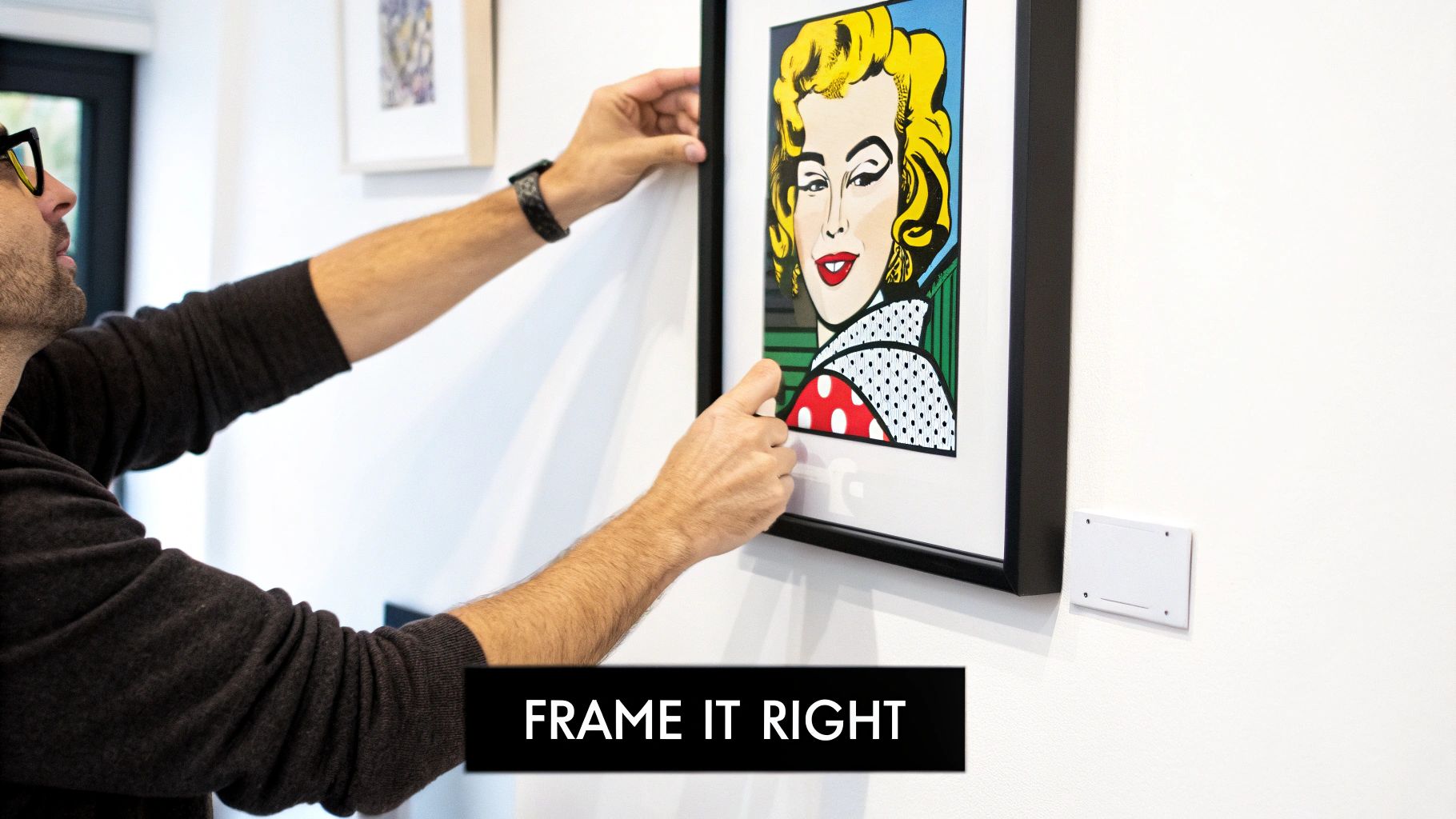
Right, you’ve done the hard yards, navigated the options, and bagged the perfect pop art print. Top stuff. But don't you dare leave that masterpiece rolled up in its tube behind the sofa. Leaving a brilliant print unframed is like having a festival headliner play an acoustic set in a library—it just doesn't do it justice.
Getting your print on the wall is the final, glorious step. This is the moment your chosen artwork transforms from a purchase into a part of your home, ready to make you and your guests smile. And no, you don't need a degree in engineering or a team of professionals to get it right.
Choosing a Frame That’s Top of the League
Think of a frame as the bassline in a classic song or the solid centre-back in a title-winning team. It might not be the star of the show, but without it, everything would fall apart. The right frame not only protects your print but makes the colours and design truly sing.
Here’s a quick rundown of your options:
- Sleek and Modern: A thin black or white frame is the equivalent of a classic Adidas Gazelle—it goes with everything. It’s clean, lets the artwork do the talking, and gives your pop art prints a sharp, gallery-style finish.
- Natural Wood: For a slightly warmer, more relaxed vibe, a natural wood frame is a great shout. It adds a bit of texture and works brilliantly with prints that have earthy or retro tones.
- Bold and Chunky: If your print is a proper statement piece, a thick, chunky frame can amplify its impact. This works well for larger prints that you want to be the undisputed champion of the room.
If you want to get into the nitty-gritty, we’ve got your back. Check out our detailed guide on how to frame posters for a masterclass in making your art look its best.
The Art of the Hang: Getting it Right
Now for the main event: getting it on the wall. The biggest mistake people make is hanging art too high, forcing everyone to crane their necks like they're trying to see over a crowd at a gig. The golden rule is to hang your print so its centre is at eye level. For most people, that’s around 57 inches (or 145 cm) from the floor.
A well-placed print doesn't just decorate a wall; it anchors the entire room. Getting the height right is the single most important thing you can do to make your space feel professionally curated, even if you did it all yourself during the ad break.
And for goodness sake, use a spirit level. A wonky picture is a crime against interior design. It’s the visual equivalent of a bum note in a guitar solo—once you see it, you can't un-see it. A few seconds with a level will save you a lifetime of quiet irritation.
Creating a Gallery Wall That Works
Why stop at one print? A gallery wall is a fantastic way to showcase your personality, mixing and matching different pop art prints to create a wall that’s uniquely you. The key is to make it look effortlessly cool, not like a chaotic mess. It’s a bit like managing a football team—you need a plan to get the best out of your star players.
Once you've selected and framed your pop art, the next step is to display it effectively. For inspiration on creating dynamic visual displays, learn how to arrange photos on a wall to tell your unique story. This will help you plan a layout that has rhythm and flow, mixing sizes and orientations for a truly knockout display.
The demand for pop art prints has never been higher. In 2022, the market saw incredible growth, with a staggering £36 million worth of prints sold at auction by the middle of the year alone. This just proves that more and more people are realising how much character this art form can bring to a home. So get framing, get hanging, and let your walls join the party.
Why Our Pop Art Prints Are Top of the League
Alright, let's talk shop for a minute. When it comes to art prints, you’ve got your Premier League contenders and then you've got everyone else stuck in the Sunday league. Not all pop art is created equal, and we want to show you exactly why ours are challenging for the title, season after season.
It’s one thing to have a great idea for a design, but it’s another thing entirely to bring it to life properly. A brilliant concept printed on cheap, flimsy paper is like watching a guitar legend play on a plastic ukulele—it just doesn't have the same impact. We’re obsessed with getting those details right because we know that’s what turns a decent poster into a piece of art you’ll genuinely love for years to come.
Built to Last Like a Classic Album
Ever bought a print that looked incredible online, only for it to arrive feeling like a takeaway menu? Yeah, we’ve been there, and it’s rubbish. That’s why the foundation of every single Striped Circle print is the paper itself.
We use high-quality, heavyweight art paper that feels substantial from the moment you get your hands on it. Just as importantly, it's all sustainably sourced. We believe you can celebrate cultural icons without costing the earth, so you can feel good about what’s hanging on your wall.
Of course, great paper is only half the story. The real magic happens with the inks. We use vibrant, archival-quality inks specifically designed to resist fading. Think of them as the anoraks of the ink world—built to withstand the elements (well, sunlight, mainly) and stay brilliantly bright. This ensures your print won't fade faster than a one-hit wonder's career, keeping its punchy colours for decades.
More Than Just a Print—It's a Passion Project
Here’s the thing that really sets us apart: we’re not some massive, faceless company churning out generic designs from an anonymous warehouse. Striped Circle is a family-run outfit, born from a genuine love for music, football, and brilliant design. Every single order is a big deal to us.
This isn’t just a business; it’s a passion that started during lockdown and has grown into something we’re immensely proud of.
We don't just hit 'print' and hope for the best. Every piece is carefully checked, packed, and shipped right from our HQ. It's a hands-on process because we're creating something we'd genuinely want to hang on our own walls.
This personal touch means we're not just selling products; we're sharing a piece of what we love. Whether it’s a subtle nod to an obscure B-side or a tribute to a cult football hero, we get it. We’re fans first, and that passion is infused into everything we do, making sure the final product does justice to the legends it represents.
Designed to Make You Smile
Ultimately, our goal is simple. We want to create pop art prints that make you and your guests smile. It’s about more than just filling a blank space on a wall; it’s about starting a conversation, sparking a memory, or just giving you a little lift every time you walk past it.
Think of it as a visual shout-out to the bands that shaped your youth, the team you’ve followed through thick and thin, or the lyrics that feel like they were written just for you. Our prints are designed to be a reflection of your personality, bringing a bit of wit, swagger, and colour into your home or office. And in a world that can often be a bit grey, a splash of that is something we can all get behind.
Your Pop Art Prints Questions Answered
Right, we’ve covered a lot of ground, from the rebellious beginnings of pop art to framing your prints like you’ve been doing it for years. But I’m willing to bet you still have a couple of questions bubbling away. That's exactly what this last part is for—a quick-fire round to clear up the common queries we get asked all the time.
Think of it as the encore after a brilliant gig. We’re here to tackle those last few burning questions, so you can dive into the world of pop art prints feeling totally confident and ready to turn your walls from bland to brilliant.
Is Pop Art Still Popular Today?
Absolutely! You could even argue it's more relevant now than ever before. At its heart, pop art was all about celebrating (and sometimes taking the mickey out of) mass culture, celebrity, and the stuff we’re surrounded by every day. In our hyper-connected, social media-driven world, that idea feels incredibly familiar, doesn't it?
You can see its influence everywhere, from high-fashion catwalks to the sharpest advertising campaigns. The themes just don't get old. Plus, with the massive resurgence of things like vinyl records and retro football kits, there's a huge appetite for the kind of nostalgia that pop art captures so perfectly. It’s an art form that simply refuses to be boring, which is why people are still so keen to get a piece of that energy up on their walls.
Pop art is the ultimate survivor. It thrives because it speaks a language we all understand, tapping into the music, icons, and cultural moments that define our lives. It’s not just popular; it’s a permanent part of our visual culture.
How Do I Clean and Care for My Art Prints?
Brilliant question. When you've invested in a piece you love, you want to keep it looking razor-sharp for years to come. Thankfully, it’s dead easy. The number one rule is simple: keep your prints out of direct sunlight. UV rays are the arch-nemesis of vibrant colour and will cause fading over time.
Once it's framed and hanging proudly, looking after it is a piece of cake:
- For Framed Prints: If your print is behind glass or acrylic, a quick wipe with a clean, dry microfibre cloth is all it needs. Steer clear of household cleaning sprays—they can damage the frame or even seep under the glass.
- For Unframed Prints: Always handle them with clean, dry hands to avoid getting natural oils from your skin on the paper. If you need to dust it, use a very soft, dry brush (like a new paintbrush) and be incredibly gentle.
In short, treat it like your most prized vinyl record or that vintage footy shirt. With just a tiny bit of care, it’ll look top-notch for a lifetime.
Can I Mix Pop Art With Other Art Styles?
Not only can you, but you absolutely should! Mixing different art styles is what gives a home its unique character. It stops your decor from feeling like a page torn out of a catalogue and turns it into a real reflection of you.
Pop art prints are surprisingly good team players. Their bold, graphic nature creates a fantastic, energetic contrast to more traditional pieces, like an old landscape painting or a classic black-and-white photograph. The trick is to find a common thread that pulls it all together.
For instance, you could:
- Find a Common Colour: Pick out a vibrant colour in your pop art piece and find an echo of it in another artwork, even if it's just a subtle shade.
- Use Consistent Framing: Hanging different styles in similar frames (like simple black frames for everything) creates a cohesive, gallery-wall feel.
- Create a Thematic Link: A vibrant pop art print of a musician like David Bowie would look fantastic next to a vintage black-and-white concert photo from the same era.
Don’t be afraid to experiment and have some fun with it. Your walls are your canvas, so feel free to break the rules and create a display that’s 100% you. It's like curating a visual playlist that tells your story.
What Makes a Great Gift for a Music or Football Fan?
You've definitely come to the right place. The best gifts are the ones that show you've really been paying attention to what someone is passionate about. A pop art print celebrating their favourite band or football club is a guaranteed winner because it’s personal, thoughtful, and a hell of a lot more memorable than another pair of socks.
Instead of some generic, off-the-shelf present, you’re giving them something that connects to a core part of their identity. For a dedicated music lover, a print featuring the lyrics of 'their song' or a stylised portrait of their musical hero is incredibly meaningful. It’s a nod to the soundtrack of their life.
And for a die-hard football fan, a print of their club's hallowed stadium or a tribute to a legendary player goes way beyond the usual scarf or mug. It's a unique, stylish piece of memorabilia they can proudly display at home or in the office, reminding them of triumphant victories and cherished memories every single day. It’s not just a gift; it’s a statement of their passion.
Ready to kick your boring walls to touch? Find a print that speaks to you and celebrates your passions at Striped Circle. Explore our full collection of music and football pop art prints today.
