
Prints of Contemporary Art to Transform Your Walls
Honestly, your bare walls are a bit like a team playing with ten men – something’s definitely missing. Staring at a blank space is as dull as a nil-nil draw in the pouring rain. This guide will help you turn those sad, empty walls into a gallery of contemporary art prints, giving your home or office the swagger of a Champions League winner.
Your Walls Need a Top-Tier Signing
Think of the perfect art print as your star striker: it grabs attention, lifts the mood, and is a clear statement of intent. It's a silent nod to your passions — whether that’s the genius of Oasis, the brilliance of Scorsese, or the unshakeable love for your football club. It’s the difference between a dull replay and that last-minute screamer you’ll be talking about for years.
Your home or office shouldn’t feel like a soulless corporate box. It's your fortress, your personal dugout, the place where every single detail screams you.
Why Settle For Boring?
Leaving a wall blank is like watching Match of the Day with the sound off – you’re missing the best part. Embracing art prints lets you:
- Inject Personality: Show off your love for 90s Britpop, cult films, or that iconic goal celebration.
- Create A Vibe: Get a proper buzz going in the living room or a chilled-out atmosphere in the office.
- Spark Banter: A cracking print gets people talking. “Where did you get that?!” is way better than another chat about the weather.
A well-chosen print doesn’t just fill an empty wall; it’s like the perfect bassline in a classic track – it holds the whole room together.
If you're stuck for ideas, kick things off with our guide on how to decorate walls. Next, we'll dive into picking prints that always hit the back of the net.
Getting Your Head Around Contemporary Art Prints
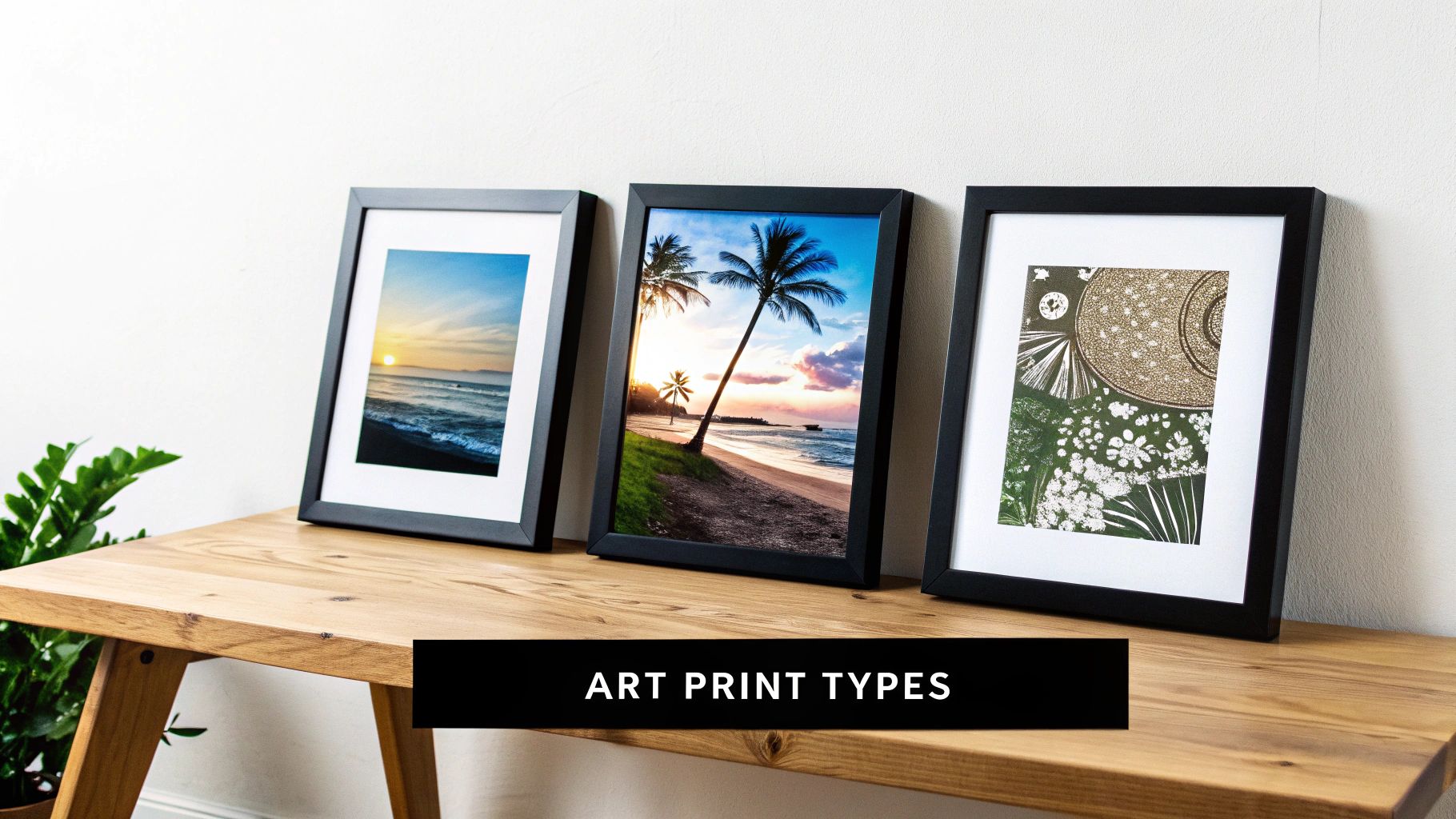
‘Contemporary art’ can sound a bit intimidating, like trying to understand the offside rule for the first time. But honestly, it just means art made by people who are alive today, creating stuff that reflects the world we’re living in right now.
When you buy a print of contemporary art, you’re grabbing a piece of that culture. It might be the raw energy of a festival anthem, a hilarious line from your favourite film, or even the crushing heartbreak of watching your team concede in the 94th minute. It’s art that gets it.
What Makes a Print a Print, Anyway?
Look, a print is not the dodgy photocopy you ran off at work last week. Think of it more like the 180-gram vinyl version of a classic album: it’s got weight, quality, and it’s made to be treasured.
Here are the key players on the teamsheet:
- Giclée Prints: Pronounced zhee-klay (fancy, eh?), this method uses top-tier archival inks and paper, meaning the colours stay punchy for decades.
- Screen Prints: A proper hands-on technique where ink is pushed through a screen one colour at a time. It gives you a bold, layered finish that you can almost feel.
A great print isn't just a copy; it's the artist's vision, remixed for a new audience. It’s the official release, not a dodgy bootleg.
Why Limited Editions Are the Real Deal
When an artist releases a limited edition print, they're basically saying, "We're only making 50 (or 100) of these, and then that's it. Game over." Each one is numbered and signed.
It’s like owning the deluxe vinyl box set instead of just streaming the single. Streaming is fine for a quick listen, but a numbered, signed print is a proper collector's item. Have a look at what makes prints limited edition and why they’re such a class act.
Now you’ve got the basics, you can stop just browsing and start building a collection that’s pure gold.
Choosing the Perfect Print for Your Space
Picking the right art shouldn't feel like taking a penalty in a shootout, with the weight of the world on your shoulders. It should be fun. This is your chance to find prints of contemporary art that are undeniably, unapologetically you.
So, where do you begin? Forget all that dusty art theory for a moment and start with what you love. Are you a die-hard fan who bleeds your club's colours? Is your brain a jukebox of 90s Britpop anthems? Do you quote Scorcese films like they're gospel? That's your foundation—your tactical starting point.
Match the Vibe to the Room
Next up, think about the room's purpose. You wouldn't blast thrash metal in a library, would you? The same logic applies here. A print that makes you chuckle is perfect for the kitchen where everyone gathers, while the bedroom might call for something a bit more chilled out, like the mellow B-side to a classic album.
It’s all about creating the right atmosphere. The goal is to make your home feel like a gallery of your own greatest hits, with each room playing its own distinct track.
The infographic below highlights just why getting into collecting contemporary art prints is such a smart move.
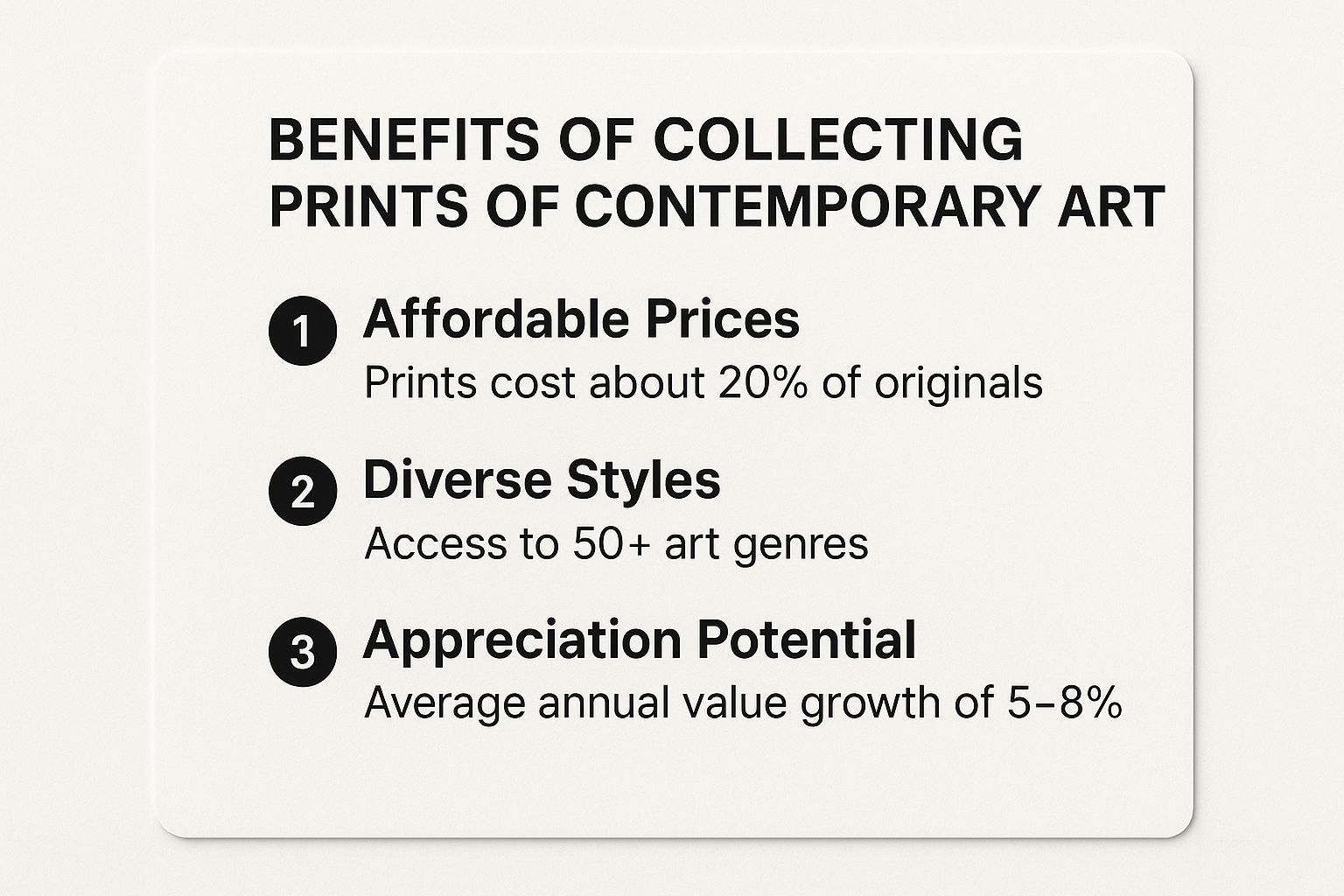
As you can see, diving into prints isn't just more affordable; it also opens up a massive range of styles to explore.
Choosing a print is less about finding something that "matches the sofa" and more about finding something that matches your soul. It’s an extension of your personality, not just a decoration.
Getting Size and Scale Right
Now for the practical bit. Shoving a massive print into a tiny hallway is like playing your star striker in goal – a tactical disaster that just looks awkward. Getting the size and scale right is crucial for making your art look intentional and cool, not like a cluttered afterthought.
Have a good look at the wall space you're working with. A large, empty wall can easily handle a statement piece, turning it into the room's headliner. Smaller spots, like the space above a desk or in a bathroom, are perfect for more modest prints or even a small collection of a few favourites.
This is where my little guide comes in handy. Think of this table as your go-to cheat sheet for matching a print to your space and personality.
Print-Picking Cheat Sheet
| Your Vibe | What to Look For | Best Room For It |
|---|---|---|
| The Minimalist | Clean lines, single-subject focus, neutral or monochrome palettes. Think abstract geometry or stark photography. | A home office or living room where you want a sense of calm and order. |
| The Pop Culture Fan | Bold graphics, film quotes, band posters, or portraits of cultural icons. Anything that sparks nostalgia. | A social space like the kitchen or a dedicated "man cave" or "she-shed". |
| The Bold Maximalist | Vibrant colours, clashing patterns, busy compositions. More is definitely more here. | The living room or dining area—somewhere you want to make a big, confident statement. |
| The Quiet Thinker | Subtle textures, serene landscapes, or thought-provoking abstract pieces with a story behind them. | The bedroom or a cosy reading nook, creating a space for reflection. |
Hopefully, that gives you a few solid ideas to get started. It's all about finding what works for you and the room you're decorating.
The accessibility of prints is a huge part of their growing popularity. In the UK, the art market is buzzing. While the very high end saw a slight dip, the number of individual sales actually went up. This points to a smart shift towards more frequent purchases of lower-priced works, like prints of contemporary art, which are far more approachable than one-off paintings. You can read more about this trend and the UK art market over at MyArtBroker.
Getting to Know the A-Listers of the Art World
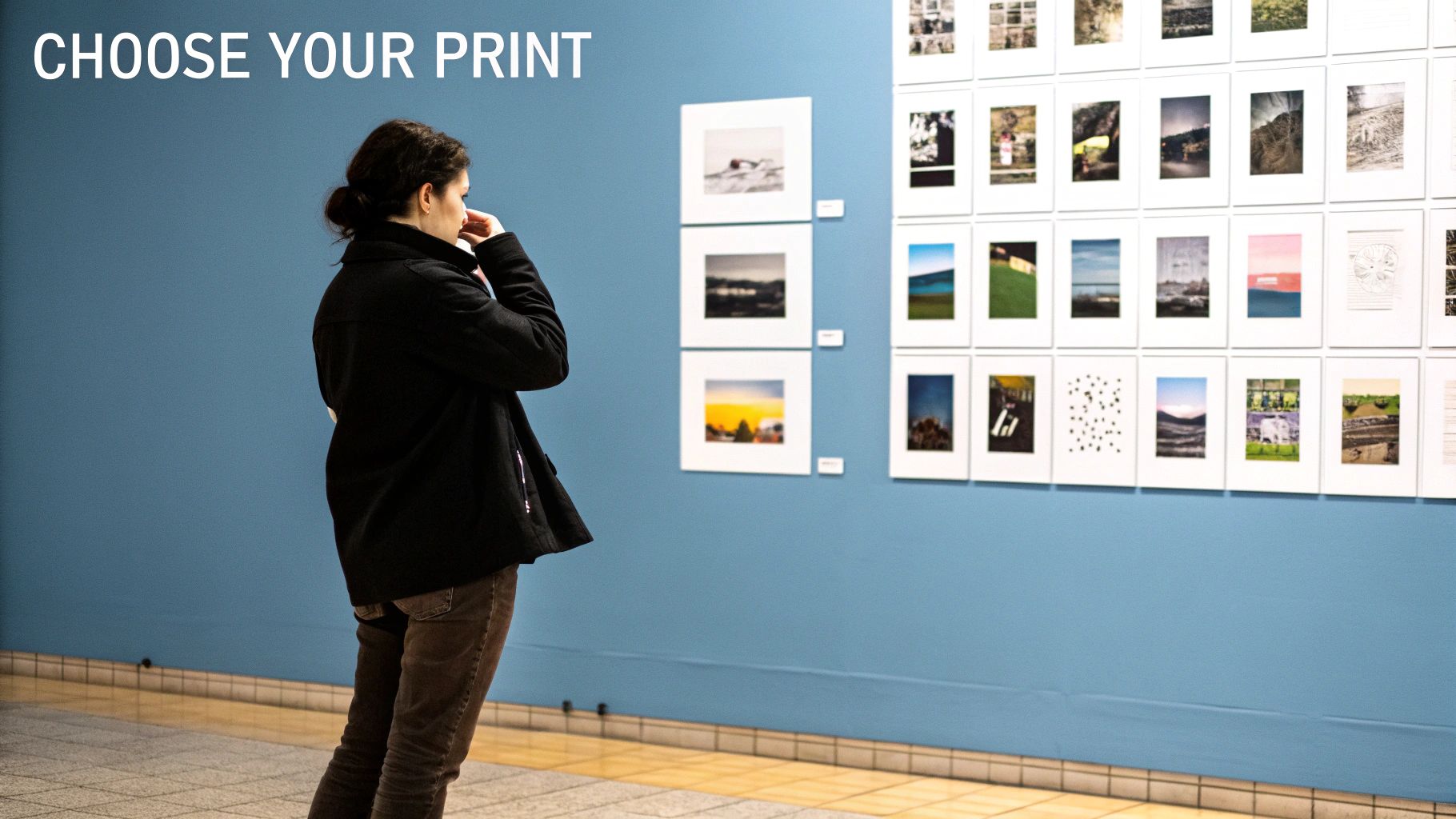
Alright, let's talk about the heavyweights of the art world. Even if you're just dipping your toe in, you've almost certainly heard names like Banksy and David Hockney. These are the artists who don't just participate in the art scene; they define it.
Knowing who they are isn't about being an art snob. Think of it like knowing your music history – understanding The Beatles helps you appreciate everything that came after. These are the artists whose ideas and styles echo throughout the world of prints of contemporary art.
The Big Names and Why They Matter
When you look at a Banksy print, you’re seeing more than just a clever image. You’re getting a piece of sharp cultural commentary, a rebellious wink at the establishment that connects with people globally. His work isn't just art; it’s a headline-grabbing event.
Then you have David Hockney, an absolute giant of British art. His sun-drenched, vibrant paintings of Californian swimming pools and Yorkshire landscapes are pure, unadulterated joy. A Hockney print brings an explosion of colour and optimism into a space, capturing a feeling that’s both classic and completely of the moment.
Getting familiar with these key figures is like listening to a band's influences. You start to hear the echoes and understand where today's new, exciting art is coming from.
This is by no means a complete list, but it's a solid starting point. The techniques and themes these artists pioneered have inspired countless others, giving you a frame of reference for what makes a great print tick.
The Art That Dominates the Market
Unsurprisingly, these iconic artists also command the art market. Their influence shapes the UK contemporary art prints scene in a huge way, and their work consistently performs like a number-one single at auction.
Between 2022 and 2023, Banksy’s prints smashed auction records across the globe. By May 2024, David Hockney's auctioned pieces were fetching multi-million-pound figures, cementing their rock-star status. For a deeper dive into how these artists move the market, you can explore the full breakdown of UK art market figures on Statista.
How to Style and Hang Your Art Prints
Right, you’ve chosen the perfect print. What now? Just sticking it on the wall with a bit of Blu-Tack is a bit like buying a beautiful new guitar and plugging it into a cheap, crackly amplifier. The presentation is what makes the art truly sing.
How you frame and hang your piece is the final, crucial step. It’s what elevates prints of contemporary art from a simple poster into a real focal point for your room. The frame isn’t just a border; it’s part of the whole experience.
Nailing the Framing Game
You don’t need to be a professional curator to get this right. Often, the simplest choice is the most effective. A clean, thin frame in black or white allows the artwork itself to take centre stage, without any distraction. It’s a classic for a reason – it just works.
If you want to give the piece a bit more presence, think about using a mount. That’s the cardboard border that sits between the print and the frame, and it provides some valuable breathing room. It draws the eye inward and gives the entire piece a more considered, professional finish.
The way you present your art tells a story. A good frame doesn’t just protect the print; it becomes part of the art itself, finishing the piece with confidence and style.
Creating the Ultimate Gallery Wall
A gallery wall is your personal exhibition, a collection of pieces that reflect your taste. The trick is to make it feel intentional and curated, not just a random jumble of pictures. Start by choosing a focal point—your "hero" print—and then build the rest of the arrangement around it.
Don't feel like everything has to be perfectly symmetrical. Mixing different sizes and orientations (a blend of portrait and landscape) often creates a more dynamic and visually interesting display. Here are a few pointers to get you started:
- Plan on the Floor First: Before you even think about picking up a hammer, lay all your framed prints out on the floor. Play around with the layout until it feels right. This simple step saves a lot of mistaken nail holes.
- Keep Spacing Consistent: Try to maintain a uniform gap between each frame, usually around 2-3 inches. This creates a sense of visual cohesion that ties the whole collection together, even if the frames and sizes vary.
- Hang at Eye Level: This is the golden rule of hanging art. The centre of your main piece, or the centre of the entire gallery wall, should be at average eye level, which is about 57 inches from the floor. It feels a lot lower than you’d expect, but it makes a world of difference.
For a deeper dive into creating the perfect layout, have a look at our complete guide on how to arrange wall art. With a few simple techniques, you can turn a collection of prints into a stunning, professional-looking display.
Keeping Your Art Prints in Top Condition
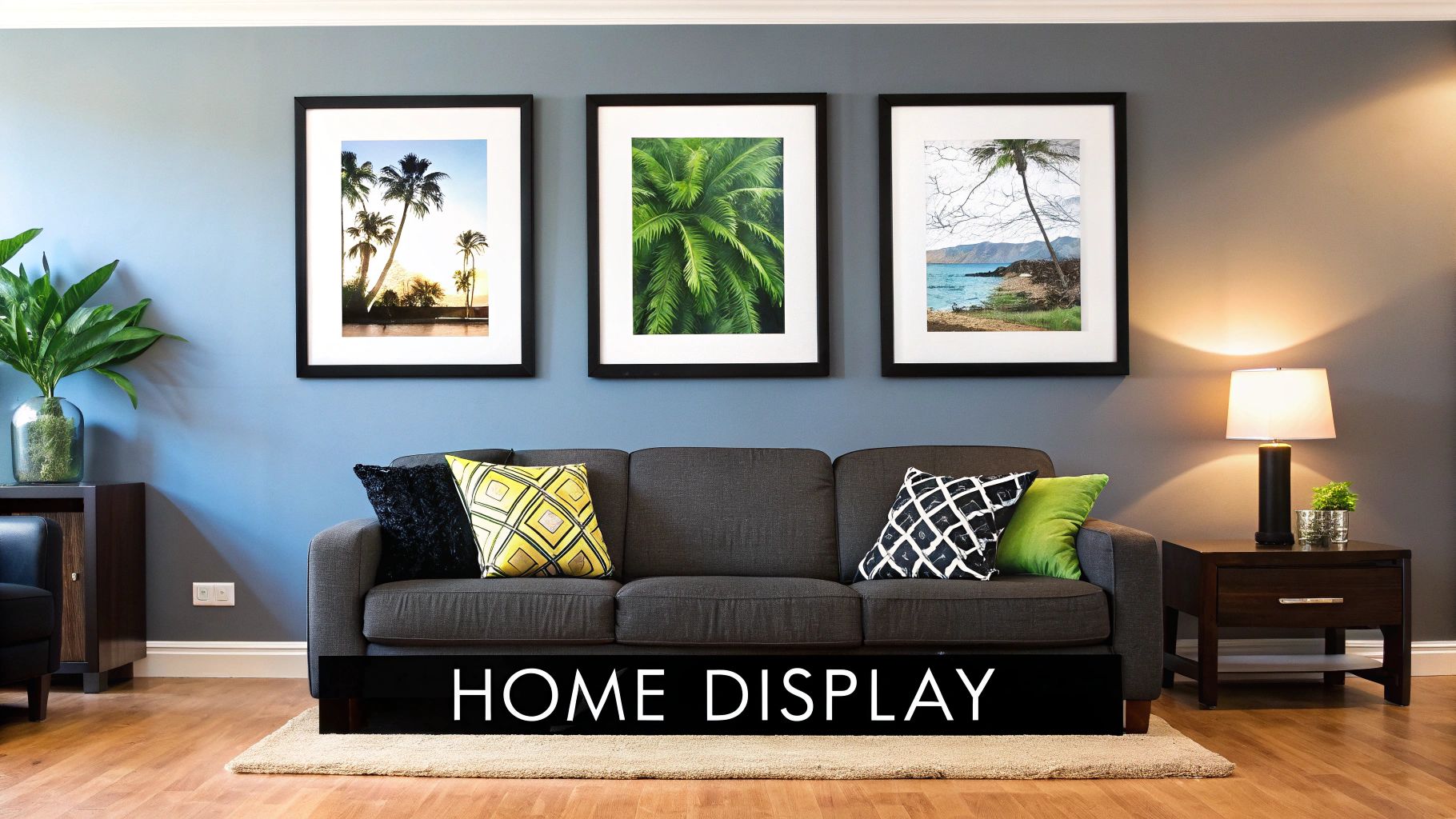
So, you’ve brought your new art home. It looks fantastic. But the job isn't quite done yet. Now it's time to make sure it stays looking fantastic. Think of it like a prized vinyl record; you wouldn't just leave it out in the garden to warp in the sun, would you? Giving your art just a little care will keep it looking gallery-fresh for years.
The number one enemy of any print is direct sunlight. It’s the arch-nemesis of vibrant colour, bleaching out those brilliant hues surprisingly quickly. UV rays are relentless, and they will eventually break down the pigments in the ink.
Location, Location, Location
Honestly, where you choose to hang your art prints is half the battle. Just a few common-sense rules will make all the difference in preserving them.
- Avoid Direct Sunlight: Try to hang your art on walls that don't get a direct blast of sun for hours on end. An east-facing wall is often a good shout as it only gets the softer morning light, but a north-facing wall is the ideal, shady spot.
- Dodge the Steam Zone: Bathrooms and kitchens might seem like cool places for art, but they're high-humidity zones. Over time, that moisture can creep under the glass, causing the paper to ripple or even grow mould. It’s a complete disaster for a print.
- Mind the Radiators: Placing art directly above a radiator is another classic mistake. The constant fluctuation between hot and cold can make the frame warp and cause the paper to become brittle.
A great piece of art is an investment in your home’s personality. Looking after it properly is like making sure your favourite musician’s voice is protected—it guarantees they’ll perform brilliantly for the long haul.
A Quick Clean-Up Job
Keeping your prints looking pristine doesn’t take much effort at all. For the frame itself, a quick wipe-down with a dry, soft cloth is usually enough to banish any dust.
If you're cleaning the glass, remember this golden rule: spray a little cleaner onto your cloth first, never directly onto the glass. This simple trick prevents any liquid from seeping under the frame’s edge and getting to the artwork itself.
By following these simple pointers, you’re ensuring your art collection will continue to be the main event on your walls, always looking as fresh as the day it arrived.
Common Questions About Contemporary Art Prints
Still got a few questions buzzing around? Don't worry, that's completely normal. Let's run through some of the most common queries we get about buying and styling prints of contemporary art.
Think of this as your quick-start guide, designed to clear up any lingering doubts before you dive in.
Is Collecting Art Prints Expensive?
This is the big one, isn't it? The short answer: not at all. While an original one-off painting might set you back a small fortune, high-quality prints are a genuinely accessible way to own a piece from an artist you admire. You can start a fantastic collection for the price of a few good nights out.
What Does Limited Edition Actually Mean?
It’s all about scarcity. When a print is a 'limited edition', the artist has made a promise to only ever produce a set number of them—say, 50 or 100. Each print is then individually numbered (e.g., 25/50) and often signed, elevating it from a simple poster to a genuine collector's item. It's the difference between a dodgy concert bootleg and a signed, numbered vinyl release.
This kind of exclusivity is highly prized in the UK's contemporary art print market. Recent analysis has even shown a major shift towards private sales, which now account for nearly a quarter of the total turnover at top auction houses. This really underlines how much the market values rarity, making those limited editions all the more desirable. If you want to dig deeper, the folks at London Trade Art have some great art market insights.
Choosing a print is your chance to own a piece of culture that speaks directly to you, without needing to remortgage your house. It’s democratic, personal, and a whole lot of fun.
Can I Mix Different Styles?
Absolutely! In fact, you should. A gallery wall that mixes different styles, sizes, and artists often has the most character and personality. Think of it like a festival lineup – you've got your established headliners hanging right next to some exciting up-and-coming acts.
As long as there’s a common thread to tie it all together—maybe a shared colour palette or a general theme like music or film—it’ll look fantastic. The most important thing is to trust your own taste.
Ready to find the perfect print that tells your story? Explore the full collection of music, film, and football-inspired prints at Striped Circle and give your walls the upgrade they deserve. Find your next favourite piece at https://www.stripedcircle.com.
