
Rock Music Posters UK: Your Wall-Ready Buying Guide
You know the wall. It's been bare long enough to become part of the furniture, and the video-call background is beginning to suggest you've moved into a very tasteful waiting room. Then a rock poster goes up, and suddenly the room says something about you beyond “owns a sofa”.
The best music prints aren't just pictures of a band. They're reminders of a venue, a city, a tour, or the night you got home with ringing ears and a setlist you've already misplaced. Britain's live-music map is part of that feeling: music tourism brought 23.5 million attendees to UK concerts and festivals in 2024 and contributed a record £10 billion to the economy, as the live-music tourism figures show.
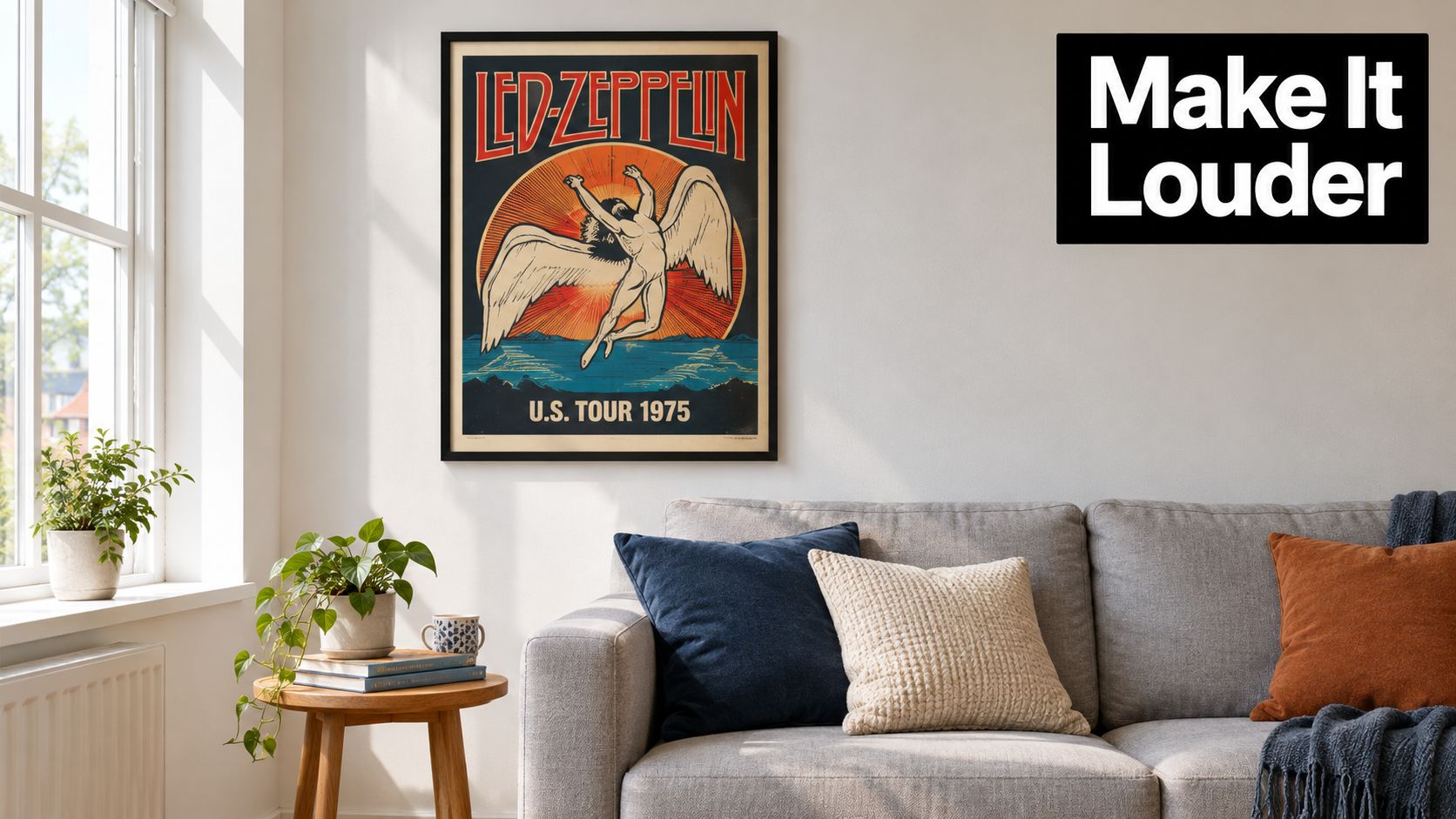
That's why choosing rock music posters in the UK is more interesting than picking a famous band name and calling it a day. A print can nod to the place you saw a gig, the scene you grew up around, or the music that still gets played too loudly while someone's trying to cook.
Put one above the sofa, desk, or the office printer that jams whenever you're in a hurry. It doesn't need to explain your entire personality. It just needs to look good and make you smile when you pass it.
Table of Contents
- Why a Rock Poster on Your Wall Beats Most Other Art
- The Main UK Poster Styles Worth Knowing
- Print Quality, Paper and What Actually Matters
- Where to Buy Rock Posters in the UK
- Framing, Hanging and Keeping Your Poster Alive
- Authenticity, Licensing and Dodgy Listings
- Gifting, Styling and Making the Wall Yours
Why a Rock Poster on Your Wall Beats Most Other Art
A good poster earns its space because it brings a story into the room. That might be a tour you remember, a band you never got to see, or an artwork that catches the restless energy of a particular music era. Compared with art chosen only to match the cushions, music prints have an unfair advantage: you already care about what they show.
They also make a room feel lived in. A gig-inspired print above a desk gives the background a bit of character without turning your home office into a tribute act's dressing room. At home, one strong image can make a blank wall feel intentional. The sofa still gets most of the attention, but at least the wall's joined the conversation.
The most satisfying choice often isn't the biggest name. It's the poster tied to a place or memory that matters to you. Maybe it's a venue you've visited, a city you keep returning to, or the band that soundtracked a long train ride home. Think of the wall as a small map of your loyalties. You don't need a geography degree to read it, just a passing interest in guitars.
Shop-floor advice: Buy the print you'll still enjoy looking at when nobody's visiting. Your walls aren't a committee, and they don't need to approve your taste.
There's a practical reason music prints suit shared spaces, too. They give guests an easy opening line that isn't “Is that a new rug?” A poster can start a conversation about a gig, a favourite album, or the surprising fact that someone else also owns a questionable band T-shirt from years ago.
So don't shop by band recognition alone. Ask what you want the room to feel like, then choose a print with the colours, place, or musical history to do that job. The best one won't just fill the wall. It'll remind you why you wanted something there in the first place.
The Main UK Poster Styles Worth Knowing
UK rock-poster design has moved through several visual moods. Knowing the difference helps you choose a style you like, rather than buying the first print where the band name is large enough to read from the kitchen.
Start with psychedelic London
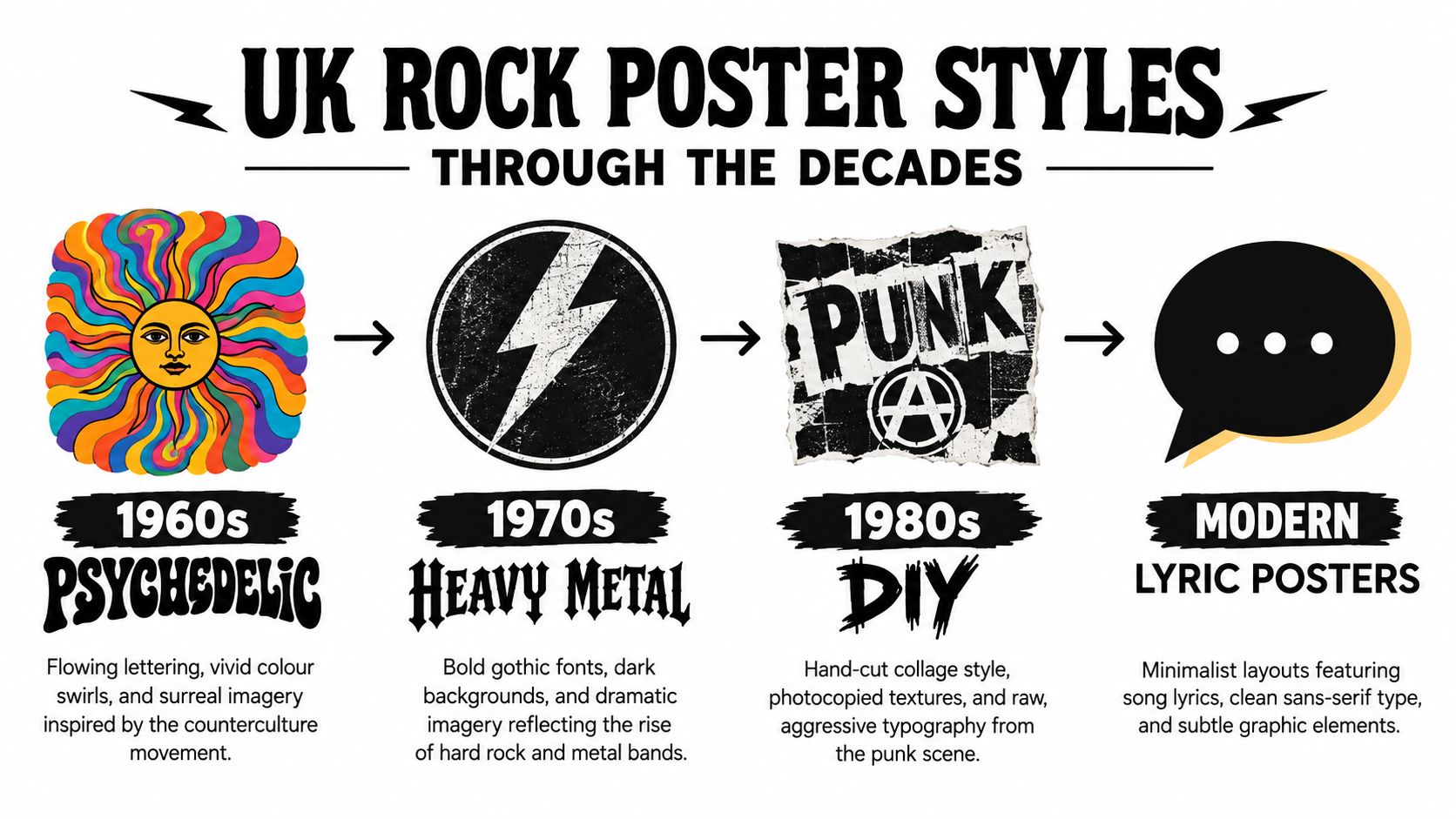
Late-1960s psychedelic posters leaned into experimental lettering, bold colour and surreal imagery. Their lettering can look as if it's melting into the background, which is visually exciting and occasionally a challenge for anyone trying to read the date. The V&A's collection includes a colour screen-print for Jazz at the Roundhouse, made around 1967, designed by Michael McInnerney and Dudley Edwards, and printed by Osiris Visions. It anchors the period in London's gig culture and independent print production, as the V&A collection record for the poster documents.
Then look at punk's rough edges
Punk and new-wave posters often feel immediate and handmade. The V&A documents a 1977 Buzzcocks poster for a show at The Vault, a Presbyterian Church on North Road in Brighton. It was printed on the classified section of the Brighton Evening Argus, using screen print and felt marker, and advertised Buzzcocks alongside Bare Hands and Juke Box. That's DIY promotion in its finest form: use what's available, make the show happen, and don't wait for a marketing department to discover scissors.
This was a local, independent approach, not a polished imitation of stadium advertising. It suits buyers who like work with a bit of grit and evidence of a real scene behind it.
Choose the later look that fits your room
Other familiar directions include heavy-metal artwork with dramatic lettering and dark, high-impact imagery, plus more polished tour prints associated with larger shows. Modern music art expands the choice further, from illustrated gig scenes and bold graphic compositions to lyric prints and pared-back typography.
For a room where you want one energetic focal point, go for psychedelic colour or striking illustration. For a calmer office, a cleaner typographic design may sit better beside bookshelves and the mug you forgot to bring home yesterday. Punk collage brings a more scrappy personality, while a lyric print can make a personal reference without turning the wall into a full-band shrine.
A simple test: look at the poster from where you'll usually sit or stand. If the design still reads clearly and the style feels like yours, it's a contender. If it looks like an eye chart that's started a band, keep browsing.
Print Quality, Paper and What Actually Matters
A product photo can make almost any poster look magnificent. It can't tell you whether the paper feels substantial, whether the colours print cleanly, or whether the artwork will look crisp on your wall rather than soft around the edges. Check the details before you buy.
The print method affects the finish. Screen printing can give colours a distinctive, tactile character and suits bold, graphic artwork. Lithographs can reproduce detailed illustrations and colour transitions with a traditional print feel. Giclée printing is commonly used for art prints where fine detail and careful colour reproduction matter. None is automatically “the best”. Match the process to the artwork, and look for a seller who explains what you're buying rather than hiding behind a glamorous product mock-up.
Paper matters just as much. A lightweight sheet may be easy to post, but it can feel flimsy and curl more readily when displayed without a frame. A heavier stock generally feels more considered in the hand. Matte finishes reduce glare and suit illustrated or typographic designs; glossier finishes can make colours pop, but they may reflect every lamp in the room. For a plain-language guide to stock and finishes, see this overview of different print paper types.
Compare the print types
| Print type | Typical look | Best for |
|---|---|---|
| Screen print | Strong colour with a crafted, graphic feel | Bold concert designs and artwork with defined colour areas |
| Lithograph | Detailed imagery and a traditional print character | Illustrated posters and designs with layered detail |
| Giclée | Fine detail and controlled colour reproduction | Art prints where subtle tones and crisp lines matter |
| Digital print | Flexible, consistent reproduction | Contemporary graphics, lyrics and accessible everyday wall art |
Ask about image quality, too. Enlarging a small, low-resolution file can leave lettering and edges looking fuzzy. A product listing should describe the format or print quality clearly, especially for larger sizes. For colour-heavy psychedelic artwork, remember that screen colours and printed colours don't always match exactly. A seller who talks sensibly about proofs and colour handling is giving you more useful information than a listing that promises “vibrant” in six different fonts.
Size is a room decision, not a competition. A smaller print works neatly in a narrow space or as part of a gallery wall; a larger format can hold its own above a desk or sofa. Before ordering, check the exact dimensions and whether a suitable frame is easy to find. Standard UK frame sizes are convenient, while unusual proportions may mean extra faff and custom framing.
Practical rule: If the listing won't tell you what the paper is like, how large the print is, or how the image is reproduced, don't let a nice mock-up do the thinking for you.
Live music's place in people's lives is easy to understand: UK audiences spent a record £6.68 billion on live music in 2024, with concerts accounting for 75.3% of that spending, according to reported UK live-music figures. That doesn't predict poster sales, but it does explain why fans want a physical reminder of a show. And if your appreciation of music stretches beyond the wall, this guide to making a custom bass drum head offers a useful look at a different way to carry artwork into a music setup.
Where to Buy Rock Posters in the UK
The right place to buy depends on what matters most: variety, originality, a specific event, or the chance of avoiding a print that looks like it was resized during a power cut. Start with the kind of poster you want, then choose your route.
Pick the shop for the job
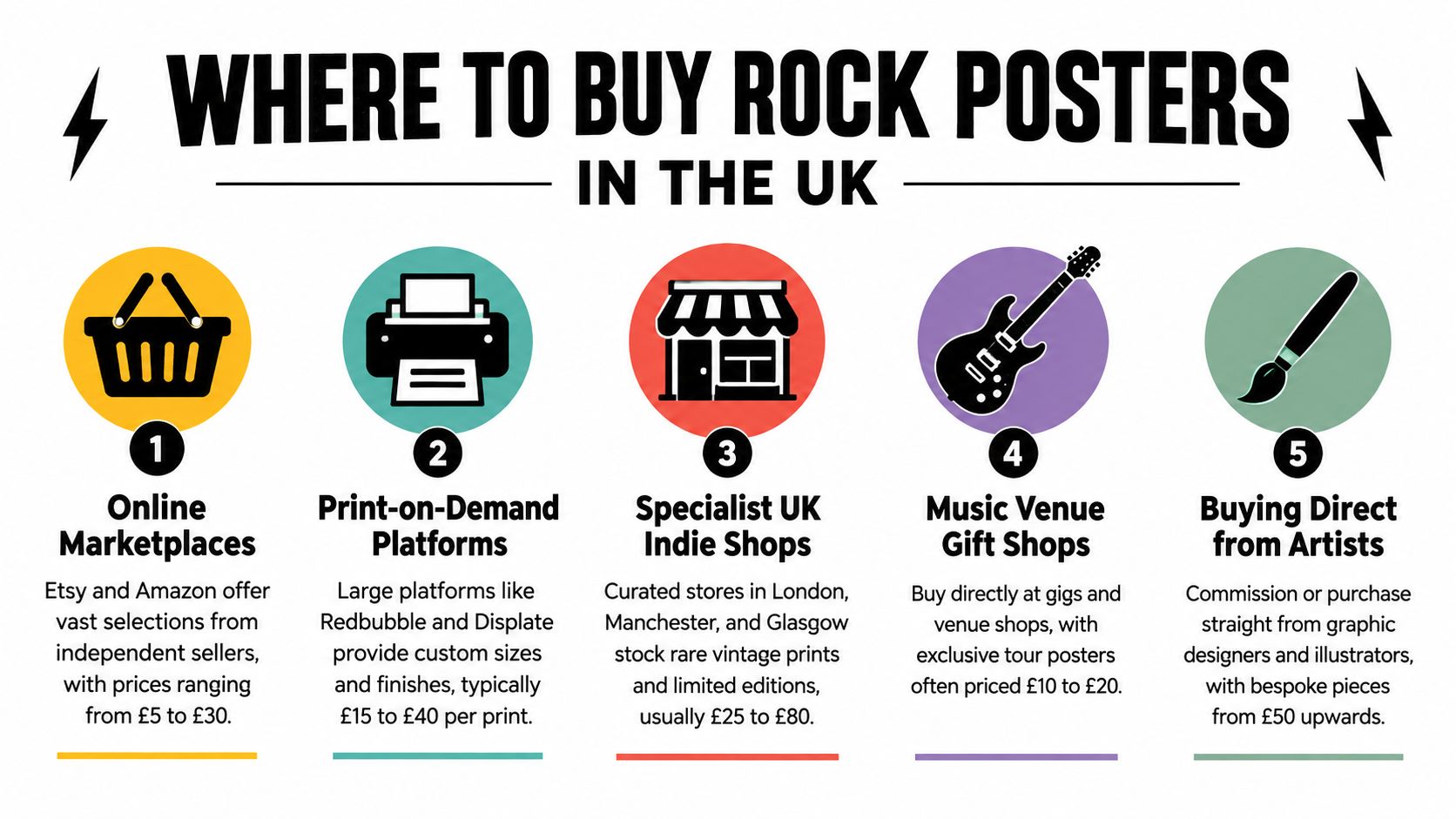
Online marketplaces such as Etsy and Amazon offer broad choice, from independent sellers to mass-produced designs. The upside is easy browsing; the downside is uneven quality and listings that don't always explain the print clearly. Look for seller details, size information and a proper description of the product, not just a band name and a photo of a very convincing living room.
Print-on-demand platforms carry plenty of contemporary designs and may offer different formats or finishes. They're convenient if you want a particular visual style, but check how the seller describes the artwork and printing. A huge catalogue is not the same thing as a carefully edited one.
Specialist indie shops are a stronger bet if you want a curated selection or a particular local feel. Venue shops and gig stalls are the obvious choice for a poster tied to a show you attended. Buying directly from an artist or small studio can be the most personal route, especially for original illustrations and designs that don't look like every other wall in the postcode.
Striped Circle is a family-run UK business offering music and football wall art, including alternative lyric prints and designs inspired by bands and songs. It's one option for shoppers who want music-focused artwork with a UK connection. For more places to browse, this guide to websites that sell posters sets out further options.
Read the listing before the checkout button wins
Check who made the design, where it's printed, what size you'll receive and how returns work. If you're buying a vintage poster, ask whether it's an original or a reproduction. Those are different purchases, and the listing should say so plainly.
Shipping can change the value of an order, particularly if you're planning a small gallery wall. Check delivery charges and any free-delivery threshold before adding prints just to make the basket feel more accomplished. The UK music industry generated £7.6 billion in gross value added in 2023, up 13% year on year, according to UK Music's industry report. The culture behind the artwork is substantial; your job is to find a print that feels personal, not to buy a stack of filler because postage has entered the chat.
Framing, Hanging and Keeping Your Poster Alive
The poster has arrived. Don't leave it rolled on the table for a month while it becomes a permanent feature of the dining area. A little care before you hang it will help it sit neatly and keep its colour and shape.
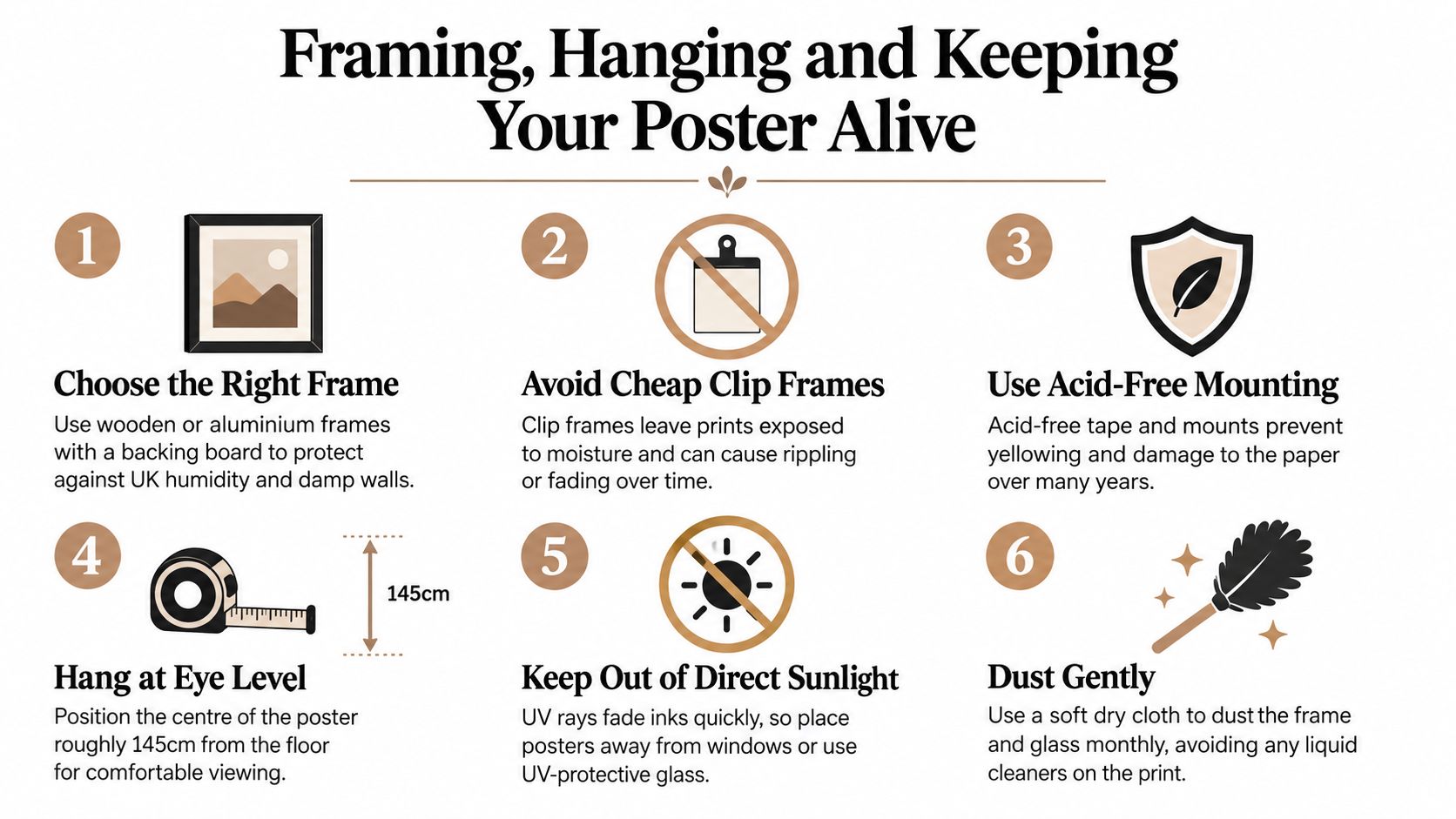
Start with a frame that suits the print and the room. Wood or aluminium frames with a backing board give the paper support; a mount adds breathing space around the artwork and makes a simple print feel more finished. Avoid letting a poster sit directly against a damp wall, particularly in rooms where condensation is common.
Cheap clip frames can work as a quick fix, but they leave the print exposed and may not hold it flat. For a print you care about, use suitable mounting materials and avoid sticking ordinary tape directly onto the artwork. If you're choosing glass or acrylic, consider the room and the size of the frame: both can protect the print, while lighter acrylic can be easier to handle for larger pieces.
Give the poster a sensible home
Hang the centre of the artwork around comfortable eye level, then step back and check how it looks from the doorway and the usual seat. Keep it away from direct sunlight, which can fade inks, and don't hang it above a radiator if you can help it. The wall may look perfect there; the heat and dry air are less charmed.
Dust the frame gently with a soft, dry cloth. If you have spare prints, store them flat in an acid-free sleeve or portfolio rather than leaving them rolled in a corner beside the exercise bike. The bike has enough unanswered questions already.
Sustainability belongs in the buying decision as well as the framing one. Ticketmaster's 2025 UK festival research found that almost 80% of fans viewed waste reduction as a priority and two-thirds said sustainability influenced ticket choices, according to the festival research. Ask whether the seller offers responsibly sourced or recycled paper, plastic-free packaging, or made-to-order printing, and reuse a sound frame when you can.
For more help choosing a frame and getting the finish right, use this practical guide to framing posters. A few careful choices beat replacing a damaged print, and they don't require you to become the sort of person who owns a special poster-handling glove.
Authenticity, Licensing and Dodgy Listings
A vintage-looking poster isn't automatically vintage. Distressed edges, faded colours and a typeface that looks like it's been through a tour bus can all be recreated today. If the listing claims an original, ask for evidence instead of trusting the filter.
Look for printer credits, dates, venue information, paper condition and any edition details. Compare the design with reliable collection records or documented examples when possible. Age can leave signs, but paper appearance alone isn't proof; sellers can describe a modern reproduction as “retro style” without making a claim of historical authenticity. If they call it an original, they should be able to explain why.
Ask direct questions
Before you buy, ask whether the print is an original event poster, an authorised reprint, or a contemporary design inspired by an era. Ask who made it and whether the listing's image shows the actual item or a mock-up. For limited editions, look for an edition number and clear information about the run. “Rare” means very little when every listing in the search results appears to be rare.
If a deal looks suspiciously cheap for a supposedly scarce original, treat the price as a reason to investigate, not a reason to sprint to checkout.
Licensing matters for contemporary work, too. A small studio can create an original design inspired by a musical mood, but reproducing a band logo, photograph, album cover, or another artist's illustration may involve rights that the seller doesn't own. Don't assume a print is officially licensed just because it includes a famous name. Look for clear wording about the artist and the product, and ask the seller when the listing leaves you guessing.
There's a real difference between buying nostalgia and buying a verified piece of music history. In either case, know what you're getting. UK Music reported 24.7 million music tourists attended UK concerts and festivals in 2025, up 4.8% from 2024, as described in the music tourism update. That many gig memories can inspire a lot of poster shopping; it still pays to separate a meaningful keepsake from a listing with more confidence than evidence.
Gifting, Styling and Making the Wall Yours
A music poster makes a strong gift when it reflects a person, not just a search for “rock band present” conducted at the last possible moment. Pick a venue, city, era, or lyric that connects to their story. For the mate who still talks about a legendary gig, choose artwork that points to the memory. For the friend with the band-shirt collection, find a print that gives the wardrobe some competition.
For a gallery wall, choose one larger poster as the anchor and build around it with smaller prints that share a colour or theme. Mix styles deliberately: a bold gig-inspired design can sit beside a quieter lyric print, while a football poster gives a multi-fan household room for both loyalties. Leave enough space between frames for each piece to breathe. A wall packed edge to edge can start to look less like a collection and more like a shop that lost its shelving.
Make it work at home or at work
In a home office, one well-chosen print can give the room personality without hijacking a video call. In a shared meeting space, music art is a welcome alternative to the stock photograph of a mountain nobody in the room has visited. Keep the colours in mind, but don't over-coordinate. You're decorating a room, not designing the away kit.
If you're buying for someone else, check their favourite band, musical era, and preferred size before you order. A print that matches their tastes beats a surprise poster of a band they "respect" but never play. When you're buying for yourself, choose the one that makes you grin when you walk past. That's a better test than whether it matches the curtains.
The UK's live scene keeps giving people memories to bring home. Analysis of 55,000 UK live events in 2024 found that a gig took place every 137 seconds, according to the live-event analysis. A poster can't reproduce the noise, the crowd, or the questionable venue chips, but it can keep a little of the evening on your wall.
Before you buy, check the design, print details, size, seller and framing plan. Then choose the place, sound or memory you want to live with. Your wall's been waiting long enough.
Striped Circle offers UK-made music and football wall art, including lyric prints and designs inspired by bands, songs and clubs. Browse Striped Circle for a print that brings a favourite gig, team or musical memory into your home or office.
