
Small Framed Prints Guide: Sizes, Placement and Styling
You've got a print still in its tube, leaning against the skirting board, and a wall that's been blank since the day you got the keys. The deposit is on your mind, the tenancy agreement is vague about nails, and every gallery wall you scroll past seems to involve a drill, a spirit level and a level of commitment you're not ready to make on a Tuesday night.
Good news: a small framed print is the cheapest win in decorating. It's light, it's easy to ship, and it can hang from something you peel off the wall in April without a repair bill. Printed images have been domestic objects in Britain for centuries, and the V&A's print collection holds more than 500,000 prints from the 15th century to the present, covering fine art and commercial work made to be looked at in ordinary rooms rather than galleries.
So here's the practical version: which size goes where, how to hang a frame you can remove without losing your deposit, and how to make a rotating display of music and football prints look deliberate rather than like a stockroom.
Table of Contents
- Small Framed Print Sizes at a Glance
- Room-by-Room Spots That Make Small Prints Work
- Protecting Prints From Light and Damp
- Choose a Renter-Friendly Hanging Method
- How to Measure and Mark Your Wall
- Gifts, Themed Displays and Your First Order
Small Framed Print Sizes at a Glance
Match the size to the wall before you fall for the design.
| Size | Dimensions | Best Spot | Visual Impact |
|---|---|---|---|
| A5 | 148 x 210 mm | Desk corner or bookshelf | Subtle and intimate |
| A4 | 210 x 297 mm | Beside a doorway or bedside table | Balanced for most walls |
| A3 | 297 x 420 mm | Above a narrow desk or console | Clear focal point |
| A2 | 420 x 594 mm | Hallway or single feature wall | Strong statement |
| A1 | 594 x 841 mm | Living room anchor or office wall | Dominant, needs space |
| A0 | 841 x 1189 mm | Large feature wall only | Maximum impact |
A5 is the shelf size. It suits a desk corner, a bookshelf or the narrow panel beside a mirror, and its job is to be noticed second, after the lamp. A4 is the workhorse: beside a doorway, above a bedside table, on the bit of chimney breast that isn't the main event. A3 makes a clear focal point above a narrow desk or console, and it's the point where a small framed print starts behaving like a small poster rather than a detail.
A2 and above stop being small. They need clear wall around them: a hallway, a single feature wall, a living room anchor. A0 belongs on a wall chosen for it, not on the first gap you find.
Two things get missed. A mount and a frame make the finished object bigger than the paper, so check the outer frame dimensions, not the print size, before you commit. Frames are also a mainstream British purchase rather than a niche one: the UK imported US$68.94 million worth of wooden picture frames in 2024, according to GTAIC's analysis of UN Comtrade data.
The wider market is sizeable without being a shortcut to a sales forecast. DCMS estimates published on gov.uk put the UK art and antiques market's gross value added at a provisional £0.8 billion in 2023, with around 39,000 filled jobs. That's the whole sector, not small prints, so treat it as context.
My shortlisting method is simple: take the largest size that still leaves a hand's width of clear wall on each side, then check it against the room rather than the ruler. If two sizes pass, go bigger. A small print that's shy about its wall looks like an accident. Our guide to what size poster frame you need works through the outer dimensions properly.
Room-by-Room Spots That Make Small Prints Work
The room does the editing. A small framed print can look crisp and deliberate in one spot and stranded in the next, so choose the wall first, then the size, then the frame. Reversible hanging fits this scale well: a few light changes can make a rented room, a seasonal display or a regularly rotated gallery wall feel planned without making the wall feel permanent.
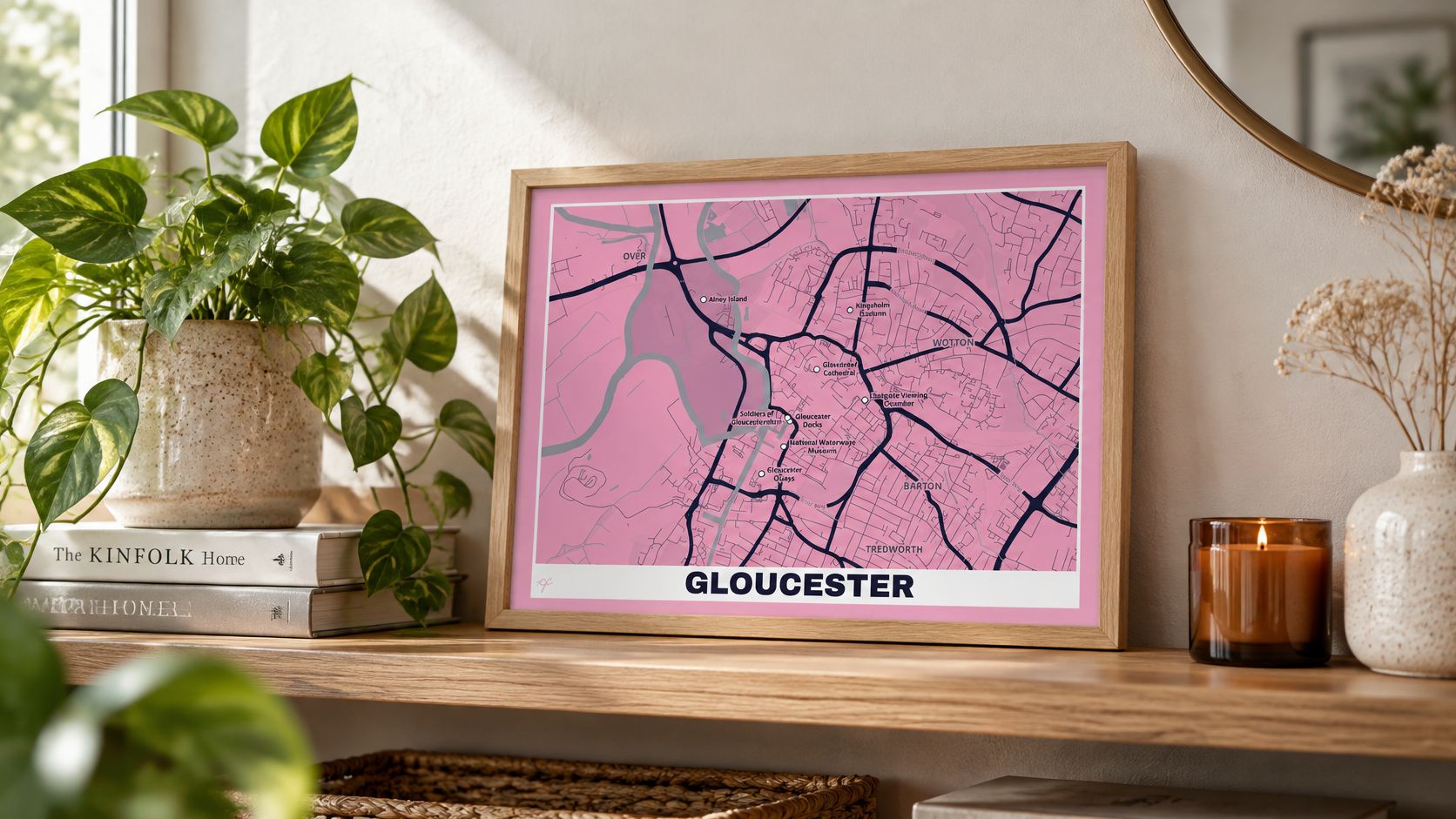
Hallways reward vertical stacking. Three portrait prints in a column follow the line of a stair wall or the end of a runner, and the eye climbs them as you walk past. Centre the column on the wall itself, not on the door frame beside it. A street map print suits this job because it gives the eye somewhere to travel; a local map also makes a hallway feel anchored without needing a full feature scheme.
Living rooms want a pair or a trio in a row. Size the group to roughly two thirds the width of the sofa or sideboard below, then stop there. A group wider than the furniture looks untethered. A much narrower one looks like a stamp on an envelope. This is also where paint, panelling and tone do useful work, so if the wall needs as much attention as the frames, browse feature wall ideas for interiors before drilling anything.
Bedrooms work with one or two, stacked above a bedside table. More than that and you're decorating a hotel room. Home offices take a single print above the desk, or up to three beside shelving, because the desk already supplies the clutter. Kitchens suit one or two prints beside a window or open shelf, far enough from the hob that steam and grease don't get a vote.
Two layouts fail predictably. A three-print row on a narrow wall spills past the edges of the wall it was meant to fill. Crowding matters just as much: twelve A5 prints in a box room turn the wall into a wall of small announcements, with no quiet space for any one print to land.
Space frames 5 to 8 cm apart within a group. Closer looks deliberate. Wider looks like a wall that lost its nerve.
Matching frames create calm. Mixed frames add personality when something links them, so keep one element repeated, frame tone, mount colour or print palette, and let the rest vary. Three lyric prints in matching black frames above a desk look intentional. Six club crests in six frame styles look like a stockroom.
| Room | Where to Hang | Prints per Group | Orientation |
|---|---|---|---|
| Hallway | Stair wall or end of a runner | 3 stacked vertically | Portrait |
| Living room | Above sofa or sideboard | 2 or 3 in a row | Mixed |
| Bedroom | Above bedside table | 1 or 2 stacked | Portrait |
| Home office | Above desk or beside shelving | 1 to 3 | Wide or portrait |
| Kitchen | Beside window or open shelf | 1 or 2 | Wide |
Trend reporting from House & Garden on 2026 interiors points toward compact, flexible living and smaller-scale, tactile pattern. That suits small prints, especially when the display can change as easily as the room does. It won't tell you how many frames to buy, though.
Test any arrangement for free. Cut paper to the outer frame size, tape it up, leave it for an evening, then decide. The Gloucester Map Print is a straightforward choice for a hallway or study because a map reads clearly at close range and still gives the wall a subject. Small prints work best when each one has a job: leading the eye upstairs, balancing a sofa, softening a desk corner or giving a quiet kitchen shelf something to say.
Protecting Prints From Light and Damp
Ultraviolet light fades inks, and damp warps paper. A rented wall can recover. A bleached print cannot.
UV is the thief. Daylight bleaches inks, and saturated, high-contrast designs go first, which is bad news for a bright lyric print or a football crest built on three strong colours. The National Archives guidance on caring for prints recommends UV-protected glass and advises keeping framed prints, drawings and watercolours out of daylight. Filtering reduces exposure; it doesn't cancel it, so the wall you choose still matters.
Contact is the second problem. Glass sitting directly on a print can transfer condensation, stick to the surface or abrade it. An overmount or window mount holds the glazing clear, which is the whole reason the air gap exists. Behind that, a rigid backing board keeps the paper flat and stops it cockling as the room changes temperature.
Humidity is the third. Paper doesn't need a laboratory; it needs a steady room. Big or rapid swings are worse than a stable reading slightly high or low, because paper and board expand at different rates and the print ripples. A cheap hygrometer tells you more than any advice about how a room "feels".
Before the hook goes in: UV glazing fitted, mount holding the print clear, backing board flat, out of direct sun, humidity steady.
Three spots are trouble regardless of specification: the bathroom, the wall directly above a radiator, and the window that catches afternoon sun. If you're set on a bathroom display, our guide to framed artwork for bathroom covers the practical workarounds.
Choose a Renter-Friendly Hanging Method
A rented flat, a 400g frame and a deposit you want back in full: that's the starting point for choosing a fixing. The reversible options below don't look like temporary bodges. Used well, they make a rotated display of small prints look as deliberate as a permanently hung wall.
| Method | Holds | Reversibility | Best For |
|---|---|---|---|
| Adhesive picture hooks | Light frames only; check pack rating | Removable with care | Rented walls, frames up to A4 |
| Picture rail with hooks | Medium to heavy frames | Fully reversible | Rooms with an existing rail |
| Leaning on a shelf or sideboard | Any frame, on a stable surface | Fully reversible | Quick rotation, no fixings |
| Screw and wall plug | Heavy frames on plasterboard or masonry | Leaves holes | Owned homes, permanent displays |
| Landlord-approved fixing | Depends on the agreed fixing | Agreed in writing | Tenancies where changes are allowed |
Adhesive hooks earn their keep on light frames, and they fail for boring reasons. Test one on an inconspicuous patch first. Check the pack's rated weight against the combined weight of frame, glazing, mount and backing, then give the hook its recommended settling time before you load it. Textured walls and paint applied in the last week cause most of the failures, and both are avoidable if you test rather than hope.
Picture rails are the quiet advantage of older UK flats: a hook and cord holds real weight and comes down without a mark. Leaning a frame on a shelf or sideboard is the only method with zero wall contact at all, which is why it suits supporters who swap a football print for a music one the moment the fixture list changes.
Where you own the wall, screws and plugs win. Plasterboard needs a cavity fixing, masonry needs a wall plug, and a timber stud is the strongest anchor in the room. Whatever the fixing, established practice for hanging framed works is secure attachment at three points: two upper fixings carrying the load plus a lower stabiliser to stop the frame tipping forward. Scaled down to a small frame, two hooks rated for the weight do the same job.
Permission varies by tenancy agreement and by nation, and Scotland is especially relevant because proposed rental reforms distinguish minor changes such as putting up posters or pictures from larger alterations. A UK survey of 1,000 renters found 19% were not allowed to decorate at all, while 43% said they would stay longer if they could personalise the property, as reported by Insight DIY's summary of the survey. That makes a reversible display a retention question as much as a deposit one.
Ask first, hang second. Anything beyond a couple of light hooks deserves a written yes, and a photo of the wall before you start is the cheapest insurance you'll ever take out.
For more ideas on making a rented room feel like yours, renter decor tips by Studio Contour covers furniture and layout moves that work with a landlord rather than against one. If you're skipping frames entirely, hanging posters without frames explains the tape-and-clip options.
How to Measure and Mark Your Wall
Work through these in order. Every step has a reason and a mistake that people make in a hurry.
- Measure the space, not the print. Note the width and height of the furniture or the clear wall the frame will sit above. The common slip is measuring the frame first and then hunting for a gap it fits.
- Cut a paper template to the outer frame size. Tape it up with painter's tape. If you cut to A4 paper when the frame is 50 x 70 cm, the template lies to you.
- Set the centre height. Centre the frame at roughly 145 to 150 cm from the floor, which lands near eye level for most adults. The classic error is hanging too high because the frame looked small on the shop shelf.
- Leave 15 to 25 cm between the bottom of the frame and the top of the furniture. Any tighter and the print looks squashed against the sofa; much wider and it floats away.
- Live with the template for a day. Rooms change character after dark, and a gap that looks fine at noon can look odd under a lamp.
- Mark the fixing points through the template, then check the spacing with a spirit level before drilling. Measure the drop from the frame's top edge to its hanging point, because that measurement is the one that ruins an otherwise perfect line.
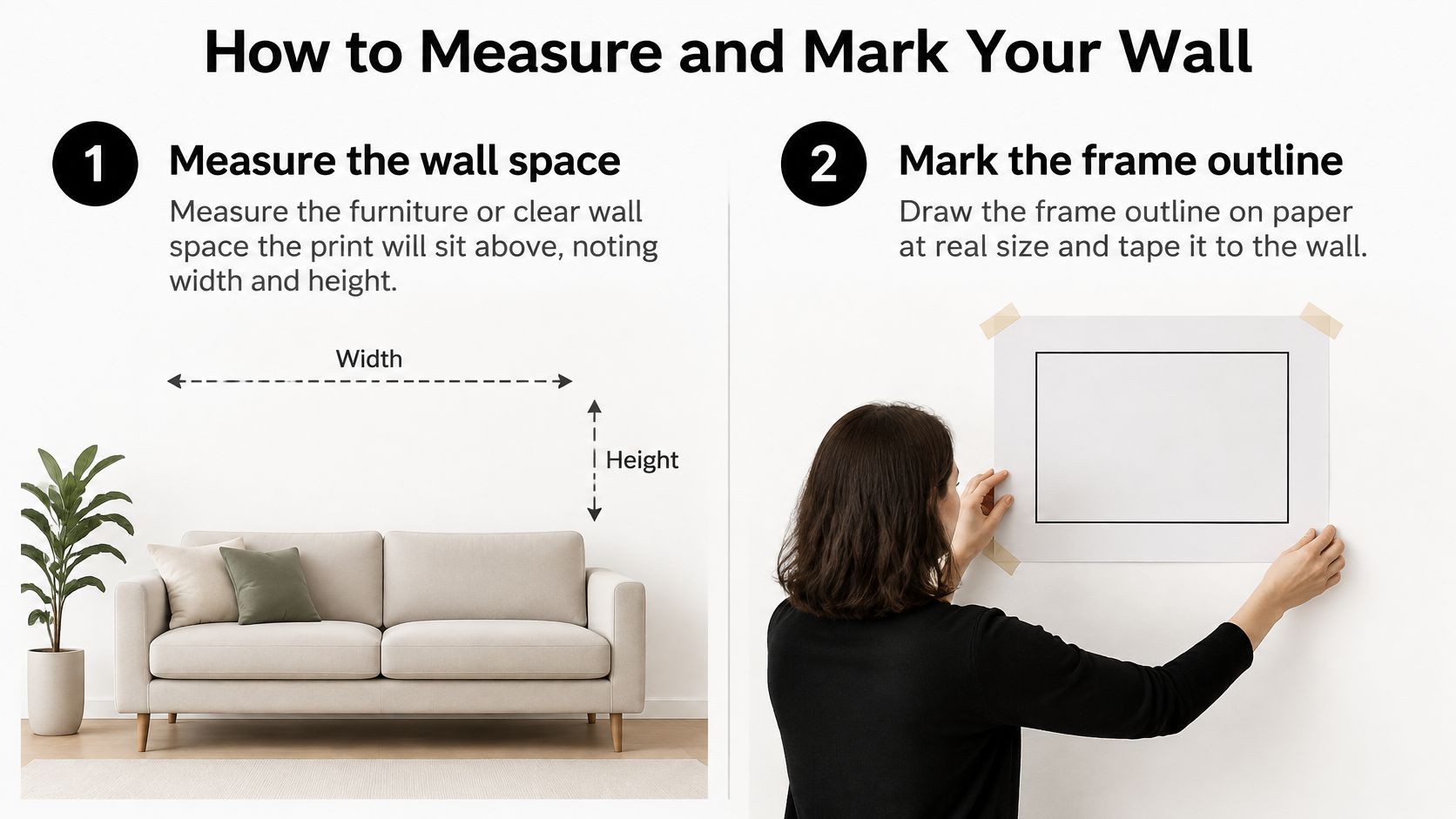
Steps one to five settle position; only then do you commit to a fixing method. Cutting the template oversize by a centimetre is fine. Drilling a centimetre high is a patch-and-paint job.
The final test costs nothing. Stand where you'll look at the print, sofa or doorway, and ask whether it sits comfortably in view without you tilting your head. If it does, stop measuring.
Gifts, Themed Displays and Your First Order
A print is one of the few gifts that works for a supporter, a music obsessive and the person who already owns everything.
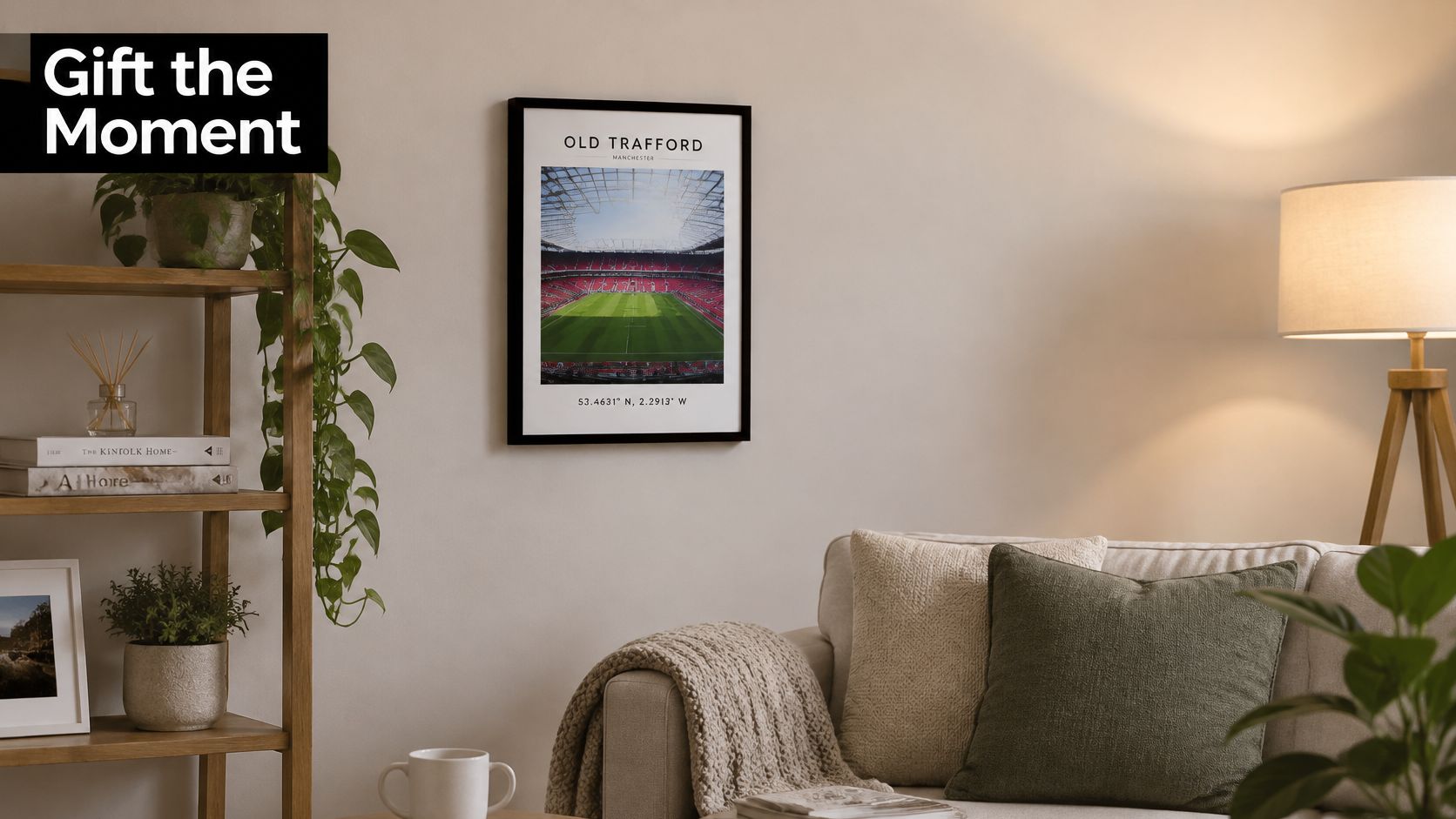
Football carries the argument on its own. In England's 2024/25 Participation Survey, 30% of adults said they'd attended live sport in person in the previous 12 months, and among those attendees men's football was the most popular sport, watched by 61%, according to the Participation Survey headline findings. Match-going sits deeper still: government football statistics for the 2025/26 season recorded around 48.4 million attendances at regulated men's football matches in and outside England and Wales. A small club or stadium print is a private version of that ritual, minus the queue for a pie.
Why music prints carry their weight
UK recorded-music consumption reached 210.3 million albums or streamed equivalents, up 4.9% year on year, in the BPI's 2025 figures, which also record audio streams passing 200 billion for the first time and vinyl rising for an eighteenth consecutive year. The industry behind it contributed £8.0 billion in gross value added in 2024, £4.8 billion in export revenue and around 220,000 jobs, per UK Music's This Is Music report. A lyric print turns something that lives on your phone into an object on a wall.
Here's how a themed wall comes together without turning into a jumble.
Matching the print to the person
Three decisions cover most gifts. Match the subject to a real allegiance rather than a colour scheme, choose a size the recipient can hang without a plan (A4 or A3 does that), and pick the frame so it arrives ready to hang rather than becoming a job for later.
The occasions that come up: housewarmings, leaving presents when someone moves cities, birthdays for the person with strong opinions about a band, and new offices where a bare wall is demoralising. The UK picture-frame market was valued at USD 624 million in 2025, according to Straits Research, so a framed print lands as an expected, ordinary gift rather than an eccentric one.
A map print handles the leaving-present brief better than almost anything else, and the Liverpool Map Print gives someone moving away a piece of the city to take with them. The same instinct behind turning a photo into something physical applies to printed keepsakes from your maternity session, where the point is a tangible object rather than a file.
A themed trio beats a themed dozen: one club print, one lyric print and one small humorous print that ties the two together. Rotated across the seasons on fixings you can undo, three prints read as a collection you curate, and swapping one out takes minutes rather than a drill.
Then commit. One size, one room, one frame style, ordered at the same time so nothing arrives that doesn't fit. Prints run from A5 to A0, ordered unframed or in a natural wood, black wood or white wood frame, with framing available from A4 to A1 and A5 and A0 supplied unframed only. Unframed prints dispatch within 1 to 2 working days and framed prints within 3 to 4 working days, which matters if the birthday is Saturday. Add four unframed prints to the basket and the cheapest comes free, though framed prints and cards sit outside the offer. UK delivery costs £2.99 for unframed prints and £5.99 for framed prints, and orders over £40 ship free. Product mockups are for reference only and don't show a specific print size or frame, so check the dimensions on the product page before you buy.
Whatever the wall, whatever the tenancy, whatever your other half says about how many football prints one room needs, the winning move is to start with the print that makes you smile and then work out where it goes. Striped Circle prints music, lyric and football artwork in sizes from A5 to A0, sold framed or unframed, with frames in natural wood, black wood or white wood so a set can hang together without matching by accident. Measure once, hang at the height you'll look at, and pick a hanging method you can undo when the lease ends. Have a look at the full range at Striped Circle.
