
Wall Posters for Bedroom Styling Guide
You're standing in your bedroom, holding a poster in one hand and a roll of tape in the other, while the blank magnolia wall looks back at you like it's waiting for a planning application. The room has a bed, a wardrobe and perhaps one heroic houseplant, but nothing that says you live there. Your favourite band, football club or brilliantly daft cultural obsession is currently trapped inside your phone, which is no way to decorate a room.
The right wall posters for bedroom styling can change that without turning the space into a chaotic student dorm or forcing you into a weekend of painting. Choose artwork with personality, hang it intelligently, protect it from sunlight and keep the sleep zone visually comfortable. The result should make you smile when you walk in, not make your brain feel like it's in extra time.
Table of Contents
- Why Your Bedroom Walls Are Begging for a Refresh
- Choosing Themes That Actually Mean Something
- The Renter Friendly Guide to Hanging Art
- Balancing Bold Aesthetics with Sleep Quality
- Protecting Your Prints from Sunlight and Damp
- Sizing, Framing, and the Perfect Gift Strategy
- Final Thoughts on Curating Your Personal Sanctuary
Why Your Bedroom Walls Are Begging for a Refresh
The blank-wall problem usually starts innocently. You move into a new place, promise yourself you'll decorate properly, then spend months deciding whether the bed should face the window. Eventually, the wall becomes part of the furniture. You stop noticing it, visitors notice it immediately, and the room develops the emotional warmth of a hotel corridor.
A poster offers a much easier intervention than repainting. You can introduce colour, humour, memories and strong visual identity without moving wardrobes or negotiating with a plasterer. A lyric print above a desk, a small football illustration beside the door or a carefully arranged group of music posters can make the room feel considered in an afternoon.
That low-commitment quality matters because bedrooms don't remain fixed forever. A survey of 1,000 UK homeowners found that bedrooms are redecorated approximately once every 29 months, while living rooms are refreshed about once every 25 months. The same research found that 55% of respondents had at least one room currently requiring decoration, according to survey findings on UK home decorating cycles.
A useful mindset: treat posters as the changeable layer of your bedroom, not a permanent commitment to one version of yourself.
The 29-month bedroom rhythm also makes sense emotionally. Your favourite artist changes, a new tour becomes the soundtrack of your year, a football club gives you another season of joy and despair, or you outgrow the design that once seemed perfect. Swapping prints lets the room keep pace without replacing every cushion, lamp and bedside table.
Small changes with a proper personality
Start with the wall you see most often, then ask what you want it to say. A room can be calm and expressive at the same time. If you're building a more reflective sanctuary, artwork doesn't have to be loud. You might even pair a restrained print with tactile objects and find calming Buddhist statues for bedroom inspiration, especially if your idea of relaxation involves fewer slogans and more quiet contemplation.
The best wall posters for bedroom styling aren't filler. They're visual bookmarks. They remind you of a song, a person, a matchday ritual or a joke that still makes you laugh every time you see it. That's a far better use of a wall than allowing it to continue impersonating a landlord's mood board.
Choosing Themes That Actually Mean Something
A generic scene can look pleasant, but it rarely tells anyone why it belongs in your room. Music and football work differently because they already live inside people's routines. They carry memories, loyalties and stories, which gives a print more emotional weight than a decorative image chosen because the colours were vaguely compatible with the duvet.
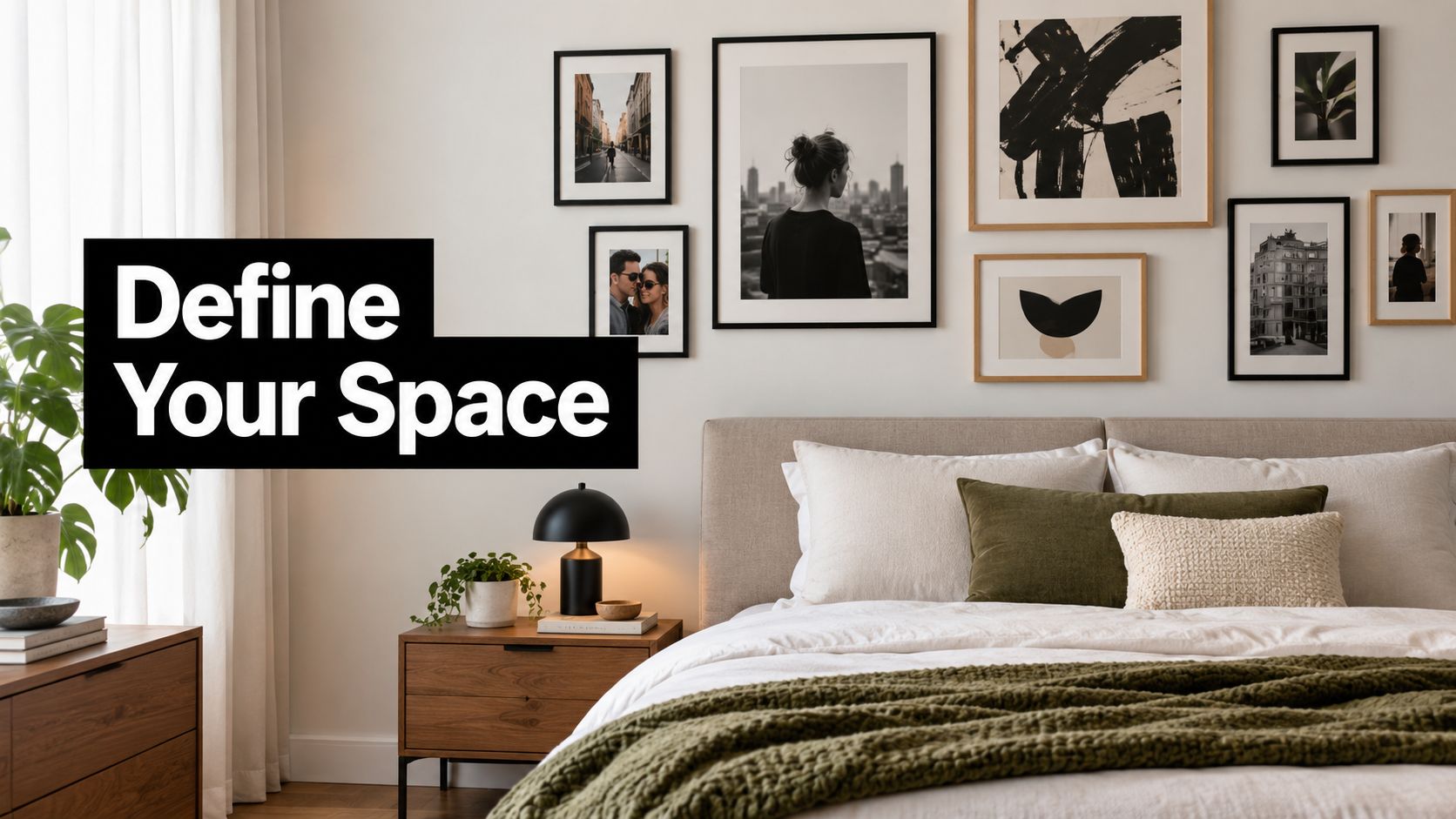
Music is an especially natural starting point. Ofcom's 2025 Audio Report found that 93% of UK adults listen to some form of audio every week, rising to 98% among 16–34-year-olds, as reported in the Ofcom 2025 Audio Report. A lyric print or artist-inspired design therefore reflects something people already do regularly. It isn't just a picture of a band. It's a visible sign of the soundtrack accompanying commutes, late-night conversations, cleaning sessions and questionable attempts at karaoke.
Football has the same identity-building power, with an added supply of emotional damage. A 2025 survey of more than 3,000 UK football fans reported that 67% support Premier League clubs, while 57% also follow at least one other team to some degree, according to the LiveScore and YouGov Sport UK football fan survey. That layered fandom opens up plenty of directions beyond a simple club badge.
Build a wall around a story
Choose a theme by asking what you want the artwork to communicate:
- A soundtrack: Try a lyric, album-inspired composition or typographic print connected to a song that still stops you in your tracks.
- A matchday memory: Look for artwork that evokes a stadium, a shared ritual, a famous era or the people you go with.
- A private joke: Witty football typography can give guests something to notice without turning the room into a replica club shop.
- A visual era: Mixing designs from different musical periods can create a room that feels collected rather than purchased in one frantic online basket.
The strongest arrangement often combines one dominant print with smaller supporting pieces. A large, visually confident design can anchor the wall, while quieter pieces give the eye somewhere else to land. Avoid placing every image at maximum volume. Your room should feel like a great playlist, with an opener, a chorus and the occasional track that lets everyone breathe.
The Renter Friendly Guide to Hanging Art
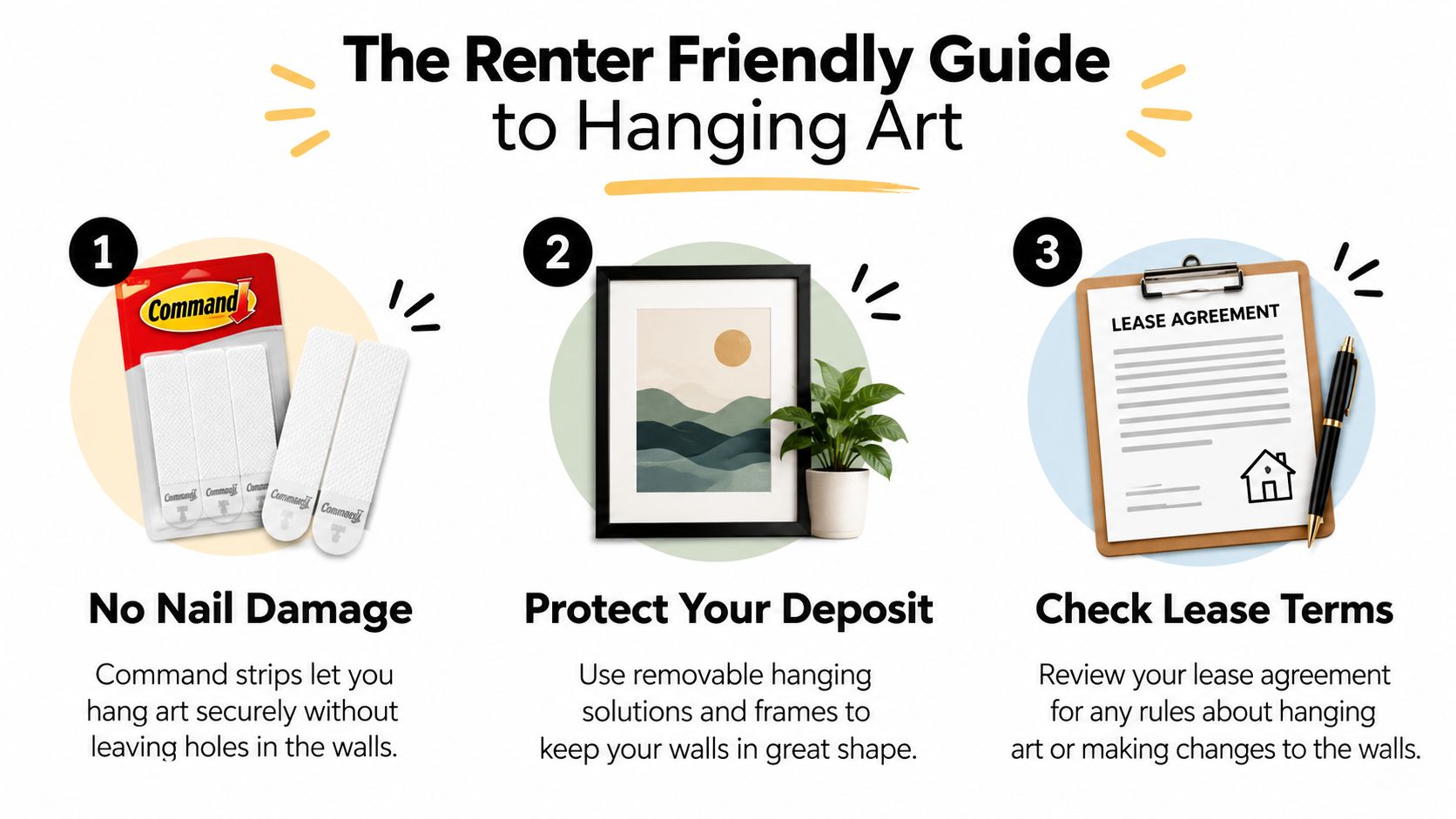
Renting doesn't mean your bedroom has to remain a shrine to magnolia. It does mean you need to understand the wall, the tenancy agreement and the removal method before enthusiastically attaching a large framed print with whatever adhesive is nearest.
The 2024 Bricks to Belonging research found that 73% of landlords were open to tenants personalising their spaces, including mounting artwork, although conditions varied over who would pay for damage or repainting, as reported in this UK renters' decoration rights coverage. That's encouraging, but it isn't a universal permission slip.
Start with the contract
Read the sections covering decoration, fixings, alterations and end-of-tenancy condition. If the wording is unclear, ask the landlord or agent in writing. A friendly message explaining that you want to hang lightweight artwork is much easier to deal with than an argument after checkout.
Then assess the surface. Painted plaster, wallpaper, wood and freshly decorated walls all behave differently. Clean a small test area, follow the fixing manufacturer's instructions and leave the test in place long enough to judge whether it holds and whether removal affects the finish.
Use this order of preference:
- Lightweight unframed prints: Poster rails, magnetic hangers and removable fixings can keep the installation simple. The lighter the artwork, the less stress you place on both the wall and the adhesive.
- Framed artwork with permission: A frame protects the paper and gives the display more presence, but it also adds weight. Check the fixing's stated capacity and the wall condition rather than trusting optimism.
- Leaning displays: A print can sit on a shelf, chest of drawers or sturdy floor surface, with the lower edge supported. It creates visual impact without putting a hole in the wall, although tall pieces must be positioned where they can't topple.
- Removable hanging systems: Follow the removal instructions slowly. Pulling an adhesive strip sideways or yanking it away from the paint is how a five-minute update becomes an unwanted redecorating project.
For readers who want extra guidance on alignment, spacing and safe positioning, this practical advice on hanging art in Ann Arbor homes covers the precision side of the job, even if your own bedroom overlooks a UK car park rather than a Midwestern street.
A no-frame approach can also help. This guide to hanging posters without frames is useful when you want a lighter, more reversible display.
If the room belongs to a Bolton supporter, For the Love of Bolton, a Bolton Wanderers Football Club print presents a father and child in Bolton colours, built around shared matchday memories and family tradition. It is hand-printed on 312gsm fine art paper, designed and made in the UK, available in sizes from A5 to A0, and offered framed or unframed to fit standard frames.
Balancing Bold Aesthetics with Sleep Quality
Your bedroom can be visually exciting without behaving like a nightclub at midnight. The current appetite for saturated interiors is obvious. Recent UK Houzz data found that searches for “pink bedroom” rose 59% year over year in early 2025, while interest in “colour drenching” rose 142%, as reported in the 2025 Houzz UK Emerging Trends Report.
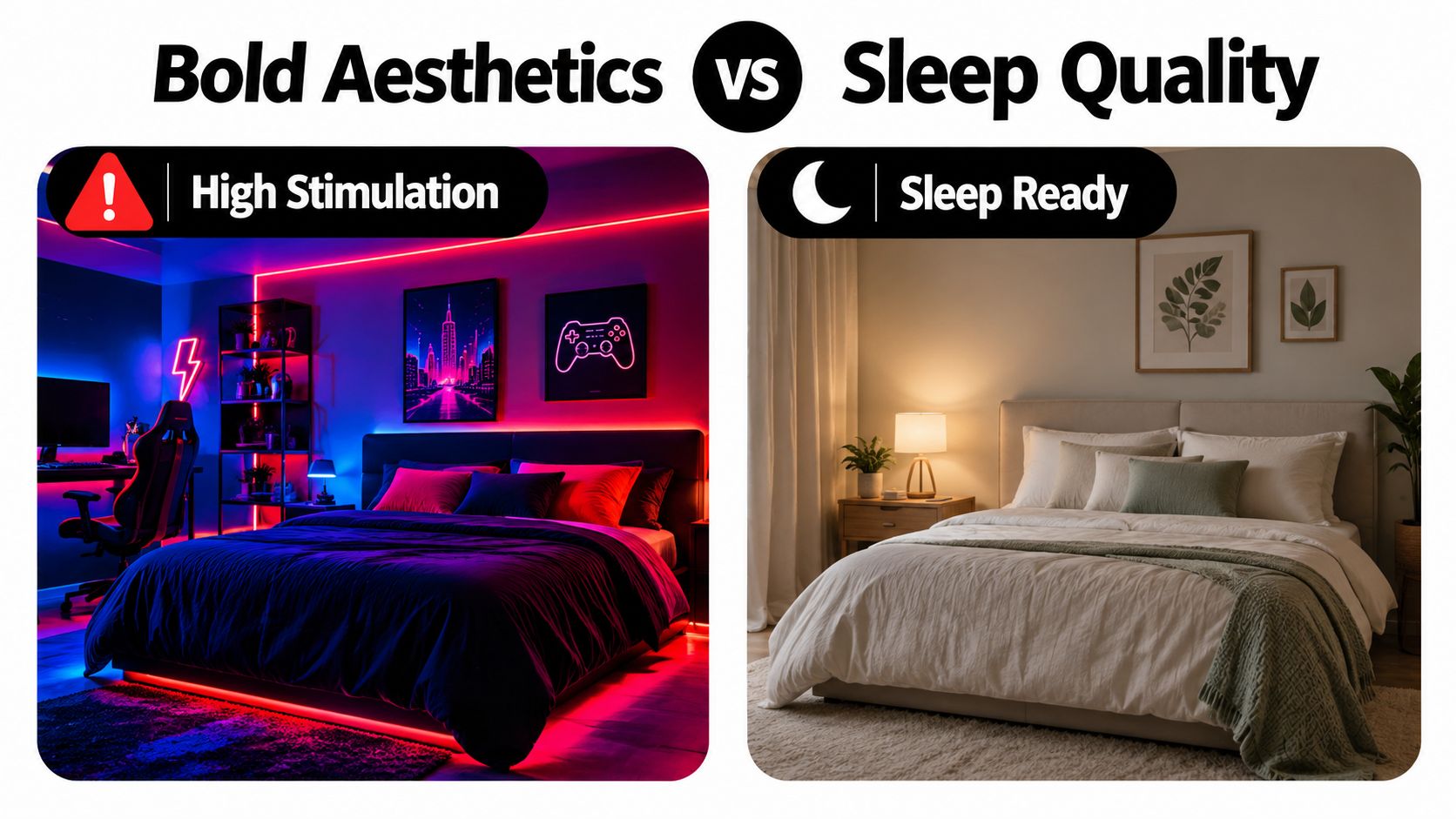
That enthusiasm is welcome, but a bedroom has two jobs. It should express your personality during the day and support your wind-down routine at night. A high-contrast print with dense typography, sharp colour clashes or emotionally charged sports imagery may be brilliant above a desk and less appealing directly opposite the pillow when you're trying to quieten your thoughts.
Give every print a job
Think about visual intensity, not just colour matching.
- High-impact artwork belongs on a feature wall, above a desk or beside the wardrobe. It can be the room's daytime statement without dominating your final view before sleep.
- Calmer designs work near the bed. Choose softer palettes, open compositions and less crowded lettering if you find busy images stimulating.
- Matte finishes tend to create less glare than reflective surfaces, particularly near lamps and windows.
- Peripheral placement lets you keep a bold football or music design in the room without putting it directly in your line of sight from the pillow.
- A single anchor print often feels more restful than a dense arrangement in which every piece competes for attention.
This isn't an argument for beige walls and a complete ban on personality. It's a reason to separate the room's energetic zone from its sleep zone. A loud gig poster above the desk can coexist with a quieter lyric print near the bed, just as a football fan can celebrate a rivalry without making the bedroom look like a pre-match studio.
For a deeper look at how colour choices influence a room's atmosphere, explore this guide to colour psychology in interior design. Test the artwork in place before committing. Live with the print through daylight, lamplight and bedtime, then decide whether it makes you feel settled or as though your wall is shouting team news.
Protecting Your Prints from Sunlight and Damp
Paper has a long memory. It remembers every bright window, every humid corner and every badly chosen adhesive. A print can look perfect when you hang it, then gradually lose colour or develop ripples if the room exposes it to harsh light and poor airflow.
Ultraviolet and visible light can break down paper fibres and fade inks. UK conservation guidance recommends keeping works on paper at no more than 50–80 lux, according to this museum guidance on lighting works on paper. You don't need to turn your bedroom into a conservation laboratory, but you should treat direct sunlight as a serious risk rather than a charming design feature.
Reduce exposure before damage starts
Place posters away from the strongest daylight. Blinds and curtains help, especially during the brightest part of the day, while UV-absorbing glazing or protective film adds another layer of defence for artwork you want to keep looking sharp.
Light damage is cumulative. A poster exposed to 100 lux for 10 hours receives the same 1,000 lux-hours as one exposed to 500 lux for 2 hours, so reducing both intensity and display time helps preserve colour. A frame near a sunny window might look fantastic in a photograph, but the print inside is suffering the worst summer of its life.
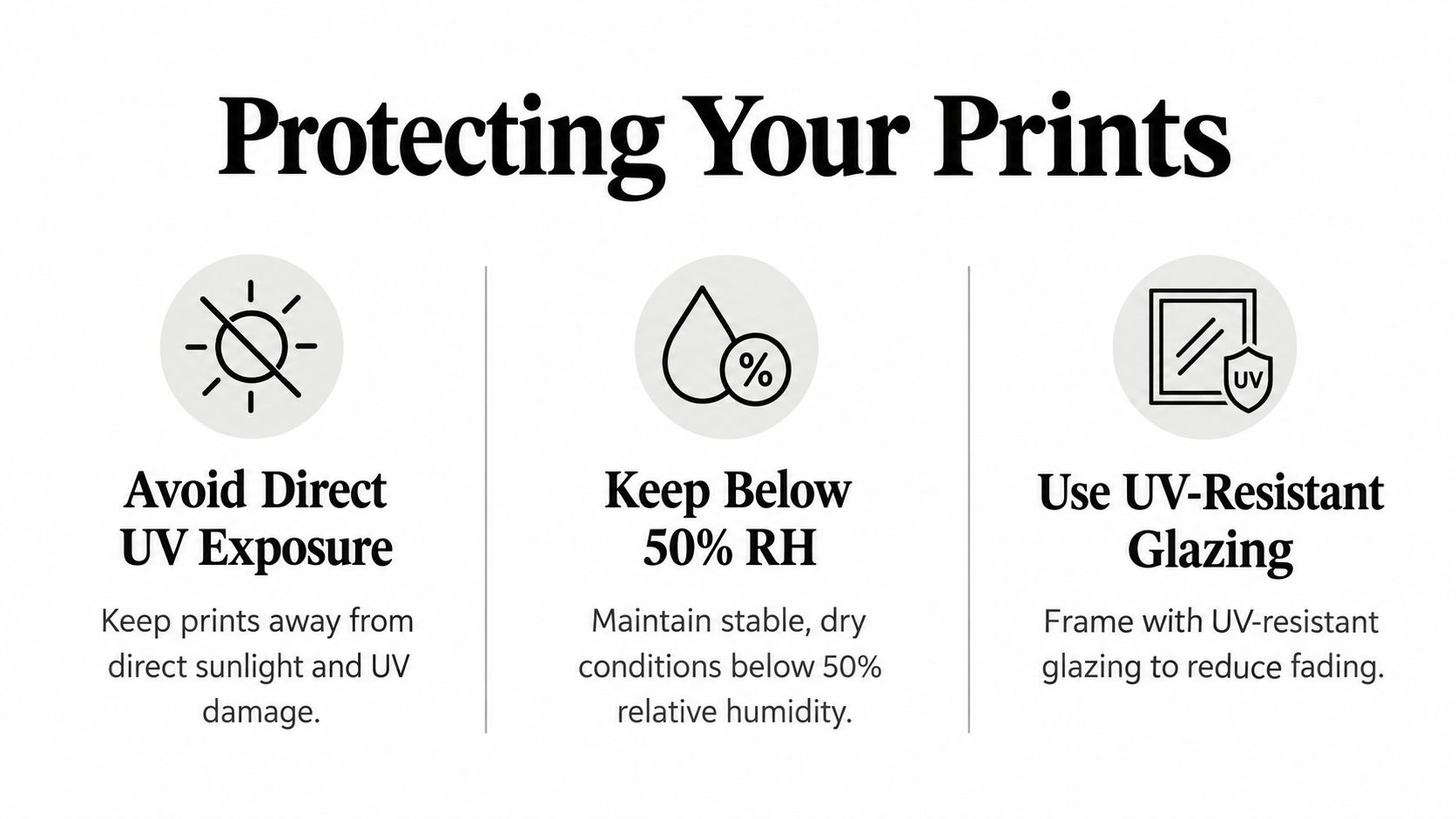
Moisture creates a different set of problems. Paper can cockle, adhesives can fail and mould becomes more likely when humid air lingers against a cold external wall. Don't mount a paper poster directly over a damp-prone patch, and leave enough separation for the wall and artwork to be inspected.
Keep the air moving
UK indoor-air guidance recommends 0.4–1 air changes per hour for living rooms and bedrooms and identifies trickle vents and air bricks as important background ventilation routes. Keep those openings fully exposed, as advised in this UK indoor-air quality report.
That means no oversized frame covering a trickle vent, no gallery wall swallowing an air brick and no clever attempt to hide ventilation behind a dramatic stadium panorama. Leave moisture-prone areas visible, air the room properly and use fixings that let you remove the print for inspection. Your artwork will last longer, and the wall won't be forced to host a tiny indoor climate experiment.
Sizing, Framing, and the Perfect Gift Strategy
A brilliant print can still look wrong if its scale fights the room. In a compact bedroom, an oversized frame may dominate the bed, while several tiny posters can look like they've been scattered by a strong breeze. Measure the wall, note the furniture beneath it and decide whether the artwork should anchor the room or provide a smaller accent.
Census 2021 data for England and Wales found that 38.5% of households had only one or two bedrooms, which makes proportion especially important when choosing wall-mounted decoration, according to this guide to bedroom design in smaller homes. A smaller room doesn't rule out large art, but the display needs breathing space and a sensible relationship with the bed, desk and storage.
Match the format to the wall
Use the wall as your starting point rather than choosing a frame first. A narrow vertical print can make use of the space beside a wardrobe, while a horizontal design may sit naturally above a headboard or desk. For a gallery arrangement, place the largest piece first and let the surrounding prints support it.
| Display choice | Works well when | Watch out for |
|---|---|---|
| Unframed poster rail | You want a lightweight, relaxed look | Check the rail's grip and the poster's paper condition |
| Wooden frame | The room needs warmth and texture | Heavy frames require suitable fixings |
| Aluminium frame | You prefer a clean, contemporary finish | Sharp edges and glare may feel too hard near the bed |
| Matte glazing | Lamps and windows create reflections | Confirm the artwork remains easy to view |
| Leaning print | You're renting or like changeable styling | Secure tall pieces against knocks and curious pets |
A practical guide to framing posters can help you decide between a protected framed display and a more casual hanging method. The right choice depends on the paper, the room's light, your tenancy and how often you expect to change the artwork.
Choose gifts with a story
Gift buying gets difficult when someone already owns the shirt, the vinyl, the scarf and enough football memorabilia to start a small museum. A thoughtfully chosen print can work because it connects to a memory rather than just repeating a logo.
For a music fan, look for a lyric or artist reference that relates to a shared moment. For a football supporter, consider the club, the era, the family connection or the joke that gets repeated every matchday. A personal design in a sensible size feels more considered than a generic poster grabbed because the recipient once mentioned liking a band.
The best gift also leaves room for the recipient's own style. An unframed print lets them choose the frame, while a standard proportion makes it easier to display without turning present opening into a measuring exercise. Nobody wants to unwrap a thoughtful gift and immediately need a spirit level, a stud finder and a small emotional support pie.
Final Thoughts on Curating Your Personal Sanctuary
A bedroom shouldn't look as though an algorithm decorated it after scanning a catalogue. It should contain the things that make you grin, remember, argue lovingly about football selections and sing slightly too loudly while getting ready. Unique wall posters for bedroom styling give those interests a physical place in the room, without demanding a permanent renovation.
The practical rules are simple. Choose themes with a genuine connection to your life, not designs that merely fill space. If you rent, read the agreement, ask permission where necessary and favour lightweight or reversible hanging methods. Keep bold artwork away from the sleep zone if it feels visually demanding, and use calmer placement rather than pretending your favourite high-energy print has suddenly become meditation equipment.
Protect the pieces once they're up. Keep paper away from direct sunlight, consider UV-absorbing protection, avoid damp-prone walls and never cover trickle vents or air bricks. A poster isn't indestructible just because your football club has survived another transfer window.
Let the room evolve
The beauty of posters is that they can change as you do. A music print can mark the album that carried you through a difficult year. A football design can preserve the memory of who stood beside you in the crowd. A witty piece above your desk can make a dull Monday feel slightly less committed to ruining your mood.
Start with one wall and one piece you genuinely love. Check its size, test its placement and live with it for a few days before expanding the display. The room doesn't need every interest represented at once. It needs a clear point of view, a little breathing space and enough personality to stop the magnolia paint feeling like it has won.
A bedroom with the right artwork feels more like yours before you've even changed the bedding. That's the trick. You aren't decorating for a showroom, a trend report or the imaginary jury from Grand Designs. You're making a space that welcomes you home, celebrates your music and football obsessions, and gives the blank wall something far more interesting to say.
Striped Circle offers high-quality wall art, posters and greeting cards inspired by music and football, including alternative lyric prints, music designs and artwork celebrating UK clubs. Visit Striped Circle to find a print for your bedroom, home office or next carefully chosen gift.
