
A4 Frame Size CM: Your Definitive Guide to Not Messing It Up
Right, let's cut to the chase. The size of a standard A4 sheet of paper is 21 x 29.7 cm. Knowing this number is the difference between your wall looking like the Tate Modern and looking like a dodgy student flat.
Why Getting Your Frame Size Right Matters (A Lot)
We've all been there. That sinking feeling. You’ve finally scored the perfect print – maybe a classic Oasis lyric sheet or a tribute to your club’s glory days – and you can’t wait to get it on the wall. But when you try to jam it into the frame you bought, it’s either comically massive, making your print look lost, or it’s a smidge too small, cropping the edges of your masterpiece.
It’s one of those uniquely infuriating moments that can turn an exciting five-minute job into a full-blown domestic incident. The good news is, it’s entirely avoidable. Just like you'd use an accurate size guide to avoid buying a sofa that won't fit through the door, knowing your paper dimensions is step one.
This guide will walk you through everything, so you can spend less time wrestling with measurements and more time admiring your perfectly framed art.
A4 Dimensions At a Glance
First things first, let's get the core numbers burned into your brain. Here are the exact dimensions for A4 paper.
| Unit | Width | Height |
|---|---|---|
| Centimetres (cm) | 21 cm | 29.7 cm |
| Inches (in) | 8.3 in | 11.7 in |
Memorise these. It's the foundation for all your A4 framing missions. It’s the key to making sure every print you hang looks sharp, intentional, and not like you did it in a rush before the match started. With that sorted, let’s get into the nitty-gritty.
Why An A4 Frame Isn't Always Just for A4 Prints
So, you’ve picked up a frame that says 'A4' on the label, but when you get it home, your A4 print fits as awkwardly as a goalkeeper playing up front. It’s a common mix-up, and thankfully, it’s not a grand conspiracy by the framing industry. The confusion all comes down to how frames are measured.
It’s a bit like assuming any two things that look similar must be the same size. For instance, new parents often ask, Are All Crib Mattresses the Same Size? The answer, just as with frames, is that the small details matter enormously. Getting it right is key, especially as the UK picture frame market continues to grow, showing just how much we all love making our walls look ace. In fact, it's projected to grow by 3.6% annually.
The Three Key Frame Measurements
To clear up the confusion for good, let’s break down the three measurements you really need to get your head around.
Think of it like a football stadium: the outer dimension is the whole stadium, the internal dimension is the pitch your print plays on, and the aperture is what the fans actually see.
- Outer Dimension: This is the full, overall size of the frame from one outside edge to the other.
- Internal Dimension (or Rebate): This is the important one. It’s the exact size of the artwork the frame is designed to hold. For a proper A4 frame, this will be 21 x 29.7 cm.
- Aperture (or Visible Area): This is the 'window' you look through to see your print. It's always a touch smaller than the internal dimension because the lip of the frame needs to slightly overlap the artwork to keep it in place.
Realising the aperture is always smaller than the internal size is the secret to great-looking framing. It’s what stops that annoying sliver of white paper peeking out around the edges and gives your favourite print a properly professional finish.
Once you’ve got these terms down, you’re well on your way to framing like a pro. It also makes it much easier to explore other options beyond the standard A4, which you can read all about in our guide to UK poster sizes.
The No-Mount Look: For Maximum Impact
Sometimes, you want your artwork to do all the talking. This is where the no-mount approach shines. It’s a bold, in-your-face framing style where your print fills the entire frame right up to the edges, creating a clean, contemporary look with maximum visual punch.
To pull this off, you need a frame that’s specifically made for A4 paper. This means its internal dimensions are a perfect match for your 21 x 29.7 cm print, holding it snugly without any gaps. This minimalist style is fantastic for bold graphic prints, a monochrome Oasis lyric piece, or a colourful tribute to your favourite football club. It puts the art front and centre, no messing about.
This diagram helps break down the different frame dimensions you’ll come across.
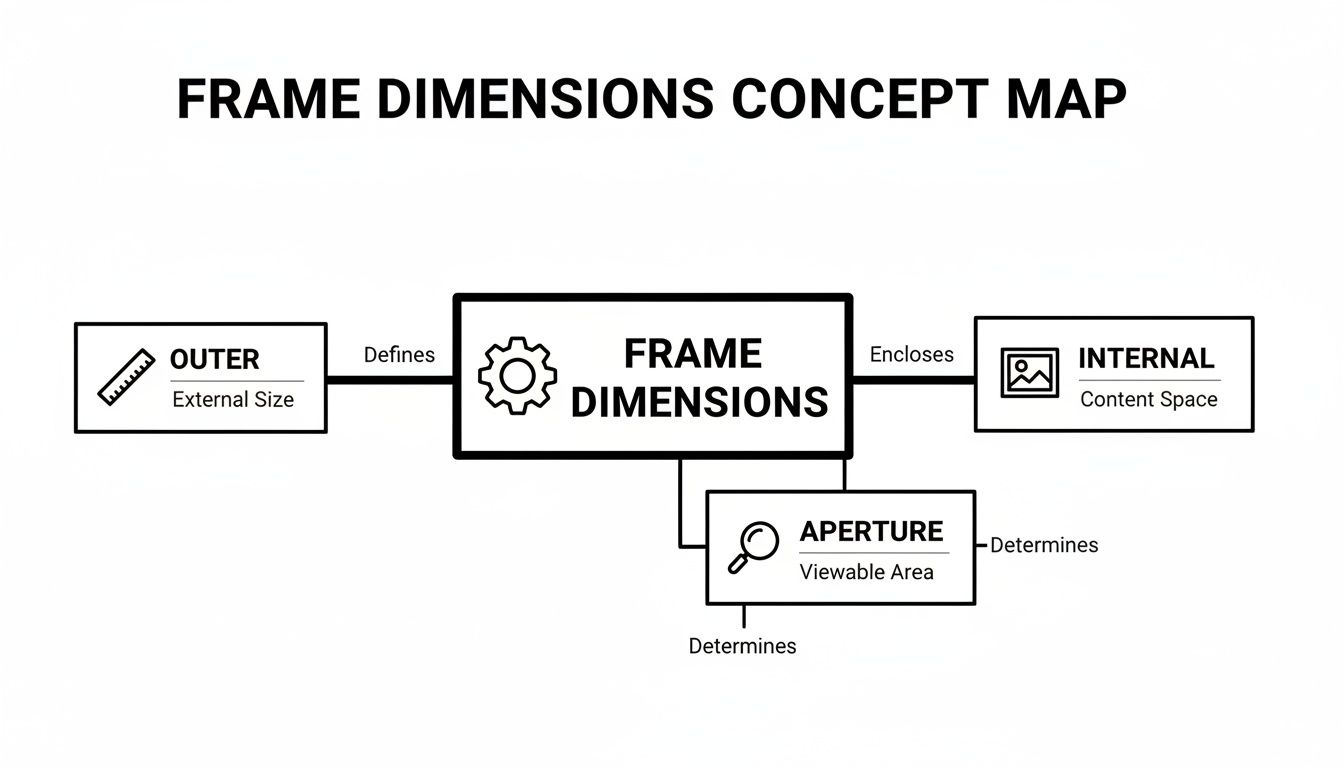
Getting your head around these three distinct measurements is the secret to finding the right frame every single time.
Choosing The Right Frame Style
Even when you're going without a mount, the frame itself still plays a vital supporting role, like a solid defensive midfielder. The trick is to choose one that complements the artwork rather than competes with it. For instance, a thin, sleek black frame can give a minimalist art print an extra bit of pop and understated confidence.
A simple, well-chosen frame enhances the print without overwhelming it. For a particularly colourful or busy piece, a natural wood frame can add a touch of warmth and ground the artwork beautifully. It’s all about creating harmony.
This edge-to-edge style is also a smart, space-saving way to display posters. If you're exploring other creative ways to get your art on the wall, you might find some useful ideas in our guide on how to hang posters without frames. At the end of the day, the goal is always to make your print look its absolute best.
Using a Mount to Elevate Your Artwork
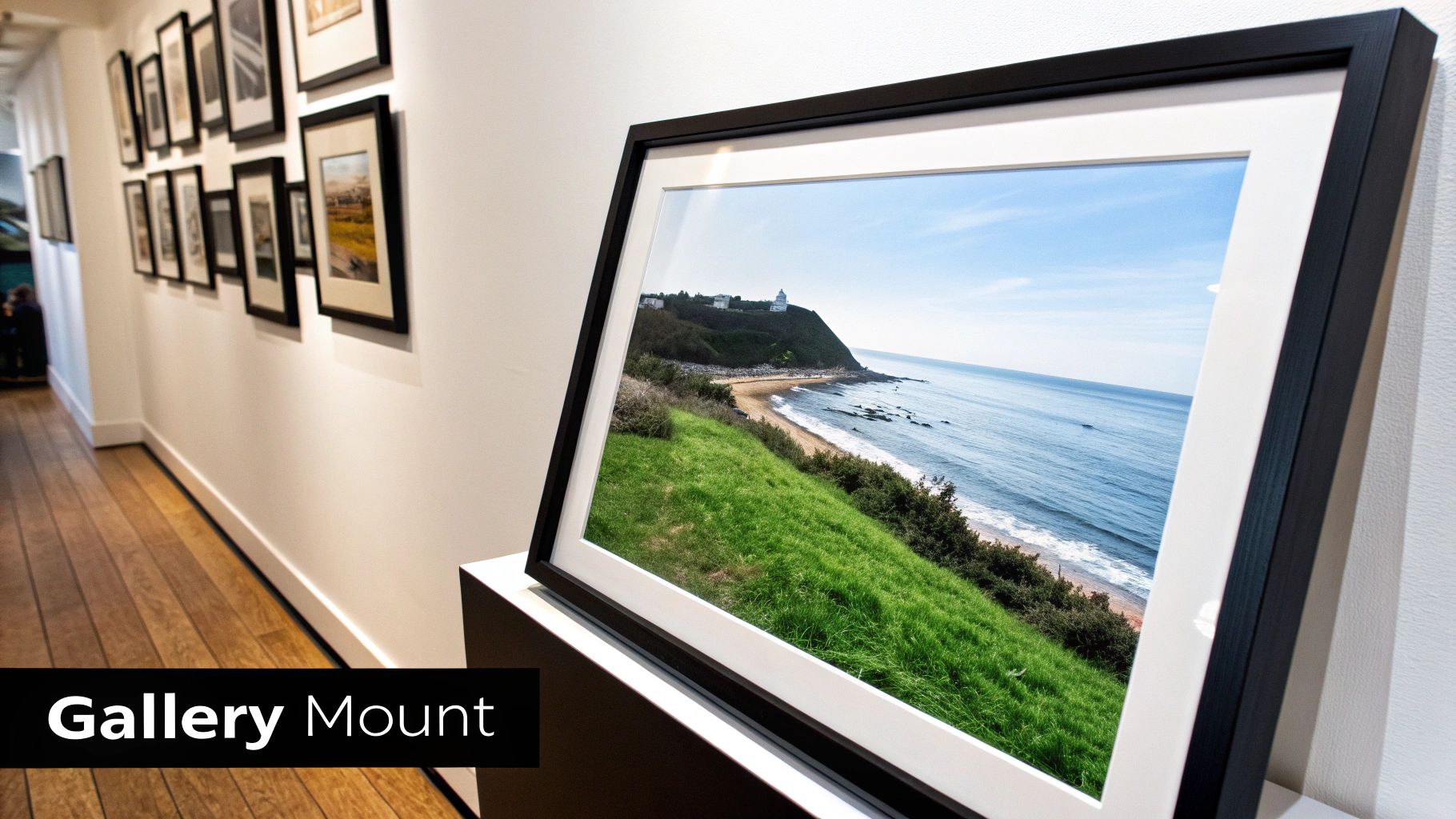
If you're aiming for that classic, professional gallery look, adding a mount is the way to go. A mount (or ‘mat’ if you're feeling fancy) is simply the cardboard border that sits between your print and the frame itself.
It does more than just fill space. A mount gives your artwork vital breathing room, drawing the viewer's eye towards the centre. It also serves a practical purpose by preventing the print from touching the glass, which helps protect it. Think of it as the difference between a poster Blu-Tacked to a wall and a piece of art ready for display.
Finding the Right Frame and Mount Combo
Naturally, if you're adding a mount, you'll need a bigger frame. You can't just cram it all into a standard A4 frame. The two most popular choices for framing an A4 print with a mount are a 30x40 cm frame or an A3 (29.7 x 42 cm) frame. Both give you enough space for a visually pleasing border around your print.
The key to getting it right lies in the mount's aperture – the size of the window opening. This opening needs to be slightly smaller than your A4 print to securely hold it in place and prevent the edges from showing. A perfect aperture size would be around 20 x 28.7 cm. This subtle overlap is crucial for a clean finish.
Think of the mount as the ultimate hype man for your artwork. It builds anticipation and makes the main event—your print—look even better.
Getting these little details right is what makes your framed art stand out. The global picture frames market was valued at an estimated USD 9,614.5 million in 2024, which just goes to show how much we all care about getting our walls looking perfect.
A4 Print Framing Cheat Sheet
To make things even easier, here’s a quick guide to choosing the right frame size for your A4 print, whether you’re going with a mount or without.
| Desired Look | Recommended Frame Size | Required Mount Aperture |
|---|---|---|
| No Mount (Full Bleed) | A4 (21 x 29.7 cm) | Not needed |
| With Mount (Gallery Style) | 30x40 cm or A3 | ~20 x 28.7 cm |
This little table should take the guesswork out of your next framing project. For a deeper dive into mounting techniques, check out our complete guide on how to frame posters.
A Simple Checklist for Perfect Framing
Let's sidestep the classic DIY disaster—the one that leaves you with a crooked picture and a wall that looks like Swiss cheese. This is your straightforward guide to getting it right first time, ensuring your print looks absolutely spot-on.
First things first, get a tape measure. Eyeballing it is a recipe for a frame that hangs like a badly parked car. Always measure your print's width and height twice, just to be certain. Think of it as the soundcheck before the gig; this simple step is crucial for a flawless finish.
Getting the Details Right
Next, think about orientation. Is your print portrait or landscape?
- Portrait: Taller than it is wide, like a classic poster of your favourite band's lead singer.
- Landscape: Wider than it is tall, perfect for that panoramic shot of the team celebrating a big win.
This basic detail determines the kind of frame you need, and it's an easy mistake to make when you're excited to get something on the wall. And it's a popular task – the desire to display our favourite memories is fuelling a global picture frame market that's projected to grow by a healthy 5.5% CAGR between 2025 and 2033. You can explore the market insights on Data Insights Market for more on that trend.
Pro Tip: When you're ready to mount your print, use a couple of small pieces of acid-free artist's tape along the top edge only. This secures it to the backing board but allows the paper to hang naturally, preventing any wrinkling or slipping down the line. It's a small detail that makes a huge difference.
Following these simple steps will make sure your print is the star of the show, perfectly presented and ready to bring a smile to your face every time you see it. No drama, no regrets—just a beautifully framed picture.
Your Common Framing Questions Answered
Right, let's get into the nitty-gritty. This is the bit where we tackle those last-minute questions that always seem to pop up when you're about to buy a frame, or worse, when you're standing there with a hammer in hand. Think of this as your personal framing helpline.
We've pulled together the most common head-scratchers people have when trying to frame A4 prints and laid out the answers, plain and simple.
Can I Use an A3 Frame for My A4 Print?
Absolutely! In fact, it’s often the best choice if you're using a mount. An A3 frame (29.7 x 42 cm) gives your A4 print plenty of breathing room, creating that professional, gallery-style finish.
The key is to pair it with a mount that has an aperture (the window) slightly smaller than your print—something around 20 x 28.7 cm works perfectly. Just don't drop an A4 print into a massive A3 frame by itself. It'll look lost and lonely, swimming in a sea of empty space like a striker in a 9-0-1 formation.
What Is the Difference Between an A4 Frame and a 30x40 cm Frame?
This is a great question. An ‘A4 frame’ is built specifically to hold an A4 print without a mount. Its internal dimensions will be exactly 21 x 29.7 cm, fitting the paper like a glove for a clean, direct look.
A 30x40 cm frame, on the other hand, is a popular larger size that’s ideal for framing that same A4 print with a mount. The extra space is what allows for that stylish border. So, think of it this way: an A4 frame is for a direct, no-fuss display, while a 30x40 cm frame gives you the space to create a more classic, mounted presentation.
Does the Frame Colour Really Matter That Much?
It matters more than you’d think! The frame is the finishing touch, and the right colour can elevate your artwork, while the wrong one can be a major distraction.
A good rule of thumb is to use simple black, white, or natural wood frames for busy, colourful prints. This lets the artwork do the talking. For more minimalist or monochrome prints, you have the freedom to be a bit more adventurous with the frame colour to inject some personality into the room. The goal is always to complement the art, not compete with it.
How Do I Stop My Print From Wrinkling in the Frame?
Ah, the dreaded print wrinkle. This is usually caused by humidity changes, which make the paper expand and contract, especially when it's pressed directly against the glass.
Using a mount is your best line of defence, as it creates a small but crucial air gap between the paper and the glass. If you're going for a mount-less look, make sure your print is perfectly flat before you frame it. You can also secure the print to the backing board with a couple of small pieces of acid-free artist's tape along the top edge. This lets it hang naturally without buckling over time.
Ready to find the perfect print for that frame? At Striped Circle, we've got a massive collection of music and football-inspired art just waiting for a spot on your wall. Find a new favourite today.
