
Double Denim 80s: How to Wear, Style and Decorate with It
At a 1986 club queue, a bloke in a sleeveless denim jacket, faded jeans and trainers looked less like he'd got dressed in the dark and more like he'd personally challenged the colour wheel. That was the magic of double denim in the 80s, a little bit rebellious, a little bit ridiculous, and entirely ready for a chorus with too much reverb.
Table of Contents
- The 80s Moment That Made Double Denim a Statement
- How the Look Actually Got Built
- Outfit Recipes for Day, Night and Modern Reels
- Vintage, Secondhand or DIY
- Bringing the Look Home With Music-Inspired Wall Art
- Rules Worth Keeping and Rules Worth Breaking
The 80s Moment That Made Double Denim a Statement
Outside a London club, the denim didn't stay still. Jackets were oversized, jeans were baggy, and acid-washed fabric caught the streetlights like someone had spilled a bucket of moonlight over the queue. A white T-shirt flashed beneath a denim jacket. Someone's trainers were scuffed. Someone else had a fringe that deserved its own record deal.
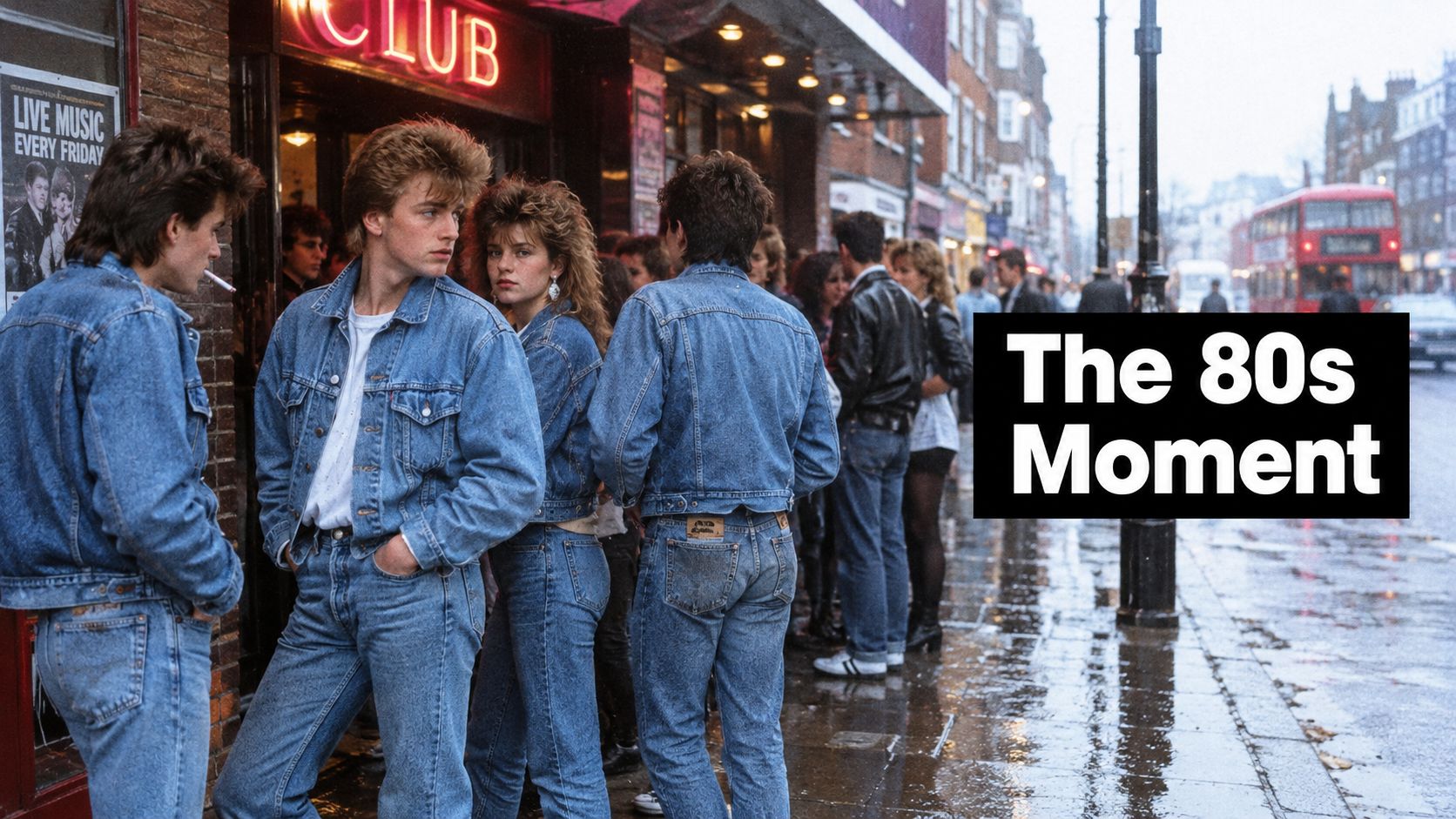
In the UK, double denim became part of a broader 1980s shift towards highly visible, experimental street and club fashion. Journalist Robert Elms described the trend as “Hard Times”, set against recession, the Falklands War and miners' strikes, as documented by the National Library of Scotland's history of 1980s denim. Denim stayed culturally prominent despite the difficult economic climate, and its affordability made it useful to young people who wanted a strong look without dressing like a visiting diplomat.
The important change was attitude. Denim had long belonged to workwear and everyday clothing, but layered denim became a youth signal tied to music, nightlife and London's growing creative scene. Jeans with a denim jacket weren't merely practical. They announced that the wearer had somewhere to go, something to hear and possibly a suspiciously large collection of cassette singles.
From workwear to club uniform
Distressed, baggy and acid-washed styles gained attention on the high street. Denim could look worn, sharp, theatrical or deliberately scruffy, often within the same outfit. That variety helped it move between gig queues, clubs, record shops and the Saturday afternoon football crowd.
The silhouette also worked because it was recognisable from a distance. A denim jacket over jeans created a clear shape, while contrasting washes stopped the wearer looking as though they'd been shrink-wrapped in blue. It was expressive without requiring a wardrobe full of expensive tailoring.
For a room with the same restless energy, a piece of retro wall art can do what the jacket did on the street. Bold colour, unusual typography and a hint of cultural mischief turn a blank wall into something with a pulse.
How the Look Actually Got Built
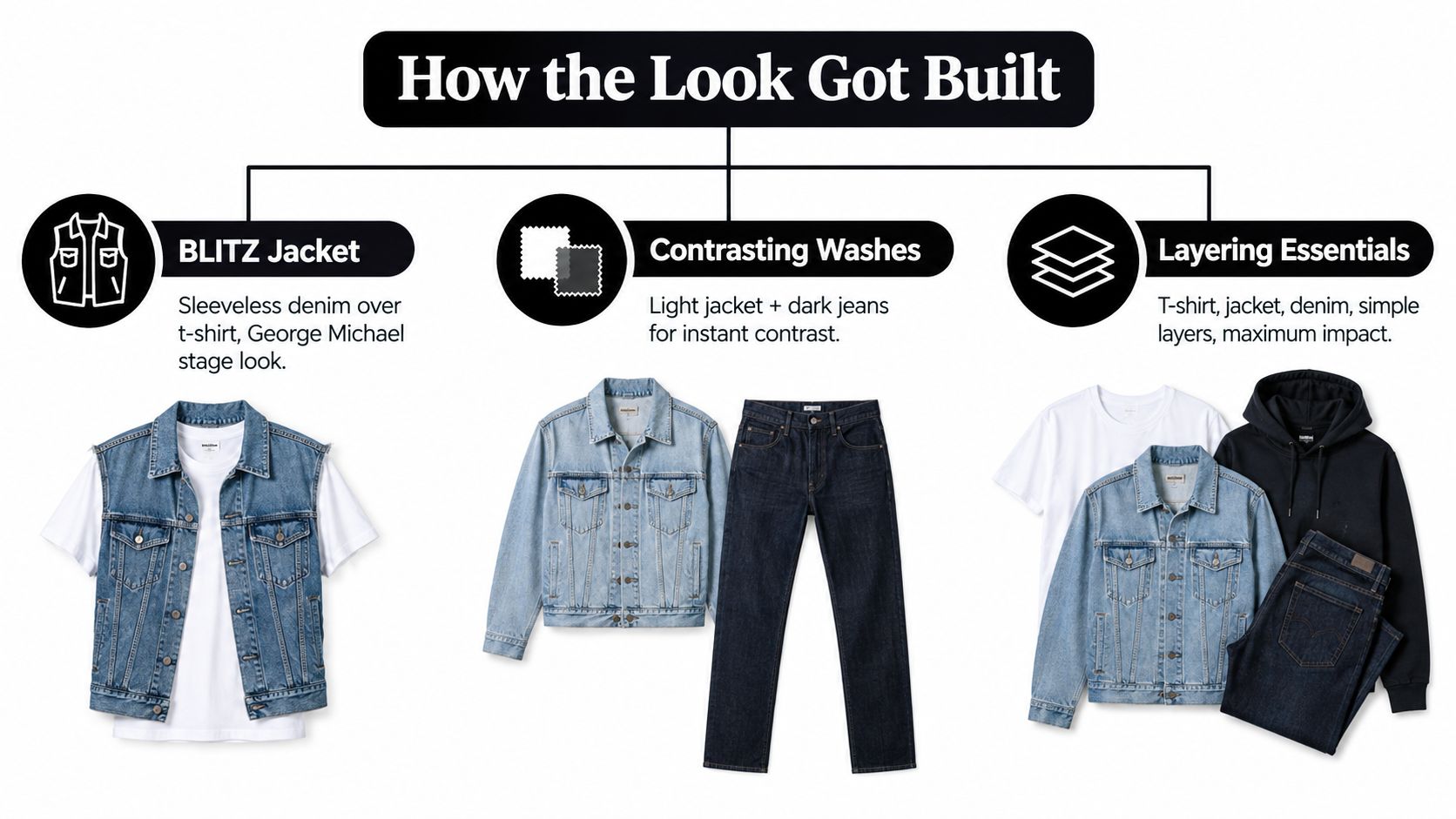
The authentic 80s formula wasn't just “put on two denim items and hope for the best”. It depended on contrast, layering and custom detail. The strongest outfits looked assembled rather than purchased as a matching set, as though the wearer had raided a charity shop, borrowed a jacket from a bandmate and ignored at least one sensible suggestion.
A useful case study arrived through BLITZ magazine. In 1986, a project commissioned 22 London-based designers to customise Levi Strauss denim jackets. The jackets were auctioned for the Prince's Trust on 10 July 1986, after being modelled by figures including Boy George and Daniel Day-Lewis at a celebrity fashion gala in June, according to the V&A exhibition account reported by Artlyst.
That project matters because it shows denim leaving ordinary casualwear behind. Designers treated the jacket as a surface for personal expression, while the charity auction and celebrity styling placed it inside British fashion culture. The jacket became a canvas, not just a layer.
The ingredients of an 80s silhouette
George Michael offered a more wearable version of the same idea. British GQ identifies his Western-style double denim as a recurring stage and video look, built around Levi's 501 jeans, a sleeveless denim jacket and deliberately varied or distressed washes, rather than a perfectly matched suit. The Oxfam history of denim through the decades also places lighter washes, acid-wash jeans and denim-on-denim combinations firmly in the late-1980s popular imagination.
The practical breakdown looks like this:
- Start with different washes: A pale jacket over darker jeans creates separation. Reverse it for a tougher, more grounded effect.
- Expose a middle layer: A white T-shirt, striped knit or graphic tee breaks up the denim and gives the outfit breathing room.
- Choose presence over precision: A boxy jacket, rolled sleeve or sleeveless cut adds movement. A perfectly fitted denim suit can look more showroom than soundcheck.
- Use custom detail: Patches, badges, visible stitching and Western-style hardware make the outfit feel owned rather than assembled by a mannequin.
Treatments helped create that visual noise. Stonewashing and acid washing gave denim visible variation, while distressed details suggested a history, even when the jeans had only just left the shop. The trick wasn't to make every piece look equally battered. It was to let the contrast do the talking.
Outfit Recipes for Day, Night and Modern Reels
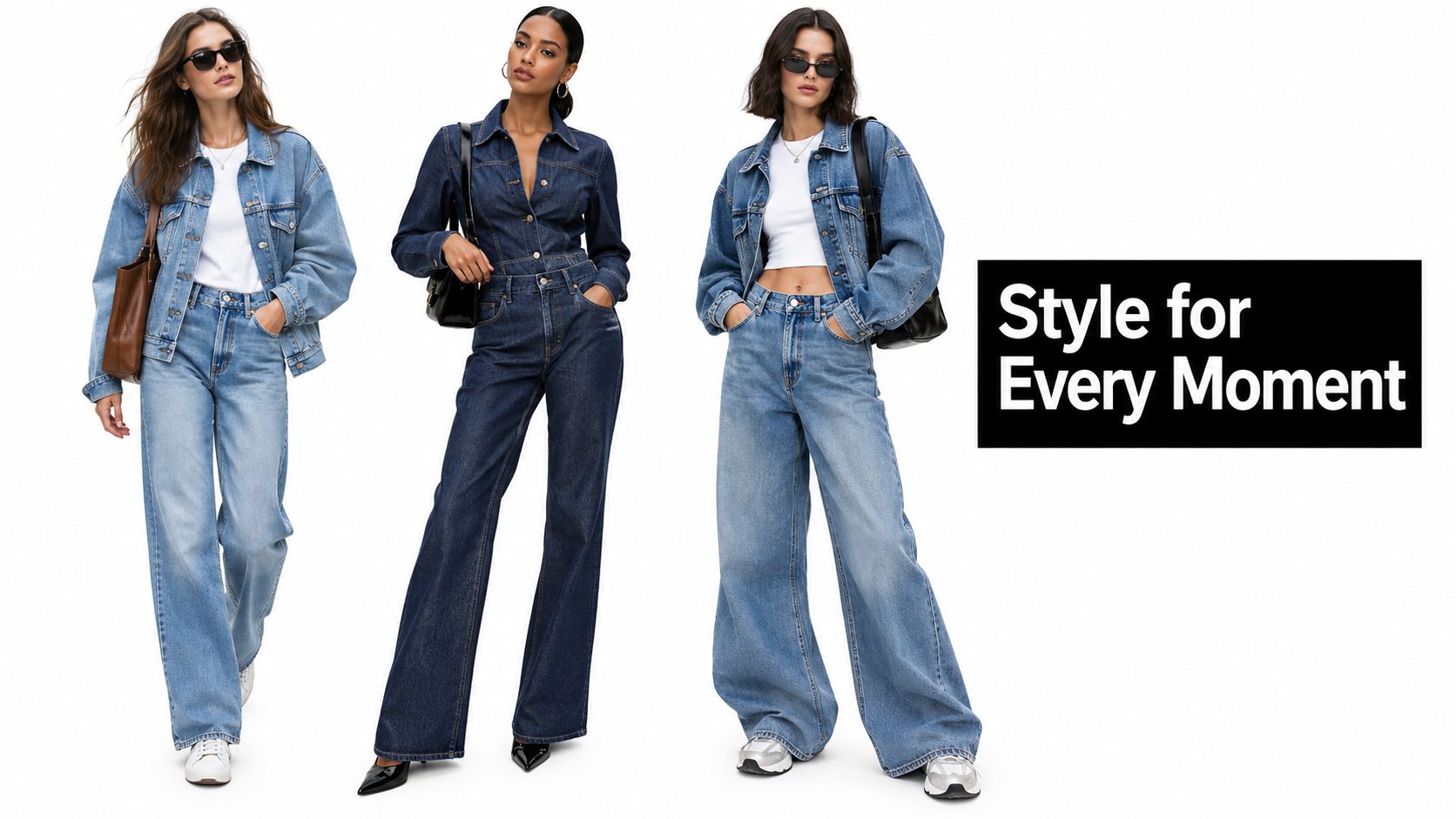
The easiest way to wear double denim now is to borrow the logic of the 80s rather than recreate a museum display. Keep the denim expressive, interrupt it with another texture and leave room for your own personality. If your outfit looks ready to star in a low-budget music video, you're probably close.
The daytime record-shop run
Pair a faded, slightly oversized denim jacket with dark straight-leg or relaxed jeans. Add a plain white tee, canvas trainers and a narrow belt, then roll the jacket sleeves once so the shape doesn't swallow you whole. A small crossbody bag keeps the look practical without introducing another loud statement.
This version works for coffee, charity shops and gig queues because the darker lower half steadies the lighter jacket. Add a cap or a woven scarf if the weather is doing its usual impression of an undecided backing singer.
Avoid matching pale denim top and bottom unless you want to look like you've arrived to install a conservatory.
The after-dark club combination
For evening, raise the volume with a sleeveless denim jacket over a black vest or fitted T-shirt. Try distressed or acid-washed jeans in a different tone, then add pointed boots, high-top trainers or a narrow leather belt. Silver jewellery, a bold watch or a patch near the chest gives the outfit the sort of detail that catches light when the bass starts behaving irresponsibly.
The contrast matters more at night. A light jacket over deep indigo jeans feels graphic, while a dark jacket with pale jeans creates a sharper, more rock-focused outline. Either way, let one piece carry the drama and keep the rest of the outfit from auditioning for three bands at once.
A short video can help translate those proportions into something contemporary, especially if you're testing the look on camera before committing to the dance floor.
The modern reel-friendly version
Use a cropped or structured denim jacket with wide-leg jeans, but keep the washes clearly different. A tucked-in graphic tee creates a clean waistline, while chunky trainers or simple boots give the outfit modern weight. If you prefer a softer interpretation, wear a denim shirt over a slip dress or a long skirt, leaving it open so the outfit reads as layered rather than uniform.
The 80s spirit survives in the deliberate mismatch. You don't need every seam, rivet and belt loop to shout at once. One vivid wash, one unusual accessory and one piece with a story will carry more charm than a complete costume.
Golden rule: Match your confidence to the denim, not the denim to itself.
Vintage, Secondhand or DIY
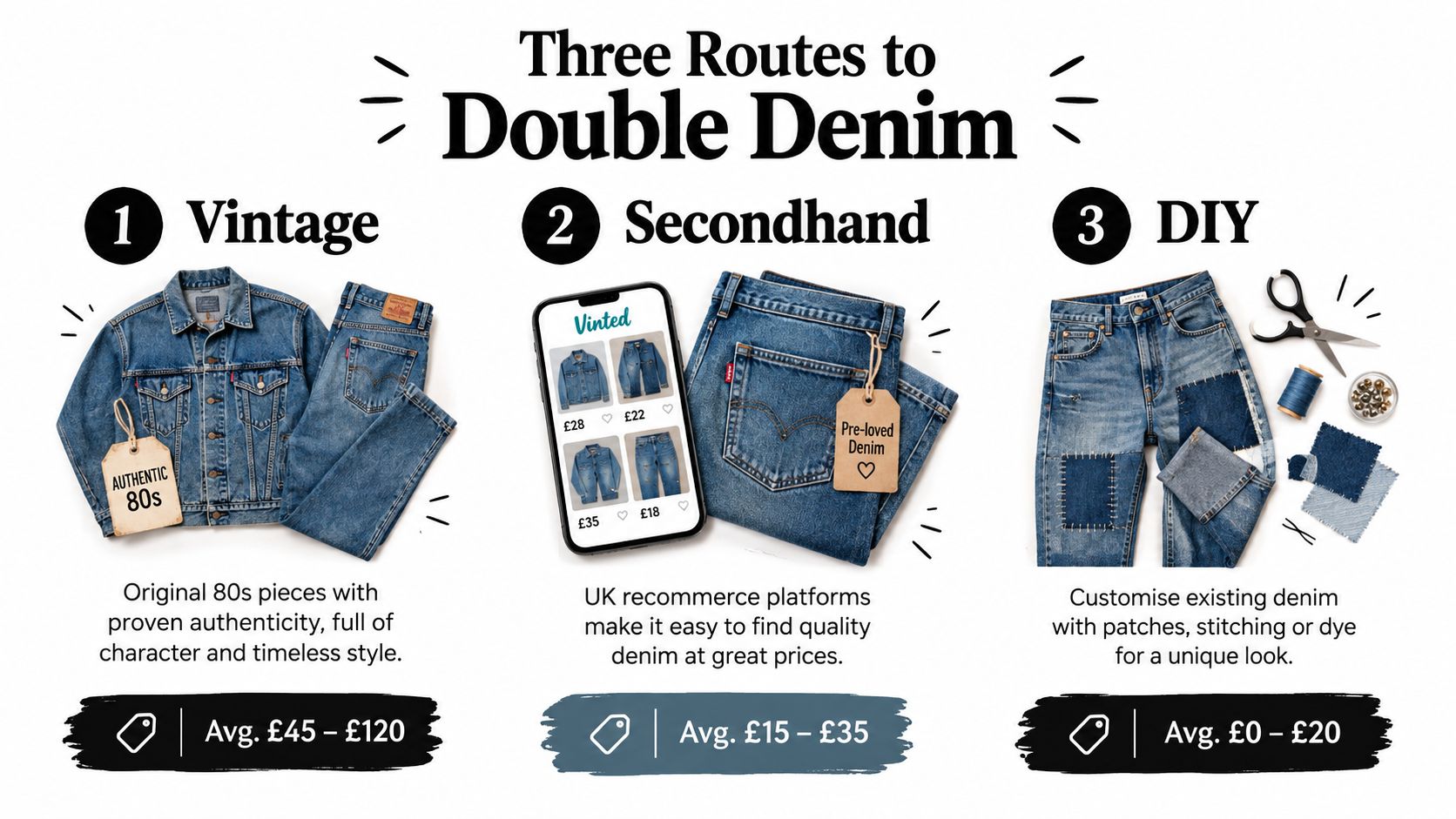
There are three sensible ways to build the look: find a genuine vintage piece, buy a second-hand substitute or customise what's already hanging in your wardrobe. None is automatically more authentic. The right route depends on whether you care most about period detail, price, fit or the satisfaction of making a jacket slightly stranger.
Authenticated vintage
A genuine 1980s jacket can offer details modern reproductions often miss, including heavier fabric, particular hardware, period labels and fading that developed through wear rather than a factory wash. The trade-off is that sizing can be inconsistent, shoulders may be narrower than expected and alterations can be more complicated than just choosing a larger modern cut.
Look closely at the label, rivets, stitching and hardware. Acid wash and distressed finishes weren't one single uniform look. Lee used large-scale stonewashing from 1982, Guess marketed pre-washed jeans in 1981, and acid-wash denim emerged commercially in the mid-1980s, as outlined in the UK recommerce reporting from GlobeNewswire.
Second-hand substitutions
Second-hand platforms make it easier to hunt for the right shape without insisting that every stitch has survived from the decade. The UK recommerce sector was forecast to grow 10.7% annually to reach $8.12 billion in 2025, after recording 13.6% compound annual growth from 2020 to 2024, according to the same market report. The report also says Vinted's UK user base grew from 1 million in 2020 to more than 2.5 million by 2023.
That matters for shoppers who want to reuse denim but don't want to pay a premium for a label. Search by cut and wash, ask for measurements and check photos of the cuffs, collar and inside label. A modern “vintage-inspired” jacket may copy the colour while missing the proportions, fabric weight and hardware that make an older garment feel convincing.
DIY customisation
DIY is the cheat code if the fit is already right. Add removable badges, sew on patches, change buttons or use visible contrast thread so you can reverse the experiment later. For basic stitching guidance, this DIY denim sewing tutorial offers a useful starting point before you attack a perfectly innocent jacket with scissors.
A framed print deserves the same care. Measure first, choose a mount that gives the artwork room to breathe and use this guide on how to frame posters when you're ready to move the attitude from your shoulders to the wall.
Bringing the Look Home With Music-Inspired Wall Art
Double denim works because it turns familiar pieces into a statement. Your room can do the same. Start with the colours rather than trying to recreate a 1980s club night in every corner, unless your home already contains a fog machine and a suspicious number of synths.
Denim gives you a useful palette: faded blue, deep indigo, black, chalky white and the occasional flash of red. Build around those tones with a print that has strong contrast and enough negative space to stop the wall becoming visually noisy. The aim is a room with rhythm, not a shrine to every prop from a forgotten pop video.
A Blue Monday-inspired starting point
A Blue Monday-inspired print is an easy bridge between 80s music culture and contemporary interiors. Striking concentric circles, glowing blues, red and orange accents, and a deep black background bring the pulse of New Order's legendary track into the room without turning the sofa into a costume change.
Hang it above a desk, record player or compact reading chair. Pair it with a faded denim cushion, a dark lamp and one warm-toned object, such as a timber shelf or amber glass. The result nods to synth-pop while remaining calm enough for someone to answer an email without feeling they've been trapped inside a laser show.
For more ways to build a wall around music, browse music artwork prints and look for a piece that connects with a song, club memory or band you'd still defend after several pints.
Let the walls tell the story
A lyric print can work like a favourite patch. It gives visitors something to read, but it also tells them what kind of person lives there. Choose one line with emotional or comic weight, then keep the surrounding furniture quieter so the words don't compete with a dozen other opinions.
You can also turn sound into a visual object. If a personal lyric, voice note or favourite chorus matters to you, this guide to visualising audio for lyric videos offers ideas for translating sound into waveform-style artwork. That approach feels especially suited to a home office, where a small custom piece can provide a private wink during a long afternoon.
Football art belongs in the same conversation. A club print, terrace-inspired graphic or matchday reference can sit beside music artwork without making the wall look like a sports bar designed by a committee. Use shared colours, similar frame finishes or a common graphic style to make the combination feel intentional.
Room recipe: faded blue textile, bold music print, one football reference and enough blank wall to let every idea breathe.
Rules Worth Keeping and Rules Worth Breaking
Keep the rule of contrast over matching. Different washes make the outfit look lived-in, while identical denim top and bottom can drift into uniform territory unless the cut and styling are extremely deliberate. The same principle works on a wall, where one strong print usually says more than a crowded gallery of unrelated slogans.
Break the rule that vintage must mean untouched. A second-hand modern jacket with the right shape can carry the mood, especially when you add a removable badge or a carefully chosen patch. Break the rule that double denim belongs only at gigs, too. A dark jacket, relaxed jeans and clean trainers can handle a workday, a pub and an impromptu discussion about whether the referee has seen a foul.
For another practical perspective on combining denim pieces, these Cedar & Lily Clothier styling tips are useful when you're deciding how much contrast your outfit can carry.
Keep: contrasting washes, a visible middle layer, one memorable detail and a print with a point of view.
Break: perfect matching, rigid authenticity rules and the idea that your home has to behave itself.
The best outfit and the best room share one quality. They give people something to smile at, ask about or remember. Wear the denim, hang the print and let the conversation start wherever it likes.
Striped Circle offers music-inspired and football wall art, including lyric prints, band artwork and designs made to bring personality to homes and offices. Visit Striped Circle to find a print that matches your favourite song, club or beautifully questionable 80s fashion decision.
