
Family Wall Art: The Definitive Guide for Fans
You know the room. The sofa is comfortable, the coffee table has survived several dramatic cup incidents, and the walls are technically painted. Yet the whole place feels like it's waiting for somebody to move in. A family photograph, a football print, or a lyric that makes you grin can change that faster than another beige cushion ever will.
Family wall art gives a home a point of view. It can celebrate a club without turning the lounge into a replica changing room, bring a favourite band into a home office, or give a teenager's bedroom something more personal than a poster bought in a panic. The trick is to treat those pieces as proper artwork, not as an afterthought with blu-tack and crossed fingers.
Table of Contents
- Why Your Walls Need a Second Opinion
- From Abstract Lyrics to Final Whistles
- Sizing and Framing Without the Headache
- Creating a Gallery Wall That Makes Sense
- The Perfect Gift for People Who Have Everything
- Keeping Your Prints Looking Sharp
- Inspiration and Where to Start
Why Your Walls Need a Second Opinion
A blank wall rarely looks neutral for long. It starts to make the furniture seem disconnected, the lighting harsher and the room less lived-in. Add a well-chosen print, though, and the same space can suddenly feel warmer, funnier and unmistakably yours.
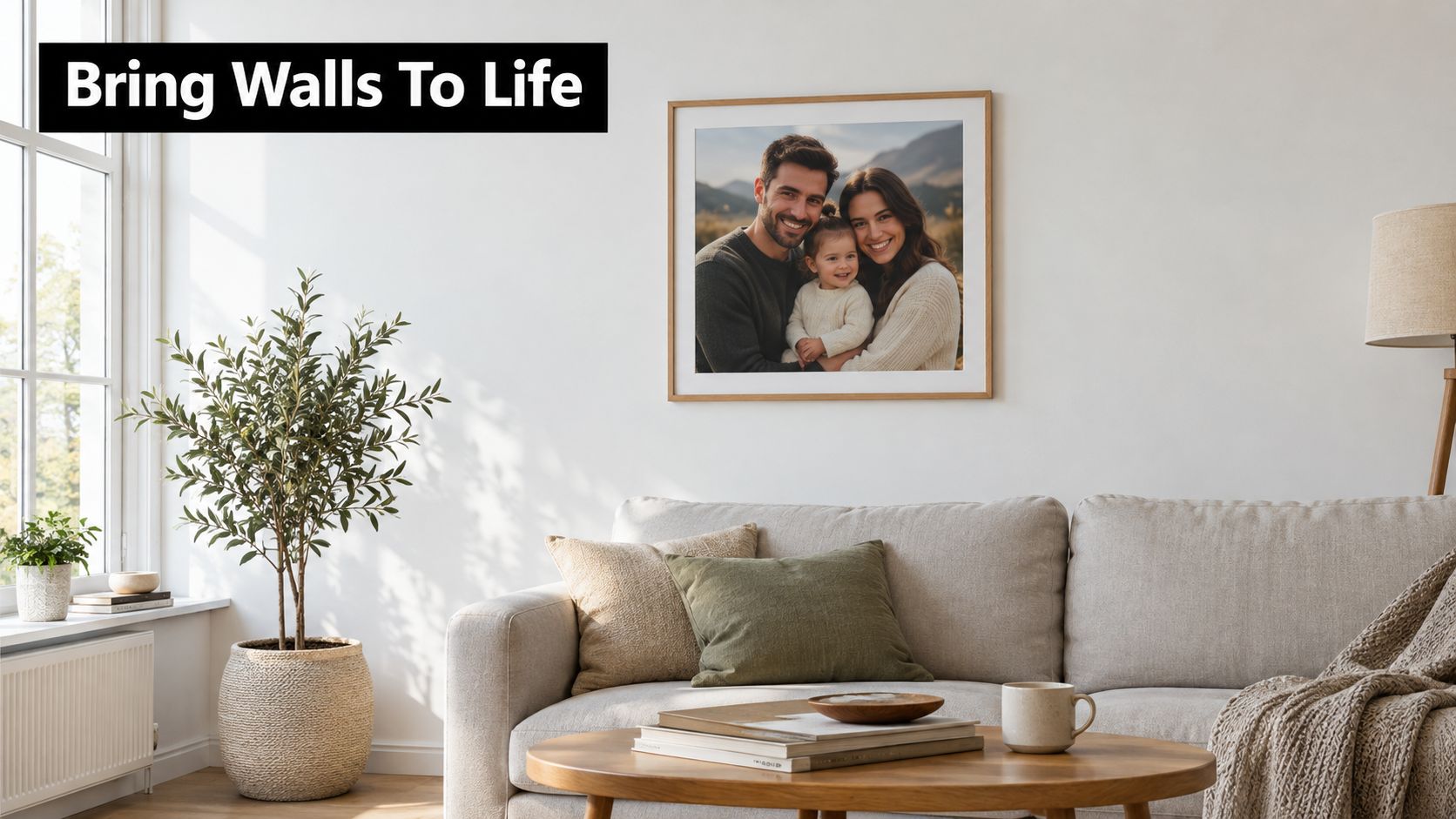
The UK already has a strong culture of improving the home. In 2022–23, the typical household spent £41.80 per week on property maintenance, repairs, alterations and improvements, with alterations and improvements accounting for £31.10, or 74.4%, of that expenditure, according to UK home renovation statistics from Hillarys. Average household spending in this category rose by 15.8% between 2019 and 2023, while decorating remained a mainstream project, with 58% of respondents planning to decorate in 2023 and 34% completing some painting or decorating that year, as the same source reports.
That context matters. Wall art isn't competing with some imaginary ideal of a finished home. It belongs to the same practical desire to make rooms more attractive and individual, only without knocking through a wall or arguing with a builder about plasterboard.
Meaning beats showroom beige
Visual art has a sizeable everyday audience too. Arts Council England's visual arts profile recorded visual-arts engagement among 46.6% of adults in England during 2016/17, with more than two in ten attending a visual-arts event. The figures don't measure print purchases directly, but they do show that artwork belongs in ordinary life, not only behind a velvet rope.
A music or football print can work as a conversation starter because it carries a story. Guests might recognise the reference, ask why you chose it, or clock the design and smile. A good piece doesn't need to shout “I support this team” in letters the size of a motorway sign. It can use colour, typography, a stadium outline or a lyric fragment that rewards people who know.
Practical rule: Choose artwork that says something about the people who live in the room, then give it enough space to say it properly.
If you're unsure where to begin, this guide on how to find the right wall art is useful for narrowing down subject, scale and placement. The best family wall art usually starts with an emotional response, then earns its place through good design.
From Abstract Lyrics to Final Whistles
Fan art sits on a broad spectrum. At one end, a bold football print makes your allegiance perfectly clear. At the other, a restrained lyric design might look like a contemporary typographic piece until someone spots the reference and gives you the knowing nod.
Neither approach is more grown-up. They just do different jobs.
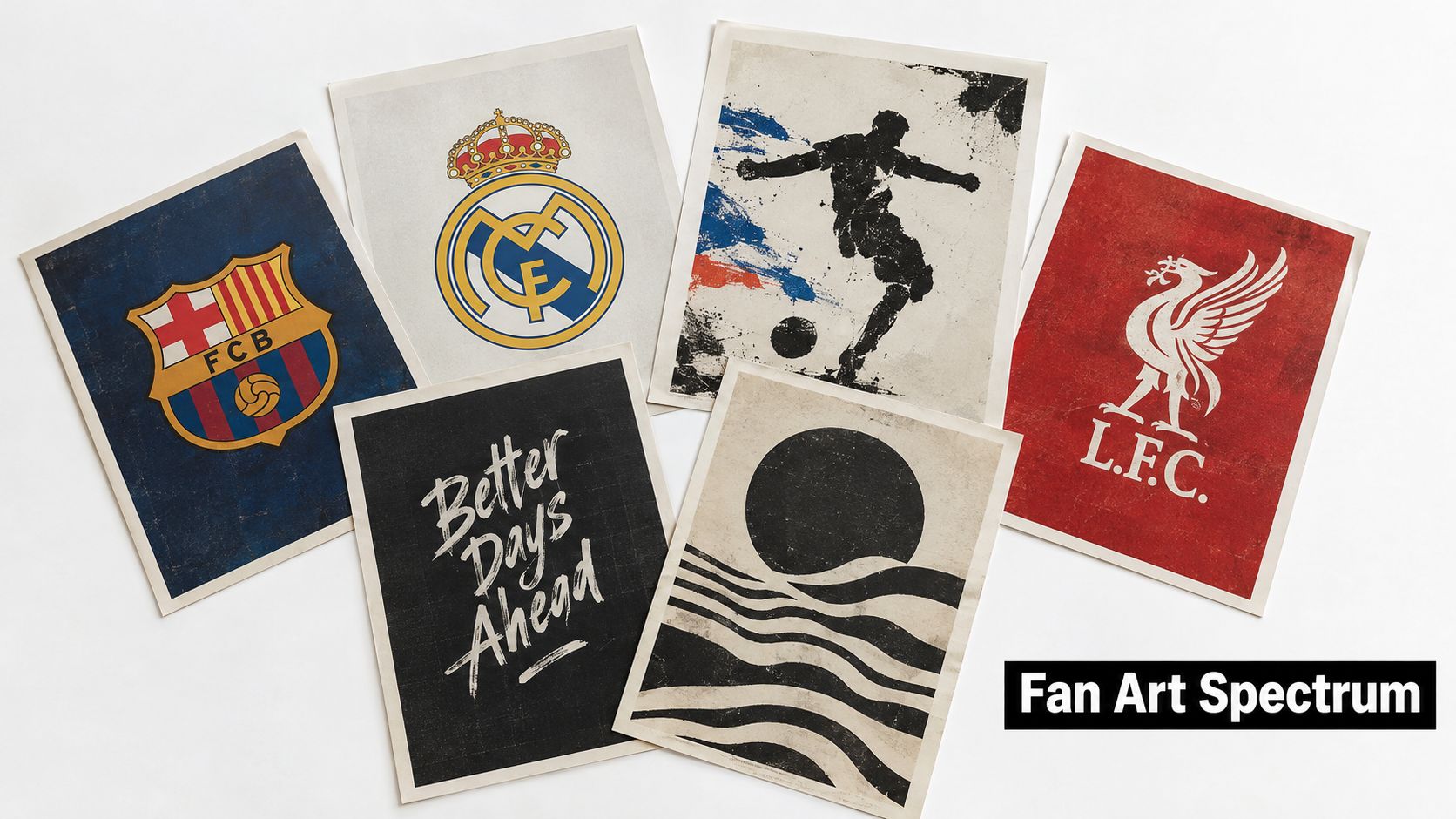
Loud, proud and gloriously specific
Literal imagery works best when the room has enough breathing space around it. A crest, kit-inspired colour scheme or stadium silhouette can anchor a study, games room or dedicated football corner. It creates an immediate focal point, especially when the design has a strong shape and limited colours rather than throwing every possible club reference onto one sheet.
Music prints can take the same route. A bold band name, tour-style composition or distinctive album-era palette announces its subject with confidence. That's ideal for somebody who wants visitors to know exactly which records get played after the children go to bed.
The risk is visual overload. If the artwork, cushions, rug, lampshade and curtains all compete in club colours, the room can start to resemble a sports bar that's waiting for a fruit machine delivery. Let one element lead and keep the supporting pieces quieter.
Quiet references with more room to breathe
Subtle designs suit living rooms, hallways and offices where the rest of the interior already has a considered feel. Minimal lyric prints, abstract notation and restrained colour palettes can connect to music without turning the room into a merchandise stand.
Family wall art becomes part of the interior rather than a fan statement. A print may echo a sofa colour, pick up a timber finish or introduce one unexpected shade. People who share the room with a devoted fan often prefer this approach because it respects both the enthusiasm and the furniture.
A mixed collection can be especially effective. Pair one literal football piece with an abstract music print, then give both a common frame finish or colour accent. The organising link might be black, cream, red, or the fact that every piece relates to a family story.
England's wider cultural life supports this crossover. The Participation Survey 2024/25 found that 91% of adults engaged with the arts during 2024/25, while 45% visited a museum or gallery. That includes participation as well as attendance, but it still reinforces the point: culture already lives in people's routines. A wall can be its domestic home, with better snacks and no school trip coach.
Sizing and Framing Without the Headache
A small print on a large wall can look apologetic. A huge piece squeezed above a narrow console can make the furniture appear to be hiding from it. Good sizing starts with the wall, the furniture beneath it and the distance from which people will view the artwork.
Measure the usable wall area, not the entire room. Above a sofa, sideboard or desk, let the furniture establish the artwork's visual footprint. A single statement print suits a broad, calm wall, while several smaller pieces work when you want movement, variety or room for the family story to grow.
A quick sizing guide
| Wall Space | Recommended Print Size | Best Frame Style |
|---|---|---|
| Narrow hallway or small alcove | Small portrait or compact pair | Slim black, white or natural wood |
| Above a desk or console | Medium portrait or landscape | Simple timber or clean metal |
| Above a standard sofa | One large print or balanced multi-print arrangement | Substantial black, oak or neutral frame |
| Wide living-room wall | Oversized statement piece or structured gallery | Frame with enough visual weight to hold the wall |
Don't buy the frame as an afterthought. A sleek black timber frame can sharpen a modern lyric print, while natural wood softens a family photograph or vintage-inspired football design. Ornate gold can work, but only if the room already supports it. Otherwise, your understated band print may suddenly look as though it's applying for a place in a stately home.
Plan before the first hole
Lay the framed pieces on the floor and test the arrangement before lifting a hammer. Mark the outer edges with removable tape, check the centre against the furniture and step back to view the whole composition. The more expensive the frame and the more stubborn the wall, the more valuable this boring little exercise becomes.
For a careful hanging sequence, use these precise picture hanging steps. If you're framing an unmounted poster, this practical guide to how to frame posters can help you avoid rippled paper, crooked backing and the general look of a print that lost a fight with a drawer.
Hang for the room you have, not the wall you wish you had.
Creating a Gallery Wall That Makes Sense
Gallery walls go wrong when every piece is treated as equally important. The result becomes a crowded committee meeting of frames, photographs, children's drawings and football nostalgia, with nobody quite sure who's in charge.
A better display has an organising principle. It might be a shared colour palette, one frame finish, a common theme or a family story that moves from music to sport to everyday life. You can mix the contents without making the wall look accidental.
Give the wall a visual referee
A perfectly matched set often looks tidy but impersonal. A deliberately curated mix has more character, provided something controls the chaos. Choose one or two anchors first, such as a larger family photograph, a strong lyric print or a vintage football image. Add smaller pieces around them rather than starting with a dozen equal voices.
The display might include:
- Family photographs: Use the images that carry genuine feeling, not every school portrait ever printed.
- Children's artwork: Frame a rotating selection so the wall evolves without becoming a permanent paper avalanche.
- Music prints: Let typography or a restrained palette bridge the gap between personal memory and interior design.
- Football artwork: Include a crest, stadium reference or club colour as an accent rather than making every item compete for the captain's armband.
A hallway or staircase often gives smaller photographs their best chance to be seen up close. A living-room wall usually benefits from a stronger central shape, with personal pieces supporting it instead of creating a tiny-frame traffic jam.
Arrange, photograph, edit
Plan the layout on the floor. Keep the outer boundary roughly consistent, vary portrait and horizontal orientations, and leave enough space for the eye to move between pieces. Take a photograph before hanging it. The camera is a useful critic and has no emotional attachment to the print your child made during a particularly ambitious glitter phase.
For a practical arrangement reference, use this guide to how to arrange wall art. Start with a generous edit. If the wall feels busy, remove one piece before adding another. A curated display needs pauses, just like a good album.
The strongest gallery walls can change. Swap seasonal photographs, replace children's artwork as they grow, or move a football print to the office when the lounge needs a calmer mood. Flexibility beats a layout so precious that nobody is allowed to touch it.
The Perfect Gift for People Who Have Everything
Buying for a serious music or football fan can feel like scouting a striker who already owns every shirt. They've seen the gigs, bought the programmes and filled the wardrobe with colours that make subtle dressing impossible. A thoughtful print offers something different because it gives their enthusiasm a permanent place in the room.

A generic gift is easy to buy but easy to forget. A personalised piece can mark a wedding date, a first concert, a favourite venue, a family in-joke or the club that has caused entirely unnecessary emotional turbulence since childhood. The best choice depends on how well you know the recipient.
Match the gift to the person
A lyric print suits someone who collects words and records, while a club-themed design works for the fan who knows the starting eleven, historic kit details and precisely when the referee made a terrible decision. For a shared home, choose something that references the interest without overwhelming the room.
Customisation adds emotional weight, but it needs restraint. A date or short message can turn a print into a keepsake. Too many personal details, however, can make the artwork look like an invitation that accidentally got framed. Ask yourself whether the recipient will still enjoy seeing it after the occasion has passed.
For broader inspiration, this guide to a gift for an art lover is a useful reminder that the recipient's taste matters more than the giver's enthusiasm. If they like clean interiors, choose a quiet design. If their house already has the energy of a pre-match pub, you can be bolder.
A print also compares favourably with cards and chocolates. Those gifts deliver a moment. Wall art can keep contributing to the room, reminding the recipient of the person who chose it every time they pass. That's a decent return for avoiding another novelty mug.
Keeping Your Prints Looking Sharp
Wall art isn't immortal. Paper and pigment respond to light, and direct sunlight can bleach colours and discolour the sheet over time. The myth that a framed print is protected from everything usually ends when somebody notices a bright rectangle on the wall and a faded rectangle inside the frame.
For paper prints, UK conservation guidance recommends approximately 50–80 lux, because visible light progressively damages pigments and paper. Art UK's preventative conservation guidance also recommends ultraviolet radiation at or below 75 microwatts per lumen, filtering daylight with blinds or UV-absorbing window film, and avoiding direct sunlight.
Location matters more than people think
Don't place valuable or sentimental prints opposite a large unshaded window. Avoid picture lights that create hot spots, especially above paper artwork. Low-UV LED lighting, curtains and blinds offer a sensible domestic compromise. You don't need to turn the lounge into a museum storeroom, but you should stop the sun from treating your favourite lyric as a tanning project.
Light damage depends on total exposure, not only how bright the artwork looks at one moment. Museums Galleries Scotland guidance explains that illumination should be measured at the artwork surface and identifies approximately 150,000 lux-hours per year as a preservation benchmark for light-sensitive objects. Continuous exposure at 50 lux produces about 438,000 lux-hours per year, while eight hours a day produces about 146,000 lux-hours in theory.
That makes a simple habit worthwhile. Switch display lights off when the room is empty, use indirect illumination and rotate especially sentimental prints if they live in a bright room. Good framing supports this protection, particularly glazing that reduces ultraviolet exposure.
The safest wall is usually the one where you can enjoy the print without putting it in direct competition with the sun.
Inspiration and Where to Start
Start with the feeling you want the room to create. A bold club print can energise a home office or games room. A restrained lyric design can bring personality to a hallway without demanding a full band biography from every visitor. A family photograph, children's drawing and music reference can sit together when one element, such as colour or framing, keeps the conversation civil.
Music has plenty of cultural weight behind it. Arts Council England's summary of Active Lives data reports that 52.2% of adults in England attended an event, performance or festival involving creative, artistic, dance, theatrical or music activity, while 46.5% visited a museum or gallery and 34.7% spent time on a creative or artistic activity or craft, as shown in its Active Lives survey research. Music-inspired wall art can extend that experience into the home, where the encore doesn't require a late train.
The UK music sector also generated £8 billion for the economy in 2025 and supported 220,000 full-time-equivalent roles, according to the This Is Music 2025 analysis reported by BIMM. A print doesn't need to claim it represents that whole industry, but it can celebrate the songs, people and places that make music matter.
For a narrow entrance or corridor, the Interiors by DeX hall gallery offers useful visual inspiration. Choose one wall, one story and one piece that makes you smile before you've even taken your coat off. A blank wall is rarely neutral. It's usually just waiting for the right chorus.
Striped Circle creates high-quality wall art, posters and greeting cards inspired by music, football and the wonderfully odd details that make a home yours. Visit Striped Circle to find a distinctive print for your living room, office, hallway or next impossible-to-buy-for fan, with free delivery on orders over £40.
