
Home Wall Decor Items: How to Choose, Hang and Protect
There's a wall in your home you've been avoiding. It's above the sofa, or beside the wardrobe, or in that hallway spot where the light switch makes everything awkward. The furniture has been rearranged twice, the rug still argues with the curtains, and this one rectangle of plaster is the last undecided thing in the room.
Treat home wall decor items as a shopping problem: scroll, find something, buy it, hang it, hope. I'd rather you treat it as three practical problems in order: how big is the wall, how much light hits it, how damp does that corner get. Solve those and the design decision gets much easier, because half the prints you were considering have already disqualified themselves.
The fun comes after that. Music and football prints are the ones that earn their spot, because they carry a story. A wall with a story on it gets looked after.
Table of Contents
- Home Wall Decor Items at a Glance
- How to Size Wall Decor for Your Space
- Matching Decor to Rooms, Styles and Moods
- Light and Damp Limits That Protect Your Prints
- Hanging Prints Safely in Rented Homes
- Buying Decor That Lasts Longer
Home Wall Decor Items at a Glance
| Format | Best room | Typical hanging | Light-damage risk |
|---|---|---|---|
| Framed print with glass | Living room, office, hallway | Picture hook or rail | Low when glazed with UV-filtering glass |
| Unframed poster | Bedroom, kitchen, rented flat | Adhesive strips or clips | High for uncoated paper |
| Canvas | Bold-colour statement walls | Two D-rings or wire | Low, but fades in direct sun |
| Mirror | Hallway, bedroom | Two-point mount into a stud or wall plug | Low |
| Card or calendar display | Kitchen, desk, cloakroom | Pegs, clips or a small ledge | Moderate, keep out of direct sun |
Paper formats are the cheapest way onto the wall and the most light-sensitive thing you can hang. Glazed frames add weight and cost but buy you protection, which is why a £12 poster and a £60 framed print are not the same product in a sunny room. Canvas suits bold colour and survives a hallway knock, but it needs a clean wall and a bit more depth, because a chunky canvas on a narrow chimney breast looks like it's been wedged in.
This isn't a niche corner of spending either. UK households spent £78.242 billion on furnishings, household equipment and routine maintenance in 2024, down from a 2022 peak of £80.744 billion, according to Office for National Statistics household spending data. Wall decor sits inside a very large, very established ecosystem of people personalising their homes.
Three quick picks by wall type:
- Narrow hallway: one tall, narrow piece, hung so the centre sits at your natural eye level. Two small prints here just look like a mistake you made twice.
- Home office: a single lyric-inspired print at eye level behind the desk. One is a talking point; four is a mood board nobody asked for.
- Kitchen: small cards or a wall calendar on a ledge, well away from the hob and direct sun.
Choose the format before you choose the design. The format decides the hanging method, the weight on the plaster and how long the thing survives up there.
How to Size Wall Decor for Your Space
The internet has decided that bigger is better. Recent UK trend coverage reports 31,100 monthly searches for large wall art and rising interest in oversized pieces, while noting that open-plan living has cut the uninterrupted wall space most homes have, per Retail Times' decor trend data. Those two facts don't sit comfortably together.
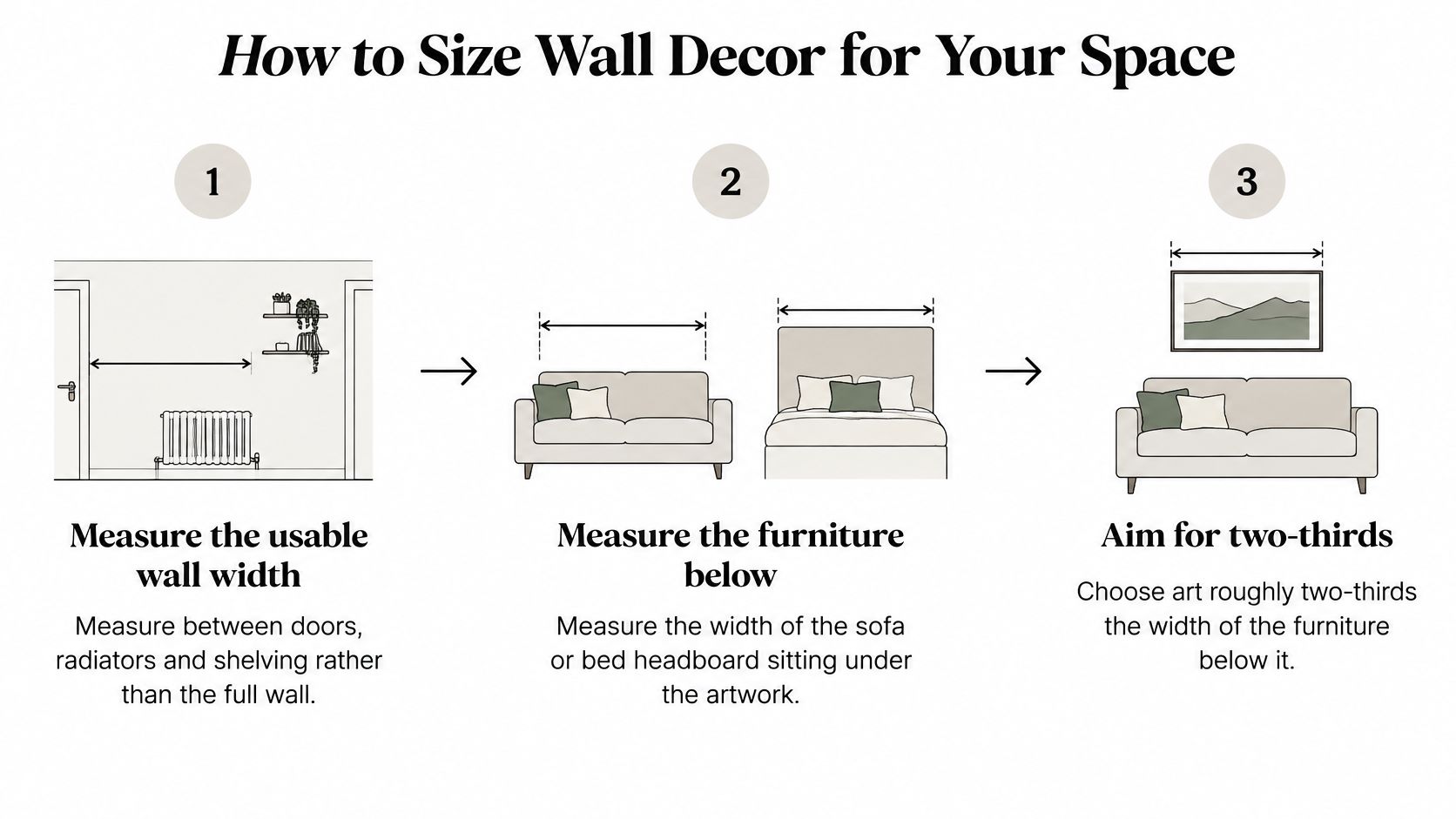
1. Measure the usable wall width, not the wall. Tape measure from the door frame to the radiator, or from the shelving unit to the corner. That gap is your canvas. Measuring the full wall to fit it often ends with discovering the doors.
2. Measure the furniture underneath. A sofa, a bed headboard, a sideboard. Write the number down, because you'll need it for the next step and you'll forget it.
3. Aim for art roughly two-thirds the width of that furniture. A 180cm sofa wants art around 120cm wide. Anything narrower floats; anything wider looks like it's pressing down on the cushions.
4. Cut paper templates and tape them up. Brown paper and masking tape, cut to the exact size of the piece. You can see the outline, the gap to the ceiling and how it sits against the lampshade without touching a drill.
5. Live with the mock-up for 48 hours. Walk past it, sit under it, look at it from the doorway. Almost every sizing error I've seen was visible on day two with paper on the wall and invisible in the shop.
Why a small room beats a big print
A single oversized piece can swallow a compact room whole. In a narrow bedroom, a shared study or a flat with a radiator on every wall, a coordinated grid of three or four prints usually works harder, because it fills the shape you have instead of fighting it. Visual impact and physical size are different things: a high-contrast lyric print holds a wall just as firmly as a large neutral canvas, and it costs less wall.
If you're set on going big, work through our guide to large wall art before you commit, because placement rules change once a piece is wider than a doorway.
Practical rule: if the art is wider than the furniture below it, it's a mural, not a print.
Weight is the other half of sizing. A big glazed frame needs a different fixing to a paper poster, and metal is heavier again. If you're weighing a metal piece against paper, it's worth comparing metal horse art finishes first, since the finish changes how much the piece reflects light as well as how it has to hang.
Final check: can you see the piece clearly from the sofa, and does it still look balanced with the lamp switched off?
Matching Decor to Rooms, Styles and Moods
A football print does its job with matte paper, deep contrast, and no frame crying for attention.
Living room. Start with the biggest wall and the piece you'd save in a fire. Either one large statement or a gallery wall of gig posters, with the largest on the longest stretch and everything orbiting it. Gallery walls fail when every frame is a different size with different gaps. Pick one gap, usually 5 to 7cm, and don't negotiate.
Kitchen. Small cards, a calendar or a food-themed print, sited away from the hob. Steam and airborne grease coat paper faster than sunlight ever will, and a print above a boiling pan is a science experiment.
Downstairs loo. A run of small prints at one consistent height. It's the cheapest personality upgrade in the house: one customer ordered 12 prints for a downstairs loo and called them a real talking point.
Home office. One witty lyric or football print at eye level, positioned so it lands in the corner of a video call. Something with a story beats a motivational quote about synergy every single time.
Three styles, three different answers. Minimalist rooms need one strong colour and nothing else, so let the print do all the talking. Maximalist rooms can mix a framed football scarf print with a vintage gig poster and get away with it, as long as the frames agree on something. Retro rooms take warm tones, which is why 1970s-influenced kitchen prints sit so comfortably next to a mustard kettle.
Music prints have a huge habit to plug into. Consumer spending on live music in the UK hit a record £6.68 billion in 2024, and the figures show a UK gig took place every 137 seconds that year, according to Access All Areas' live music spending report. The UK music sector itself contributed £8 billion in gross value added in 2024 and supported 220,000 jobs, per the House of Lords Library. A gig poster isn't decoration for a national obsession, it's a receipt for one.
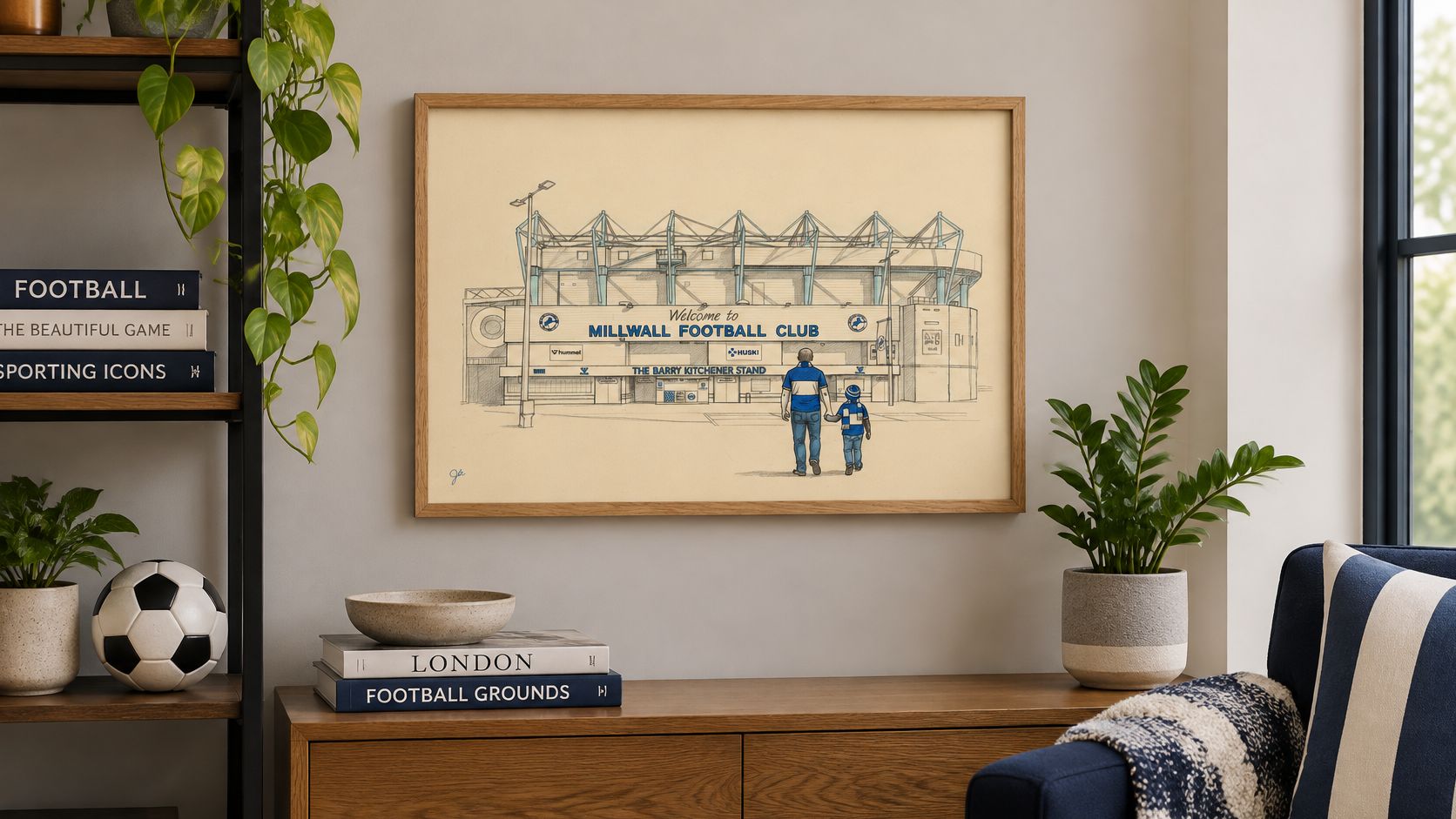
Football does the same job with more shouting. "Into the Lion's Den" Millwall Football Club print captures the stands and a father and child in Millwall colours, printed on high quality matte fine art paper and available from A5 up to A0. If someone in your house stood in the Cold Blow Lane end, that's the wall sorted.
Pick the room first, then the style, then the subject. Reversing that order is how people end up with art that suits a Pinterest board and nobody in the actual house.
Light and Damp Limits That Protect Your Prints
| Factor | Target | Practical step |
|---|---|---|
| Light | About 50-80 lux on paper prints | Avoid unfiltered south-facing windows and spotlights |
| Relative humidity | 40-60%, stable within about 20 points and below 65% | Check with an inexpensive hygrometer each season |
| Placement | Away from radiators and steamy kitchen walls | Hang higher on the wall or move the print |
| Glazing | UV-filtering glass or acrylic | Choose glazing for bright rooms; blinds help too |
Light is cumulative and permanent. Art UK's preventative conservation guidance recommends limiting illumination to roughly 50-80 lux for framed paper-based work, because visible light bleaches pigments and discolours paper, and the damage does not reverse. A print that fades over two summers isn't unlucky, it was hung in the wrong place. Avoid the wall directly opposite an unfiltered south-facing window and the patch beneath a high-output spotlight.
Humidity is the quiet destroyer. The same guidance recommends keeping relative humidity stable within roughly a 20-percentage-point band and below 65%, since damp air invites mould, mildew and pests. A domestic target of 40-60% RH, read off a cheap hygrometer, is a sensible benchmark. You don't need lab equipment. You need to know whether that corner sits at 48% or 72%.
Placement decides most of it. Off the wall directly above a radiator. Off the external wall that runs cold in January and wet in November. Out of the kitchen steam zone and away from the bathroom door.
Practical rule: if you can feel warmth or moisture on your palm held against the wall, the print shouldn't live there.
Uncoated paper is where this bites hardest. Music posters and football artwork printed on matte or archival stock fade and cockle faster than a glossy framed piece, so they deserve the best wall in the house, not the worst. Rotate valuable prints out of bright rooms each season, and check the hygrometer when the clocks change. If you're taking a print down to move it, safe packing tips for framed art are worth five minutes before it goes in a van.
Hanging Prints Safely in Rented Homes
Renting narrows your options but doesn't remove them. It just means the decision starts with the tenancy agreement rather than the drill.
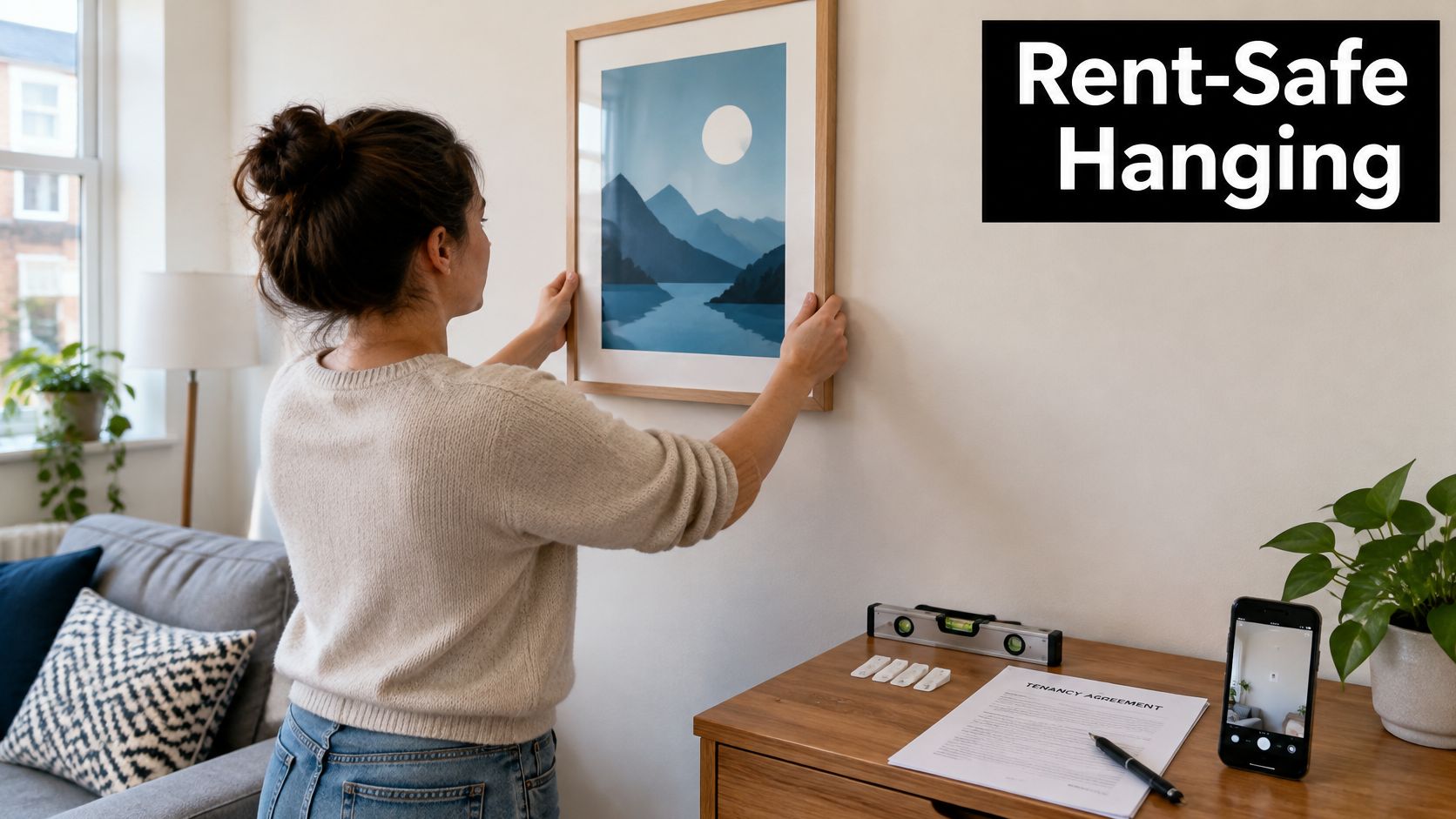
1. Read the agreement and photograph the wall. A dated photo of bare plaster is your evidence at checkout time, and it costs nothing to take.
2. Use adhesive strips rated above the piece weight. Press firmly for the full cure time, usually an hour, then test removal on a hidden corner after a day. Strips fail when they're rushed, not when they're cheap.
3. Hang from a picture rail if you have one. Gig posters and football prints can then change with your mood and no new holes. It's the single best feature a rented flat can offer.
4. Two-point mount anything heavy. A glazed frame or mirror wants two fixings into studs or proper wall plugs, not one nail and optimism. One fixing rotates; two hold.
5. Lean it if drilling is off limits. A large canvas or framed print on a sideboard, pushed back against the wall with a museum putty pad under the front edge, looks deliberate rather than defeated.
If you're avoiding holes entirely, our guide to hanging posters without frames covers the tape, clip and ledge routes in detail.
Framing materials matter more than people expect. The National Gallery's guidance on paintings and their environment sets gallery conditions for easel paintings at about 55% relative humidity plus or minus 5%, light around 150 lux, and roughly 21°C in winter and 23°C in summer. Those figures are for oil on canvas in a controlled room, not a poster in a rented flat, but the mechanism transfers exactly: paper and board take on and release moisture, the sheet moves, and you get waviness, a bowed mount, a gap at the frame or the print touching the glass. Leave a small air gap behind the frame, fit a rigid backing and an acid-free mount, and keep the glazing off the paper.
After the first damp week, look for four things: ripples in the sheet, a mount bowing forward, a gap opening at the frame edge, or the print kissing the glass. Any of those means take it down, move it off the cold external wall, and flatten it under a light, even weight before rehanging.
The five-point check before you commit
- Weight rating: adhesive strips or fixings rated above the piece, not equal to it.
- Cure time: the full hour, not the four minutes you have before dinner.
- Two-point fix: anything glazed or heavy gets two fixings.
- Air gap: a few millimetres behind the frame so moisture can move.
- Removal test: one hidden corner, one day later, before the whole piece goes up.
Buying Decor That Lasts Longer
The cheapest, lightest print is not automatically the greenest one. That assumption needs challenging, because it drives people towards disposable decor and calls it eco-friendly.
UK trend reporting notes that buyers increasingly ask about recycled or FSC-certified materials, water-based inks, print-on-demand production and maker practices, and cites a YouGov finding that 74% of UK consumers consider sustainability when purchasing home and lifestyle products, according to Trowbridge Gallery's UK wall art trend analysis. Demand is real. Comparable information is not. "Eco-friendly" on a product page is a claim, not evidence.
An unframed print uses less material than a framed one. A framed print protects the paper, so it stays up instead of being replaced. Which is greener depends entirely on how long each stays on the wall, and that's a question about your plans, not the packaging.
What to check before you buy
- Paper weight and stock: heavier stock holds up to handling and humidity better. Recycled stock is worth asking for, but ask what it's recycled from.
- Frame material: solid wood and metal can be refinished or reused. Thin composite frames usually can't.
- Glazing: glass is recyclable and easy to separate. Check whether acrylic is marked as recyclable before you assume it is.
- Packaging: minimal and kerbside-recyclable beats a box inside a box inside a bag.
- Local production: UK-made cuts transport, and a shorter supply chain is easier to verify. Our prints are handmade in the UK, which makes this an easy one for us to say.
- Expected life: a print tied to a club or a band you'll still care about in ten years is a better buy than a trend piece you'll rotate out by spring.
Disposal matters too. Separate glazing, card backing and frame components according to your council's rules, and reuse a frame before you bin it. A battered frame with a fresh print inside is a free upgrade, and paper stock matters more than it first appears, which is why it's worth understanding what archival paper actually means before you pay extra for the word.
The music and football angle makes this simpler, not harder. Buy fewer pieces tied to lasting loyalty and skip the disposable trend decor. One print that stays up for a decade beats six that get replaced every spring.
Striped Circle is a family-run UK studio making music prints, football prints, greeting cards and wall calendars for people who'd rather their walls said something. Every order is checked by hand, our framed prints arrive ready to hang with a hanging kit included, and delivery is free on orders over £40. Measure the wall, check the light, then come and find the one print you'll still be happy with in ten years at Striped Circle.
