
What Is Archival Paper and Why It Lasts
A thick sheet can still yellow and weaken. Archival permanence is measured through the paper's chemistry, not by its weight or by a reassuring label.
For a specific benchmark, The National Archives' Grade 1 specification for permanent paper asks for 100% chemical pulp, a pH between 7.5 and 10 and a kappa number no higher than 5. Those figures describe the paper's composition and chemical stability, rather than how substantial it feels in your hand.
Weight tells you how much paper there is per square metre. It affects the feel of a print and how it handles, but it cannot tell you whether the sheet will retain its colour or strength over time. Heavyweight stock can feel reassuring, much like a football shirt with thick lettering, but heft alone is no guarantee of lasting quality.
The practical test is whether the paper's properties meet a permanence standard. A lyric print on unstable stock can discolour; a carefully specified sheet gives the image a better chance of lasting. The frame and the wall matter too: even good paper can suffer if its surroundings expose it to damaging conditions.
Table of Contents
- What Archival Paper Actually Means
- The Measurements That Prove Permanence
- Acid-Free Paper and the Rest of the Spec
- How Prints Age on a Normal UK Wall
- Mounts Glazing and Backing That Matter
- Choose a Print You Can Keep Looking At
What Archival Paper Actually Means
Archival paper is paper engineered to stay chemically stable over a long period, so the sheet keeps its strength and the image sitting on it stays intact. That's the definition worth memorising, because it lets you set aside most of the packaging copy you'll read in a gift shop.
In the UK, the idea is pinned to a permanence standard rather than a retail label. The benchmark is BS EN ISO 9706, the British adoption of the international standard for permanent paper used for documents, which BSI publishes and maintains. It applies to unprinted paper intended for documents, and it draws a line between permanent paper and board, which matters the moment a framer tells you the mount board behind your print is archival too.
What the Standard Refuses to Promise
The tests behind it look at measurable behaviour: resistance to acid deterioration, and whether the paper retains strength over time. They don't promise a sheet will survive soaking, a radiator, blazing direct sun, heavy pollution or a loft that swings between damp and dry. Nor is the edition fixed. BS EN ISO 9706:2000 remained current until 13 June 2025, when BS EN ISO 9706:2025 was published as its replacement, so a supplier quoting a certificate number ought to be able to say which edition they were tested against.
Archival paper against ordinary paper
| Quality | Archival or permanent paper | Ordinary wood-pulp paper |
|---|---|---|
| Fibre | Chemical pulp with longer, cleaner fibres | Mechanical wood pulp with shorter fibres |
| Acidity | Neutral to alkaline, so cellulose isn't eaten away | Often acidic, so fibres hydrolyse and go brittle |
| Lignin | Kept very low, so the sheet resists yellow-brown decay | Left in the sheet, where it oxidises and discolours |
| Alkaline reserve | A buffer, often calcium or magnesium carbonate | Little or no reserve against acids that form later |
| First visible failure | Slow change if light, heat or damp is severe | Yellowing, weak folds and tears in ordinary handling |
| What the label should mean | A documented permanence standard such as BS EN ISO 9706 | A bright look, a heavy feel or a premium price |
A match programme from a 1990s cup final shows the right-hand column doing its work. So does a gig flyer that spent a fortnight stuck to a venue wall. Both are usually printed on mechanical wood pulp, and the cellulose in that pulp is vulnerable to acid-catalysed hydrolysis and oxidation, which is how the British Library's conservation programme describes modern wood-pulp paper turning brittle. Short fibres, leftover lignin and a warm loft are enough, and the sheet cracks along the fold before the scoreline has even begun to fade.
Thickness doesn't enter into that at all. A thick card can be acidic from edge to edge, and a thin conservation sheet can be permanent. What separates them is chemistry you can measure, which is where the numbers come in.
The Measurements That Prove Permanence
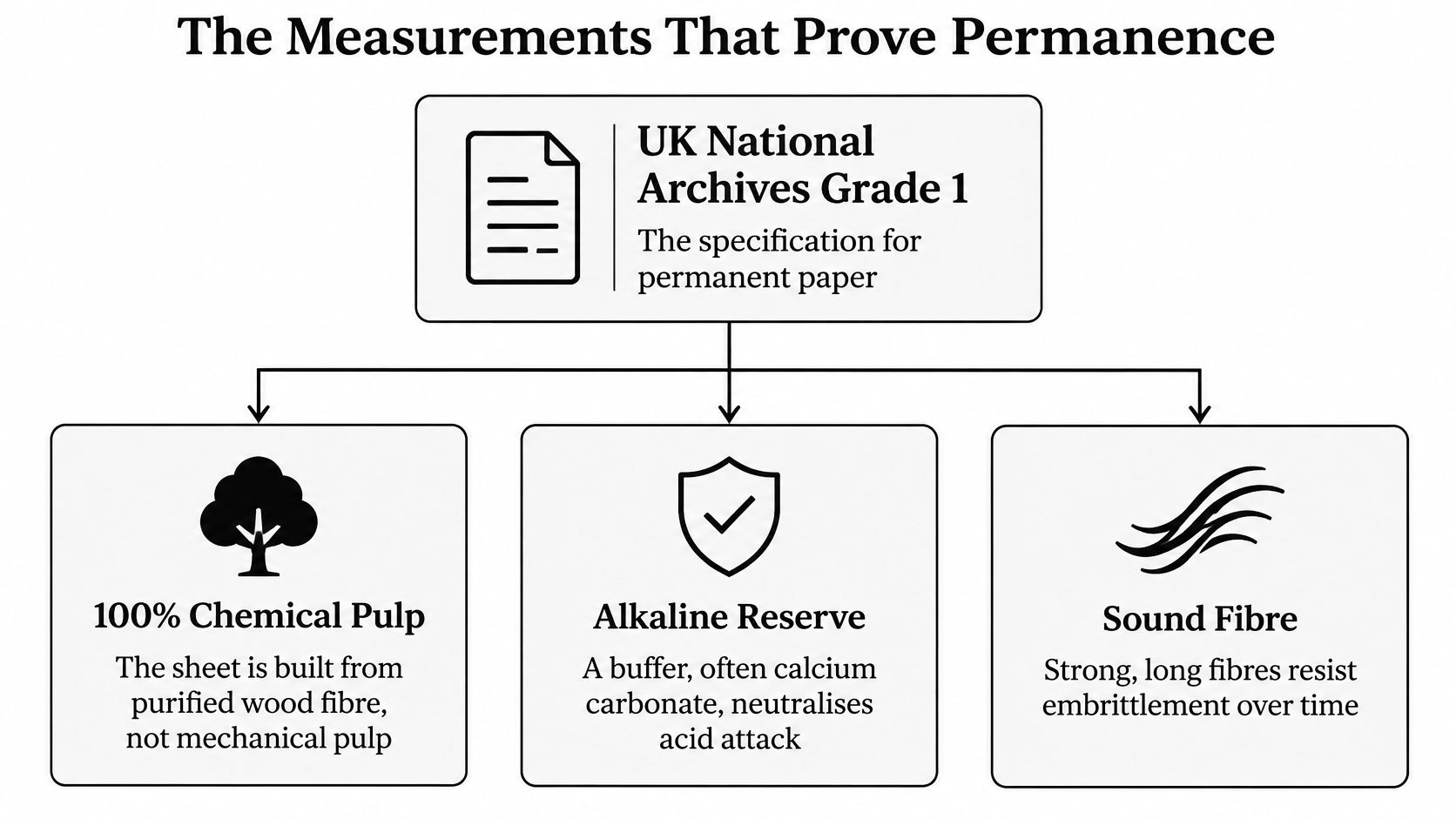
Words are cheap. Grade 1 permanent paper has a numeric definition, and the National Archives sets it out in its guidance on preparing paper files: 100% chemical pulp, a pH between 7.5 and 10, and a kappa number no higher than 5, or alternatively less than 1% lignin. Three tests, one sheet, no adjectives.
Kappa Number in Plain English
The kappa number measures how much easily oxidised material is still sitting inside the paper. Wood-derived impurities are fuel, and fuel is what turns a white ground beige and makes a corner snap instead of fold. A low kappa means the mill took the impurities out rather than leaving them in and hoping for the best.
UK permanent-paper measurements
| Test | Figure looked for | What it protects |
|---|---|---|
| Chemical pulp | 100% | Avoids weak, impurity-heavy mechanical fibre |
| pH | 7.5 to 10 | Keeps the sheet neutral to slightly alkaline |
| Kappa number | No higher than 5 | Limits oxidisable material that yellows paper |
| Lignin alternative | Under 1% | Fewer wood residues that turn yellow-brown and weaken fibres |
What Each Figure Prevents
Chemical pulp at 100%. The sheet is built from purified wood fibre rather than mechanical pulp, which is the difference between a fabric that holds its shape and one that pills after three washes. Clean, longer fibre keeps its strength when a print is lifted off a hook, moved house in a cardboard box and rehung in a different room.
pH between 7.5 and 10. The white ground stays neutral to slightly alkaline, so it doesn't drift towards tea-stained beige from the inside out while the ink on the surface is still perfectly healthy.
Kappa at 5 or below. Fewer oxidisable residues means less yellowing, less brittleness, and a fold that survives being flattened out again when the print goes back in its sleeve.
The retro football shirt is the right comparison and only needs making once. Twenty summers in a loft turn white stripes cream and turn a red sponsor's logo orange, and the culprit is oxidation of the same kind that works on a sheet of paper, just slower and with less emotional damage. That's the whole reason a mill bothers measuring kappa instead of describing the paper as luxurious.
These figures describe chemical design under suitable storage. They don't buy you a century on a sunny landing, and no honest paper merchant will say otherwise. The next question is whether a sheet that only carries the words acid-free can make the same claim.
Acid-Free Paper and the Rest of the Spec
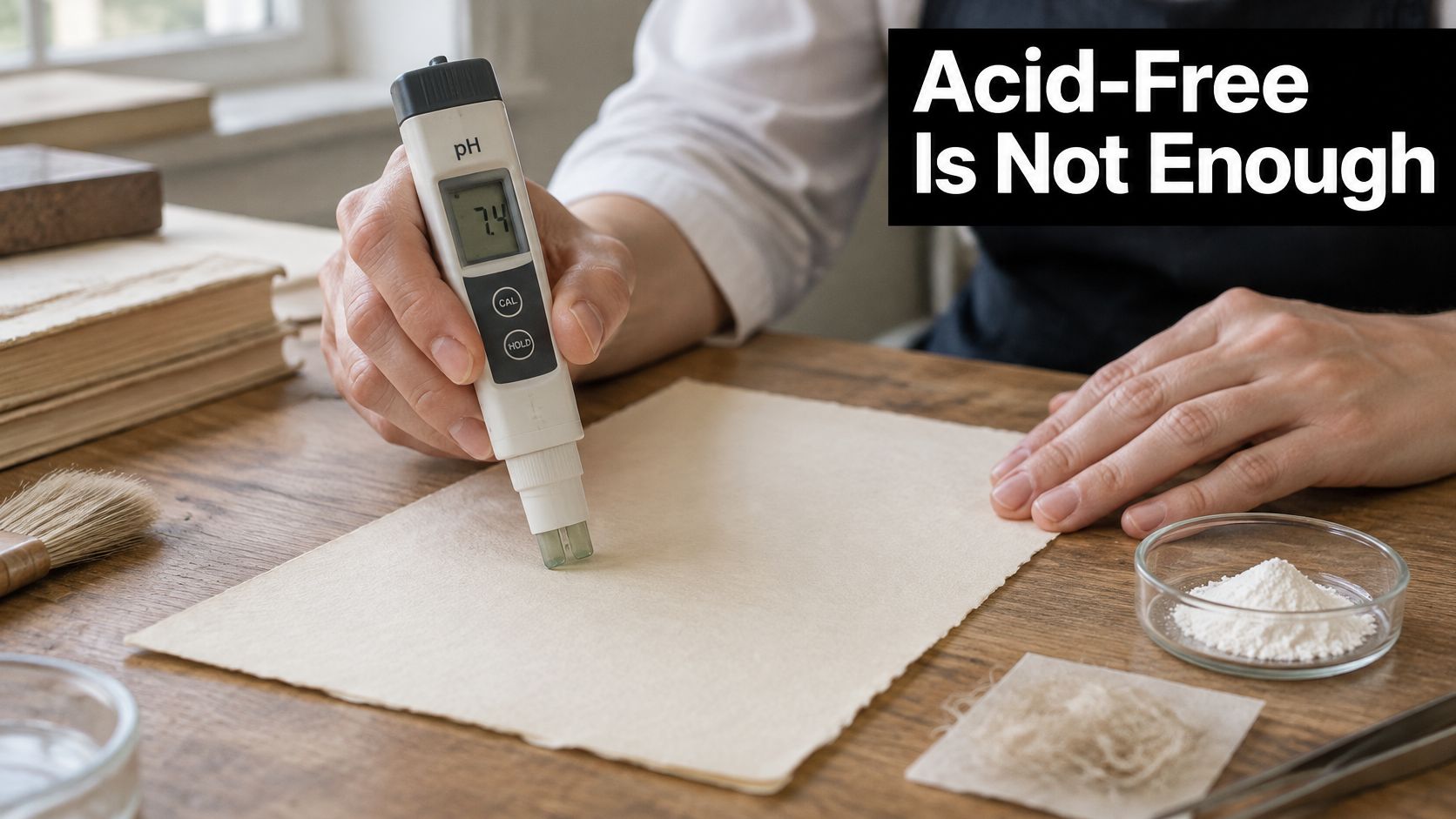
Acid-free is the phrase that does the most damage in print buying, because it sounds like the finish line and it's closer to the starting whistle. The National Archives draws the distinction plainly: acid-free describes paper with a neutral or slightly alkaline pH, and that label alone doesn't mean the material is wood-free or guaranteed to last indefinitely, as its guidance on evaluating archival box board explains.
Permanence and Durability Are Two Jobs
Permanence is chemistry. Does the sheet stay chemically and physically stable over a long period without eating itself? Durability is physical. Does it survive being rolled into a tube, posted, unrolled, propped on a shelf and dusted twice a year? A heavy poster can fail both. A light conservation sheet can pass the first and fail the second if it's packed carelessly.
Permanent paper also leans on fibre quality and an alkaline reserve, often calcium or magnesium carbonate, which neutralises acids that form later. The reserve is the reason a buffered sheet can absorb a bit of atmospheric mischief without the image paying for it. Without one, the paper has no answer when pollutants arrive.
Four Questions Before You Buy
- Buffered or unbuffered, and what pH? A number beats a badge. If nobody can tell you, assume there's no reserve in the sheet.
- What fibre, and how much lignin? Wood pulp isn't automatically disqualified, but it needs documented lignin control rather than a vague claim.
- Which permanence test was used? A named standard such as BS EN ISO 9706 is checkable. "Museum quality" is a mood, not a measurement.
- Are the inks, mount and glazing fit for long display? The best sheet in the shop still loses to an acidic backing board and a strip of sticky tape.
Fine lines show discolouration first. A lyric print with thin lettering over a pale background will look tired long before a dense block of colour does, and the white space inside a club crest goes cream at the edges before anything else shifts. Both are the sort of print people keep for reasons that have nothing to do with investment, which is exactly why the paper deserves the question.
If you want the wider comparison across stock, weights and finishes, our guide to print paper types covers what each one does on a wall.
pH is one line on the team sheet. Useful, checkable, and nowhere near the whole squad list.
How Prints Age on a Normal UK Wall
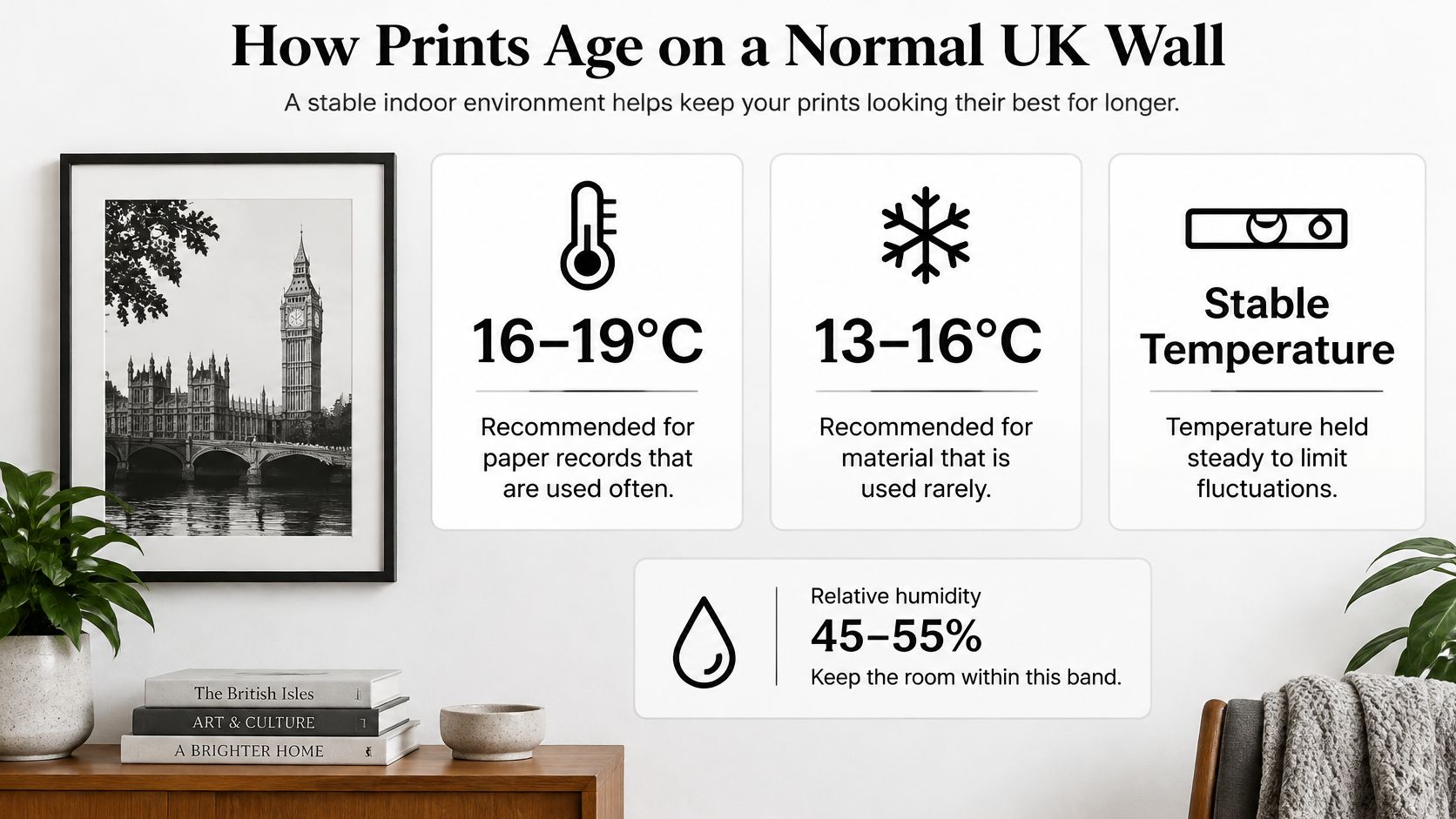
A print can be made to last and still be damaged by an ordinary house. The National Archives' UK repository standard treats paper as part of a preservation system. Its climate guidance is useful context, though a living room is not a controlled archive.
Climate bands for paper and a UK home
| Situation | Temperature | Relative humidity | Risk if ignored |
|---|---|---|---|
| Paper records used often | 16 to 19°C, about ±1°C | 45% to 60%, about ±5% | Heat or damp can speed chemical ageing |
| Paper used rarely | 13 to 16°C | 45% to 60% | Long-term storage suffers if conditions drift |
| Beside a radiator or sunny window | Often warmer than 19°C | Can swing well outside ±5% | Fading, cockling and faster acidity |
| Damp external wall or loft | Cold, then warm as heating cycles | Moisture spikes | Mould, stains and brittle edges |
One Living Room, One Kitchen, One Loft
A steady indoor temperature and moderate humidity help paper age more slowly. In practice, a living-room print may face a radiator switched on through winter, or direct sunlight through the same window each afternoon. Heat speeds chemical change; light fades ink.
Kitchens bring sharp humidity swings. Steam from a kettle or pan raises moisture in the air, then ventilation brings it down. As paper absorbs and releases moisture, it can swell and shrink, leaving a print cockled inside its frame.
The loft is a poor place for spare prints. Temperature shifts between cold and hot seasons, and a leak can leave paper damp in a dark box. Fibres respond to those changes, while warmth and moisture encourage faster ageing and mould.
Practical rule: Choose an inside wall, away from direct sun and heaters, and avoid a damp external wall.
There is no reliable lifespan in years for a print displayed in a typical home; conditions vary from house to house. Archival paper slows chemical ageing, but it cannot prevent sun damage, leaks, creasing or a damp box in the loft. If you need to store spare prints between hangs, Admiral's Yard Self Storage Bristol runs archive storage in Bristol.
A large print gives sunlight and damp more area to affect. Consider the room and display position when choosing large wall art.
Mounts Glazing and Backing That Matter
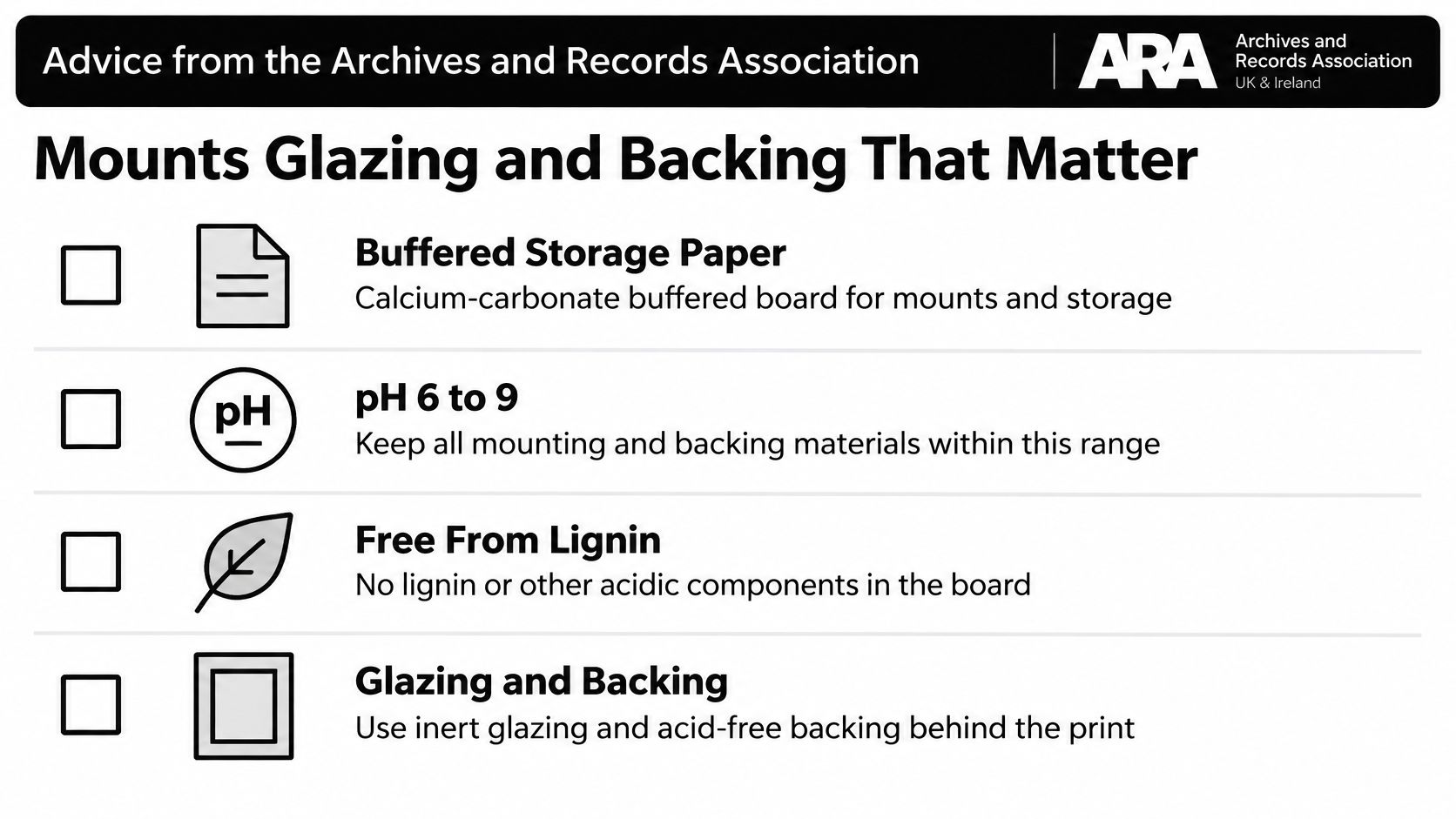
A well-made sheet can still share a frame with a bad influence. The Archives and Records Association recommends that paper and board used for archival storage enclosures should be calcium-carbonate buffered, have a pH from 6 to 9, and be free from lignin and sulphur, as set out in its guidance on storage enclosures for paper archives. That advice is written for archives, and it applies directly to the board sitting behind your print.
The Failures You Actually See
- A brown line along the mount edge. Acid has migrated out of a cheap mount or backing board and into the print, and it shows first where the two touch.
- A cockled corner after a humid summer. Paper takes on moisture unevenly when air can reach one edge and not the other, and the ripple never quite flattens again.
- A stadium print faded on one half. The side that faced the window has lost its blues while the shaded side still looks new, which tells you the sun did the damage, not the sheet.
British Library conservators note that high-quality conservation materials are tested for undesirable additives and for their tendency to release damaging compounds, while also warning that accelerated-ageing tests cannot guarantee behaviour over 50 or 100 years. The aim is reducing risk, not buying certainty.
What to Specify Instead
Use a known, buffered backing board rather than whatever came with the frame. Keep tape off the sheet itself and hinge it so it can move slightly with the seasons. Add UV-reducing glazing in any room that gets bright, and leave a small gap so the print isn't pressed flat against glass where condensation collects.
If you're doing the job yourself, this walkthrough on how to hinge and mat prints from William Tucker Art sets out the order of work so the print stays supported without being glued into place.
Framing choices carry their own decisions about glazing, spacing and backboards, and our guide to how to frame posters covers the practical sequence from unrolling to hanging.
One rule holds regardless of budget. Repair belongs with a qualified conservator, not a kitchen experiment with an iron and a damp tea towel.
Choose a Print You Can Keep Looking At
Before you buy anything for a wall, run the four checks and then ask a harder question: will this print still feel deliberate in five years, once the novelty of the lyric or the crest has worn off? A witty lyric sheet or a club print earns its place if it makes people smile and still looks intentional after a few winters.
Weight is not a shortcut to any of that. A thick sheet is durability in the hand, not a lifespan, and the frame and the wall will decide most of what happens next. An inside wall, no radiator, no south-facing bake, and a buffered backing board do more for a print than an extra hundred grams per square metre ever will.
Striped Circle prints for music and football fans on brilliant-white 250gsm heavyweight matte paper that's smooth, glare-free and acid-free, with paper that's FSC-certified or equivalent, and framed pieces sit behind shatterproof plexiglass that guards the sheet against knocks and dust. Acid-free heavyweight matte production is the honest description there, not a quoted BS EN ISO 9706 certificate, and it's worth knowing the difference when you read the label on anything else.
Pick a print you'll want to live with, then give it the best chance of staying that way. Striped Circle makes alternative lyric prints, music artwork and football club prints for people who care what hangs above the sofa, all produced in-house on heavyweight acid-free matte stock, with free delivery on orders over £40. Choose the piece that makes you smile, hang it on an inside wall away from the radiator, and back it with a buffered board so the joke still lands in ten years.
