
A Guide to Limited Edition Print Collecting
Ever seen 'LTD ED' on a print and wondered if it's just some clever marketing ploy? A limited edition print is simply a piece of art produced in a deliberately small, fixed batch, making it scarce by design. And in a world where everyone's got the same IKEA poster, scarce is seriously cool.
Think of it as owning a rare vinyl B-side versus a CD single you could grab at any petrol station—one is a collectible, the other is just... there. One makes your mates nod in appreciation; the other gets used as a coaster.
More Than Just a Poster On Your Wall
Right, let's get one thing straight. Calling a limited edition print a "poster" is like calling Oasis just "those two brothers who argued a bit." It’s technically true, but you’re missing the whole glorious, swaggering point.
A standard poster is mass-produced, printed by the thousand, and designed to be stuck up with Blu-Tack until it curls at the edges in quiet surrender. A limited edition print, however, is something else entirely.
It's a piece of art with a built-in backstory of scarcity. By capping the number of prints created, it becomes a collectible item from day one. It’s not just about filling an empty space on your wall; it’s about owning a slice of a story that not everyone can have. It's the difference between being in the crowd and having a backstage pass.
Limited Edition Print vs Standard Poster
To see the difference in a nutshell, here’s a quick head-to-head comparison. Think of it as a Premier League team versus a pub team.
| Feature | Limited Edition Print | Standard Poster |
|---|---|---|
| Production Run | Small, fixed number (e.g., 50, 100, 250). Once gone, it's gone. | Mass-produced in the thousands, often reprinted. |
| Quality | High-grade archival paper and pigment inks for longevity. | Thin, glossy paper; standard inks prone to fading. |
| Authenticity | Individually numbered and often signed by the artist. | No individual numbering or signature. |
| Value | Holds or increases in value over time due to rarity. | Little to no resale value; purely decorative. |
| Purpose | A collectible piece of art for connoisseurs and fans. | A disposable decoration for temporary display. |
As you can see, one is an investment in art and passion, while the other is a temporary fix.
The Allure of Exclusivity
Why does this matter? Because exclusivity is cool. It’s the difference between wearing a generic football top and owning the signed shirt from a cup final. Both show you’re a fan, but one tells a much, much better story.
A limited edition print does the same for your home or office. It says you’re a connoisseur, someone who appreciates the finer details—whether that's an iconic goal, a legendary album cover, or a moment in pop culture history.
Here’s what sets them apart:
- Scarcity by Design: The artist or publisher decides on a fixed number—say, 50 or 100—and once they’re sold, that’s it. No reprints, no second chances. Game over.
- Enhanced Value: Because they are rare, they often hold or increase their value over time. It's the basic rule of supply and demand, just with way better taste.
- Superior Quality: These aren't flimsy posters. Limited editions are typically produced using high-grade archival paper and inks, ensuring the colours stay vibrant longer than your favourite band's career.
A physical print can bring a photo to life and transport the viewer to another time and place, evoking all kinds of emotions and memories. With so many photos observed on social media for just a few seconds, the physical print invites viewers to slow down and engage deeply with the work.
From Your Wall to Your Identity
Ultimately, a limited edition print is a statement. It’s a nod to your passions and your personality. It shows you’re "in the know" without you having to say a word. To better understand the value and nature of limited edition prints as unique works, you may find insights from discussions on NZ original art pieces.
Whether you’re a die-hard music lover wanting to immortalise your favourite lyrics or a football fanatic celebrating a moment of pure genius, a limited run print turns that passion into a tangible, exclusive piece of art.
For a deeper dive, check out our guide on how a https://stripedcircle.com/blogs/posts/print-limited-edition can elevate your space. It's about making your walls smile, and maybe making your mates just a little bit jealous.
Decoding Edition Numbers and Markings
Alright, let's get into the details. You've found a print you love – maybe it's the unmistakable swagger of Liam Gallagher captured on paper, or the iconic moment Sergio Agüero clinched the title. You look closer and spot a little fraction pencilled at the bottom, something like '17/100'. That’s not just a random doodle; it’s the print’s secret handshake, the clue to its genuine exclusivity.
That little fraction is the edition number. The bottom number (100 in our example) tells you the edition size – that’s the total number of prints made in this specific run. The top number (17) is your print’s unique number within that batch. Simple. But this is where the real fun begins for a collector.
An edition of /100 is great, but an edition of /25? Now we're talking. The smaller the edition size, the fewer prints there are in the world. This scarcity instantly makes each one rarer and, naturally, more desirable to other fans and collectors.
This diagram helps show exactly where a limited edition print sits in the art world – a significant step up from a standard poster.
As you can see, limited editions hit that sweet spot. They offer the collectability and quality of original art but without the often eye-watering price tag of a complete one-off piece.
Beyond The Basic Numbers
Just when you think you've got it figured out, the art world can throw a few curveballs. Alongside that standard edition number, you might occasionally spot some other mysterious letters. Think of these as special proofs – the art world’s version of a band's pre-release demo tape or a footballer's trial match before getting their first professional contract.
Here are the main ones you might come across:
- AP (Artist's Proof): Artists usually keep a small number of prints for themselves, typically around 10% of the main edition size. While identical in quality, these are considered extra special simply because there are so few of them. It's like owning the director's cut.
- PP (Printer's Proof): It’s common practice for a couple of prints to be given to the printer as a thank-you for their skill and hard work. These are rare finds and have a unique backstory, which makes them a fantastic piece for a serious collector.
- HC (Hors de Commerce): This is French for "not for sale," and these prints were originally used as display copies in galleries. They aren’t part of the main numbered edition and are often marked separately, for instance, as HC 1/5.
Think of edition numbers like squad numbers in football. The number 7 at Manchester United or the number 10 at Barcelona carries more history and weight than number 47. Similarly, the edition markings on a limited edition print tell a story about its rarity and place in the collection.
Why This All Matters
Understanding these markings instantly tells you just how exclusive your print is. It's the key difference between a mass-produced poster you can pick up anywhere and a genuine, tangible collectible. And the appetite for this kind of accessible, unique art is only getting stronger.
In fact, the UK art market has seen a massive surge in limited edition print sales, especially for more affordable pieces. Sales of prints under £4,000 grew by 13% in volume and 7% in value recently. Even more impressively, the number of prints sold in this price range has shot up by 79% since 2020, with nearly 129,000 sold. It’s clear proof that more and more people are on the hunt for cool, authentic art for their walls. You can read more about these art market trends to get the full picture.
So, the next time you’re sizing up a print, pay attention to the numbers. They’re not just admin; they're your guide to owning a proper slice of pop culture history.
Why Signatures and Certificates Matter
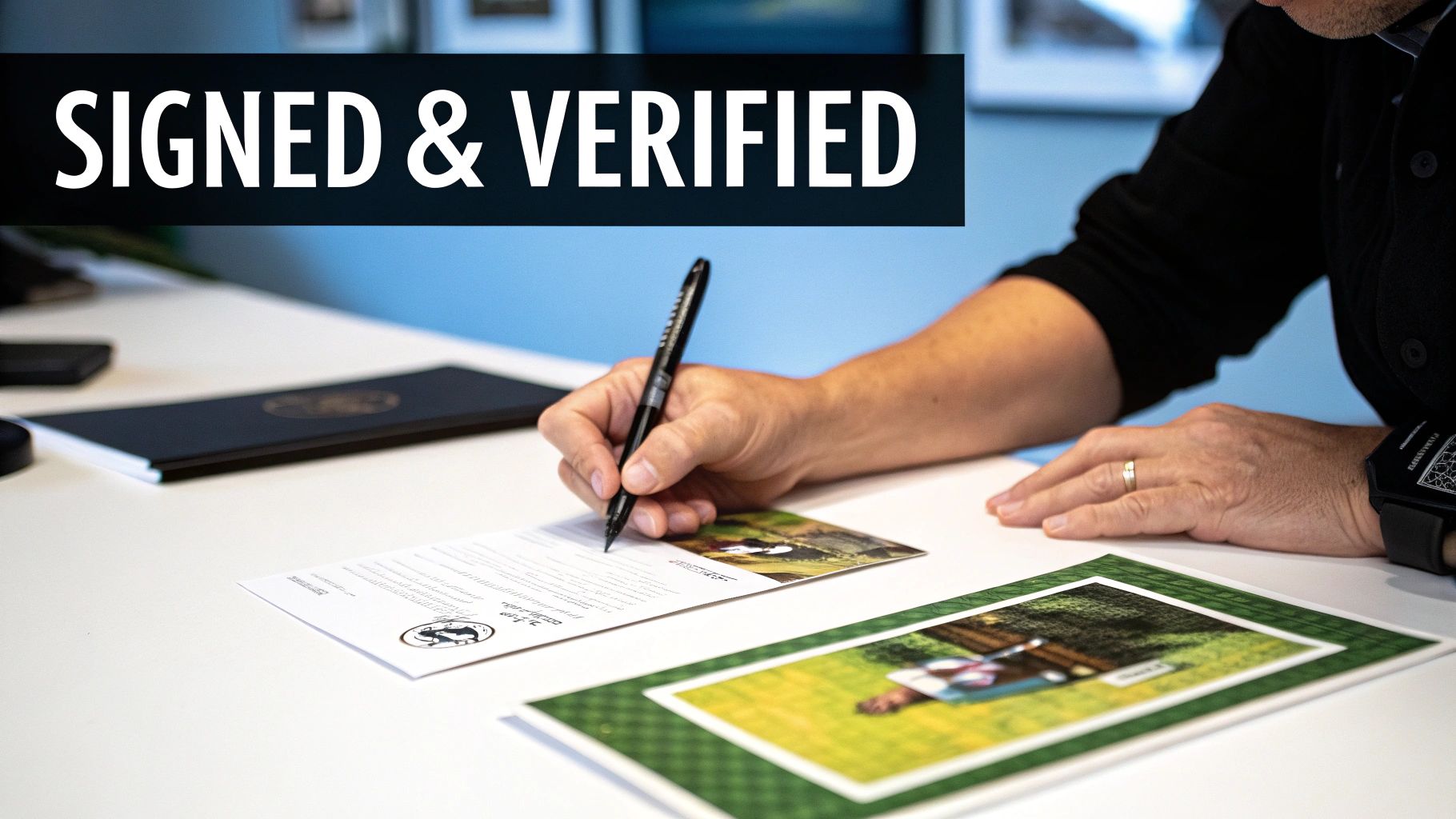
So, you’ve found a limited edition print that’s caught your eye. It looks incredible, the edition number seems right, and you’ve already picked out the perfect spot on your wall. But before you go all in, there are two small but crucial details that can make all the difference: the artist’s signature and a Certificate of Authenticity (COA).
These aren’t just formalities; they’re what separate a genuine collector’s item from just a nice picture.
Think of an artist's signature on a print like David Bowie scrawling his name across a vinyl sleeve. It’s that personal touch, that direct link to the creator, confirming they saw it, approved it, and gave it their blessing. It instantly elevates a piece of paper into something more – a tangible connection to the artist.
Without the signature, you have a brilliant design. With it, you have a piece of their story. A genuine, hand-signed signature adds a huge amount of credibility and value, making sure that slice of football history or musical genius is the real deal.
Your Print's Passport: The Certificate of Authenticity
If the signature is the personal endorsement, the Certificate of Authenticity (COA) is the print’s official passport. It’s the formal document that lays out its identity, its backstory, and its legitimacy in black and white. It’s your guarantee from the artist and publisher that what you're holding is exactly what they say it is.
A proper COA is much more than a fancy piece of card. It’s a vital part of the print's history—its provenance—and it should contain all the key details. This is the paperwork that backs up your investment and gives you complete peace of mind.
A flimsy, vague certificate isn't worth the paper it's printed on. A robust COA should be packed with specific, verifiable information.
What to Look For in a COA
When a COA comes with your print, give it a proper look. You don’t have to be an art detective, just a savvy buyer who knows what matters. A legitimate certificate is your assurance of both quality and authenticity.
Here’s what a solid COA should always include:
- The Print's Title: The official name of the artwork.
- Artist’s Name: Clearly stating who created the piece.
- Edition Number: Your specific print’s number and the total edition size (e.g., 25/100).
- Print and Paper Details: Information on the printing method (like Giclée) and the type of archival paper used.
- Date of Printing: When the edition was produced.
- Official Signature: Signed by the artist or an authorised representative from the publisher (like us at Striped Circle).
A Certificate of Authenticity is your signed promise from the creator. It confirms the print run is genuinely limited and that once they're gone, they are gone for good. It's the document that underpins the entire value of a limited edition print.
This level of detail is non-negotiable. It’s what separates a professional, collectible piece from something mass-produced. It ensures the story of your print is properly documented, protecting its value for years to come.
Whether it’s a tribute to your club’s glory days or a nod to a life-changing album, the signature and COA are the final seals of approval. They confirm your piece isn’t just cool—it’s a certified classic.
Understanding Print Paper and Ink Quality
Right, let's get into the nuts and bolts of what makes a print truly special. Choosing a print based on its materials is a bit like picking a guitar based on the wood it’s made from. It’s not just about looks; it defines the feel, the quality, and how long it’ll last.
The same goes for the paper and ink used for your limited edition print. They are the unsung heroes that turn a cool digital image into a piece of art that’ll still look brilliant long after your questionable fashion choices from the noughties have been forgotten.
You wouldn’t want a print of your team’s greatest victory to fade faster than their chances of winning the league next season, would you? That’s why we obsess over the quality of our materials. It’s the difference between a print that looks mint in ten years and one that looks like it’s been left out in the sun at a four-day festival.
Getting Geeky with Giclée
You’ll often see the term Giclée (pronounced 'zhee-clay', if you're wondering) thrown around when talking about high-quality prints. It sounds fancy, but it's basically the Premier League of printing. This isn't your standard desktop printer job; it’s a sophisticated process using specialist printers, pigment-based inks, and archival paper to create prints with incredible detail and colour accuracy.
Think of it this way: a normal poster is like listening to your favourite album on a tinny phone speaker. A Giclée print, on the other hand, is like hearing it on a perfectly balanced, top-of-the-range sound system. Every subtle detail is there, the colours are richer, and the whole experience is just on another level.
Giclée printing uses up to 12 individual pigment-based inks, a huge step up from the four used in standard printing. This wider range allows for smoother gradients and a much deeper, more accurate spectrum of colour, capturing every nuance of the original artwork.
This method is what ensures the razor-sharp detail needed to capture a footballer's look of sheer determination or the rich, moody colours of a classic album cover. The result is a print that doesn't just look good now but is built to last for generations without fading.
Paper: The Unsung Hero
The paper a print is on is every bit as important as the ink. You can have the best printing tech in the world, but if you put it on flimsy, cheap paper, it’s a total waste of time. For a limited edition print to be worthy of the name, it needs to be on high-grade, archival-quality paper.
Here’s a quick rundown of why it matters so much:
- Archival Quality: This means the paper is acid-free. Acid is the ultimate enemy of longevity, causing paper to yellow and become brittle over time. Archival paper is chemically stable, making sure your print stays pristine.
- Weight and Texture: Heavier paper (measured in GSM, or grams per square metre) gives a print a substantial, premium feel. Different textures, from smooth to lightly textured, can also add real character and depth to the artwork.
- Colour Reproduction: The right paper has a specific coating that allows the ink to sit on the surface perfectly. This results in vibrant, true-to-life colours that pop right off the page.
The demand for this level of quality is growing fast. The UK print-on-demand market, which is crucial for producing top-tier limited editions, was valued at around £4.9 billion and is projected to more than double to £12.4 billion by 2031. This just shows the massive appetite for quality, custom prints that truly stand out.
We take all this incredibly seriously. Getting the combination of ink and paper just right is a bit of an art form in itself. To see exactly what goes into our process, have a look at our deep dive into our commitment to print quality. It's why our prints look so good and are made to be enjoyed for years to come.
How to Buy and Care For Your Print
So, you’ve found it. The one. A limited edition print that perfectly captures that spine-tingling guitar riff or that 94th-minute winner. Before you hit ‘buy’ and start clearing a space on the wall, let’s run through a quick owner’s manual. Getting the print is the easy part; making sure it’s the real deal and keeping it in top-flight condition is where the real game is won.
Buying a limited edition print online is brilliant, but it pays to be a bit savvy. Think of yourself as a football scout checking out a new signing. You need to do your due diligence to make sure you’re getting a future star, not a player who’s past their prime.
Your Online Buying Checklist
When you're browsing online, the photos are your eyes. Look for high-resolution images that show the print from multiple angles, including close-ups of the signature and edition number. If the pictures are blurry or low-quality, it’s a definite red flag.
A reputable seller will be totally transparent. Check their reviews and see what other buyers are saying. Don’t be shy about asking questions before you commit; a good seller will be happy to provide extra photos or details about the print’s condition and history.
- Verify the Seller: Are they a known gallery, an established brand like Striped Circle, or a random seller with zero feedback? Trust your gut.
- Inspect the Details: Zoom in on the signature, edition number, and any textures. Does it match what you expect?
- Ask Questions: Enquire about its history (provenance), the condition of the paper, and how it’s been stored.
Keeping Your New Treasure in Mint Condition
Right, the postman has delivered your new pride and joy. Resist the urge to rip it open with greasy, post-crisp-binge fingers. How you handle your print from this moment on will determine whether it stays looking incredible for years to come.
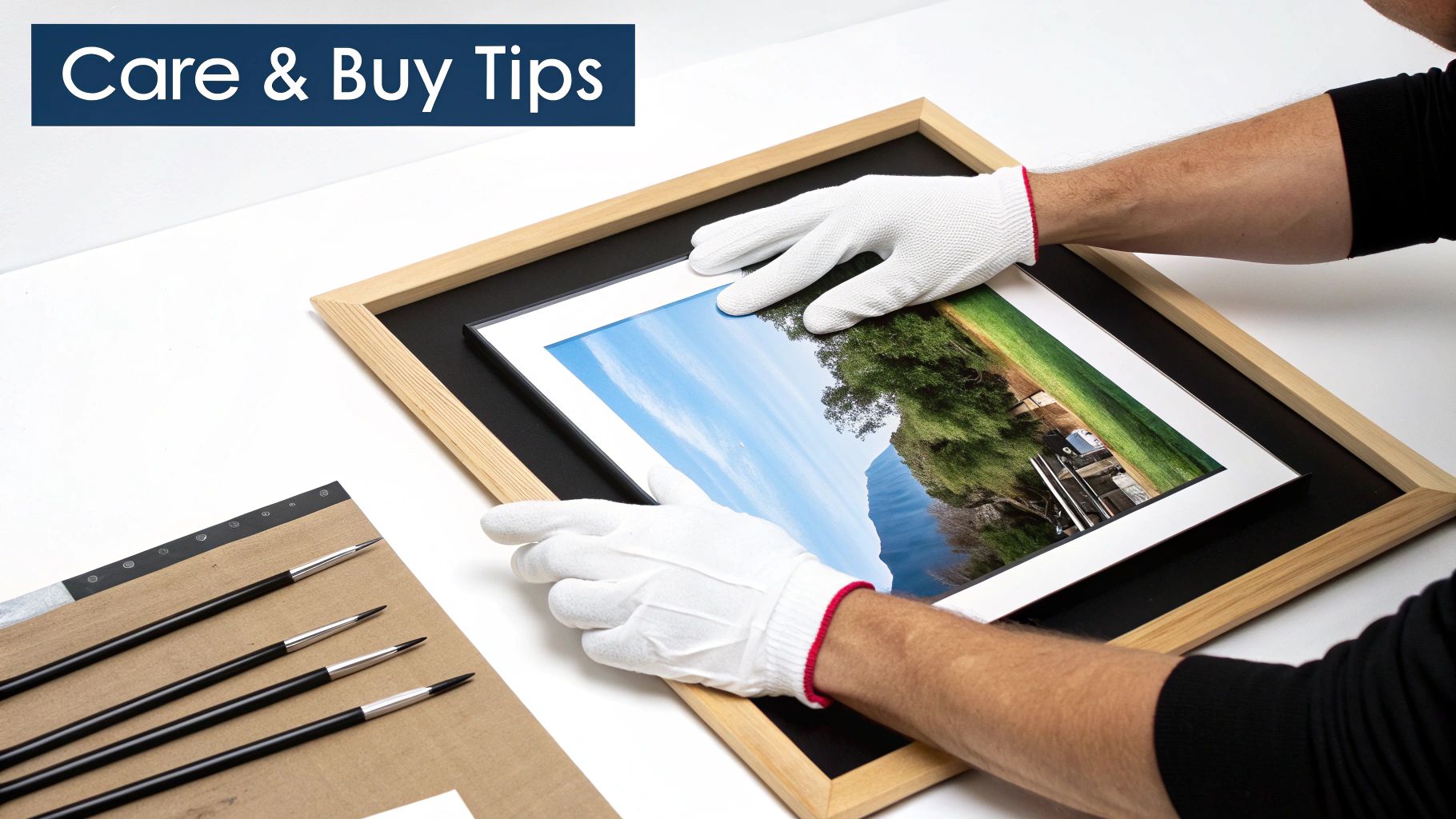
First rule of print club: handle it as little as possible. When you do, make sure your hands are clean and dry. It’s best to hold it by the edges to avoid leaving any marks on the artwork itself. Think of it like a rare vinyl record—you wouldn’t grab it right across the grooves, would you?
Next, keep it away from its natural enemies: direct sunlight and moisture. UV rays are the arch-nemesis of ink, causing colours to fade over time. And damp conditions can lead to mould or cause the paper to ripple, which is a look that suits no one.
Think of caring for your print like putting a star player on a long-term contract. A little investment now in proper handling and framing ensures it stays in peak condition, protecting its value and appearance for the future.
Framing Your Print The Right Way
Let’s be clear: framing isn’t just a fancy accessory. It’s your print’s best mate, its bodyguard, and its personal climate-controlled limo all in one. A good frame doesn’t just make your art look fantastic; it provides crucial protection from dust, damage, and those dreaded UV rays.
Choosing the right frame can feel overwhelming, but it boils down to a few key choices. You’ll want to consider the mount (the card border inside the frame), the frame material itself, and, most importantly, the glass.
For a true investment piece, UV-protective glass is non-negotiable. It acts like a permanent layer of factor 50 sun cream for your print, filtering out up to 99% of harmful ultraviolet light. It’s a small extra cost that makes a massive difference in preserving those vibrant colours. The UK custom printing industry, which includes limited edition prints, is a big deal, forming part of a wider printing market valued at around £23 billion. Within this, services for high-quality, on-demand printing were worth about £410 million, a figure expected to rocket to £1.9 billion by 2030, showing just how much people value quality.
If you’re ready to give your print the home it deserves, we’ve put together a full guide. For everything you need to know, check out our guide on how to frame posters and prints properly.
Common Questions About Limited Edition Prints
Right, you’ve made it this far, which means you’re probably just one decent frame away from having the coolest walls in your postcode. But even the most die-hard fans have a few last-minute questions before they commit. It’s completely normal.
Here are the most common queries we get from people diving into the world of a limited edition print. We’ll give you straight, no-nonsense answers to help you feel like you know exactly what you’re doing.
Is a Limited Edition Print a Good Investment?
Honestly? It can be, but that shouldn't be the only reason you buy one.
Think of it like a rare vintage football shirt. Some will skyrocket in value over the years, becoming genuine collector's items. Others will simply remain a treasured piece of your own personal history. The real, immediate value comes from how much you love looking at it on your wall every single day.
Of course, prints from famous artists have seen massive returns at auction. But for most of us, the primary value is the joy it brings. Our advice? Buy what you love. If it happens to be worth a small fortune one day, that’s just a glorious, unexpected bonus goal in extra time. The main investment is in making your walls look absolutely class.
What Is an Artist's Proof?
You might have spotted the letters 'AP' next to an edition number and wondered what that was all about. An Artist's Proof (AP) is part of a much smaller, separate batch of prints created alongside the main edition. Traditionally, these were for the artist to keep for their own collection or to give to collaborators. Think of them as the first copies hot off the press.
They are identical in quality to the main edition but are numbered separately (e.g., AP 1/10). Because there are so few of them, they're often seen as more exclusive and desirable by serious collectors. It’s like getting a copy of an album with a 'promo only' sticker on it—it just has that extra behind-the-scenes cool factor.
An Artist's Proof is the collector's equivalent of a backstage pass. It's the same great show, but with an added layer of exclusivity that says you're a true insider.
These proofs offer a unique story and are a fantastic find for anyone looking to own a particularly special piece of an artist's work.
How Do I Know if a Signature Is Real?
This is a big one, and rightly so. The simplest and safest way to guarantee authenticity is to buy from a reputable source. That means buying directly from the artist, a trusted gallery, or a brand like us that guarantees the legitimacy of every single piece we sell.
Your best friend in this process is a solid Certificate of Authenticity (COA), which we've already covered. This is your official paperwork—your proof of purchase and provenance all rolled into one. If you're ever tempted to buy second-hand from an online marketplace, you really need to do your homework.
- Compare the signature: Look for other known, verified examples online and study them closely.
- Check the source: Does the seller have a history of dealing in legitimate art? Read their reviews.
- Trust your gut: If a deal on a signed print from a big name seems way too good to be true, it almost certainly is.
At the end of the day, sticking with trusted sellers is the only way to avoid the crushing disappointment of ending up with a clever fake.
Is Print Number 1 Better Than Number 100?
In theory, absolutely not. Every single print in a properly produced limited edition run should be of the exact same high quality. The artist and printer work incredibly hard to ensure consistency from the first print right through to the last.
However, human psychology is a funny thing. Some collectors have a real thing for low numbers, especially the coveted number 1. It’s more of a personal preference than a genuine measure of quality or value. It's a bit like a striker wanting the number 9 shirt instead of number 29 – both can score goals, but one just feels more iconic.
Unless you're a hardcore collector chasing specific numbers, any number from a small, exclusive edition is a fantastic piece to own. Don't get too hung up on it—the art itself is what truly matters.
Ready to find a piece that speaks to your inner music guru or football fanatic? At Striped Circle, we live and breathe this stuff. Explore our collection of unique, high-quality limited edition prints and find the perfect artwork to make your walls smile.
