
How to Create a Wall With Art That’s Actually Cool
That blank wall is more than just empty space; it’s a missed opportunity. Think of it as a silent protest against boring décor, a beige flag of surrender. This guide is your intervention, your call to arms against blandness, because a great wall with art tells a story, sparks conversation, and reminds you daily of what makes you tick.
Your Walls Are Crying Out for Help
Let’s be honest, that massive, empty wall in your living room isn't fooling anyone with its "minimalist" vibe. It's just bored. It's seen better days, and it's practically begging for a bit of personality. We’re talking about turning that neglected canvas into the focal point of your home, creating a visual mixtape of your life that celebrates the bands that defined your youth and the football moments that still give you goosebumps.
A fresh coat of paint can dramatically transform your space, setting the perfect stage for your art. If your walls are truly crying out for a refresh, you might want to consider learning how to paint interior walls before you start hanging anything.
Ditching the Dull for the Daring
It’s time to trade soulless, generic stock art for something with a bit of heart and swagger. Think about it: anyone can buy a mass-produced print of a Parisian street from a big-box store. But a print that quotes your favourite Smiths lyric or immortalises that ninety-fifth-minute winner? That’s personal. That’s a conversation starter.
This isn’t just about covering up paint; it's about curating a collection that is unapologetically you. And you're not alone in this thinking. The UK wall art market is booming, with revenue hitting approximately USD 3,597.2 million in 2022 and projected to climb to over USD 5,500 million by 2030. This surge is partly thanks to a growing love for personalised prints celebrating music and sports.
Your home should tell the story of who you are and be a collection of what you love. It's about surrounding yourself with things that make you smile, whether that's a tribute to Oasis or a nod to your club's glory days.
So, let's get started. We're on a mission to rescue your walls from mediocrity, one brilliant print at a time. This is where you inject your personality, your passions, and your questionable music taste directly onto your walls for all to see.
Finding Your Theme: Music, Football, or Both?
Right, this is where the real fun begins. Deciding on a theme for your gallery wall is a bit like creating the ultimate festival line-up for your living room. Who are your headliners? Are you a strictly Stone Roses and Oasis household, or is there room on the bill for your club’s crest? This is where you get to map out your passions and decide what story your wall is going to tell.
Think about the albums you know backwards and the matches you’ll never forget. We’re not aiming for a sterile, soulless gallery here; this is about building a shrine to the things that give you goosebumps. The goal is to curate a collection that’s unapologetically you—not something that looks like a teenager’s bedroom poster collection (unless that's the vibe you're after, no judgement here).
Madchester Tributes and Glory Years
So, what's your story? You could go all-in on a single theme. Imagine a 'Madchester' tribute wall, packed with swagger and iconic lyrics. Or perhaps you'd prefer a visual history of your team's glory years, with each print representing a trophy lift or a legendary goal.
- Music-Centric: You could focus on a specific era (think Britpop or punk), a legendary artist, or even a record label. A wall dedicated to Factory Records, for example, could be visually stunning.
- Football-Focused: Chronicle a specific season, celebrate your club legends, or simply showcase the beauty of your home ground through different artistic interpretations.
- The Eclectic Mix: This is for those of us who refuse to choose between our loves. And why should you?
The Art of the Mashup
"But can I really hang a lyric from 'Live Forever' next to a print of a last-minute winner?" Absolutely. The idea that your passions have to live in separate rooms is nonsense. In fact, mixing music and football often creates the most dynamic and personal gallery walls. The key is simply finding a common thread to tie it all together.
The best walls tell a story that is uniquely personal. Don't be afraid to mix your heroes. A wall that features both Ian Brown and Eric Cantona is a wall that understands the soul of Manchester.
That common thread could be anything. Maybe it’s a shared colour palette that runs through each print. Perhaps you stick to a consistent style, like minimalist lyric prints for both your favourite songs and iconic post-match quotes. Or maybe the connection is simply the raw, unfiltered energy they both represent.
For a deeper dive into curating your sound-inspired space, our guide on choosing the perfect music artwork prints has loads of ideas to get you started. Ultimately, this is your gaff, your rules.
Mastering the Art of the Hang
Right then, you've curated your prints, and they're leaning against the sofa, looking brilliant. Now for the tricky bit: getting them on the wall without it looking like you've had a fight with a hammer and lost. This is where a little planning saves a lot of Polyfilla.
First things first, don't even think about picking up a drill yet. The most important step happens on your floor. Lay all your prints out and shuffle them around like you’re trying to solve a puzzle. This is your chance to see how your Liam Gallagher sneer lines up with that print of Old Trafford. It’s a true relationship-saver, trust me.
Getting the layout right on the floor first lets you experiment without consequence. Swap that small lyric print with the larger album art. See how the colours flow. Once you're happy, take a quick photo on your phone so you don't forget the masterpiece you've just created.
Choosing Your Formation
Just like your favourite gaffer picks a formation before a big match, you need to choose a layout style. Are you a rigid 4-4-2 grid, or more of a chaotic, all-out-attack salon hang? There's no right answer, only what works for your space and your collection.
Choosing a layout can feel daunting, but it's really about matching the style to your prints and the vibe you're aiming for. This table breaks down the most common approaches to help you decide.
Choosing Your Gallery Wall Layout
| Layout Style | Best For | Top Tip |
|---|---|---|
| The Grid | Prints of the same size and orientation for a clean, modern look. Think of it as the well-drilled defence of gallery walls—solid and reliable. | Use a spirit level and measuring tape religiously. The precision is what makes this layout so satisfying. |
| The Salon Hang | An eclectic mix of different sizes, frames, and orientations. Perfect for a growing collection with a more free-spirited, rock 'n' roll vibe. | Start with your largest "hero" piece in the centre and build outwards. This creates a focal point and keeps the chaos under control. |
| The Vertical Stack | A single column of prints, ideal for narrow walls or awkward spaces like the gap between two windows. | Great for telling a linear story, like displaying a triptych or a series of related prints in chronological order. |
| The Ledge | For those who love to switch things up. Picture ledges allow you to layer frames and change your display without creating new holes. | Overlap your frames! It adds depth and a casual, curated feel. Mix in a small plant or object for extra personality. |
Ultimately, the best layout is the one that feels right to you. Don't be afraid to mix and match elements to create something uniquely yours.
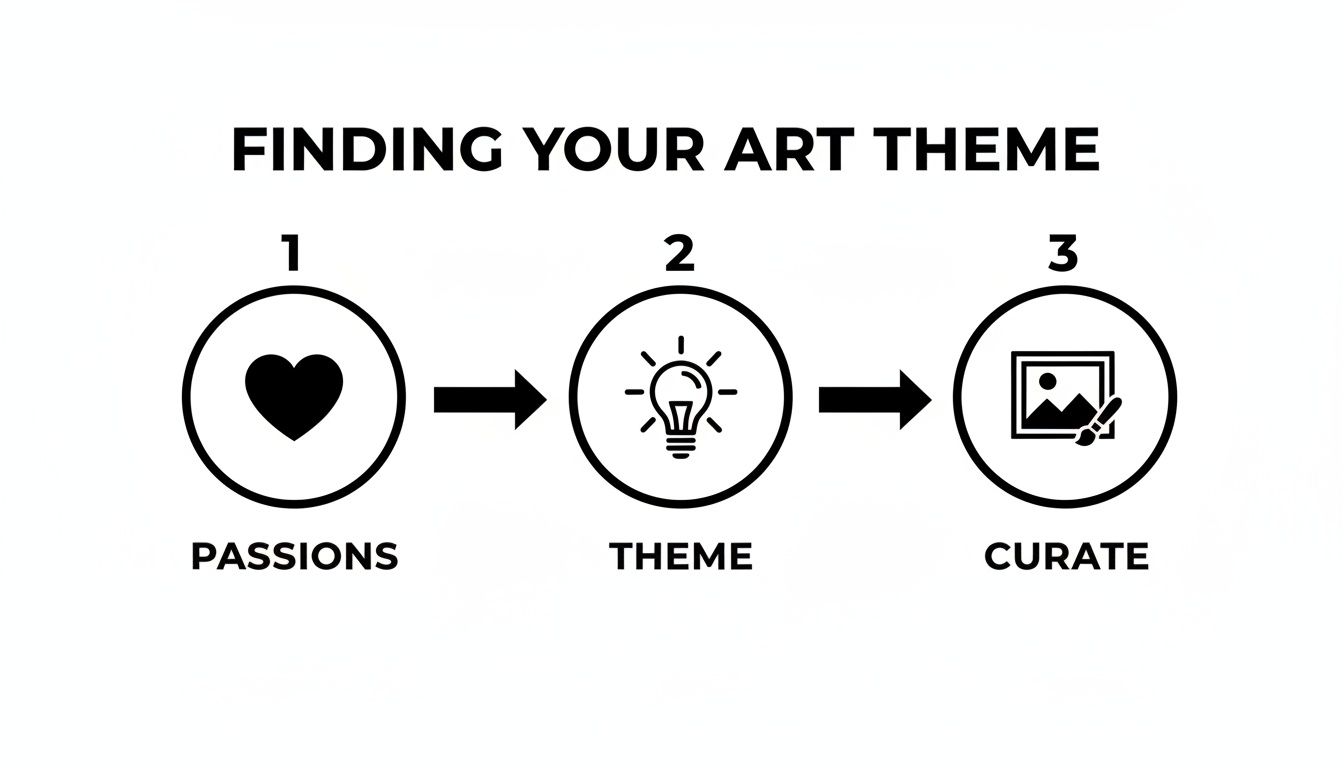
Seeing your passions flow into a theme and then into a curated collection shows how a great wall with art is a natural extension of who you are.
The Nitty-Gritty: Spacing and Height
Now for the details that separate a pro-looking wall from an amateur effort. Spacing is crucial. Aim for a consistent gap between each frame, usually around 5-10 cm (2-4 inches). This consistency is what makes a collection of different prints look cohesive, rather than like a random jumble.
Next up is height, the single biggest mistake people make. Don’t hang your art so high that people need to crane their necks. The golden rule is to hang your art so the centre of the main piece (or the centre of the whole arrangement) is at eye level. This is roughly 145-152 cm (57-60 inches) from the floor. This connects the art to the room and its furniture, making it feel deliberate.
For a deeper dive into arranging your collection, check out our full guide on how to arrange wall art.
The goal is to make it look intentional. Consistent spacing and correct height are the secret ingredients that turn a bunch of pictures into a proper gallery wall. It’s the difference between looking like a cool pub wall and a student digs noticeboard.
If all this sounds like a bit too much faff, there's no shame in calling in the experts. For those who prefer a flawless, gallery-worthy finish, considering professional picture hanging services can elevate your home decor with precision and expertise. They’ll get it spot on, every time.
Frames, Lighting, and Finishing Touches
Right, you’ve mapped out your masterpieces and you're ready to get them up on the wall. But hang on a second. A print without the right frame is like a striker without decent boots – it just won’t perform at its best. The frame is the essential backbone, the unsung hero that turns a great print into a knockout piece for your wall with art.
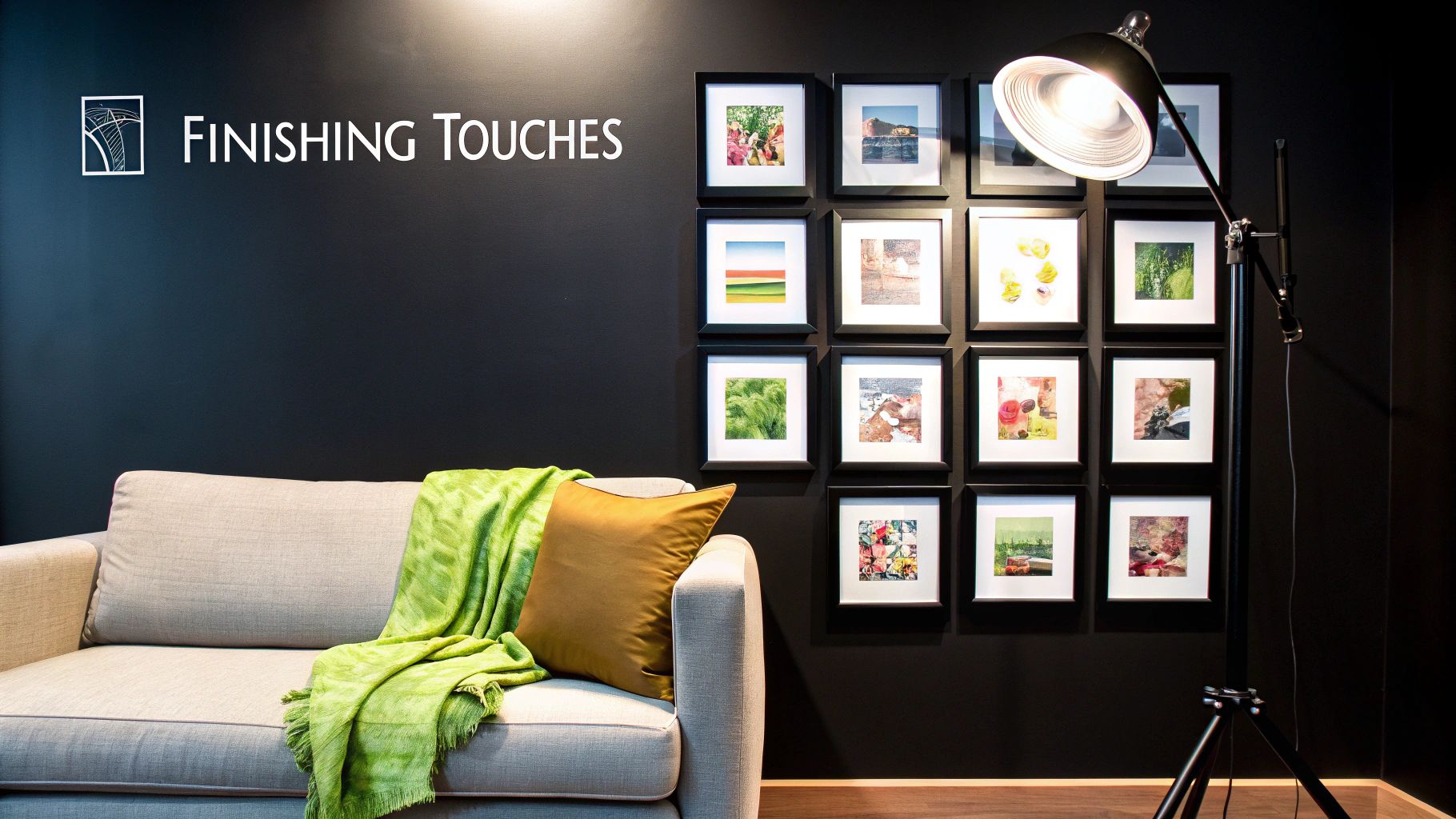
This is the stage where you elevate your collection from just 'stuff on a wall' to a curated exhibit. Think of it as the final mix on a classic album; these details are what make everything come together perfectly.
Frame and Fortune
Choosing a frame is about so much more than just finding something that fits. It’s a deliberate style choice that can completely change the vibe of your art. You’ve got a few solid options, so let's break them down.
-
Minimalist Black or White: These are the reliable workhorses of the framing world. A slim black frame is brilliant for making bold colours and graphics pop, giving your print a sharp, modern edge. White frames, on the other hand, offer a clean, airy feel that’s perfect for lighter prints or when you’re aiming for a more relaxed look.
-
Natural Wood: For a more laid-back, almost acoustic feel, you really can't beat a natural wood frame. Oak, pine, or walnut add a welcome warmth and texture, which is a fantastic way to complement prints with earthy tones or a bit of a vintage feel.
-
The Mount Decision: A mount (that white border between the print and the frame) gives your art crucial breathing room. It creates a professional, gallery-like finish and helps draw the eye inward. A good rule of thumb I always follow is to use a mount for more detailed or 'busier' prints to stop them from feeling crowded by the frame.
For a deeper dive on getting this spot on, our complete guide on how to frame posters is your next port of call.
Let There Be Light
Never underestimate the power of good lighting. It's your secret weapon. You could have the best print collection in the world, but if it's lurking in a dark corner, nobody’s going to fully appreciate it. And you don’t need a fancy gallery lighting system, either.
A simple, well-aimed picture light can completely transform your display. Modern, battery-powered LED options are dead easy to install and won't require calling in an electrician. Even something as simple as strategically placing a floor lamp to cast a warm glow across your gallery wall in the evening can make a world of difference, adding a bit of drama and focus.
Think of lighting as the stage crew for your art. It works behind the scenes to make sure your headliners look their absolute best when the lights go down.
Tying It All Together
The final flourish is to connect your newly curated wall to the rest of the room. This is what makes your display feel like it truly belongs, rather than just being an afterthought. The trick is to pick out one or two key colours from your prints and echo them in the room's decor.
Got a print with a splash of your team’s home colours? Find a couple of cushions to match. Is there a subtle grey or blue in that album art print? A rug or a throw in a similar shade will tie it all together beautifully. You could even go full superfan and drape a vintage football scarf over a nearby chair. It’s these small, thoughtful details that create a cohesive, stylish space that’s just buzzing with personality.
How to Gift Art and Grow Your Collection
Giving a truly brilliant gift is an art form in itself. Let’s be honest, nobody really needs another novelty mug or a pair of socks. A well-chosen print, however, is a top-tier move. It shows you’ve paid attention and put some real thought into it, which is miles better than a last-minute panic buy.
This is your chance to be the ultimate gift-giving hero. Think about your mate who’s just moved into a new place. Instead of another bottle of plonk, imagine giving them a print of a lyric from the first gig you ever went to together. Or for your dad, a minimalist design of his beloved club's stadium, a place where you've shared countless ups and downs. It’s personal, meaningful, and guaranteed to make them smile.
The Art of Thoughtful Gifting
Picking the perfect piece for someone is all about tuning into their world. It’s a fantastic way to celebrate an inside joke or a shared passion that runs deep.
- For the Music Lover: What’s that one album they’ve had on repeat for a decade? A subtle lyric print from their favourite song is a guaranteed winner.
- For the Football Fanatic: Think beyond the usual club shop gear. An artistic representation of a legendary goal or a tribute to a club icon shows you really get it.
- For the Big Milestones: A new home, a big birthday, or just because. A print can immortalise a memory, making it a permanent fixture in their life.
This personal touch is exactly why online marketplaces are thriving. While traditional shops have their place, e-commerce has opened up a world of customised, artist-direct prints perfect for music and football themes. Market analysis reveals that while offline stores historically led sales, online platforms have massively increased their share by offering this kind of bespoke art. You can find more details on the evolving wall art market and its trends.
Building Your Own Legacy Wall
Just as you'd gift a print to mark a moment for a friend, you should do the same for yourself. A truly great wall with art isn't created overnight. It’s a slow burn, an evolving masterpiece that grows right alongside you. Think of your collection as a visual timeline of your life, with each new piece acting as a chapter marker.
Don't rush to fill the space. A collection built over time tells a far more interesting story than one bought in a single afternoon. Each piece should have a reason for being there.
Every print you add can represent something significant. That first festival after lockdown, the season your team finally won the league, or the song that got you through a tough time. Over the years, your wall becomes more than just decoration; it becomes a personal, visual diary of your passions, your history, and the moments that made you. It’s your story, told one frame at a time.
Got Questions About Your Art Wall? We’ve Got Answers.
Right, you’ve got the vision, you’ve picked out your prints, and you’re absolutely buzzing to get started. But then, a familiar feeling creeps in. The fear of commitment. The fear of turning your pristine plasterboard into something that looks like a block of Swiss cheese. Don’t worry, we’ve all been there.
Before you start swinging a hammer with the wild abandon of a drummer during a finale, let's run through a few common questions. Think of this as your final pep talk before you create a wall with art that’ll be the envy of all your mates.
How Can I Hang Art Without Wrecking My Walls?
This is a big one for renters, the commitment-averse, and anyone who’s ever had a disastrous run-in with Polyfilla. Your new best friend is the adhesive picture-hanging strip. Brands like Command are brilliant for lighter frames, but always double-check the weight limit before entrusting them with your prized Joy Division print.
Another top-tier option is the picture ledge. You only need to install a single shelf—which means minimal drilling—and then you’re free to lean, layer, and rearrange your art to your heart’s content. It’s the ultimate in creative freedom, letting you switch up the display whenever you fancy a change without making more holes.
Is It Okay to Mix Different Frame Styles and Colours?
Yes, absolutely! In fact, you probably should. A wall filled with identical frames can sometimes look a bit too uniform, maybe even a bit corporate. Mixing things up is what gives a gallery wall personality and creates a far more interesting, eclectic vibe.
The trick is to have a single unifying element that pulls it all together. Think of it like a great concept album—all the tracks are different, but they all serve the same story.
For example, you could mix black, white, and natural wood frames, but have all the prints inside feature the same band. Or perhaps the frames are a complete jumble of styles, but the artwork itself shares a similar colour palette. As long as there’s some kind of visual thread running through the display, your wall will look intentionally cool, not like a chaotic mess.
What’s the Biggest Mistake People Make?
Without a doubt, the single biggest rookie error is hanging the art too high. It’s a classic mistake, and it makes the entire room feel off-balance and disconnected. For some reason, people have this weird instinct to hang pictures way up near the ceiling, as if they’re trying to impress a giraffe.
Here’s the golden rule: hang your art so the centre of the main piece (or the middle of the whole arrangement) sits at eye level. For most people, that’s somewhere around 145-152 cm (57-60 inches) from the floor. Nailing this one detail will instantly make your display feel more professional and properly anchored to the rest of the room.
Ready to turn that blank space into a masterpiece? Head over to Striped Circle and explore our massive collection of music and football prints. Find the pieces that tell your story.
