
Bob Marley Poster Guide: Styles, Sizes and Hanging
The usual advice on buying a Bob Marley poster goes like this: get the biggest red, gold and green sunset silhouette you can find and sling it above the sofa. It is wrong often enough that you should treat it as a warning, and it fails in the way that leaves a front room looking like a student bar that has given up.
A poster is a specification decision: the design, the wall and the light. What the print shows, how many millimetres of wall it has to fill, and how much daylight lands on it between March and September. Get those three right and a modest print outclasses an expensive mistake every time. Get them wrong and you have paid real money to watch Bob's face bleach to a pale pink over two summers.
The silliest part is that nobody measures. People measure for a sofa, a fridge, a telly. Then they eyeball a picture hook, drill, and discover six months later that the print floats somewhere near the ceiling like it is trying to escape the room. I have made that hole. The fix is boring and it works: decide the style and the size first, then shop.
Table of Contents
- Pick Your Bob Marley Poster Style and Size
- Why a Marley Print Still Works on a British Wall
- Official, Licensed or Inspired By
- How to Buy and Hang a Bob Marley Poster
- Keep the Colours From Fading
- Build the Wall Around the Poster
- Make the Decision and Get It on the Wall
Pick Your Bob Marley Poster Style and Size
Six directions cover almost everything on the market, and each one has a room where it earns its place. Scan this before you read a single product page.
| Design direction | Best room | Suggested size | Frame choice |
|---|---|---|---|
| Black-and-white photographic portrait | Hallway, study, dark-painted wall | A3 or A2 | Thin black wood or bare oak |
| Rastafari red-gold-green graphic | Kitchen, teenage room, garden office | A3 or A2 | Black frame, no mount |
| Vintage concert-poster treatment | Living room with vinyl and gig tickets | A2 or A1 | Wide natural wood with mount |
| Lyric or typography-led print | Rented flat, shared space, office desk wall | A4 or A3 | Slim black or unframed clip hanger |
| Burgundy or warm-neutral colour study | Bedroom, lounge with warm neutrals | A2 or A3 | Oak or walnut |
| Album-art homage | Music room or studio corner | A3 | Black frame in a gallery cluster |
Six directions, one decision each
A black-and-white portrait is the one that survives every repaint. It doesn't argue with a dark wall, it doesn't clash with a coloured sofa, and it reads as a photograph rather than merchandise. Put it in the hallway where nobody sits down to stare at it, because portraits reward a passing glance more than a long hard look.
The red-gold-green graphic is the loudest option and the one shoppers often default to. It's brilliant in a kitchen or a teenager's room, where energy beats subtlety. In a beige lounge it can look like a flag someone left behind. If your heart is set on it, pick one colour as the dominant field and let the other two appear as accents, or the print will shout over everything else in the room.
A vintage concert-poster treatment earns a living room that already has vinyl out and gig tickets in a drawer. And a lyric or typography print is the renter's friend, because it hangs from a clip, weighs nothing and doesn't need a drill.
For bedrooms, a burgundy or warm-neutral colour study does more work than any reggae cliché. Burgundy is the fastest-rising colour in UK wall art, up 116% year on year, according to Desenio's UK wall-art index, whose analysis draws on more than 180 search terms across 12 British regions. An album-art homage finishes the set in a music room, where it belongs next to the turntable and not in the hall.
Size follows the wall, not the other way round
Aim for a print that fills roughly 50 to 66 per cent of the furniture underneath it. A narrow sideboard takes A3. A two-metre sofa wants A2 or A1. A whole empty wall, or a room with high ceilings, takes A0 without looking shouty.
Tape newspaper sheets to the wall at your chosen size before you spend a penny. Stand at the door, sit on the sofa, and check the frame doesn't crowd a light switch or a door frame. If the frame's top edge lands within a hand's width of the ceiling, drop a size, because a print jammed against the cornice looks like it's trying to escape. Our UK poster sizes guide converts the letters into millimetres so you don't buy twice.
Glazing matters at this stage too. Bigger sheets of glass reflect more, so anything A2 or larger facing a window deserves a spot on the perpendicular wall, or you'll spend every evening looking at your own telly in it.
If you're going further and painting a colour-field backdrop or a canvas to sit alongside the print, foundational skills for new painters covers the basics without assuming you've been to art school.
Retailers building a display face the same style decision at volume, and the lyric-led route travels well beyond Marley. The Wake Me Up Before You Go-Go print (Wholesale) is a typography design in the same bracket as the lyric row above, and it shows how a single strong song-title layout can anchor a gifting range beside the reggae titles.
Write the style row and the size on your phone before you open a single product page.
Why a Marley Print Still Works on a British Wall
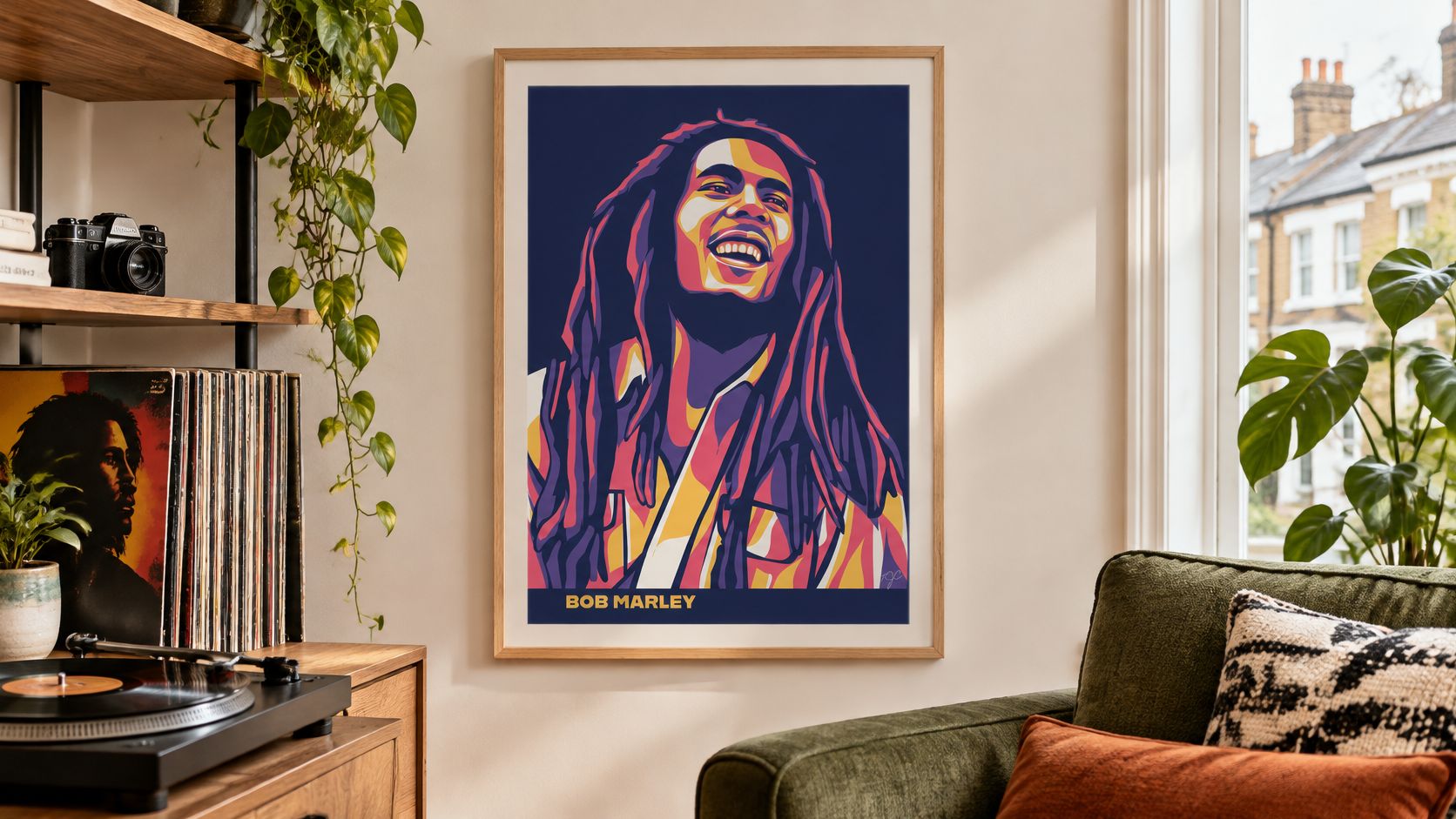
Strip the nostalgia out and the numbers are still absurd.
Bob Marley & The Wailers have 1 UK No. 1 album, 7 UK Top 10 albums and 13 UK Top 40 albums, and those albums have spent 466 weeks in the UK Top 40 and 1,173 weeks in the UK Top 75, as Official Charts records. That isn't a phase anyone grew out of. It's a catalogue bolted into the national furniture.
The early singles were just as stubborn. Official Charts' Bob Marley artist page has "No Woman, No Cry" reaching number 22 in September 1975 with 9 weeks on the chart, then "Exodus" peaking at number 14 in June 1977, also 9 weeks. Four decades on, the catalogue kept returning. Forbes' report on his 2024 chart entries put Legend back at number 94 on the UK Official Physical Albums chart and number 100 on the Official Albums Sales chart in November 2024, having already passed 500 weeks on the latter.
The British chapter is the real story
Britain didn't just import him. The BBC's profile notes he recorded some of his most successful albums here and that a celebrated show at London's Lyceum Theatre helped propel him towards global fame, while his influence ran through British politics, culture and identity during a period of serious social unrest.
That history is why the print carries weight. The Black Cultural Archives' 2024 One Love exhibition explored his lasting impact on the UK and London using archival material documenting his 1970s London presence, alongside film stills and artist responses.
A framed portrait here is a conversation about London, migration and solidarity. It's not celebrity wallpaper.
That's the argument for spending on the good version. Our Bob Marley print - Legends Collection is available unframed in A5 through to A0, which means the same design can sit on a desk or hold a whole wall.
Buy the design you'll still like in five years. Trend cycles are shorter than Bob's chart run, and that's saying something.
Official, Licensed or Inspired By
Three completely different things sell under one search term, and the product page rarely tells you which you've landed on. Here's the short version.
| Category | What it is | Buyer checks | Value note |
|---|---|---|---|
| Original or vintage poster | Documented artefact such as a 1980 Bob Marley and the Wailers concert poster from Brighton, where venue, date and provenance drive value | Named photographer or estate, provenance, a rights file covering image, territory, print quantity and licence term | Usually highest and condition-sensitive |
| Authorised reproduction | Printed under licence from a photographer or estate | Credit line naming photographer or estate, "licensed by" wording, UK sales channels, print quantity and licence term | Mid; predictable quality and legitimate cultural value |
| Inspired-by artwork | New design that references Marley but isn't a licensed likeness | "Inspired by" wording, no official-release claim, original artwork ownership | Lower to mid; often the best-looking legitimate home-wall choice |
Four checks you can run in under a minute
First, look for a name. A licensed print credits the photographer or the estate. An uncredited celebrity image is a print, not an artefact.
Second, find the rights statement. UK guidance classifies photographs, illustrations, music and written works as copyright-protected categories, and copying generally needs permission from the current rights holder, with licences often limited by purpose, territory and duration, per The National Archives' copyright guidance. A seller should be able to say who created the image and what the licence covers.
Third, read the wording. "Inspired by" is honest. "Official" needs evidence behind it.
Fourth, don't assume a purchase travels. Owning a record sleeve or a physical photograph doesn't transfer reproduction rights, so buying a copy never gives you the right to reprint it.
This isn't hypothetical in the UK. The V&A's collection record treats Dennis Morris's 1975 Lyceum photograph as a specific photographic work requiring licensing for commercial use, and the museum also holds a 1980 Brighton concert poster for Bob Marley and the Wailers, where venue, date and provenance are the value.
None of that makes an original design a bad buy. A newly drawn, unlicensed artwork you own outright is a perfectly legitimate choice for a home wall, provided nobody is claiming it's something else.
How to Buy and Hang a Bob Marley Poster
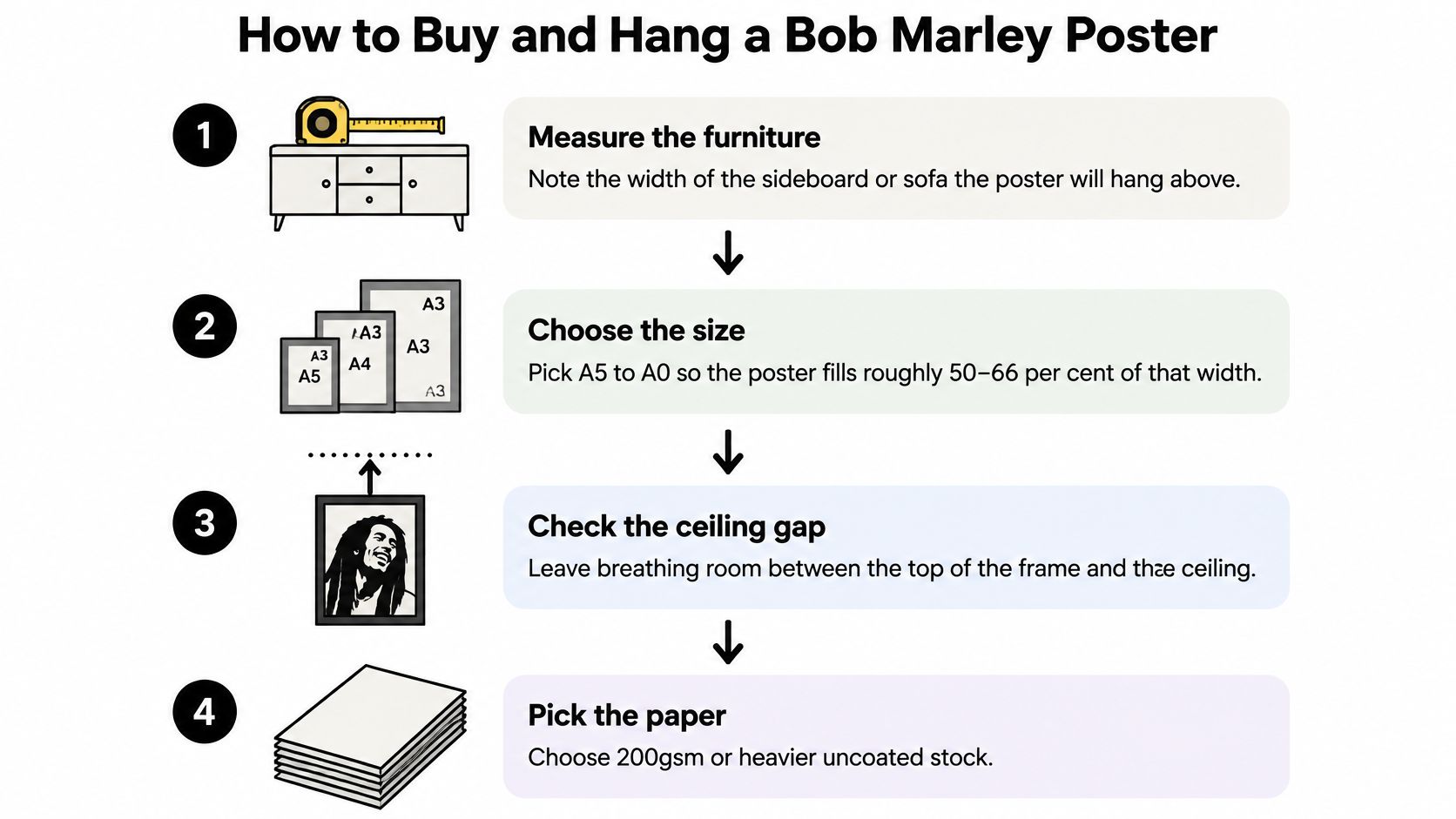
Here's the afternoon in order. Ninety minutes, one tape measure, one drill, no arguments.
The seven-step afternoon
- Measure the furniture, not the wall. Note the width of the sideboard, sofa or bed. Your print should cover 50 to 66 per cent of it. A 1600mm sideboard takes an A2 comfortably; a metre-wide console wants A3.
- Choose the paper weight. Go for 200gsm or heavier uncoated stock for a matte look that doesn't throw glare. For a photographic portrait, a satin or giclée finish gives deeper blacks. Ask whether the paper is archival or dye-based, because it decides how long the reds stay red.
- Decide framed or unframed. A4 and A3 suit magnetic hangers and rented walls where you'd rather not drill. From A2 upward, a proper frame looks finished and arrives ready to hang. We sell framed prints as well as unframed, which saves a second shopping trip.
- Order a 50 to 80mm mount and UV-filtering glazing if the wall sees daylight. The mount keeps the print off the glass, and the glazing does the fading work.
- Hang with the centre at 1450 to 1550mm from the floor, which is roughly eye level for most adults. Use two hooks, not one, so the frame doesn't tilt. Run a cable detector across the drill line first.
- Add the cluster afterwards. Get the anchor print up, live with it for a day, then build outwards with 60 to 80mm gaps.
- Run the spec check before you bin the packaging.
The two-minute check: size run goes down to A5, paper is 200gsm or heavier, the mount is 50 to 80mm, the glazing filters UV, and the frame weighs less than the fixings are rated for.
Three mistakes that cost you a reprint
Hanging too high. The single most common error, usually because someone eyeballs it standing up and steps back too late. Centre at 1450 to 1550mm and stop.
Hanging above a radiator. Rising heat dries the paper and warps the frame, and the wall above a radiator is the worst place in the room for anything you care about.
Putting a heavy A1 in a lightweight clip frame. The clips bow, the print sags, and one warm week leaves it wavy. If you want a clip hanger, keep it A3 and below.
If frames are the part you keep getting wrong, our guide to framing posters properly walks through mount widths and glazing without the gallery markup. A customer said the posters are great quality and delivery was fast, which is the only review that matters once the drill comes out.
Keep the Colours From Fading
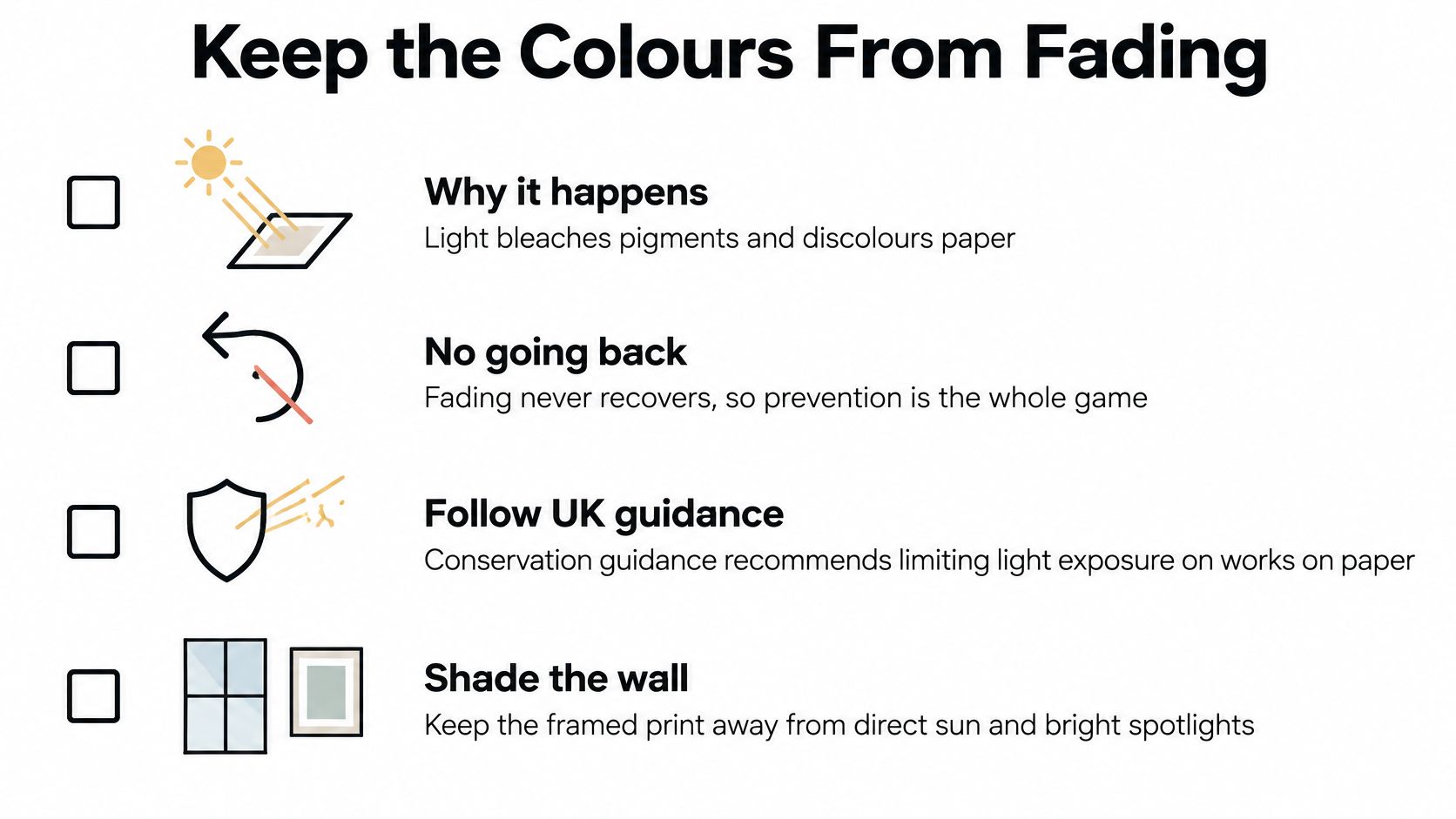
Light bleaches pigments and discolours paper, and you do not get that colour back. Treat prevention as a hanging decision, not a cleaning job. Get the spot, glazing and daily light right and the print does the rest.
The numbers are tight. Museums Galleries Scotland's guidance on caring for paper collections advises a maximum of 50 lux during display and an annual exposure target of no more than 100,000 lux-hours. Ordinary rooms are not galleries, but a bright wall can still do serious damage over time. Put the Marley where the light is controlled, and the reds, yellows and greens have a much better chance of staying sharp.
Reggae graphics punish bad placement. Saturated colour shifts, and once the red dulls, the whole print starts to look like a cheap copy. Sun does that. The printer gets the blame, usually after the frame is already on the wall.
The room check
Walk the wall at three points in the day, morning, early afternoon and around six. If sunlight crosses the frame at any of those, move the piece or shade it.
- Swap the spotlight for a dimmable warm-white LED, and don't aim it at the print.
- Fit UV-filtering glazing or acrylic where morning sun is unavoidable.
- Dust with a dry microfibre cloth, and never spray glass cleaner near an unframed print.
- Watch the south-facing hallway wall, which is the fastest way to lose the green entirely.
Fix it in order of cost. Rehang first, then re-glaze, then reframe. Fading often looks like a paper problem, but placement and daily light are usually doing the damage. If prints are going straight into frames, check what archival paper actually means before you spend more money on glazing.
Build the Wall Around the Poster
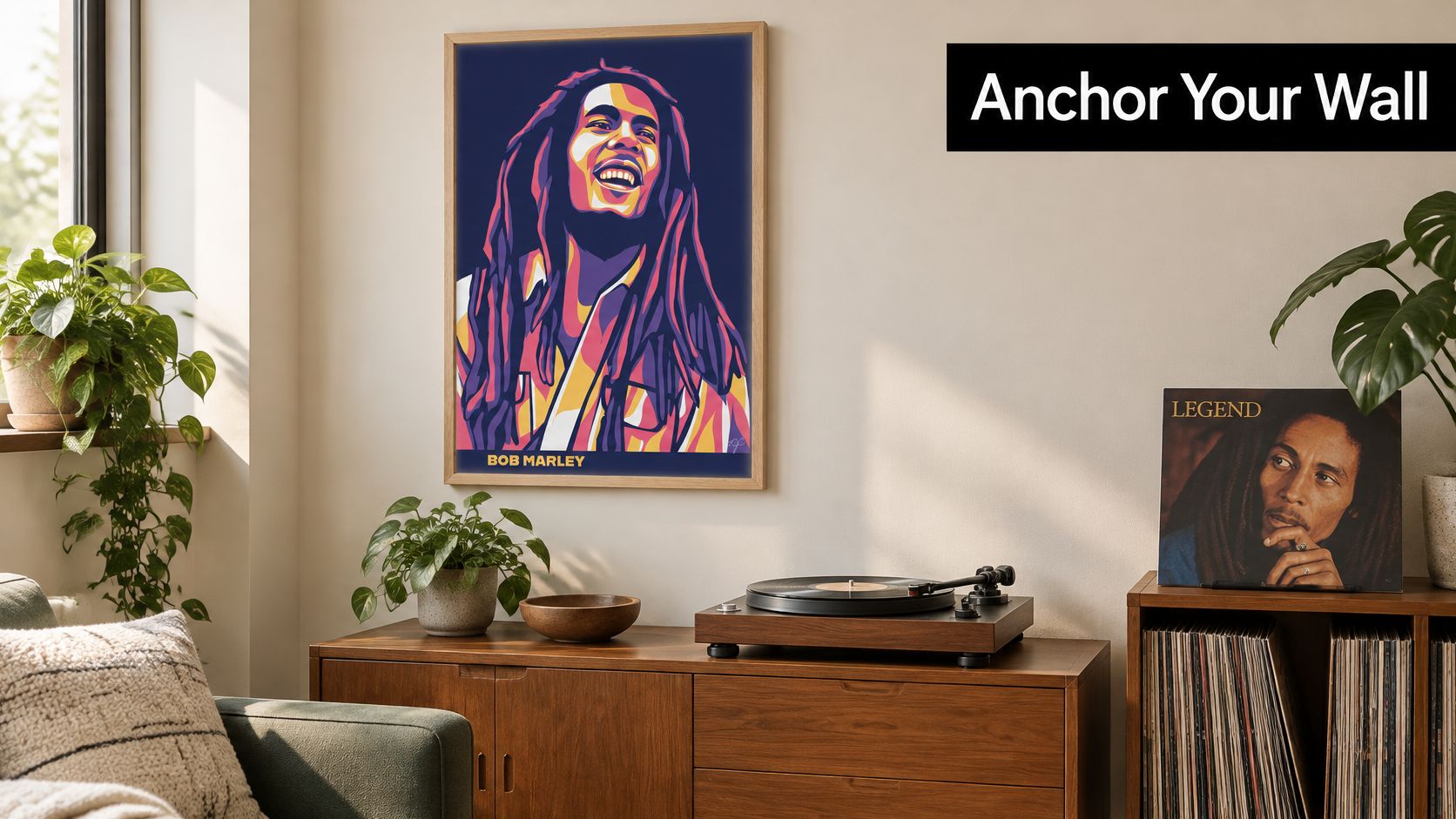
One print per wall. The Marley is the anchor and everything else is a support act, so it should know its place. Build around the actual design and the room you have, not a automatic red-gold-green shrine. A framed poster above a record console works because the subject, storage and listening habits all point the same way.
Start with sound. A turntable on a low console, a shelf of records with the sleeve propped up behind the deck, and a cable tidy you'll thank yourself for. Keep the vinyl close enough that the wall reads as a music corner, not a themed guest room with one good idea and no equipment.
Here's how the layers read at eye level before you commit to a second hook.
Then texture: a rug that isn't the same grey as the floor, a cable-knit throw over the arm, a cane or rattan chair if the room can take it. Texture is what stops a wall looking like a display in a shop. If photos are already fighting for space, That Blanket Co memory decor tips show how to layer personal pieces without turning the wall into a noticeboard.
Light comes last. A warm lamp in the corner does more for a print than four ceiling downlights, which flatten everything and fade the paper while they're at it. Aim the lamp into the room, not across the glazing, and let the poster sit in a calm pool of light rather than a spotlight interrogation.
The palette rule and the shared-room treaty
Pick two room colours plus one accent lifted from the poster. A red-gold-green graphic wants an off-white wall and a black frame. A monochrome portrait tolerates a darker wall and warmer wood. That's the whole system. If the room already has a strong palette, match the print to that palette first. The best Marley poster in a British front room is a spec decision: match an authenticated or original design to wall measurements and light, not to red-gold-green defaults.
Then there's the shared room. If your other half doesn't fancy a reggae wall, give each taste its own territory: Marley on the long wall, a football or film print on the opposite one, equal frame sizes so nobody wins. Striped Circle's range includes song lyric prints, football prints, music posters, greeting cards and clothing, so the companion piece can carry the room without copying the Marley. A good pairing is Where Love Lives Alternative Lyrics Music print | UK Wall Art, used as a quieter counterpoint rather than a second bold statement.
The office version is smaller. A4 or A3 above the desk, one shelf of records, one good lamp. Keep the surrounding wall emptier than you think it needs, because a desk already brings enough clutter.
Make the Decision and Get It on the Wall
Choose the poster for the wall you have. An authenticated or original design that fits your room beats choosing red-gold-green by default.
Which design direction matches the room's palette? Warm neutrals suit the burgundy study or black-and-white portrait. Choose the red-gold-green graphic when those colours belong in the room, rather than because reggae apparently needs a uniform.
Which measured size fits the furniture? Use your measurements to settle the size before browsing. Check the framed dimensions, too: the mount needs room.
Does the wall get direct daylight? Make UV-filtering glazing part of the purchase decision rather than an upgrade after the colours have faded.
Buy the print and frame together where practical, checking that the mount and print fit.
The hand-off list: use the earlier buying and hanging checklist before ordering, then keep it handy for installation.
Striped Circle is a family-run business selling music, alternative music and football prints, with framed and unframed options. Its multi-buy offer makes the cheapest item free when you add 4 prints, excluding framed prints and cards. Buy companions because you want them, not just to fill the basket.
UK delivery for framed prints costs £5.99. Browse Striped Circle with your chosen design, dimensions and glazing requirements settled. Then give the poster its place on the wall.
