
Prints 30 X 40: What the Size Really Means for Your Wall
Thirty by forty inches is 76.2 x 101.6 cm, a genuine statement piece that takes over a wall. Thirty by forty centimetres is roughly 11.8 x 15.7 inches, a modest print you could slot between a door frame and a light switch. Same words on the listing, entirely different objects in the tube.
Say you've moved into a flat with one long, blank living-room wall and you ordered a print in a hurry. It lands. You unroll it on the carpet and discover it's either the size of a cereal box lid or the size of a stadium banner, and the listing never warned you which. That's the trap, and it catches plenty of people who are otherwise perfectly competent at measuring things.
What follows is the gap between those two readings, how to work out which one a listing means, which wall suits which, and how to hang it so it's still flat and bright in six months. There's football, there's music, and there's one very specific warning about A3 frames.
Table of Contents
- 30 x 40 Print Sizes at a Glance
- The Centimetre Trap When Ordering Frames
- Picking the Right 30 x 40 Size for Your Room
- Why a Unique Print Earns Its Place on the Wall
- How to Hang a Large Print Without Damage
- Measure Twice Before You Order Your Print
30 x 40 Print Sizes at a Glance
Two listings can carry the same four characters and describe completely different objects, so the unit matters far more than the number. The imperial reading belongs to the same family as the historic Quad Crown sheet at roughly 762 x 1016 mm, and the UK POS poster paper size guide traces it back to Britain's pre-metric printing trade, when paper was sold under named imperial sizes rather than today's ISO A-series. That lineage explains why a print at this scale reads like a gig poster or a stadium banner even before you've chosen the artwork.
| Size | Centimetres | Inches | Nearest UK standard |
|---|---|---|---|
| 30 x 40 inches | 76.2 x 101.6 cm | 30 x 40 in | None, an imperial format between A1 and A0 |
| 30 x 40 cm | 30 x 40 cm | 11.8 x 15.7 in | Close to A3, not equal |
| A3 | 29.7 x 42 cm | 11.7 x 16.5 in | A3 |
| A2 | 42 x 59.4 cm | 16.5 x 23.4 in | A2 |
| A1 | 59.4 x 84.1 cm | 23.4 x 33.1 in | A1 |
| A0 | 84.1 x 118.9 cm | 33.1 x 46.8 in | A0 |
The useful consequence of that table is blunt. A 30 x 40 inch print is not a drop-in for any standard UK paper size, so no off-the-shelf A-series frame will take it without a custom mount or a made-to-measure frame. Read the nearest-standard column before you fall for a design.
Why It Reads Like a Poster
Proportion does a lot of the work here. A 30 x 40 inch print runs at a 3:4 ratio, or 1:1.333, against the ISO ratio of roughly 1:1.414 set out in Hampshire County Council's paper size guidance. Squarer means friendlier to centred type, stacked album-style layouts, band portraits and club crests. It's the difference between a design that sits comfortably inside the frame and one that looks crammed against the edges.
There's also the simple fact of surface area. The UK POS guide works it out at about 0.774 square metres, which puts the format in statement territory rather than desk ornament. Hang one of those above a sofa and it becomes the thing people comment on before they've taken their coat off.
Practical rule: if a listing gives no unit at all, treat that as an unpaid question, not a detail. A poster-style design hints at inches, but a hint is not a measurement.
Sort the unit, sort the frame, then spend money. In that order.
The Centimetre Trap When Ordering Frames
"30 x 40" on a product page is a coin flip between a modest wall print and a film poster, and the gap is enormous. EasyFrame's sizing guidance puts the centimetre reading at about 11.8 x 15.7 inches and the inch reading at roughly 76 x 102 cm. Neither is a mistake. The listing hasn't told you which one it means, and UK retailers muddy it further by labelling inch-based frames with the nearest metric size, so a 12 x 16 inch frame may in reality be a 30 x 40 cm frame.
Here's the difference in one picture.
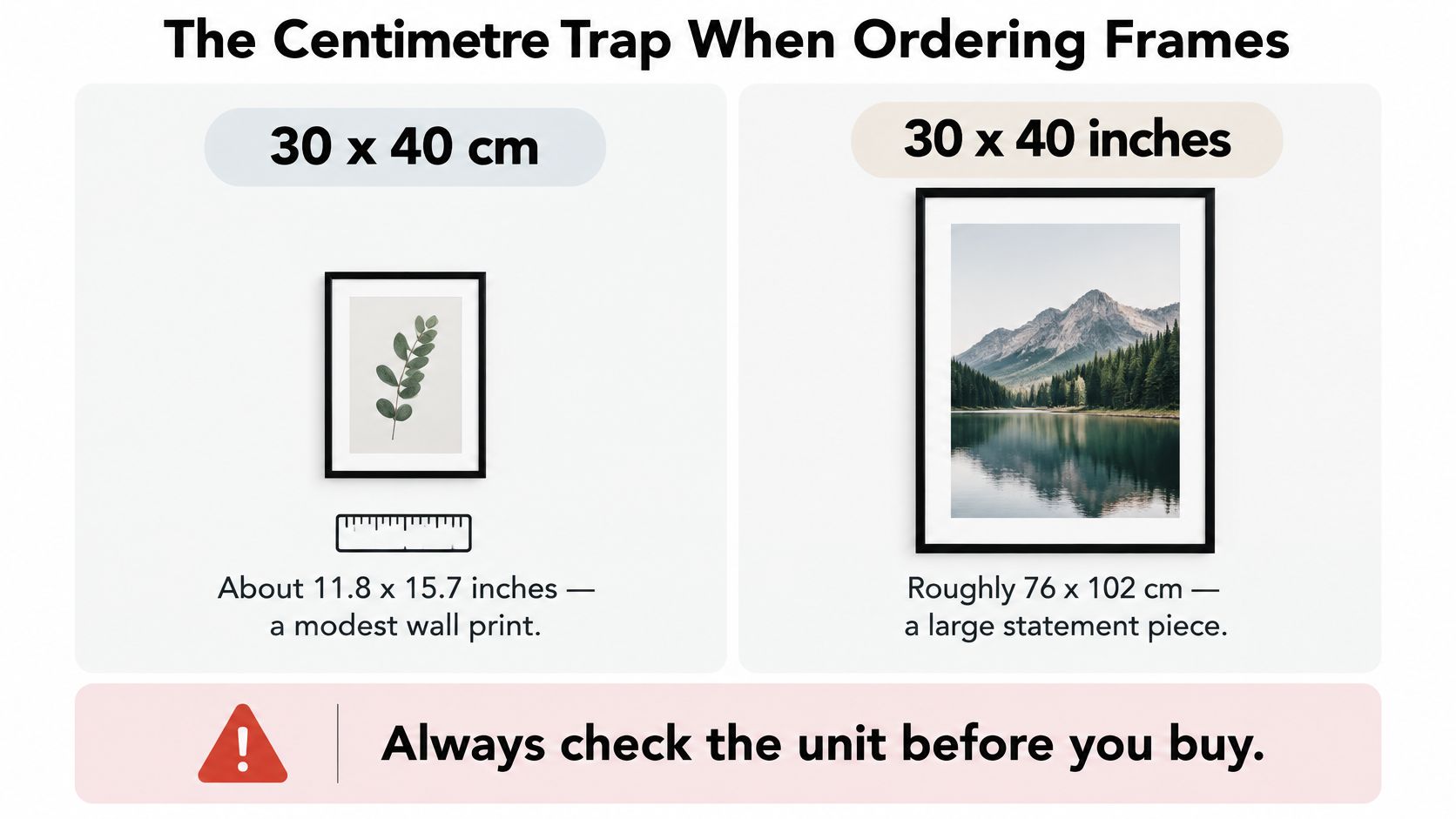
Then there's the second layer of confusion: three different measurements get called "the size". The paper size is the sheet in your hand. The visible aperture is what you see once a mount overlaps the edges. The outside frame is the footprint on the wall, and it's always bigger than the artwork because moulding and mount add width. A mounted 30 x 40 cm print can easily need a 40 x 50 cm frame, which changes your wall plan, your packaging and your postage.
The A3 question comes up more than any other. An A3 frame will not take a 30 x 40 cm print, because the IKEA frame guide notes that comparison leaves a 3 mm width mismatch and a 2 cm height mismatch. Close enough to look tempting, wrong enough to leave your print sliding about behind glass.
The One-Minute Check
- Confirm the unit on the listing, centimetres or inches, before anything else.
- Ask what the figure describes. Paper, visible aperture or outside frame? All three appear in product copy.
- Measure the frame opening, not the outside edge, with a tape rather than a guess.
- Add the mount width if you plan to use one, and remember the visible opening should be slightly smaller than the print so edge variation hides.
- Compare that final number with your print size before you pay.
If you'd rather work forwards from the frame instead of backwards from the print, our guide to what size poster frame you need walks through the aperture maths in order.
Picking the Right 30 x 40 Size for Your Room
The rule of thumb is simple: a 30 x 40 inch print belongs on a feature wall or above a sofa, where it holds attention from across the room. A narrow hallway or stairwell is a different job entirely, and an upright 30 x 40 cm print or an A2 handles that space without elbowing the furniture.
| Room or wall | Suggested size | Why it works |
|---|---|---|
| Feature wall or wall above a sofa | 30 x 40 in (76.2 x 101.6 cm) | Holds attention from across the room |
| Hallway or stairwell | 30 x 40 cm or A2 | Upright format suits narrow walls |
| Downstairs loo | Set of A3 or A2 prints | A group reads as a gallery and sparks conversation |
| Home office or desk wall | A3 or A2 | Viewed at arm's length, so detail matters |
Viewing distance drives the decision more than taste does. A print you pass at 0.5 to 0.7 metres in a hallway needs detail and wit; a print you see from three metres away needs scale and confidence. Tiny artwork on a big wall looks nervous. A metre-tall banner in a two-metre-wide corridor looks like a hostage situation.
Small rooms reward grouping. One customer ordered 12 prints for a downstairs loo and called them a real talking point, which is the correct energy for a room guests visit alone and emerge from talking about the wallpaper.
Mockup warning: our mockup images are for reference only and don't represent a specific print size or frame, so judge scale with a tape, not with a picture on a screen.
Before you order anything, tape a paper template cut to the target size on the wall and leave it there for a day. You'll spot the light switch it clashes with, the radiator it hangs over and the picture rail that makes the whole thing sit two inches too low.
If you want somewhere to start, the We Can't Read... Cheltenham Town Football Print was designed in collaboration with the 1887 Red Army, with profits from the range shared to fund matchday displays at Whaddon Road, and it's available unframed from A5 through to A0. Our wider collection of large wall art covers the scale question from the other direction.
Why a Unique Print Earns Its Place on the Wall
A bold print of a club crest or a favourite album sleeve does something a beige rental does not: it makes a room feel like yours rather than a showroom. That's the whole argument for a distinctive piece, and the numbers behind the culture are absurdly good.
The UK music industry contributed £8.0 billion in gross value added in 2024, up 5% from £7.6 billion, generated £4.8 billion in export revenue and supported 220,000 jobs, according to UK Music's This Is Music 2025 report. The tune on your wall is part of an industry with real weight behind it. It has, in all likelihood, paid more tax than your old sofa.
Recorded music tells the same story in miniature. Revenue reached £1.49 billion in 2024, up 4.8%, with physical formats including vinyl and CDs growing 1.3% to £246.5 million, per the full This Is Music 2025 report. People are deliberately buying objects again, not just streams. A print on the wall sits in exactly that tradition.
Culture at home is already normal, too. The Government's Participation Survey 2024-25 found that 90.6% of adults engaged with the arts at least once between April 2024 and March 2025. British homes aren't cultural deserts waiting for another grey motivational slogan. They're already full of references, and a football or music print brings one of them into the hallway.
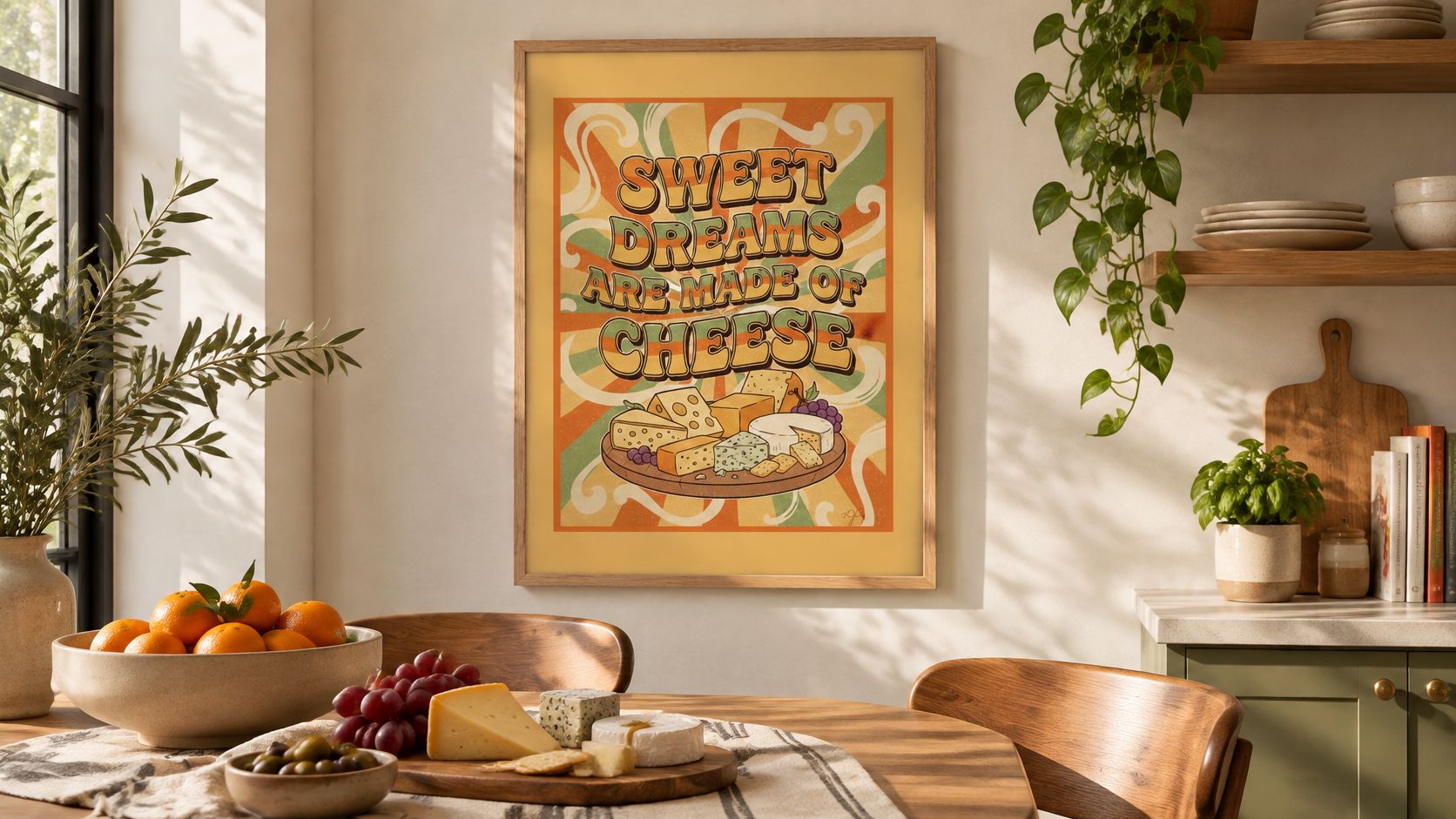
The Sweet Dreams wall print sits in our Music x Food collection, a retro 1970s set built to add humour and colour to a kitchen wall, and it comes unframed in A5 to A0 or framed in A4 to A1. If you're still deciding how a print fits a decorating scheme, these easy bedroom wall drawing ideas from Interiors by DeX are a useful read on building a wall rather than filling one.
How to Hang a Large Print Without Damage
Display conditions matter far more than the dimensions of the print. A beautifully made piece on a sunny, draughty wall will age faster than a cheap one in a stable hallway, and paper is the part that suffers first. The UK National Archives guidance on caring for prints is clear that daylight, south-facing exposure and cold external walls are the enemies, because condensation forming inside the frame encourages mould.
Here's the sequence that works.
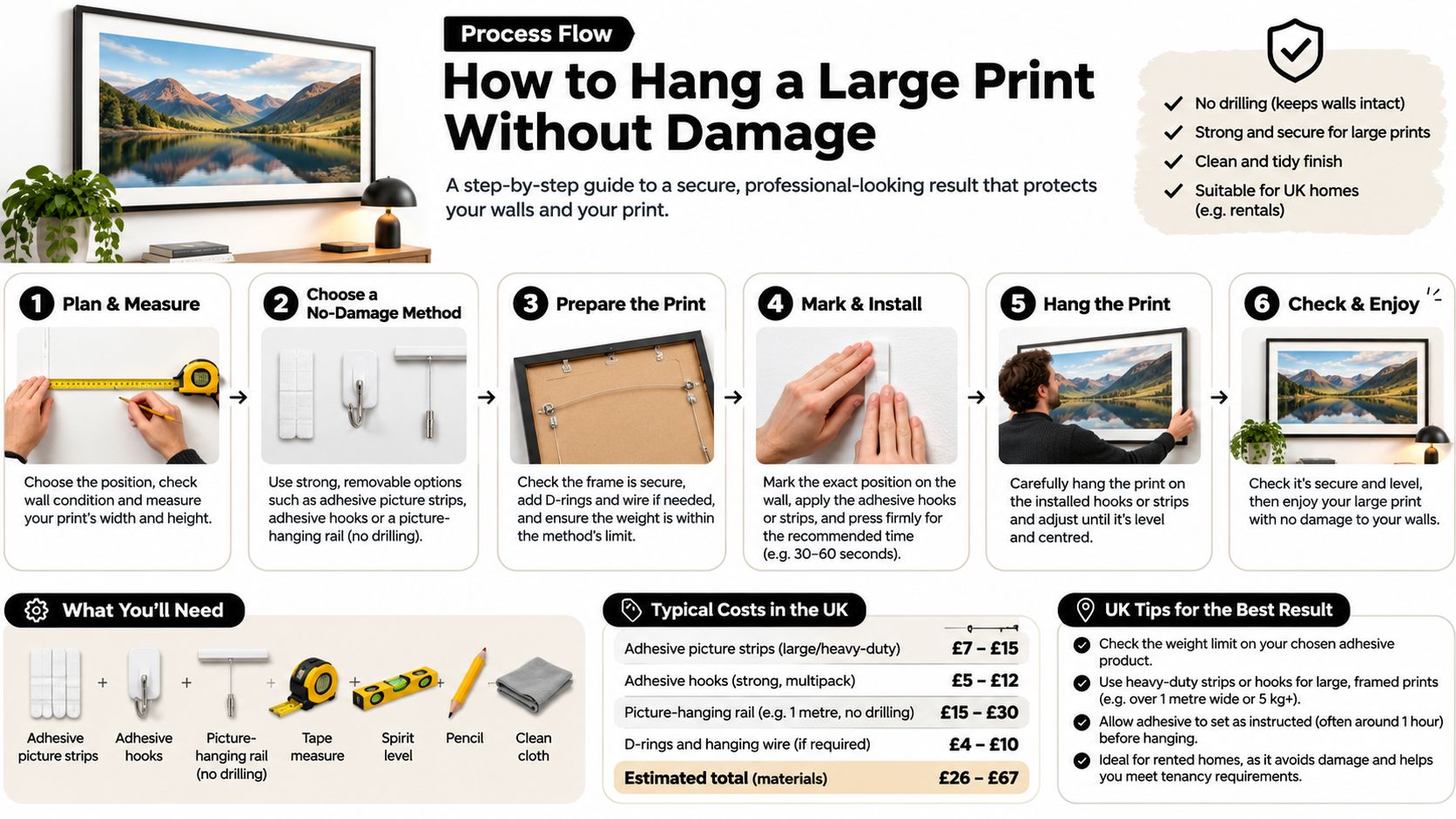
- Pick the wall first. Away from direct sun, south-facing light, radiators and spotlights. Heat sources dry the air and keep dust moving, which is how prints end up grubby at the top edge.
- Leave a gap from cold external walls so condensation can't form behind the frame. A finger's width of air circulation does more than any gadget.
- Mark the centre at eye level, which is roughly 150 to 160 cm from the floor, then measure the frame width to place your hanging points.
- Use hooks rated above the framed weight, and two hooks for anything large. A 30 x 40 inch frame is heavy, and one hook is a bet you don't need to place.
- Level it and leave a small gap between frame and wall so air can move. Grouped prints should be spaced evenly, so the eye reads them as one arrangement.
- Check it after a month for fading, warping, condensation or dust, while any problem is still fixable.
The conservation standard worth aiming for is a stable 16 to 19°C and 45 to 60% relative humidity, with UV-filtering glass or acrylic and acid-free, conservation-quality mounts. Those three choices do the most to prevent yellowing, embrittlement and dimensional movement in the paper.
Mould, not sunlight, is the quiet killer of paper prints on cold walls. If the back of a frame feels cold to the touch in winter, it's in the wrong place.
If you want a second opinion on placement and hardware before you commit to a hole in the plaster, this picture hanging guide for Virginia Beach homeowners from Willis Furniture & Mattress covers levelling and layout well, and our own notes on picture wall hooks cover the fixings in detail.
A well-displayed print after six months looks exactly like it did on day one: flat, bright, and dry at the corners.
Measure Twice Before You Order Your Print
Write the target size down twice, once in centimetres and once in inches, then confirm what that figure describes: the paper, the visible aperture or the outside of the frame. That single habit prevents most of the returns in this category. If the wall in question doesn't suit 30 x 40, take the nearest standard size from the size table, tape it up, and live with it for an evening.
Our prints are made to order in A5, A4, A3, A2, A1 and A0, available unframed or in a natural wood, black wood or white wood frame, with A5 and A0 supplied unframed. Because the frame opening has to match the print exactly, check the dimensions on the listing before you pay, and confirm whether the 30 x 40 size you want is offered as its own option or as the nearest standard size instead.
Then run the test that costs nothing. Tape the size to the wall, leave it there for a day, notice where the light lands on it at four in the afternoon, and order once you're sure. A good print deserves a wall without an awkward gap beside it.
Striped Circle is a family-run print studio making wall art inspired by music and football, from alternative lyric prints to club pieces designed with supporters' groups, all printed in-house on 250gsm acid-free matte paper. Everything is made to order in sizes from A5 to A0, framed or unframed, so you can match the piece to the wall rather than squeezing the wall around the piece. Browse the full range at Striped Circle and find the print that makes you, and everyone who visits, smile.
