
A Guide to Limited Edition Print Art
So, you’ve heard the term limited edition print art being thrown around, probably in a gallery where everything was confusingly white and quiet and you were terrified you might knock something over. Let's break it down, minus the chin-stroking. In simple terms, it means there’s a fixed, deliberately small number of prints created from an original piece of art. Once they're gone, they are gone forever. No reprints, no second chances, no begging the artist on Twitter.
What Makes Limited Edition Prints So Special
Let's cut through the art-world jargon for a moment. You’ve seen a million posters of famous album covers or iconic movie scenes, right? That’s what’s known as an 'open edition' print – they can be printed endlessly, forever and ever. Think of it like your team's standard home shirt from the club shop; thousands are made, and anyone can grab one. It's cool, but it's not exactly rare.
A limited edition print, on the other hand, is completely different. It’s the equivalent of the match-worn, signed shirt from a cup final win. It’s that festival-only band t-shirt that was only sold for one weekend. It’s the rare vinyl pressing with the alternate cover that only 200 people in the world own. Its value comes directly from its scarcity.
The Allure of Exclusivity
Having something exclusive on your wall is a game-changer. It’s a statement that says you appreciate craft, originality, and the story behind a piece. It's not just decoration; it's a piece with a specific origin, a point in time when an artist decided, "Right, I'm only making 50 of these, and then I'm off to the pub." That deliberate restriction is what elevates a print from a simple poster into a collectible piece of art.
Why does this actually matter for your walls? Because your space should reflect you. It should be filled with things that make you and your guests smile. A print that isn't hanging in every other house on the street achieves a few key things:
- It’s a Conversation Starter: When someone spots that unique print of a legendary goal or an obscure lyric design, they'll ask about it. It’s an instant connection point for fellow fans, and way better than talking about the weather.
- It Adds Real Personality: A limited edition piece shows you've gone beyond the generic and found something that truly resonates with your passion for music, football, or film. It says "I have excellent taste," without you having to actually say it.
- It Holds Potential Value: Because there's a finite supply, the demand can increase over time, especially if the artist becomes more popular. It’s like getting in on a band just before they blow up.
The core idea is simple: scarcity creates desirability. By deliberately capping the number of copies, the artist ensures each print remains a special item, cherished by those lucky enough to own it.
Ultimately, choosing a limited edition print is about owning a small slice of creative history. It’s about celebrating the moments and icons you love in a way that feels more personal and significant than a mass-produced item ever could. It’s the difference between streaming a song and owning the signed record. Both are great, but only one feels truly special.
How These Unique Prints Are Made
So, you’ve decided you want something a bit more special for your wall—not the same poster your mate has from IKEA. But what actually goes into making a piece of limited edition print art? Let’s be clear, this isn’t someone just hitting ‘print’ on a dodgy office machine. This is all about craft, skill, and a bit of arty magic.
Think of it like producing a classic album. You’ve got different recording techniques that create entirely different sounds. Art printing is exactly the same; the method used has a massive impact on the final look, feel, and quality of the artwork. It’s the difference between a rough demo tape and a fully mastered record from Abbey Road.
To help you see the core difference between the special stuff and mass-produced posters, here's a quick breakdown of limited versus open editions.
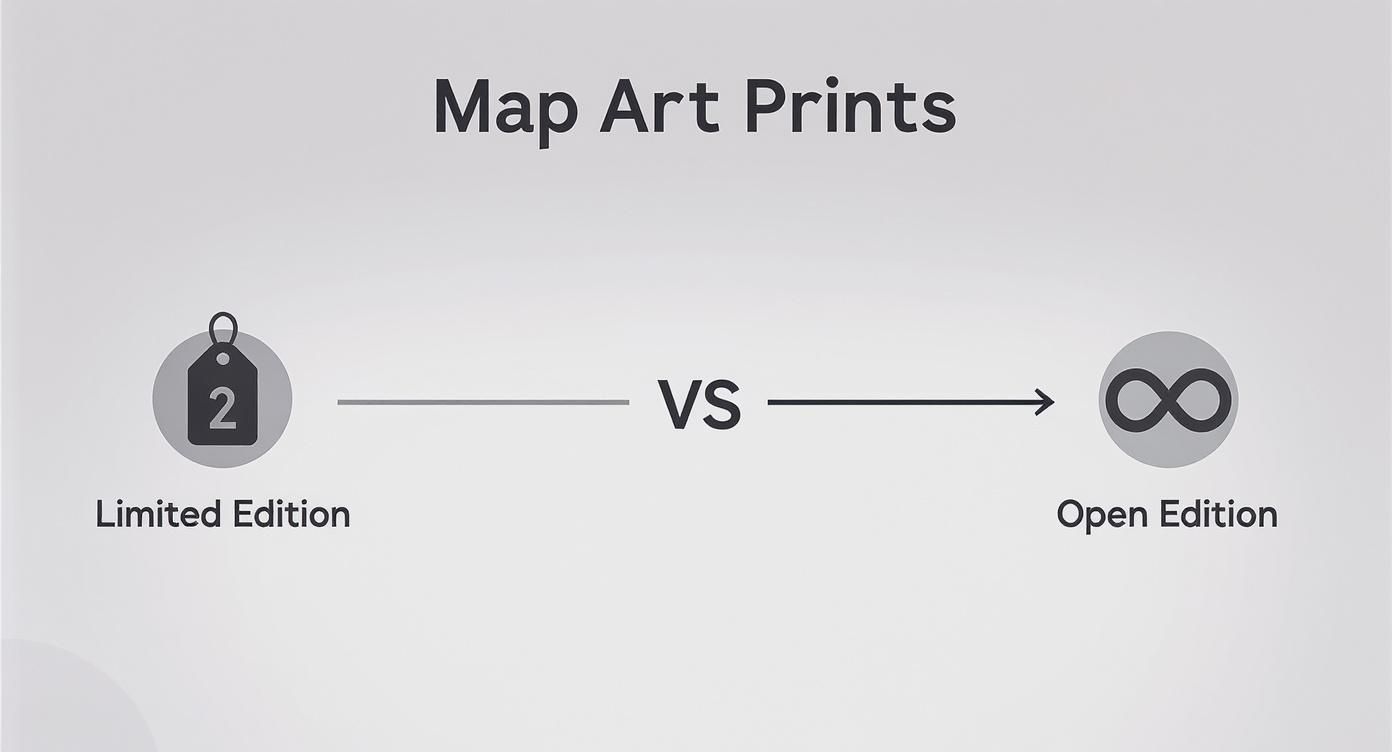
As you can see, the value and uniqueness are baked right into the limited edition concept. It’s defined by that fixed number, whereas open editions can be printed forever.
Giclée: The Premier League of Printing
First up is Giclée printing. If art printing had a top flight, this would be it. The word 'giclée' (pronounced zhee-clay) is French for "to spray," which is a fancy way of describing how a very sophisticated inkjet printer works. But don't for a second picture the machine you use for your gig tickets.
These printers use up to 12 different archival pigment inks, mixing them on the fly to create an incredible spectrum of deep, vibrant colours. The result is a print with stunning accuracy to the original artwork, boasting a richness and depth you just can't get from standard methods. It’s also printed on high-quality, acid-free archival paper, which means it won't fade or yellow over time. Your art won't end up looking like a sad, forgotten newspaper.
A Giclée print is built to last. Properly cared for, its colours can remain vibrant for 100 years or more. It’s the gold standard for artists who want their digital designs or reproductions to look as brilliant on paper as they do on screen. This is the method we use at Striped Circle because the quality is simply unbeatable.
Screenprinting: The Rock and Roll Method
If Giclée is the finely tuned striker scoring a perfect goal, then screenprinting is the punk rock three-chord anthem. It’s raw, it’s hands-on, and it’s responsible for some of the most iconic visuals in pop culture history. Think of classic band posters or the bold, graphic art of Andy Warhol—that’s screenprinting.
The process is brilliantly simple in theory but demands incredible skill in practice.
- Create a Stencil: An image is transferred onto a fine mesh screen, blocking some areas and leaving others open for ink to pass through.
- One Colour at a Time: A squeegee is used to push a single layer of ink through the stencil and onto the paper. It's surprisingly satisfying.
- Layer Up: For multi-coloured designs, you need a separate screen for every single colour, each one layered perfectly on top of the last.
This technique produces incredibly vivid, opaque colours that sit right on the surface of the paper, giving the print a distinct, tactile quality. It's a real labour of love, and the slight variations between each print are part of its charm. Each one is a unique performance, just like a live gig.
Lithography: The Old-School Classic
Finally, there’s lithography, the old-school legend of the printing world. This technique works on a simple principle: oil and water don't mix. An artist draws their design onto a stone or metal plate using a greasy substance. The plate is then treated with chemicals so that when ink is rolled on, it only sticks to the greasy drawing, not the blank areas.
The inked image is then transferred onto paper using a press. It’s a complex, traditional method that allows for a huge range of tones and textures, from fine lines to soft, painterly shades. It was the go-to for classic French poster art and remains a favourite for artists who love its historic, hands-on process. It's proper old-school cool.
Print Making Methods at a Glance
Choosing a print can be as much about the process as the image itself. Here’s a quick guide to help you tell your Giclées from your screenprints.
| Technique | What It's Like | Best For | The Vibe |
|---|---|---|---|
| Giclée | A high-end inkjet printer using up to 12 archival inks for perfect colour. | Fine art reproductions, photography, and complex digital illustrations. | Precision & Longevity. The museum-quality choice for faithful reproduction. |
| Screenprint | Pushing ink through stencilled screens, one colour at a time. | Bold graphics, pop art, posters, and text-based designs. | Bold & Tactile. A hands-on process with a unique, vibrant finish. |
| Lithograph | An image is drawn on a stone or plate with grease, then inked and pressed. | Painterly prints, detailed illustrations, and traditional artwork. | Classic & Artistic. An old-world method loved for its texture and tone. |
Understanding these methods helps you appreciate the skill and intention behind every piece of limited edition print art. Each technique tells a story, and knowing that story makes the art on your wall that much more meaningful.
Decoding the Numbers and Signatures
Alright, so you’ve found a piece of limited edition print art that’s really caught your eye. Maybe it’s an abstract take on your club’s stadium or a design inspired by a favourite album. But down in the corner, you spot some pencil scribbles – a signature, sure, but also a fraction that looks suspiciously like leftover maths homework, something like ‘17/100’. What’s that all about?
Don’t worry, it’s not a complex equation. Think of it like that limited-edition sneaker drop you queued for online. That ‘17/100’ simply means you’re looking at print number 17 from a total run of only 100. It’s the print’s birth certificate and serial number all rolled into one, a clear statement that says, "There are only 99 others like me in the entire world." This number is your guarantee of scarcity.
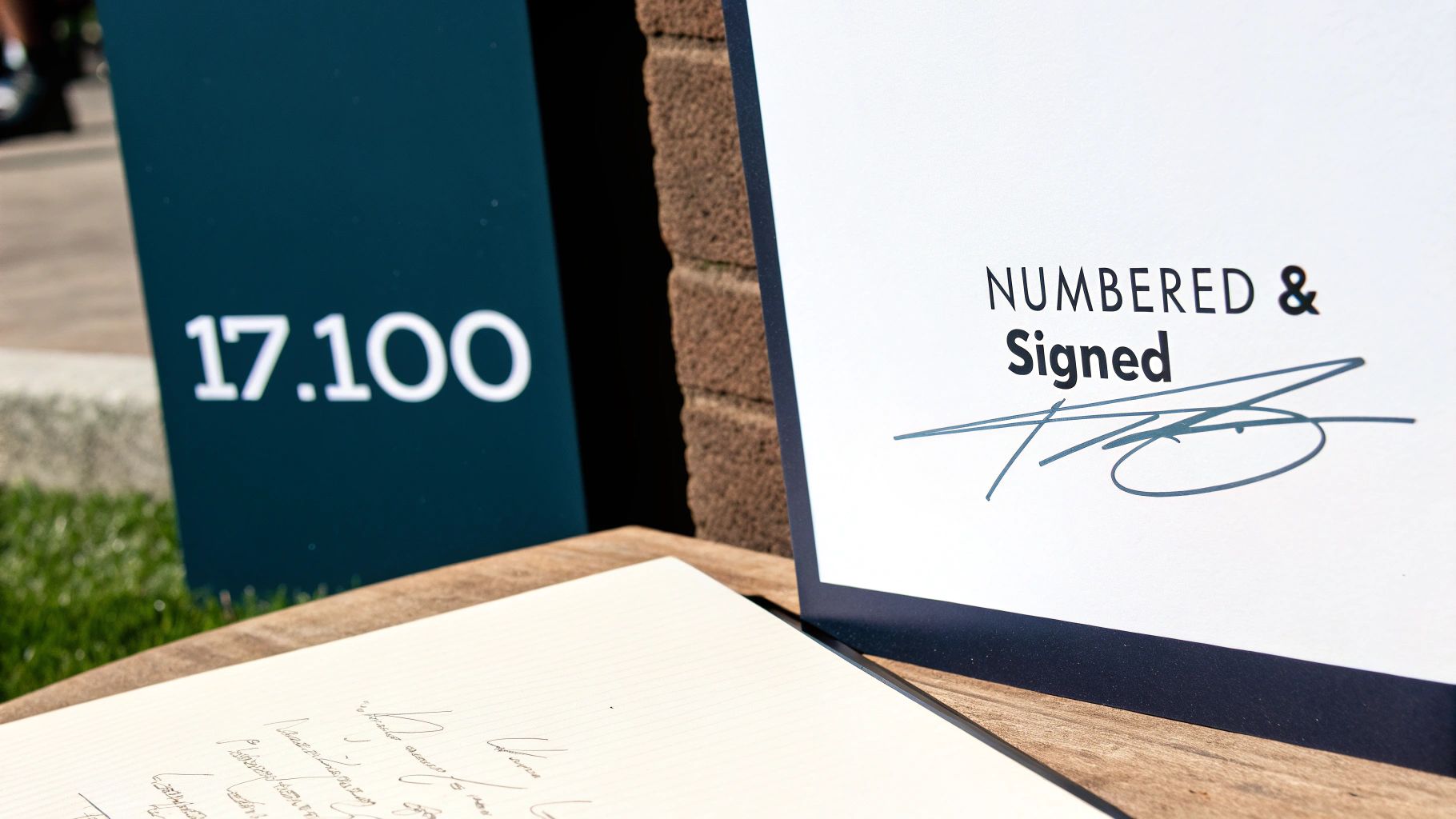
This simple fraction, known as the edition number, is usually written in pencil. This is a traditional touch that embeds the mark into the fibres of the paper, making it much harder to alter or erase than ink. It's a fundamental mark of authenticity.
The Backstage Passes of the Print World
Now, while most prints get a standard number, some are even more exclusive. You might occasionally see letters instead of, or alongside, the numbers. These are the VIPs of the art world—the equivalent of a backstage pass.
-
AP (Artist's Proof): These are traditionally the first prints pulled for the artist to approve the quality, colour, and details before the main edition is run. They're identical to the rest of the run but are much rarer, typically making up just 10-15% of the total edition size. Collectors love them because of that close connection to the artist’s process.
-
PP (Printer's Proof): This is a print given to the master printer or the studio that produced the work. It’s a mark of respect and a record of a job well done—a bit like a band giving their sound engineer a signed copy of the album they helped create.
-
HC (Hors de Commerce): This is French for "out of trade," and these prints aren't originally intended for sale. They were often used as display copies for galleries or samples. Like APs, they are scarce and highly sought after by serious collectors.
Think of the main numbered edition as the tickets sold to the public for a massive gig. The APs, PPs, and HCs are the all-access passes for the band, crew, and special guests. They all get you into the same show, but some come with a little extra story attached. If you want to dig deeper into what makes these so special, you might find our guide on what defines a limited edition print useful.
Does a Low Number Mean More Mojo?
Here’s the big debate in the collecting world: is print number 1/100 inherently more valuable than 100/100?
Technically, no. Every single print in a properly produced edition should be of the exact same quality. However, human nature loves a good origin story, and the low numbers—especially 1, 2, or 3—just feel more special to some people.
Some collectors will absolutely pay a premium for the very first print off the press. It’s purely psychological, of course, but in a market driven by passion, psychology plays a massive part. It’s like owning the first-ever pressing of a classic vinyl record versus a later one from the same initial batch.
A Certificate of Authenticity, or COA, is the print’s logbook. It’s a document from the artist or publisher that verifies the artwork’s details: the title, the date, the edition size, and the printing method. Always keep this safe! Don't use it as a coaster.
Ultimately, the combination of the artist’s signature, the edition number, and a COA is your holy trinity of authenticity. It’s the proof that you own a genuine slice of creativity, not just a pretty picture. So next time you see those scribbles, you’ll know you’re not looking at random doodles, but at the very DNA of your limited edition print art.
How to Buy Prints Without Getting Ripped Off
Right, so you’re ready to dive in. You've got the lingo down, you know the difference between a Giclée and a screenprint, and you can spot an edition number from fifty paces. You're itching to splash some cash on a piece of limited edition print art that’ll make your walls sing.
Hold on a minute. Just because you’re buying art doesn’t mean you should leave your common sense at the door.
Navigating the art market can feel a bit like trying to nab tickets for a sold-out gig. You need to know where to look, what to look for, and how to avoid the dodgy touts. Get it right, and you'll walk away with a brilliant piece that not only looks the business but also holds its value. Let’s make sure your hard-earned money goes on something genuinely special.
What Determines a Print's Value
Before you even think about clicking 'buy', it’s crucial to understand what gives a limited edition print its price tag. It’s not just random numbers pulled out of thin air; four key factors are at play. Getting your head around these is your first step to buying smart.
-
The Artist's Reputation: Is the artist an established name or an exciting up-and-comer? An artist with a strong following, a history of exhibitions, and growing demand will naturally command higher prices. Think of it like a band's career—a print from an artist on the verge of blowing up is like owning an early demo from a future stadium-filler.
-
Edition Size: This one’s a no-brainer. Scarcity is king. A print from an edition of 25 will almost always be more valuable than one from an edition of 250. The smaller the number, the rarer the piece, and the higher its potential value. It's simple supply and demand.
-
Print Quality and Condition: The materials really matter. A high-quality Giclée on archival paper is simply going to be worth more than a lesser-quality print. Condition is also vital; any fading, creasing, or damage will significantly knock down the price. You're looking for a print in mint condition, as if it just came off the press.
-
Authenticity: Does it have the holy trinity? A pencil signature, an edition number, and a Certificate of Authenticity (COA) are your proof that it’s legit. A print without these is like a football shirt without the club badge—it just isn't the real deal.
Where to Find Your Perfect Print
Knowing where to shop is half the battle. You want to buy from places you can trust, where quality and authenticity are guaranteed. Fortunately, you’ve got more options than ever before.
- Direct from the Artist or Studio: This is often the best route. Buying directly from the artist's website or a trusted studio like Striped Circle means you're getting the genuine article and supporting the creator directly. No middle-man, just good vibes.
- Reputable Online Galleries: Websites that specialise in prints are a great place to browse. They often curate collections from various artists, giving you a wide selection. Just do your homework and check reviews to ensure they’re legit.
- Trusted Marketplaces: Some online platforms are hubs for buying and selling art, but tread carefully. Stick to sellers with high ratings and a proven track record of happy customers.
When you're buying limited edition prints online, the quality of the photos is everything. Understanding the principles of good product photography can help you critically evaluate what you're seeing in a listing and make sure it matches what arrives at your door.
Buying limited edition print art is easier and more accessible than ever. The market is no longer just for the super-rich; it's a playground for anyone with a passion for art, music, or football.
In fact, the limited edition print world has seen huge growth, especially at more wallet-friendly prices. Recent analysis shows that prints and multiples now make up 7% of the total art market's value. More telling is the fact that sales of prints under $5,000 have rocketed by 79% since 2020, proving that more and more people are getting into collecting accessible art.
By keeping these factors in mind, you can navigate the market with confidence. You'll not only avoid getting ripped off but also find a piece of art that you’ll love for years—one that genuinely reflects your personality and puts a massive smile on your face every time you see it.
Framing and Caring For Your New Art
So, you’ve done it. You’ve brought home a stunning piece of limited edition print art that just screams ‘you’. It’s propped up against a wall, looking brilliant but also a bit vulnerable. You wouldn’t leave a brand-new guitar out in the rain, and your new art deserves that same level of respect. Getting it framed and hung properly is the final, crucial step.
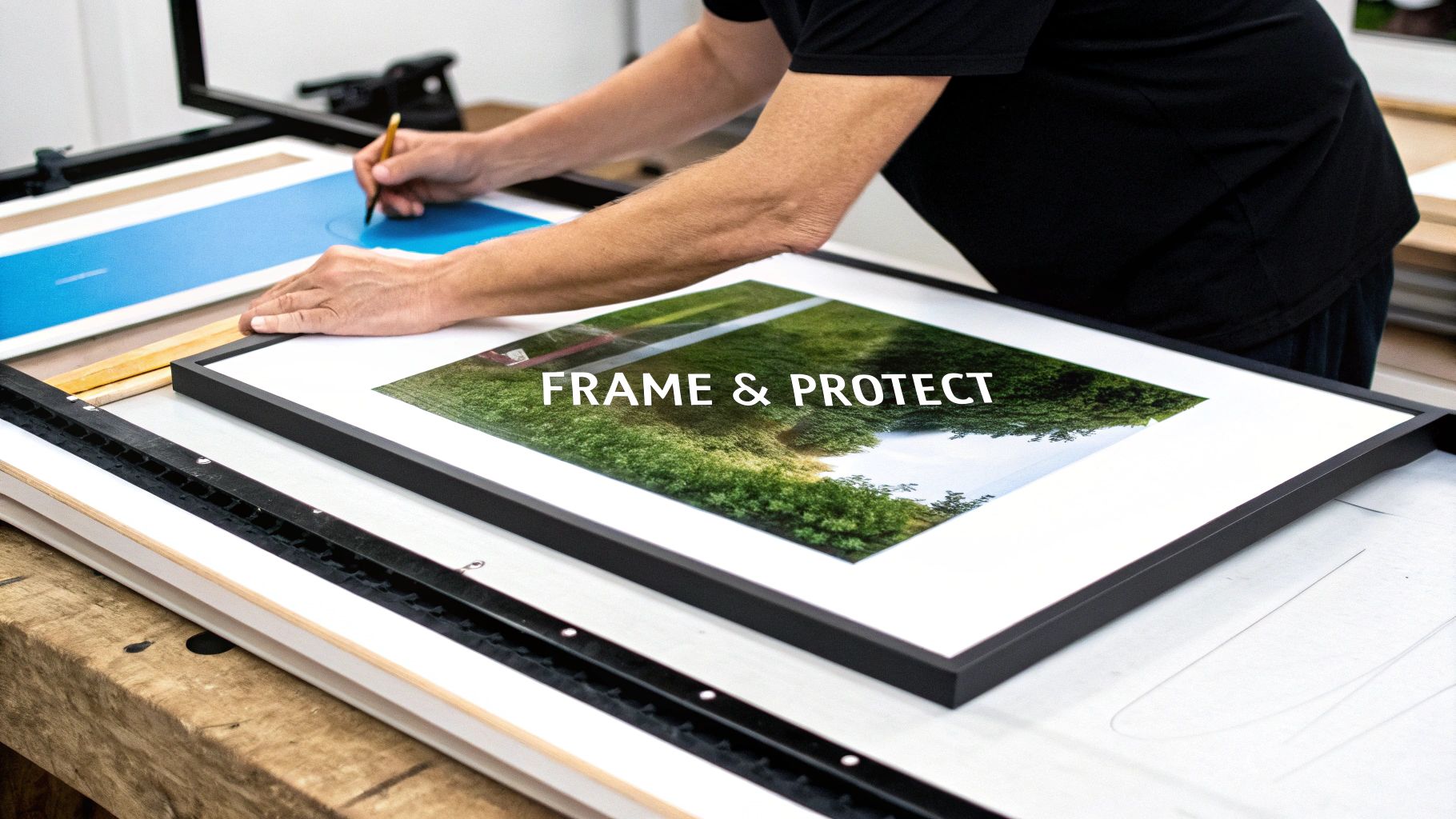
Think of a frame as the roadie for your rockstar print. Its job is to protect, support, and make the main act look as good as possible. While a DIY job might seem tempting, especially for standard posters, taking a limited edition piece to a professional framer is a game-changer. They’re the experts who know exactly how to make your art pop while keeping it safe for the long haul.
The Technical Stuff Made Simple
When you chat with a framer, they’ll mention a few things that sound complicated but are actually pretty straightforward. Getting your head around them means your print gets the protection it needs to last a lifetime, and maybe even longer.
- UV-Protective Glass: This is basically sunscreen for your art. Standard glass does very little to stop the harmful ultraviolet rays in sunlight, which are the number one cause of fading. UV-protective glass, on the other hand, blocks over 99% of these rays, keeping the colours in your print as punchy as the day they were made.
- Acid-Free Mounting: The materials touching your print matter hugely. Standard mount boards contain acid that will, over time, leach into the paper and cause that horrible yellow-brown stain you sometimes see on old pictures, a process known as 'mat burn'. Insisting on acid-free or archival mounting is non-negotiable for a valuable print; it ensures it stays pristine.
Choosing the right frame and mount isn't just about aesthetics; it's an investment in preservation. It ensures the artwork you fell in love with will still be making you smile in decades to come, not turning a sad shade of beige.
Finding the Perfect Spot
Once it’s beautifully framed, where should you hang it? Location is everything. Think of your print as a cool, art-loving vampire—it hates two things above all else: direct sunlight and dampness.
Even with the best UV-glass, hanging a print directly opposite a sunny window is asking for trouble. Constant, direct light will eventually take its toll. Likewise, avoid walls that are prone to damp, such as in bathrooms, or those directly above a radiator. Extreme changes in temperature and humidity can cause the paper to warp or ripple inside the frame. A cool, dry wall with plenty of indirect light is the sweet spot.
Before getting the hammer out, it's worth having a look at a guide to understanding various print dimensions to make sure the piece fits the space you have in mind.
Matching the Frame to Your Vibe
Choosing a frame style is the fun part. The golden rule here is to complement the artwork, not overpower it. A simple, thin black or white frame often works wonders, letting the art do all the talking. If the print is already bold and colourful, a neutral frame creates a nice sense of balance.
For more ideas, check out our deep dive into how to frame posters and prints for some extra inspiration. Ultimately, though, it’s your wall and your style, so pick something that you love looking at.
Finding Art That Puts a Smile On Your Wall
Let's be honest about why we buy art. It’s not about trying to impress snooty critics or making your living room feel like a stuffy, silent gallery. It’s about finding something that sparks a bit of joy, starts a conversation, and puts a massive smile on your face every time you walk past it. Art should be fun. It should be personal.
That’s the entire philosophy behind Striped Circle. We create limited edition print art for people who are passionate about the big stuff: legendary football moments, iconic music, and the pop culture that shaped generations. Our prints are designed to be bold, witty, and packed with personality—because your walls should never be boring.
Ticking All the Right Boxes
We're not just making pretty pictures; we're creating proper collectibles. Everything we’ve covered in this guide—scarcity, quality, and authenticity—is baked into every single piece we produce. We make sure we tick all the right boxes, so you know you’re getting something genuinely special.
- Properly Limited Runs: We keep our edition sizes small. This isn't just a marketing gimmick; it’s our promise that you're buying something exclusive that you won't see in every other home on the street.
- Top-Notch Giclée Printing: We use the best techniques out there. Our prints are made using the Giclée method on archival-quality paper, ensuring the colours are rich, deep, and will stay vibrant for a lifetime.
- Designs That Get People Talking: Our art is inspired by the moments that give you goosebumps. Whether it’s a subtle nod to a classic album, a tribute to a cult film, or a stylised celebration of a last-minute winner, our designs are made by fans, for fans.
Your home is a reflection of you, and the art on your walls should shout about the things you love. It’s about creating a space that feels uniquely yours, filled with character and stories.
Choosing the right piece can feel like a big decision, but it really doesn't have to be complicated. If you're wondering where to even start, you might find some helpful pointers in our guide on how to choose art for your home.
Ultimately, our mission is simple. We want to create prints that connect with you on a personal level. It's about celebrating those shared passions and bringing a little piece of that magic into your everyday life. This is art that’s meant to be lived with and loved.
Your Limited Edition Print Art Questions Answered
Alright, you've made it this far, which means you're well on your way to becoming a print connoisseur. Still, a few questions might be lingering. Let's tackle some of the most common ones with straightforward, no-nonsense answers.
Is Limited Edition Print Art a Good Investment?
It certainly can be, but it’s rarely a get-rich-quick guarantee. The best way to think about it is less like a hot stock tip and more like buying a piece of classic furniture; you buy it because you love it and it enhances your life, and any increase in value is a welcome bonus.
The investment potential of a print hinges on a few key factors: the artist's rising reputation, a particularly small edition size, and the general buzz in the art market. While some prints do see their value skyrocket, the real payoff should always be the daily joy it brings you. My advice? Buy the art that speaks to you, and if it becomes more valuable down the line, consider it a fantastic cherry on top.
What Exactly Is an Artist's Proof or AP?
An Artist's Proof (or AP) is part of a very small, separate batch of prints made exclusively for the artist, outside of the main numbered edition. While the quality is identical, these prints are marked with 'AP' instead of a standard edition number.
Historically, these were the first prints pulled from the press. The artist would inspect them to ensure colours, registration, and details were absolutely perfect before giving the green light for the full run. Because there are far fewer APs and they have a closer connection to the artist's hands-on process, they're often seen as more desirable by serious collectors. They’re the 'friends and family' version of the print—a little more special.
Owning an AP is like having a soundcheck recording from a legendary concert. It’s the same incredible performance, but with an extra layer of behind-the-scenes cool that true fans really appreciate.
How Do I Know a Limited Edition Print Is Authentic?
This is the big one, and rightly so. Your best line of defence against fakes involves checking for a few key markers. Look for the artist’s signature (traditionally in pencil), the unique edition number (e.g., 25/100), and a Certificate of Authenticity (COA) that outlines the print's details.
Above all, your most important tool is buying from a reputable source. When you purchase from a trusted gallery, directly from the artist, or from a dedicated print house like Striped Circle, you can be confident you're getting the genuine article. If you spot a deal on a random website that looks too good to be true, it almost certainly is. Stick with the pros, and you'll sleep soundly knowing your art is the real deal.
Ready to find a print that tells your story? Striped Circle has a massive range of limited edition art inspired by the music and football you love. Find your perfect conversation starter today.
